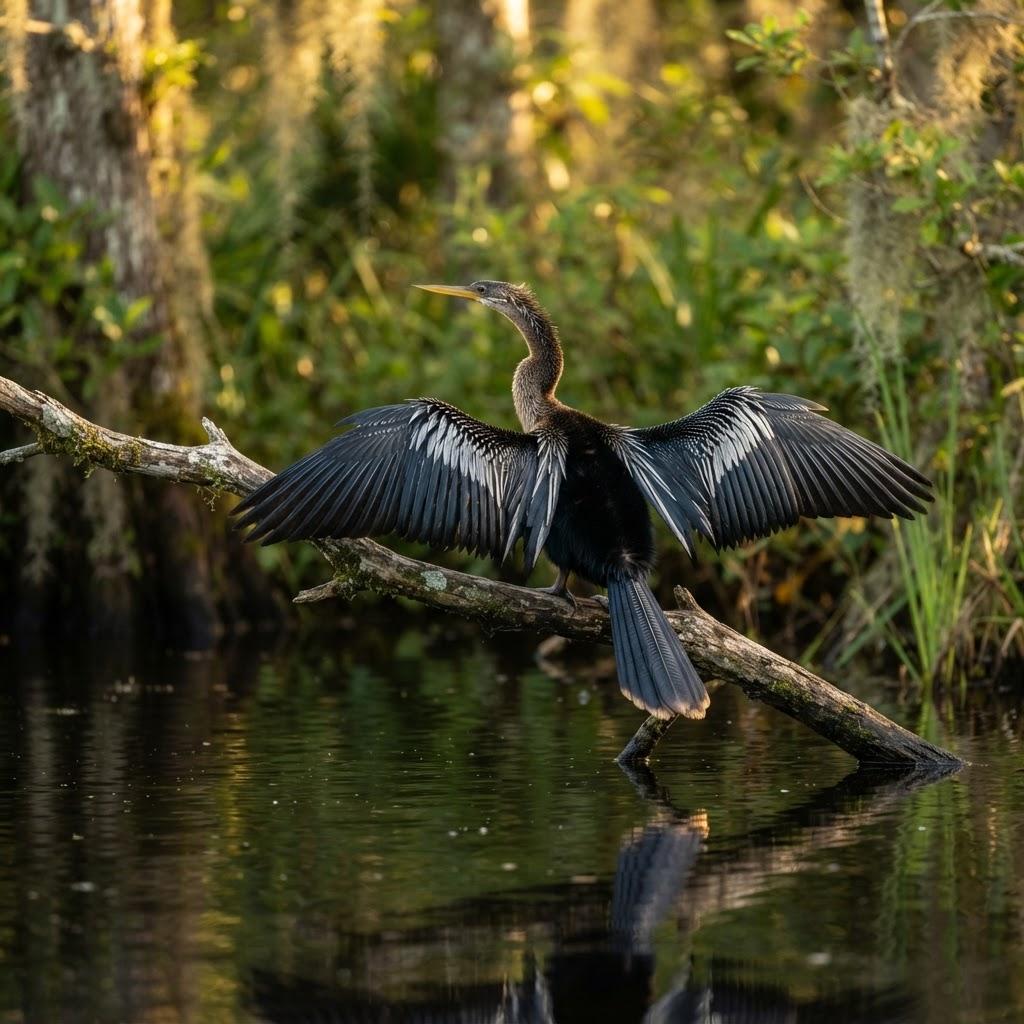
Anhinga anhinga
Anhinga
Meet the Anhinga, the prehistoric-looking swamp ninja that hunts like a torpedo and dries its wings like a gargoyle. It is the most dramatic bird you will ever encounter in a Florida canal.
Meet the Bird
Picture a prehistoric sea serpent that decided to trade its scales for feathers and move into a swamp. That is the Anhinga, a bird that looks like it stepped right out of a pterodactyl-themed casting call. Often called the snake-bird, this creature has an unnervingly long, thin neck that it weaves through murky water, making it look exactly like a submerged cobra plotting world domination. Unlike most ducks or geese that float like carefree rubber toys, the Anhinga cruises low, often with its entire body hidden under the surface and only that serpentine neck visible. It is the undisputed champion of the 'I am not here, ignore me' aesthetic. When it finally decides to emerge, it does not do so gracefully; it clambers onto a branch with the elegance of a wet mop. But the real show starts when it realizes it is soaking wet. It spreads its wings wide like a sun-worshiping gargoyle, frozen in a pose of eternal brooding, completely unbothered by your bewildered stares. It is eccentric, it is slightly terrifying, and it is a total icon of the wetlands.
Superpowers & Weird Abilities
Most birds spend their lives trying to stay buoyant, coating their feathers in a special oil from a gland near their tail to ensure they glide on water like a boat. The Anhinga, however, threw that rulebook out the window. It has evolved feathers that are intentionally not waterproof. This biological choice might sound like a mistake, but it is actually a genius tactical move for an underwater assassin. Because its feathers get waterlogged, the Anhinga loses its natural floatation, which allows it to sink like a stone and stay submerged while chasing down lunch. It is essentially wearing a heavy wet suit that helps it maneuver through the depths with the agility of a torpedo. While other birds are bobbing on the surface like corks, the Anhinga is navigating the dark, murky underwater world with precision. Once the hunt is over, it uses its massive wingspan to hike back up to a branch and wait for the sun to act as a natural blow-dryer. It is a classic trade-off: buoyancy for pure, unfiltered predatory efficiency.
Drama, Personality & Feathered Chaos
If the Anhinga had a social media account, it would be filled with dramatic selfies and cryptic captions about its enemies. These birds are not exactly the social butterflies of the avian world; they are more like the reclusive, slightly grumpy neighbors who watch everyone from their porch. When they share a nesting tree with other birds like egrets or cormorants, the atmosphere is pure, high-stakes drama. Anhingas are notorious for being territorial, especially when it comes to their favorite sunning spot. If another bird dares to land on 'their' specific branch, the Anhinga will engage in a tense staring match, often followed by a display of aggressive wing-flapping that screams, 'Do you have any idea how long it took me to get this spot dry?' They do not suffer fools, and they certainly do not share their sunbeams. Seeing them interact is like watching a low-budget soap opera where the only dialogue consists of harsh, croaking grunts and the rustle of wings.
Bizarre Rituals & Quirky Habits
The most defining ritual of the Anhinga is its sun-drying stance, which looks like a bizarre religious ceremony to the untrained eye. After a long dive, the bird finds an exposed branch and stands completely still with its wings splayed fully open. It might stay there for twenty minutes, or even an hour, never moving a muscle while its feathers bake. To us, it looks like it is airing out its laundry, but in the bird world, this is a essential thermal regulation maneuver. If you walk past a canal and see what looks like a row of black, jagged ornaments on a fence, you are witnessing a communal sunning session. They do not just do this because they are bored; they do it because if they do not dry off properly, they will be too heavy to fly, effectively tethering them to the ground or the trees. It is a quirky, high-maintenance habit that forces them to live a life governed by the intensity of the solar UV index.
Legends, Folklore & Human Stories
Throughout history, the Anhinga’s bizarre appearance has made it a favorite subject for local tall tales. In many parts of the American South, the sight of a swimming Anhinga has terrified more than a few unsuspecting tourists who mistake the long, thin neck for a cottonmouth snake. Folklore often paints the Anhinga as a shape-shifter or a spirit of the swamp. It has been described in regional literature as the 'water-turkey,' a nod to its long, fleshy tail and its rather strange, gurgling vocalizations. In older, rural communities, the Anhinga was often viewed with a mix of respect and superstition, treated as a guardian of the hidden parts of the river. While it does not feature in big, Hollywood-style epic myths, its presence in the cultural tapestry of the southern wetlands is deep and undeniable. It is the bird that people point at when they want to show their visitors that they are in 'real' nature, a living link to the primeval swamp.
Mating: The Ridiculous World of Avian Dating
When it comes to finding a partner, the male Anhinga turns into a flamboyant performer, throwing everything he has into a display of courtship that would make a Broadway director weep. He gathers sticks and presents them to a potential mate, but he does not just drop them off; he performs a series of intricate displays, including sky-pointing, where he aims his sharp beak toward the clouds while flapping his wings with intense, rhythmic vigor. He has to convince the female that he is not just a handsome devil, but also a competent provider and a master of the local real estate market. The female, ever the critic, watches these displays with a cold, analytical eye. If the male fails to impress her with his wing-spreading or his stick-selection, she simply takes off, leaving him to continue his dance in front of an empty branch. It is a brutal, high-stakes game of show-and-tell where only the most persistent and well-presented males get a second date.
Nesting: Master Architects and Lazy Slumlords
Anhingas are actually quite impressive builders compared to some of the lazier birds that just throw a few twigs together and call it a home. Both the male and the female participate in the construction, weaving a bulky, sturdy platform of sticks, leaves, and aquatic vegetation high above the water. These nests are designed to be substantial, as they need to support a growing family and withstand the humid, stormy weather of the swamp. However, they are not winning any interior design awards. The nest looks like a chaotic pile of sticks, but it is anchored firmly in the fork of a tree, usually overhanging the water. This is a smart move; if a predator tries to sneak up on the chicks, the babies can literally just drop into the water and swim away long before they can even fly. The parents are diligent, constantly reinforcing the structure throughout the breeding season, turning a simple platform into a fortress that keeps the kids safe from raccoons and snakes.
Raising Babies: The Screaming Food Disposals
Once the chicks hatch, they are arguably some of the most unattractive babies in the avian world. Imagine a pile of wet, wrinkly, gray-skinned fuzz that seems to be mostly neck and beak. These chicks are loud, demanding, and utterly relentless. The parents become slaves to their offspring, spending their days diving for fish to keep the little monsters satisfied. The chicks reach into the parent's throat to feed, a process that is as grotesque as it is efficient. As they grow, they develop a layer of white down that makes them look like little storm clouds. They do not just sit quietly; they screech and flap, demanding more fish, more regurgitated snacks, and more attention. It is a chaotic scene, often occurring in colonies where hundreds of chicks are all screaming at once. Parenting an Anhinga is a test of endurance, but the parents are tireless, ensuring that their brood transitions from helpless blobs into sleek, swimming machines as quickly as possible.
Bird-Watching Travel & Local Hotspots
If you are dying to catch a glimpse of this prehistoric wonder, you need to head to the southern United States, specifically Florida, Louisiana, or the coastal regions of the Carolinas. The Everglades National Park is the absolute Mecca for Anhinga spotting. Specifically, the Anhinga Trail at Royal Palm is practically a guarantee. You do not even need binoculars there; the birds are so accustomed to people that you can walk right past them as they lounge on the handrails. Another fantastic spot is the Brazos Bend State Park in Texas, where the swampy lakes offer plenty of trees for the birds to dry their wings. When planning your trip, aim for the spring months when the birds are actively nesting and displaying their courtship antics. Look for slow-moving bodies of water with plenty of logs and overhanging branches. If you see a row of black birds standing like statues, you have found the right spot. Bring a camera with a good zoom, because while they tolerate people, they still prefer to maintain their personal space.
Food, Feeder Hacks & DIY Projects
Here is the reality check: you are not going to attract an Anhinga to a plastic tube feeder in your backyard. They are strictly fish eaters. They do not care about your premium sunflower seeds or your suet cakes. If you want to support them, you have to support their habitat. If you have a pond on your property, stocking it with native fish is the best way to invite them for a visit. To make your backyard a haven, focus on native vegetation that keeps the water clean and provides cover for small fish. If you really want to do a DIY project, build a 'natural' basking platform—a large, flat log partially submerged at the edge of a pond or canal. It mimics the fallen trees they love. Don’t waste your money on commercial bird food for them; instead, invest in protecting the wetlands they call home. By keeping the local water healthy, you are providing the ultimate five-star dining experience for these aquatic hunters.
Seasonal Guides & "Crisis" Management
Anhingas are largely year-round residents in the warmer parts of their range, so you do not have to worry about traditional migration patterns as much as you would with warblers. However, their behavior shifts during the winter. When it gets chilly, they prioritize sunning even more intensely to maintain their body temperature. In the spring, the focus shifts entirely to the madness of nesting and protecting chicks. If you happen to find a baby bird that looks like a bundle of grey fuzz on the ground, do not panic and do not immediately scoop it up. Check for nests in the trees above. If the baby is active and the parents are nearby, leave it alone. These birds are masters of their environment, and they know what they are doing. If the bird is injured—meaning it is clearly bleeding, dragging a wing, or being swarmed by ants—contact a local wildlife rehabilitator. Otherwise, let nature play out its occasionally awkward, but ultimately successful, course.
Backyard Tech & Gadget Reviews
If you are trying to observe these birds from a distance, technology can be a huge help. AI-powered cameras, like a weather-proof trail camera, are your best friend. Set one up on a tripod facing a pond edge where you have seen them sunning. You will get amazing, high-definition footage of them diving, surfacing, and drying their wings without having to stand outside in the humidity for hours. Regarding window collisions, Anhingas are not usually hitting houses, but if you live near a canal, apply window decals or UV-reflective film to your glass to help other birds see the obstacle. Avoid 'smart' bird feeders that require seeds, as they won't attract an Anhinga, but do look into long-range trail cameras with motion sensors. These allow you to record your local wildlife without disturbing their natural rhythms. It is the perfect way to get a front-row seat to the daily soap opera of your local swamp without ever getting your shoes muddy.
How to Spot One & How It Is Doing
To identify an Anhinga, look for a long, thin neck, a sharp, dagger-like beak, and that iconic, spread-wing posture. They are mostly black with silvery-white markings on their wings, and the males look a bit more intense than the females. Listen for their guttural croaks and clicks; they are not exactly songbirds, but they have a distinct, prehistoric sound that cuts through the noise of the swamp. Thankfully, the Anhinga is doing quite well. Their conservation status is 'Least Concern,' largely because they are masters of the difficult, murky habitats that many other species avoid. The best way to help them is to advocate for clean water. Wetlands are the kidneys of our environment, and every effort to reduce pollution in your local canal or lake helps ensure the Anhinga keeps its favorite hunting grounds pristine. Keep your eyes on the water, respect their space, and enjoy the show—these swamp ninjas have been perfecting their craft for millions of years.