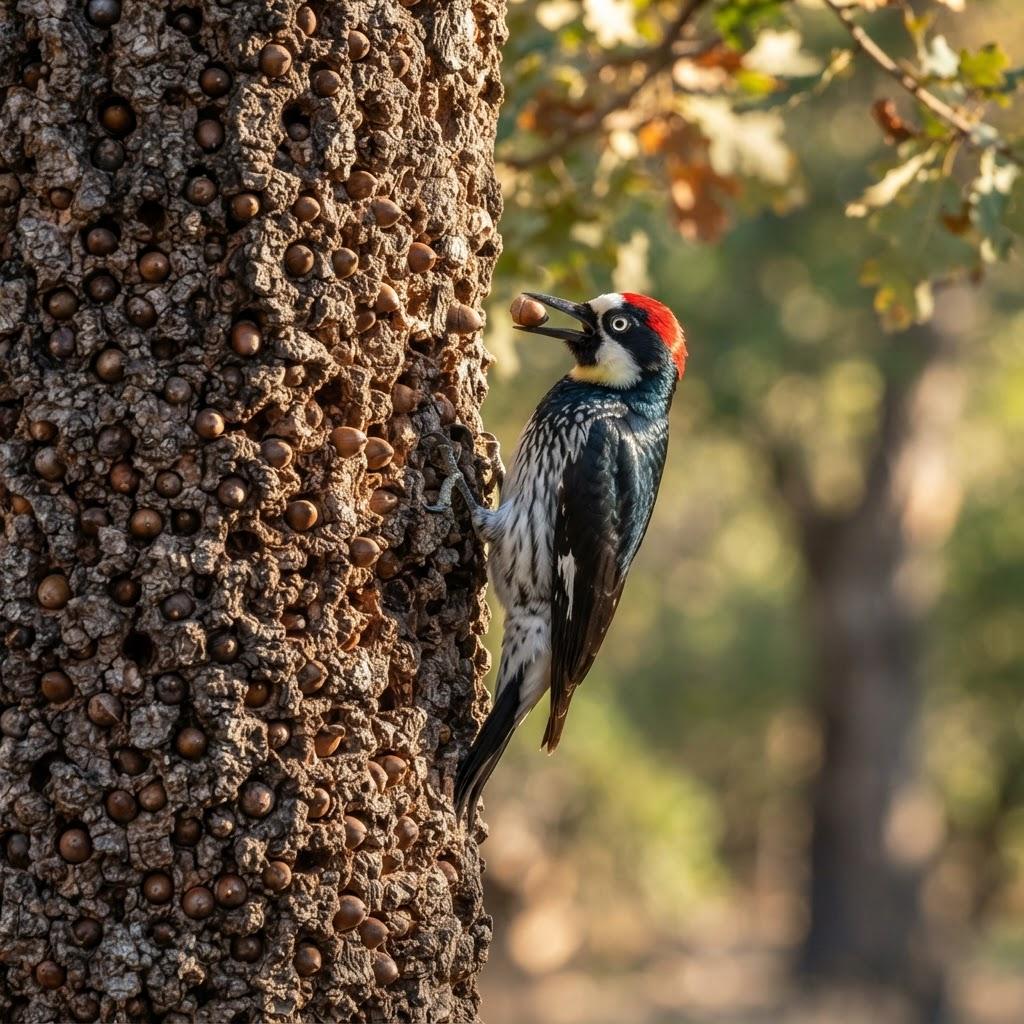
Melanerpes formicivorus
Acorn Woodpecker
Meet the avian world's most obsessed hoarder, a clown-faced woodpecker that treats every tree like a giant piggy bank. With their chaotic social lives and drilling addiction, these birds are the high-energy stars of the oak forest.
Meet the Bird
Imagine a bird that walked into a costume shop, bought a tuxedo, realized it forgot to paint on its eyebrows, and decided to wear a white mask just to keep things confusing. That is the Acorn Woodpecker. With their bright red berets, piercing white eyes, and a face that looks like a cartoon villain plotting something mischievous, they are the undisputed comedians of the woodland. Unlike your typical solitary, grumpy woodpecker that taps on a tree just to say 'leave me alone,' the Acorn Woodpecker is a social butterfly—if that butterfly was hopped up on espresso and lived in a commune. They are loud, they are opinionated, and they spend their entire existence obsessed with the local real estate market. They don't just peck; they curate. When you hear that signature 'waka-waka' call echoing through the trees, you aren't hearing a bird; you are hearing a tiny, feathery foreman screaming at his crew about the structural integrity of their collective pantry.
Superpowers & Weird Abilities
The Acorn Woodpecker has a skull that would make a stuntman jealous. You see, when you spend your day jackhammering a tree with the force of a falling anvil, you generally end up with a massive headache or a concussion. These birds, however, are built like armored tanks. They possess a specialized, sponge-like bone structure in their skulls that acts as a built-in shock absorber, dissipating the impact force before it reaches their tiny brains. But the real magic happens in their feet. They have zygodactyl feet, meaning two toes point forward and two point backward. This provides them with the grip of a professional rock climber, allowing them to cling to vertical tree trunks at impossible angles for hours. It is essentially a biological grappling hook system that lets them defy gravity while they meticulously drill holes to store their precious acorn stash, turning a simple tree into a piece of functional art.
Drama, Personality & Feathered Chaos
If you think your neighborhood homeowners association is intense, you haven't seen a family of Acorn Woodpeckers. These birds live in complex social groups where everyone is related, everyone has a job, and everyone is constantly arguing over the snacks. It is a true 'feathered chaos' environment. They are notorious for being the neighborhood bullies, occasionally chasing off rival species just to prove they can. But the real drama happens during 'storage' time. Since they share a communal granary—a single tree that might hold thousands of holes—they are constantly checking to make sure no one is stealing from the pantry. Imagine a group of roommates who love each other dearly but spend forty percent of their time policing the fridge to ensure the milk hasn't been pilfered. They are fiercely territorial, communal, and loud enough to be heard three blocks away during an intense family meeting.
Bizarre Rituals & Quirky Habits
Their most famous habit is, of course, the hoarding. An Acorn Woodpecker will take a perfectly good acorn and drill a hole specifically sized to fit it, then hammer the nut into place with all the focus of a blacksmith. Some trees, known as granary trees, are so riddled with these holes that they look like they’ve been chewed on by a giant with a vendetta. Why do they do this? Because winter is coming, and they don't want to go hungry. But it goes beyond just storing food. They engage in communal drilling, where the entire group will gather around a fresh tree trunk and drill holes in a coordinated frenzy. It is less like a bird feeding and more like a high-stakes construction project where the contractor is also the structural engineer and the chief food critic. Watching them work is a lesson in extreme focus and long-term planning.
Legends, Folklore & Human Stories
In many Native American traditions, the Acorn Woodpecker is viewed with a mix of respect and amusement. Given their dependence on the oak tree, they are often linked to the bounty of the harvest. There are stories of how these birds 'taught' humans the importance of preparing for the lean months, serving as a furry, feathered reminder that the grasshopper shouldn't be the only role model in the forest. Humans have long been fascinated by their granary trees, with some early settlers stumbling upon a tree riddled with thousands of nuts and wondering if a woodpecker had somehow gained sentience. While they aren't the subjects of grand, sweeping epics, they are the quiet heroes of the forest floor, symbols of industry and the power of teamwork. Every time a hiker spots an old oak tree that looks like it was attacked by a sewing machine, they are witnessing a piece of living, natural history.
Mating: The Ridiculous World of Avian Dating
The dating scene for an Acorn Woodpecker is a bizarre, high-energy affair that looks like a dance marathon gone wrong. Because they live in groups, finding a partner isn't just about impressing one bird; it’s about navigating a social circle. They engage in spectacular aerial displays, fluttering their wings and showing off their flashy white wing patches like they are auditioning for a bird version of a Broadway show. But here is the kicker: they often practice cooperative breeding. In some clans, multiple brothers will mate with multiple sisters, and everyone helps raise the resulting chicks. It is the ultimate team sport, where the 'dance' involves a lot of posturing and vocalizing to establish status within the group. If you aren't high enough on the social ladder, you might just find yourself relegated to the 'aunt and uncle' role, which in the bird world is still plenty of work.
Nesting: Master Architects and Lazy Slumlords
When it comes to housing, these birds are the master architects of the avian world. They don't just build a home; they renovate the entire neighborhood. They excavate deep cavities in the trunks of dead trees, often using the same tree that serves as their pantry. These nests are protected by thick wood walls, which act as a fortress against predators. Unlike the lazy mourning dove, which tosses three sticks together and prays for the best, the Acorn Woodpecker treats its nest like a high-security vault. They keep the interior lined with fresh wood chips, creating a clean, safe, and surprisingly sturdy nursery. They are the 'do-it-yourself' renovators of the forest, always sanding, smoothing, and expanding their living spaces to ensure the next generation has a penthouse view of the woodland.
Raising Babies: The Screaming Food Disposals
Raising baby Acorn Woodpeckers is a 24-hour operation that requires the help of the entire clan. Once the eggs hatch, the nest becomes a cacophony of screeching, gaping mouths that would make a concert crowd look quiet. The parents—and often other members of the group—are constantly on the move, bringing insects, bits of fruit, and, of course, bits of nut to the nest. It is an intense, high-calorie relay race. The chicks are demanding, impatient, and utterly convinced that the next delivery is taking far too long. They fledge after about a month, but even then, they don't stray far. They stick around to learn the family trade, which mostly involves watching the adults and trying not to get in the way while the grown-ups argue about the best way to wedge an acorn into a hole.
Bird-Watching Travel & Local Hotspots
If you want to see these characters in action, you need to head to the oak-dominated regions of the American West. California is the absolute epicenter for these birds. Spend a day in Big Basin Redwoods or Pinnacles National Park, and you will almost certainly hear the 'waka-waka' chorus. They are not shy; if there is an oak tree with a good crop of acorns, they will be there. In the Southwest, look for stands of mature oak in canyons and foothills. The best time to visit is during the late summer and fall, when they are at their most frantic, stocking their larders for the winter. They are social creatures, so where you see one, you will see a whole gang of them, making them one of the easiest birds to spot once you know what to listen for.
Food, Feeder Hacks & DIY Projects
Attracting Acorn Woodpeckers to your yard is easier than you think, but you have to play by their rules. They love suet, but they prefer it in a log rather than a plastic cage. Take a natural log, drill several one-inch holes, and stuff them with a mix of high-quality beef suet and chunky peanut butter. This mimics the feeling of their natural pantry trees. Avoid the cheap, dusty millet mixes at the store—birds hate it, and it just turns into a soggy mess that invites rats. If you have the space, planting a native oak tree is the ultimate 'if you build it, they will come' move. Even if it takes twenty years to grow, the wood will eventually become an irresistible home for these wood-drilling dynamos. Just keep the suet log filled, and you’ll have a permanent, entertaining group of visitors who pay their rent in pure personality.
Seasonal Guides & "Crisis" Management
Winter is 'showtime' for the Acorn Woodpecker. While other birds are busy struggling to find frozen insects, our feathered friends are living it up, raiding their carefully curated nut supply. This is the best time to keep your suet logs topped off, as their natural food sources start to run low. Come spring, you might run into the 'fledgling panic' season. If you find a baby bird on the ground that looks like a mini-version of the adult but is a bit clumsy, take a deep breath and walk away. The parents are likely watching from a nearby branch, ready to dive-bomb any cat that gets too close. Unless the bird is visibly injured or in immediate danger from a pet, it is best to leave it alone. Nature has a way of working things out, and most of these 'grounded' babies are just awkward teenagers taking their first flying lessons.
Backyard Tech & Gadget Reviews
Want to see who is stealing the nuts from your feeder? A simple motion-sensor camera trap is a game-changer. These devices have become incredibly cheap and allow you to capture high-definition footage of your neighborhood birds without having to stand outside in the cold. For the tech-savvy, a smart feeder can identify the birds that stop by, sending alerts to your phone. It is a great way to monitor which individuals in the flock are the biggest food-hogs. As for keeping them safe, if you find birds hitting your windows, simple window decals or external screens are the way to go. They break up the reflection that confuses the bird, turning your 'invisible' glass into a clear obstacle. It is a small investment that saves your backyard buddies from a nasty headache and keeps your bird-watching experience peaceful for everyone involved.
How to Spot One & How It Is Doing
Spotting an Acorn Woodpecker is like playing a game of 'Where’s Waldo' with a very loud, very colorful character. Look for that red, white, and black pattern. If it looks like the bird is wearing a white mask and a red hat, you have found your target. Listen for their rhythmic, chattering call, which sounds like they are mocking you in a very specific, upbeat language. Their conservation status is 'Least Concern,' meaning they are doing quite well, provided there are enough oak trees to go around. You can help by supporting local land conservation efforts that protect old-growth forests and oak savannas. These birds rely on big, dead trees to store their hoard, so if you have a dead tree in your yard that isn't a safety hazard, consider leaving it standing. It is essentially a luxury condo for a whole family of these charismatic, nut-obsessed, and utterly hilarious birds.