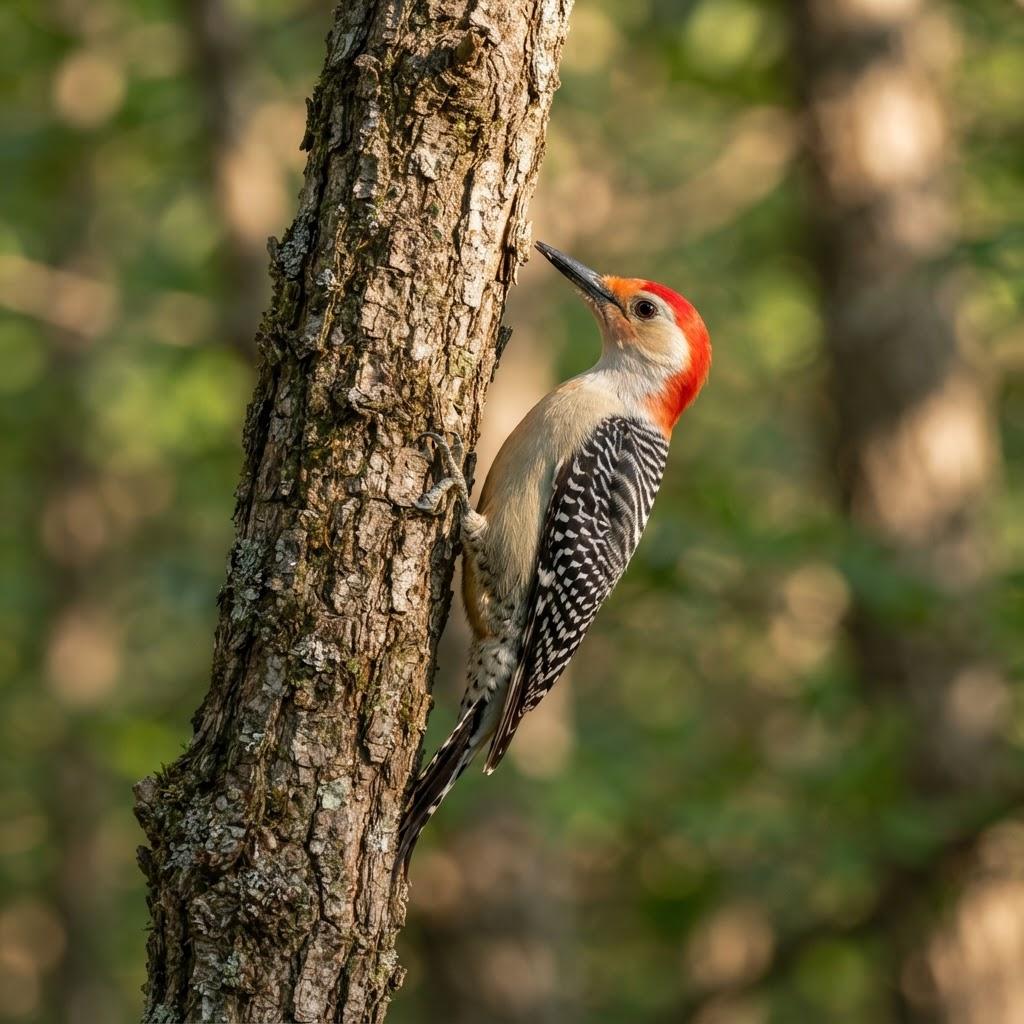
Melanerpes carolinus
Red-bellied Woodpecker
Meet the Red-bellied Woodpecker, the tuxedo-clad percussionist of the forest who famously suffers from a slight identity crisis regarding its own belly color. This high-energy bird is the life of the backyard party, providing constant entertainment with its acrobatic feeding and loud, chattering personality.
Meet the Bird
The Red-bellied Woodpecker is the avian equivalent of that one neighbor who is always doing home renovations with a jackhammer at 7:00 AM. Clad in a dapper, zebra-striped black-and-white coat with just a sophisticated splash of crimson on the nape of the neck, this bird cuts a dashing figure. However, it suffers from a naming disaster that would make any marketing executive weep. Despite its name, you will rarely see a bright red belly. It is more of a smudged, faint hint of a peach crayon that a toddler dropped in a puddle. If you are standing in your backyard squinting at a bird through binoculars, wondering why it does not look like a candy-cane-colored clown, do not worry; you are definitely looking at the right bird. These feathered acrobats are the caffeinated extroverts of the woodpecker world, constantly moving, calling, and inspecting every nook and cranny of your oak trees with the intensity of a private investigator.
Superpowers & Weird Abilities
If you slammed your face into a tree at 15 miles per hour, you would have a concussion, a massive headache, and probably a very confusing conversation with a doctor. The Red-bellied Woodpecker does this for a living and considers it a light morning workout. They possess a suite of biological engineering marvels that prevent their brains from turning into scrambled eggs. Their skulls are reinforced with spongy, shock-absorbing bone, and their brains are positioned in a way that minimizes impact force. Even more mind-boggling is their tongue. It is so long that it literally wraps around the back of their skull and attaches to their nostrils. When they poke it into a crevice to snag a beetle, the tongue acts like a sticky, harpooned fishing line. It is basically a built-in multi-tool that would make a Swiss Army knife look incredibly primitive and deeply embarrassed by its own lack of biological ingenuity.
Drama, Personality & Feathered Chaos
When it comes to neighborhood politics, the Red-bellied Woodpecker is the undisputed drama king of the suet feeder. They possess a level of confidence that is honestly inspiring; they will happily bully a Blue Jay, which is essentially the neighborhood bouncer of the bird world. While other birds are polite, waiting their turn for a snack, the Red-bellied swoops in with a piercing 'churr-churr' call that translates roughly to 'Get out of my way, I am the main character here.' They are not just bullies; they are also opportunistic kleptomaniacs. If another bird finds a particularly tasty morsel, the Red-bellied will often just swoop down and claim it as a tax payment. It is a world of feathered chaos where the loudest, fastest, and most persistent bird takes the prize. They are the ultimate backyard entrepreneurs, always looking for a new territory to exploit or a feeder to dominate with their sheer, unadulterated presence.
Bizarre Rituals & Quirky Habits
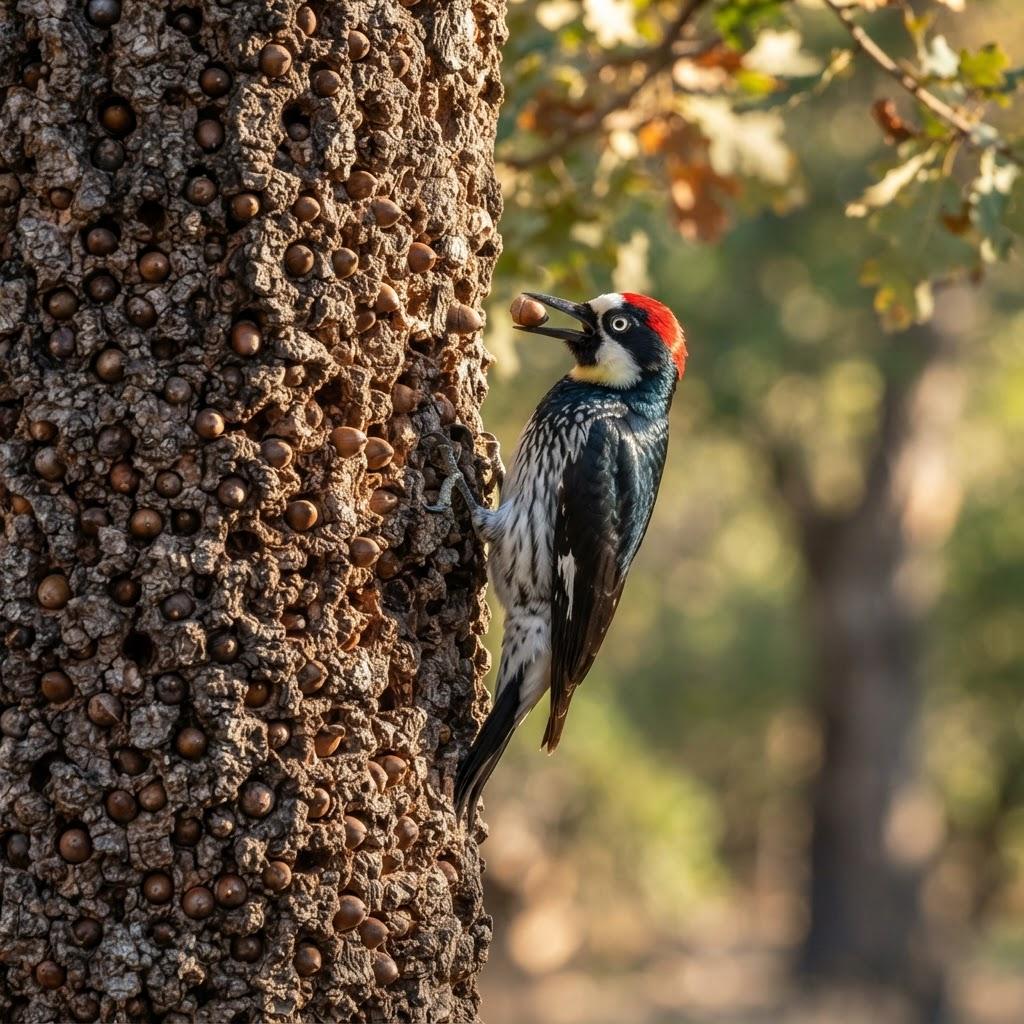
These birds have a penchant for 'caching,' which is bird-speak for being a master of the pantry. Because they do not want to rely on luck, they stuff acorns, nuts, and seeds into cracks in tree bark, fence posts, and even the siding of your house. They are essentially little feathered hoarders. If you find a mystery pile of sunflower seeds tucked into the bark of your backyard elm, you have been visited by a Red-bellied who is prepping for a rainy day. They also participate in a strange behavior called 'anting,' where they will deliberately provoke a pile of ants and let them crawl over their feathers. The theory is that the ants spray formic acid, which acts as a natural parasite repellent or a way to keep their plumage in tip-top shape. It is a bit like a bird-sized day at the spa, if your spa involved angry, biting insects and a lot of frantic dancing.
Legends, Folklore & Human Stories
While woodpeckers in general are often seen as symbols of hard work and persistence in folklore, the Red-bellied Woodpecker occupies a unique space in modern Americana. Because they are so common, many people grew up seeing them as the quintessential 'backyard bird.' There is a wonderful tradition in some rural areas where the sound of a woodpecker drumming on a hollow tree was said to be a weather oracle. If the drumming was particularly rhythmic and loud, it meant a storm was brewing. It is a romantic idea—nature playing the drums to signal the arrival of rain. Throughout history, these birds have been associated with the forest's heartbeat. They are the guardians of the wood, the creatures that ensure the trees stay healthy by controlling insect populations. They might not be the heroes of epic myths, but they are the quiet, sturdy legends of our local ecosystems, keeping the woods humming with life.
Mating: The Ridiculous World of Avian Dating
Courtship for a Red-bellied Woodpecker is an exercise in high-stakes performance art. It begins with the male finding the perfect hollow tree cavity, which he shows off to potential mates like a real estate agent at an open house. He will stand outside the hole, drumming away on a nearby branch to create a rhythm. If a female approaches, the two engage in a series of synchronized flights and vocalizations that look like a very intense, high-speed game of tag. They will chase each other around the tree trunk, bobbing their heads in a mesmerizing display of coordination. If the female is not impressed by his drumming technique or the prime real estate he has secured, she will simply fly off, leaving him to pound away at a tree in solitary confusion. It is a harsh, rejection-filled world, and success only comes to those who can prove their rhythm and their carpentry skills are up to code.
Nesting: Master Architects and Lazy Slumlords
When it comes to housing, Red-bellied Woodpeckers are the gold standard of DIY renovation. They do not just move into any old hollow; they often excavate their own nesting cavities in dead trees, branches, or even wooden utility poles if they are feeling particularly bold. The female and male take turns chipping away at the wood, working with a precision that would put a master carpenter to shame. The inside of the nest is surprisingly minimalist, with no elaborate lining—just a bed of wood chips produced during the construction process. It is a cozy, dark, and safe bachelor pad for the soon-to-be-parents. They are the opposite of the 'slumlord' birds like pigeons, who view a few twigs balanced on a ledge as a finished home. These birds treat the architectural integrity of their nest as a matter of extreme importance, ensuring the safety of their brood is protected by solid wood.
Raising Babies: The Screaming Food Disposals
Once the chicks hatch, the nesting cavity turns into a high-volume, 24/7 dining establishment. Red-bellied Woodpecker parents are essentially slave laborers for their offspring. The babies are loud, demanding, and utterly relentless. If you were to peer into a nest, you would see a writhing mass of hungry beaks pointed directly at the entrance. The parents work themselves to the point of exhaustion, flying back and forth with beaks full of insects, berries, and bits of fruit. The chicks grow rapidly, demanding more food every single hour. It is a chaotic, noisy, and high-energy environment. For about three to four weeks, the parents do nothing but deliver calories to the screaming food disposals inside the hole. When the young finally fledge—a fancy word for leaving the nest—they emerge as slightly less coordinated versions of their parents, ready to start their own lives of terrorizing the backyard feeders.
Bird-Watching Travel & Local Hotspots
If you want to catch these guys in action, you do not need to book a flight to the Amazon rainforest. They are everywhere in the Eastern U.S. If you want to see them in their natural glory, head to the Great Smoky Mountains National Park or the Everglades. Any mature deciduous forest in the Southeast is basically a Red-bellied playground. In the northern parts of their range, look for them in suburban parks with big, old oaks and maples. The best time to spot them is in the early morning when they are at their hungriest, or during late winter when the leaves are down and they are easier to see as they hop up and down tree trunks. Look for birding hotspots like Point Pelee in Canada or the various wildlife refuges along the Atlantic flyway. They are the reliable, steady companions of the birder, always there to greet you with a friendly, if slightly noisy, welcome.
Food, Feeder Hacks & DIY Projects
Want to be the most popular house on the block? Start a suet bar. Red-bellied Woodpeckers go absolutely crazy for high-fat suet. While a generic mix of sunflower seeds and millet is fine for sparrows, you want to invest in a wire suet cage. If you want a DIY project, take a small log, drill a few holes into the side, and stuff them with a mix of peanut butter and cornmeal. This is basically a five-star hotel meal for a Red-bellied. Avoid those cheap bags of 'wild bird seed' filled with red milo and wheat; the woodpeckers will turn their beaks up at it, and you will just end up with an army of squirrels. Adding a native holly bush or a serviceberry tree to your yard is the ultimate long-term investment. They love the berries, and you get a beautiful garden. It is all about giving them high-energy fuel for those intense drumming sessions.
Seasonal Guides & "Crisis" Management
In the spring, keep your feeders well-stocked because the birds are busy building nests and need that extra caloric boost. Winter is the time for the 'fat' approach—ensure that high-energy suet is always available to help them survive those long, freezing nights. As for the 'fledgling panic' season, please, step away from the bird. If you see a fluffy, awkward-looking youngster on the ground, 99 percent of the time, the parents are watching from a nearby branch, cheering the kid on. They are just learning to fly. Unless the bird is visibly injured or in immediate danger from a cat, leave it alone. The parents are far better at raising their babies than any human could hope to be. Your job is just to watch from a distance and keep the neighborhood cats indoors, which is the single most helpful thing you can do for the avian population.
Backyard Tech & Gadget Reviews
If you really want to get to know your local Red-bellied, a smart feeder with a camera is a complete game-changer. Seeing a high-definition video of a woodpecker working over a suet block is like watching a nature documentary in your own backyard. Regarding window collisions, they are a massive problem for all birds, including our stripe-backed friends. The best solution is to break up the reflection. If you have a clear pane of glass, use window films, decals, or even some decorative cordage. The goal is to make the window look like a solid surface to the bird's eye. If you want to get creative, set up a motion-activated trail camera near a tree where you have seen them caching food. You will be amazed at the sheer volume of activity going on in your yard that you usually miss. Technology allows us to become active participants in the secret lives of these busy birds.
How to Spot One & How It Is Doing
To spot a Red-bellied, look for the 'zebra-striped' back and listen for that distinctive, rolling 'churr' sound. If you are in the eastern half of the U.S., they are likely already in your neighborhood. Conservation-wise, they are doing fantastic. They have actually been expanding their range northward as the climate changes and more suburban areas provide food. They are the winners of the avian world, perfectly happy to adapt to our human landscapes. You can help them continue to thrive by maintaining large trees in your yard and resisting the urge to clear away all the 'dead wood.' A dead branch is not trash; it is a five-star dining hall and a luxury apartment building for a woodpecker. By leaving a little bit of nature's mess, you are providing the perfect environment for these loud, funny, and incredibly resilient little characters to keep brightening up our forests and backyards.