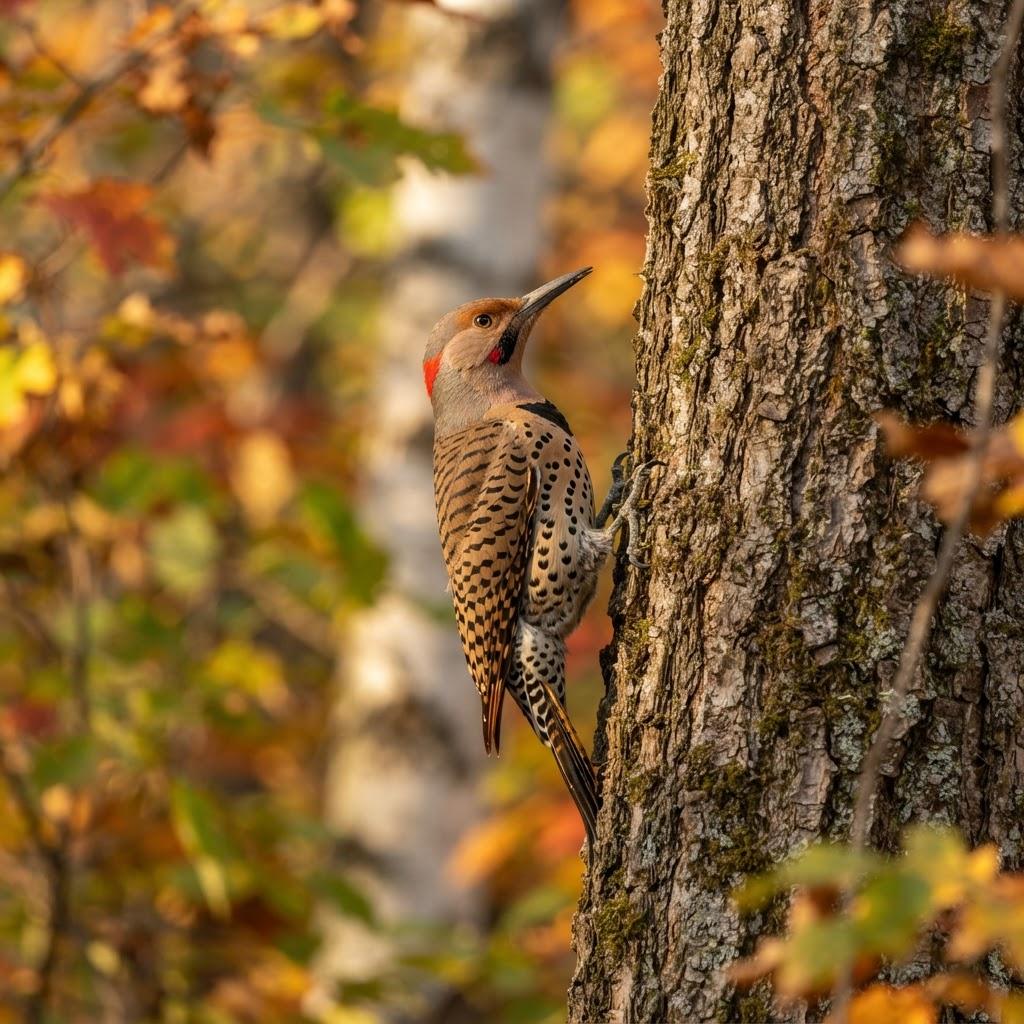
Colaptes auratus
Northern Flicker
Meet the Northern Flicker, the tuxedo-wearing, ant-eating rebel of the woodpecker world. This quirky bird breaks all the rules of avian society while looking fabulous in polka dots.
Meet the Bird
Imagine a bird that decided the typical life of a woodpecker—banging its head against trees all day—was far too monotonous. Enter the Northern Flicker, the only woodpecker in North America that clearly missed the memo on how to be a normal tree-hugging bird. With a vibrant, golden-yellow or salmon-red under-wing flash that looks like a neon sign flickering on and off, this bird has a personality that screams for attention. Unlike its more refined, tree-clinging cousins, the Flicker is often spotted shuffling awkwardly across your lawn like a tuxedo-clad tourist searching for a dropped wallet. It is a ground-dwelling specialist, a flamboyant oddball, and frankly, the closest thing to a disco dancer you will find in your backyard. They are hefty, loud, and carry a certain 'I do what I want' attitude that makes them the most entertaining characters in the neighborhood wildlife drama.
Superpowers & Weird Abilities
While most woodpeckers are busy perfecting their concussive therapy on oak trees, the Northern Flicker has evolved to be the ultimate ant-vacuums of the bird world. Their tongues are absolute marvels of biological engineering; they are long, barbed, and sticky, extending far beyond the beak to lap up thousands of ants and beetles from the dirt. Think of it like a biological sticky trap that retracts into their skull, wrapping all the way around their brain to cushion it. Yes, their tongue literally acts as a shock absorber for their head. When they aren't chowing down on a six-legged buffet, they are flashing those brilliant wing feathers that give them their name. These wings don't just look pretty; they serve as a 'hey, look over here!' signal during flight and territorial disputes. It is basically a built-in light show, a strobe effect that warns competitors that this patch of grass is spoken for.
Drama, Personality & Feathered Chaos
Northern Flickers are the neighborhood bullies of the ant world, but they are also the absolute kings of dramatic noise. They are notorious for drumming on man-made structures—metal gutters, chimney caps, and siding—specifically because the reverberation sounds louder and more impressive to the ladies than a boring old hollow log ever could. This causes significant, headache-inducing drama for homeowners who wake up to the sound of a jackhammer on their bedroom wall. They aren't trying to be malicious; they are simply broadcasting their rugged masculinity at maximum volume. If you own a house with metal trim, you are essentially a giant amplifier for a bird looking to date. They are remarkably bold and can be seen chasing off squirrels, other birds, or even staring down domestic cats with a look that clearly suggests they aren't afraid of a little physical confrontation.
Bizarre Rituals & Quirky Habits
The Flicker has a habit that sounds like a college experiment gone wrong: they love ants, but they also love using those ants to groom themselves. This is called 'anting.' A Flicker will intentionally park itself on an anthill, letting the angry insects crawl all over its feathers. The ants, in a panicked defense, spray formic acid onto the bird. The Flicker then shakes itself, distributing this acidic chemical throughout its plumage. Scientists think this is a way to get rid of parasites or keep their feathers clean, acting like a natural, stingy deodorant. It looks frantic and chaotic, but to the Flicker, it is essentially a trip to the spa—even if the spa treatment involves being bitten by thousands of tiny, vengeful insects. They are also known to soak in birdbaths with such enthusiasm that they leave the water looking like a muddy swamp, proving they prioritize function over refined etiquette.
Legends, Folklore & Human Stories
Historically, the Flicker has been a bird of significance, often associated with the sun or rain in various Indigenous American mythologies. Because of that vivid yellow flash under their wings, some cultures saw them as manifestations of sunlight itself, or perhaps a feathered bringer of gold. In folklore, they are often characterized as energetic and persistent, mirroring their tireless quest for food on the forest floor. There are countless tales of early settlers being startled by the sudden, explosive sound of a Flicker drumming on a metal roof, often thinking it was a phantom carpenter or some other worldly presence. Even today, they remain a source of wonder, as their unexpected appearances in city parks bring a splash of wilderness to the concrete jungle, reminding us that we are still part of a larger, buzzing, and sometimes very noisy, ecosystem.
Mating: The Ridiculous World of Avian Dating
If you want to witness a truly bizarre romantic comedy, find a pair of Flickers in the early spring. The males engage in a ritual called 'fencing,' where they face off, bob their heads, spread their tails, and flash those fancy wings in a synchronized dance that looks like a high-stakes version of a Vegas show. It is essentially a mating dance competition where the bird who can wiggle his head, flash his colors, and drum on a resonant surface the loudest wins. If a female isn't feeling it, she won't hesitate to fly off, leaving the male standing alone on a branch, looking rather foolish. This ritual is as much about proving vigor and health as it is about romance. The male who can make the most impressive racket while looking the most vibrant is the one who gets the prize, proving that in the bird world, confidence is everything.
Nesting: Master Architects and Lazy Slumlords
When it comes to real estate, the Northern Flicker is a sophisticated home renovator. They don't just find any old tree; they carve out deep, circular cavities in dead or decaying wood, creating a secure, insulated bunker for their future brood. It is precision engineering—a perfectly shaped hole that keeps the weather out and the babies in. However, they are also prone to being 'slumlords' of the forest. Because they put so much work into creating these perfect apartments, they often find themselves fighting off invaders like starlings or squirrels who want to squat in their hard-won nest holes. If a Flicker is evicted from a previous year's home, they simply start digging again. They are persistent, industrious, and essentially the master contractors of the bird world, providing luxury housing that keeps their families safe from the prying eyes of hawks and snakes.
Raising Babies: The Screaming Food Disposals
Raising a family for a Flicker is an exercise in extreme stamina. Once the eggs hatch, the nest becomes a chaotic, screeching, feather-filled elevator of hunger. Both parents work an exhausting tag-team schedule, flying hundreds of times a day to bring back mouthfuls of ants and larvae. The babies, meanwhile, are essentially loud, hungry mouths with wings, vibrating with energy and screaming for more. They don't have a concept of 'quiet time' or 'polite waiting.' They are professional beggars. The parents must be constantly vigilant, as the smell of food and the noise of the babies can attract predators. It is a high-stress, high-reward environment where the kids grow at an incredible rate, transforming from naked, squirming blobs into miniature, polka-dotted versions of their parents in just a few short weeks, ready to take on the world of ants and wood-drumming.
Bird-Watching Travel & Local Hotspots
If you are dying to catch a glimpse of this energetic clown, head to almost any woodland edge or suburban park across North America. In the United States, they are year-round residents in many states, but they are particularly visible in the open fields of the Midwest or the forest edges of the Pacific Northwest. Visit places like the Cuyahoga Valley National Park in Ohio or the many city parks in Seattle where they frequent the open lawns. The best time to spot them is early morning, when they are most active searching for food on the grass. Look for a bird that looks like it is having a mild nervous breakdown while hopping across your lawn. If you see a medium-sized bird with a white patch on its rump taking off in a heavy, undulating flight, you have successfully spotted a Northern Flicker.
Food, Feeder Hacks & DIY Projects
Feeding Northern Flickers is a unique challenge because they aren't your typical seed-enthusiasts. Skip the cheap bags of milo and millet—the Flickers won't touch it. Instead, invest in high-quality suet, specifically suet cakes made with insects or peanuts. They love it. For a DIY project, take an old log, drill some holes into it, and pack it with a mixture of suet, peanut butter, and sunflower hearts. Hang this from a tree branch, and you have essentially created a five-star dining experience for a Flicker. They also love suet feeders that are attached to a pole rather than swinging, as they are not acrobats. If you want a more natural approach, plant native shrubs and bushes that support ant and beetle populations. A healthy, pesticide-free lawn is the best feeder you can possibly provide, as it acts as an all-you-can-eat ant buffet for your local feathered friends.
Seasonal Guides & "Crisis" Management
Spring is the busiest season for the Flicker, as migration kicks in and territorial drumming reaches a fever pitch. If you notice a Flicker hitting your siding, it’s not an attack; it’s a concert. Deter them by hanging shiny reflective tape or old CDs to break up the surface area. Come late spring, you might find a 'fledgling' on the ground—a young bird that looks clumsy and flightless. Do not panic! This is the 'fledgling panic' season. Most of these birds are just learning to fly. Unless the bird is visibly injured, leave it alone. The parents are likely watching from a nearby tree, still feeding it. In winter, Flickers stay in many regions, but they appreciate extra fat. A heated birdbath is an absolute game-changer in freezing temperatures, ensuring they can drink and stay hydrated when water sources are frozen solid.
Backyard Tech & Gadget Reviews
To really get to know your local Flickers, consider setting up a motion-activated camera near your suet feeder. While the fancy AI-powered bird feeders are great, they are often designed for small songbirds that perch easily. For a Flicker, a mounted camera trap or a simple security camera aimed at your backyard log feeder will catch much better, high-definition action. If window collisions are a concern—and they should be—use window decals, frosted film, or even external screens. These methods break up the reflection that tricks birds into thinking they have a clear path through your living room. Protecting your windows is the single best way to ensure your backyard stays a sanctuary rather than a hazard. A little bit of camera tech allows you to capture those fleeting moments of ant-hunting and drumming that you would otherwise miss while doing the dishes.
How to Spot One & How It Is Doing
Spotting a Northern Flicker is easy once you know what to look for. Listen for a loud, piercing 'klee-yer' call—it sounds a bit like someone blowing a whistle. Visually, look for that distinctive white rump patch that is revealed when they take flight; it is a dead giveaway. They are doing quite well across their range, classified as 'Least Concern' by conservationists. Their adaptability allows them to thrive in suburbs and human-altered landscapes, but they still benefit from dead tree snags being left standing rather than cleared away. You can help by keeping a 'messy' corner in your yard with logs and leaf litter, providing the perfect habitat for the ants they love to eat. By embracing a little bit of natural messiness, you are providing a home for one of the most charismatic, loud, and downright entertaining birds in the sky.