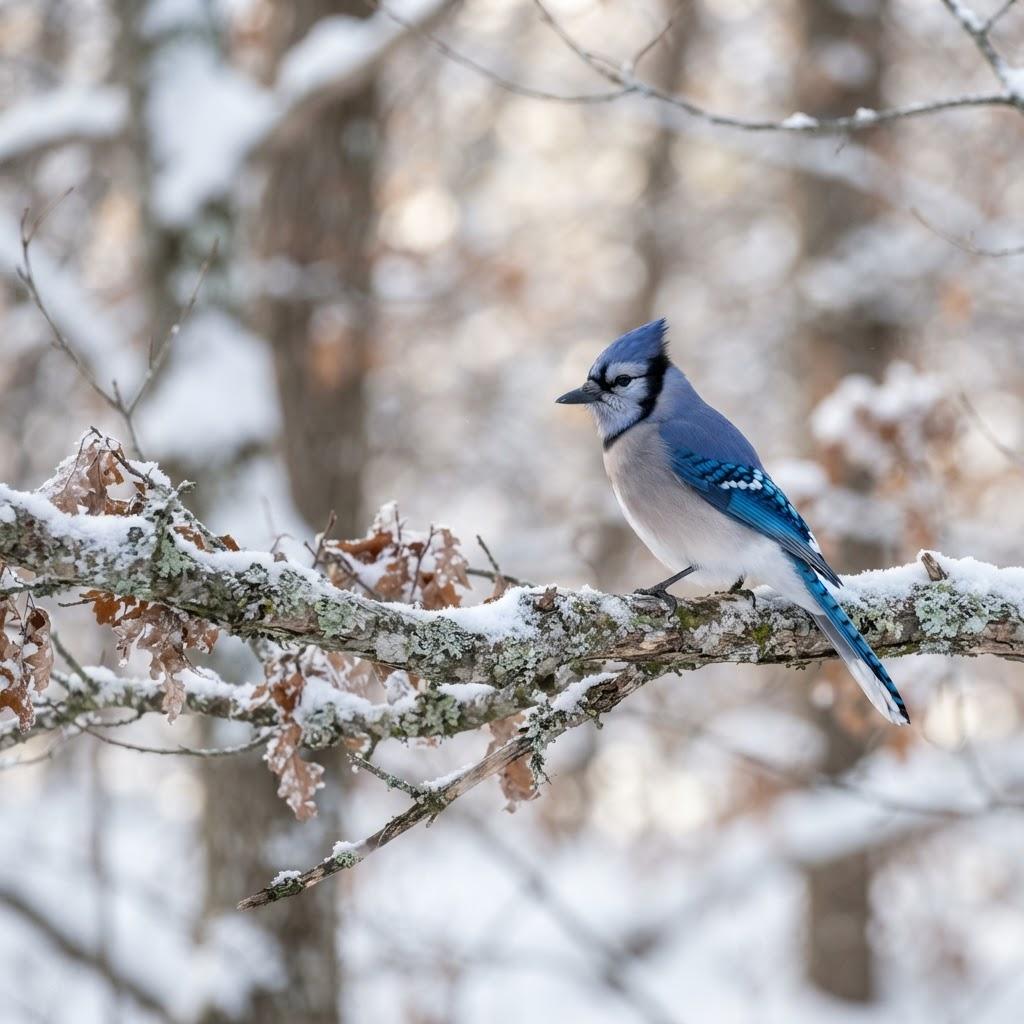
Cyanocitta cristata
Blue Jay
The Blue Jay is the loud, unapologetic neighborhood celebrity of the bird world, rocking a mohawk and a personality that ranges from social butterfly to total menace. Dive into the world of this cobalt-colored mastermind and learn why your backyard would be a boring place without their chaotic energy.
Meet the Bird
Imagine a bird that walked into a party, kicked the door off its hinges, demanded to be the center of attention, and then started roasting everyone in the room. That is the Blue Jay. With its signature brilliant blue crest—a feathery mohawk that stands tall when it is annoyed or excited—this bird is the ultimate avian punk rocker. It does not just fly into your yard; it makes a grand entrance, usually announced by a cacophony of squawks that sound like a rusty gate swinging in a windstorm. It is a striking sight, featuring a mix of electric blues, white underbellies, and black accents that look like they were painted on with a very precise, very moody artist's brush. While other birds might flutter by gracefully, the Blue Jay lands like a boss. It is the bird world's equivalent of the friend who brings snacks to the movie but talks through the entire feature film. They are bold, brash, and possess a level of confidence that is honestly kind of admirable if you ignore the fact that they are currently stealing a peanut from a squirrel.
Superpowers & Weird Abilities
If you think the Blue Jay is just a pretty face, think again. These birds are actually master cryptographers and memory champions. Their greatest superpower is their ability to act as the forest's unofficial alarm system. They possess a complex vocal range, allowing them to mimic the screech of a Red-shouldered Hawk with unsettling accuracy. Why do they do this? It is a tactical ruse, a feathered 'fake-out' designed to make other birds scatter so the Jay can have the feeder all to itself. Beyond their deceptive vocal talents, their memory is legendary. A single Blue Jay can hide thousands of acorns in a single autumn, burying them in various secret locations across a massive territory. Remarkably, they remember where almost every single one of those caches is located, acting as accidental gardeners by inadvertently planting new forests when they forget a few. They are essentially the tiny, winged architects of the hardwood ecosystem, using their superior cognitive map to navigate the world with precision that puts your smartphone GPS to shame.
Drama, Personality & Feathered Chaos
In the soap opera of your backyard, the Blue Jay is definitely the lead villain with a heart of gold—or at least, a stomach full of stolen seeds. They are famous for being the bullies of the bird feeder, frequently chasing off smaller, more polite visitors like Chickadees and Nuthatches. It is a real-life version of high school drama where the popular kid keeps grabbing all the lunch money. However, their 'meanness' is often misunderstood. They are fiercely protective of their territory and their kin. If a predator dares to enter their neck of the woods, the entire local Jay squad will mobilize in a frenzy of noise, circling and dive-bombing the intruder until it decides that whatever it was hunting simply isn't worth the headache. They live for the drama. Watching a Blue Jay interact with a group of birds is like watching an intense, high-stakes political debate where the Jay always insists on having the final, loudest word. Their social structure is surprisingly tight-knit, proving that behind all the bullying, they really do care about the gang.
Bizarre Rituals & Quirky Habits
If you ever look out your window and see a Blue Jay sitting still with its wings spread wide and looking completely zonked out, do not panic. It is not sick; it is 'anting.' This is a classic, albeit strange, ritual where the bird finds a mound of ants and allows them to crawl over its feathers. The ants, feeling threatened, spray formic acid as a defense mechanism, which the Jay happily lets seep into its feathers. Scientists believe this weird spa day helps the bird kill off parasites, mites, and lice that are lurking in those hard-to-reach places. It is essentially an all-natural, bug-fueled dry cleaning service. They are also known to get a bit goofy on fermented fruit, sometimes acting erratic or stumbling about after feasting on overripe berries in the late summer heat. It is a reminder that even the most put-together birds have their moments of questionable decision-making. Their ability to turn a terrifying encounter with a mound of biting insects into a grooming session is the kind of outside-the-box thinking we should all strive for.
Legends, Folklore & Human Stories
Throughout human history, the Blue Jay has been cast in many roles. In some Native American traditions, they were viewed as tricksters—clever, noisy, and occasionally dangerous, but always entertaining. Because of their blue color, which is actually a structural illusion caused by the way light reflects off their feathers rather than pigment, they have often been associated with the sky and heavens in folklore. Early European settlers in North America were often perplexed by these loud, aggressive creatures compared to the smaller, more familiar birds back home. They gained a reputation for being 'bad' birds, partly because they would occasionally eat the eggs of other species, a biological reality that humans found difficult to forgive. Yet, people remain fascinated by them. There are countless stories of Blue Jays forming surprising bonds with humans who feed them peanuts, eventually learning the specific sound of a car or a person walking to the porch. They aren't just birds; they are distinct characters that have woven themselves into the local legends of our suburbs.
Mating: The Ridiculous World of Avian Dating
When it comes to finding love, the Blue Jay puts on a show that would make a Broadway producer weep with joy. The courtship process is a lengthy, high-energy affair that begins with the 'nuptial flight.' The male will fly around with his crest raised, puffing out his feathers to look as large and intimidating as possible, while the female follows suit, creating a blue, feathery blur in the sky. If she is interested, they engage in a ritual of bowing and head-bobbing, a dance that looks remarkably like a synchronized aerobics class performed at double speed. It is a delicate game of 'follow the leader.' If the female decides the male’s dance moves aren't quite up to par, she simply flies away, leaving him to search for another partner. They are monogamous for the breeding season, and sometimes for life, which is a big commitment considering how much time they spend screaming at other birds. The sheer dedication they show to impressing their partners is both romantic and deeply hilarious.
Nesting: Master Architects and Lazy Slumlords
Building a home for the next generation of screaming blue monsters is a task the parents take very seriously. Blue Jay nests are sturdy, bowl-shaped structures built primarily of twigs, bark strips, and moss, and then held together with a generous helping of mud. They aren't just slapping together a pile of sticks; they are creating a fortress. These nests are usually tucked away in the thick branches of a tree, often 10 to 25 feet off the ground, hidden behind a curtain of leaves. They are remarkably well-constructed, designed to withstand the spring storms that would easily dismantle the lazy, haphazard efforts of a Mourning Dove. Inside, the nest is lined with soft roots and fine grass to cushion the eggs. It is a cozy, high-tech bunker designed for safety. While they might be loud, boisterous, and frankly annoying to other birds in the neighborhood, they are objectively impressive construction workers who provide their chicks with a secure, well-fortified start to life.
Raising Babies: The Screaming Food Disposals
The parenting phase for a Blue Jay is essentially a non-stop, high-stakes food delivery gig. Once the three to five eggs hatch, the nest becomes a chaotic symphony of demands. The chicks, which start out blind, naked, and incredibly ugly, quickly transform into feather-covered, wide-mouthed screaming machines. They require massive amounts of protein to grow, and the parents spend their entire day ferrying insects, caterpillars, and seeds to satisfy the bottomless pits that are their offspring. It is a grueling schedule. The chicks exhibit a behavior called 'gaping,' where they stretch their necks toward the sky with their bright, gaping mouths open, daring the parents to drop in a worm. Watching the parents return to the nest with a beak full of food while the chicks chirp in a frenzy of excitement is a frantic, beautiful, and slightly overwhelming spectacle. By the time they fledge, or learn to fly, about three weeks after hatching, the parents look like they have aged ten years in just a few weeks.
Bird-Watching Travel & Local Hotspots
If you want to see a Blue Jay in the wild, you do not need to book an expensive flight to a remote island. These birds are the kings of the backyard. However, for a true birding expedition, head to mature hardwood forests where the oak trees are plentiful. Places like the Great Smoky Mountains National Park or the expansive deciduous forests of the Northeast are gold mines for spotting them. If you are near the Great Lakes region, look for them along the forest edges during the peak of autumn, when they are busy storing acorns for winter. They are most active during the early morning hours, so set your alarm clock and head to a local park that has a good mix of dense trees and open clearings. You will know you have arrived when you hear that unmistakable, harsh 'jay-jay' call echoing through the canopy. They are everywhere, provided you know how to look—just listen for the most obnoxious sound in the woods and you will find your bird.
Food, Feeder Hacks & DIY Projects
To become a Blue Jay’s favorite human, you need to understand their love language: peanuts in the shell. While they will happily eat black oil sunflower seeds, a peanut is the equivalent of a fine-dining experience for them. They will swoop down, snatch a peanut, fly off to hide it, and return within seconds for another. Avoid cheap filler seeds—the ones full of red milo and cracked corn—because the Jays will just toss them on the ground while searching for the 'good stuff,' making a massive mess. For a fun DIY project, take a pinecone, coat it in natural peanut butter (no xylitol!), and roll it in high-quality bird seed or crushed peanuts. Hang it from a sturdy branch. The Jays will love the challenge of pulling the seeds out. Another great hack is to plant native oak trees or fruit-bearing shrubs like serviceberry. It gives them a natural pantry, which keeps them healthy and keeps them coming back to your yard season after season.
Seasonal Guides & "Crisis" Management
In the spring, keep your feeders full because the Jays are exhausted from a long winter and are busy preparing for nesting. As winter approaches, prioritize high-fat suet. It provides the essential calories they need to keep their tiny bodies warm through freezing nights. If you happen to find a fluffy, uncoordinated baby bird on the ground in May or June, take a deep breath: it is likely a fledgling. It is currently in the 'toddler stage' of bird life—it has left the nest but is still being watched and fed by its parents. Unless it is clearly injured or in immediate danger from a cat, leave it alone! The parents are almost certainly nearby, screaming at you to keep your distance. Giving the baby space is the most helpful thing you can do. By late autumn, when resources get scarce, these birds rely heavily on their hidden stashes, so keep your feeders clean and ready, as they will be the most grateful customers during the coldest weeks of the year.
Backyard Tech & Gadget Reviews
Tech has completely changed the way we bird-watch, and Blue Jays are the perfect test subjects for new gadgets. AI-powered smart feeders, like those that snap photos when a bird lands, are fantastic for capturing the Jays' antics up close. Seeing a high-definition close-up of that sharp, black beak and the detailed blue feathers makes you appreciate the bird's aesthetic even more. For window collisions, which are a real risk for fast-flying birds, use window decals or 'bird tape' that create patterns visible to birds but barely noticeable to you. It is a simple, cheap way to save lives. If you want to see what happens in your yard after dark, or catch the Jays in their more private moments, a trail camera with infrared night vision is a game changer. Mounting one near your feeder can reveal a secret world of behavior you would otherwise never see, turning your backyard into your own private nature documentary set.
How to Spot One & How It Is Doing
Spotting a Blue Jay is easy: look for the flash of blue, listen for the raucous yelling, and watch for the bird that acts like it owns the place. They have a white face with a black border, a prominent crest, and those striking white wing bars. When you see one, you are looking at a species that is thriving. Blue Jays are listed as 'Least Concern' on the conservation scale, meaning their populations are healthy and they are very good at adapting to the human-altered landscapes we call suburbs. You can help keep it that way by keeping your yard chemical-free, providing clean water in a birdbath, and keeping your outdoor cats inside or supervised. These birds are survivors, entertainers, and accidental foresters all in one. By welcoming them into your space, you are not just hosting a bird; you are bringing a little bit of the wild, chaotic, and beautiful natural world right to your doorstep, ensuring that the backyard remains the most interesting show in town.