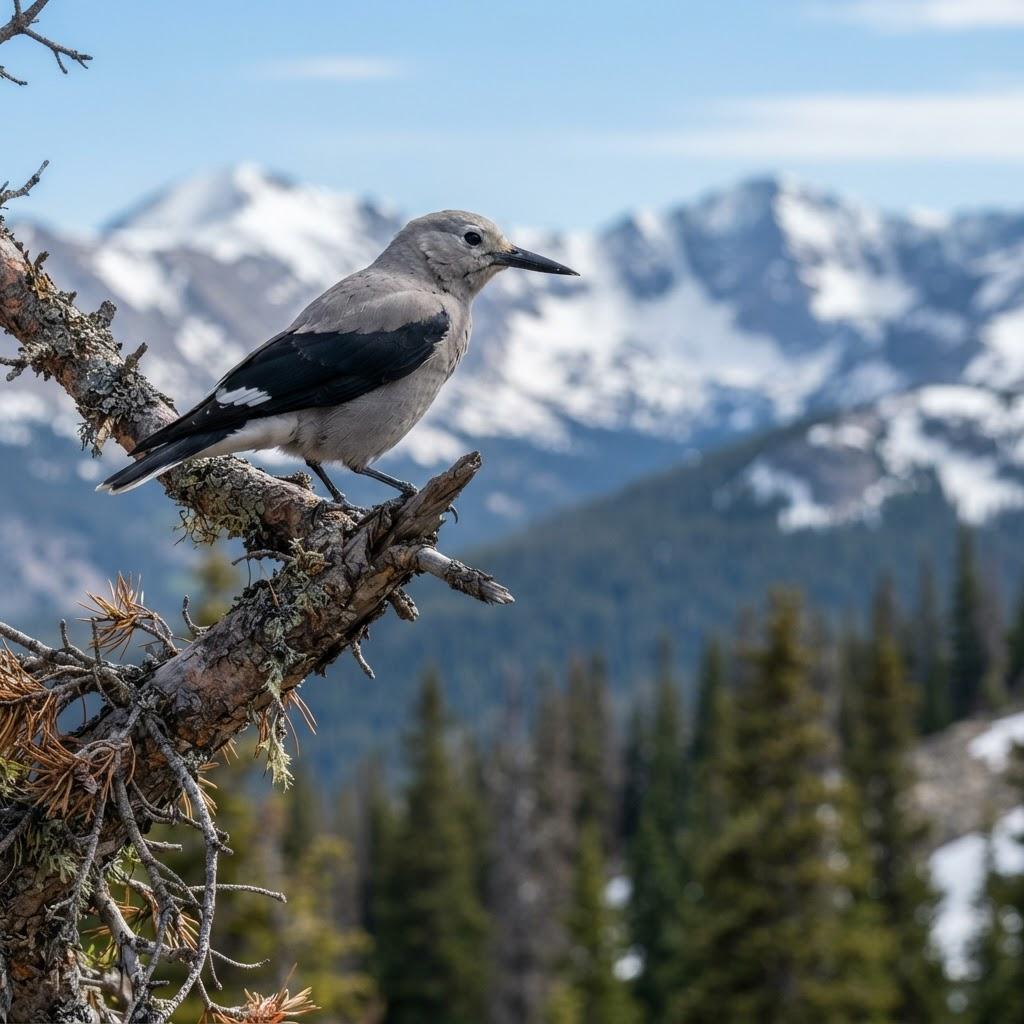
Nucifraga columbiana
Clark's Nutcracker
The Clark's Nutcracker is the forest's most obsessed land surveyor and master of memory, spending its entire life playing a high-stakes game of hide-and-seek with thousands of seeds. It is a brilliant, grey-feathered mastermind that literally shaped the landscape of the American West.
Meet the Bird
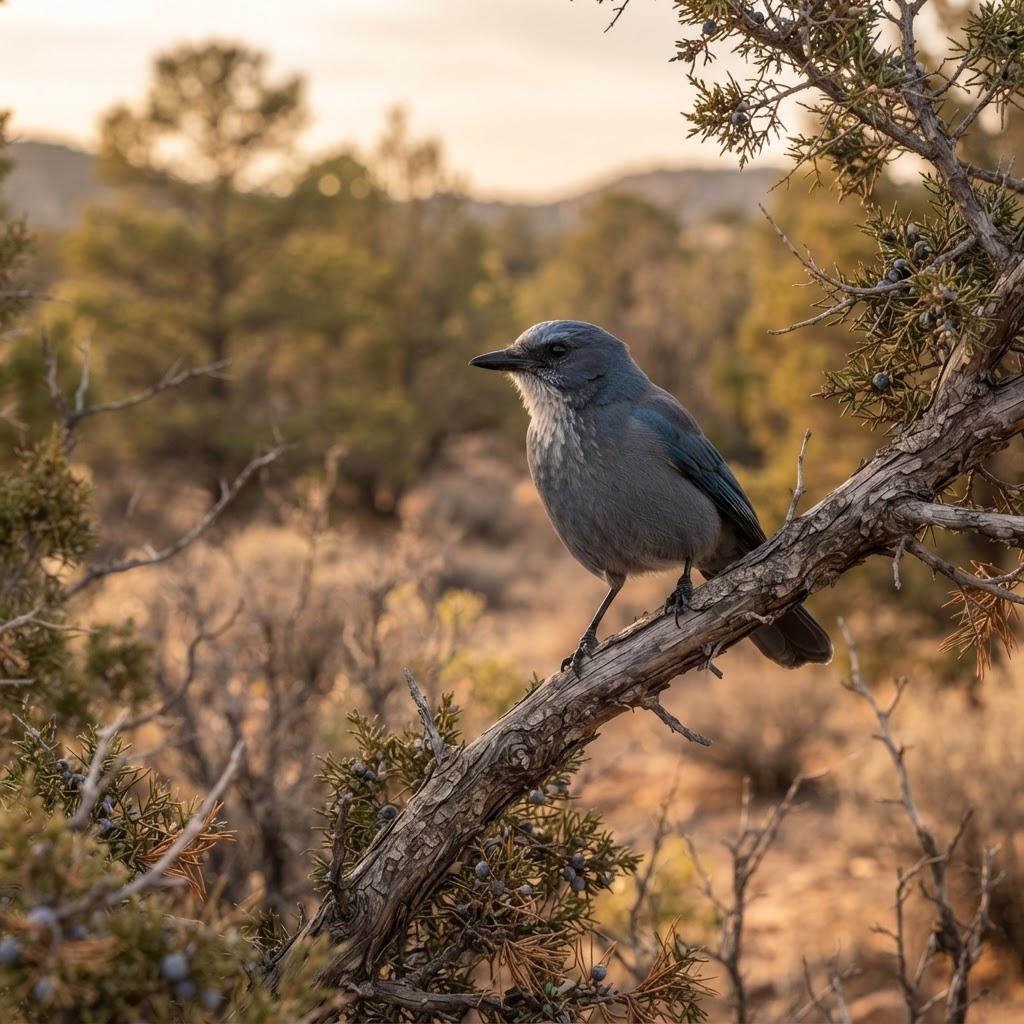
Imagine a bird that treats life like an intense, high-stakes finance job where the currency is pine seeds. The Clark's Nutcracker is not your typical neighborhood chirper. It looks like a crow that spent a bit too much time in a monochrome photo filter, sporting elegant charcoal-grey plumage and stark, crisp black wings with patches of white that flash like a neon sign when it takes flight. This bird has the personality of a caffeinated forest ranger. It is smart, intensely active, and possesses an observational focus that would put a professional detective to shame. While most birds spend their days gossiping in the trees, the Nutcracker is busy calculating the exact location of its life savings. It is a member of the Corvidae family, which means it is essentially the genius cousin of the raven and the blue jay. These birds don't just exist in the forest; they run it with an air of sophisticated, slightly twitchy authority.
Superpowers & Weird Abilities
The Clark's Nutcracker possesses a memory that would make a supercomputer cry. In a single season, a lone Nutcracker will stash up to 30,000 pine seeds across its territory. What is the real-world utility of this? It can remember the exact location of these thousands of tiny caches months later, even when the forest is buried under several feet of snow. This isn't just luck; it is a specialized brain function. Their hippocampus—the part of the brain that handles spatial memory—is massive compared to other birds. Think of it as having a built-in, unhackable GPS that doesn't rely on satellites. They also have a specialized sublingual pouch, essentially a built-in stretchy cargo bag under their tongue, which allows them to carry up to 100 seeds at a time. This is the biological equivalent of a professional hiker being able to carry their entire pantry in their cheeks while sprinting up a mountain.
Drama, Personality & Feathered Chaos
These birds are the ultimate Type-A personalities of the avian world. They are not shy, they are not subtle, and they certainly do not have time for nonsense. If you enter their territory, you might hear a harsh, grating 'kra-aa-aa' that sounds remarkably like a rusty gate hinge being forced open. They are known to keep a close eye on other potential seed-thieves, and they have no qualms about defending their property with a bit of avian bravado. However, they are also incredibly social with their partners. They are essentially the power couple of the mountain peaks, operating as a synchronized team to manage their massive winter food inventory. They do not hold grudges in the petty way jays do, but they are intensely observant. If they see you watching them hide a seed, they might wait for you to leave, or they might just start a fake-out routine to lead you to an empty hole.
Bizarre Rituals & Quirky Habits
One of the most peculiar habits of the Clark's Nutcracker is its tendency to engage in what scientists call 'caching deception.' If a bird feels like it is being watched by another member of its species while it is burying its winter loot, it will intentionally pretend to hide a seed in one spot, then move to a different spot to actually bury the prize, all while keeping a suspicious eye on the intruder. It is a level of psychological warfare usually reserved for spy novels. They also have a strange obsession with heat management. You will often see them perched on the highest, most exposed branches of trees, not to sing, but to maximize their sun exposure. They are constantly monitoring the temperature of the landscape to ensure their caches don't get too wet or too hot, acting like tiny, feathered weather forecasters obsessed with the preservation of their pine-nut stockpile.
Legends, Folklore & Human Stories
While they lack the massive mythological profile of the Raven, the Clark's Nutcracker has a deep connection to the history of the American West. Named after William Clark of the famous Lewis and Clark Expedition, these birds were the explorers' constant, noisy companions as they crossed the rugged terrain of the Rockies. To the local indigenous peoples who shared the mountain ranges with these birds, they were often seen as symbols of hard work and foresight. Stories told by those who live in the high mountains often describe the Nutcracker as the bird that keeps the forest alive. This is actually scientifically accurate: they are the primary planters of whitebark pine trees. By forgetting a tiny percentage of their 30,000 caches, they essentially reforest the mountains one buried seed at a time. They are the unwitting, loud-mouthed architects of the high-altitude ecosystem, ensuring the forest survives the winter.
Mating: The Ridiculous World of Avian Dating
Dating for a Clark's Nutcracker is a serious, lifelong commitment that starts in the harshest conditions imaginable. While most birds wait for the balmy warmth of spring, Nutcrackers begin their courtship in the dead of winter, often while snow is still piling up in drifts. The male puts on a show, but not with flashy colors or elaborate songs. Instead, he demonstrates his value through 'gift-giving.' He will bring a cache of high-quality seeds to a potential mate. If the female accepts, it is a sign that he is a capable provider who can keep the family fed during the lean months. They then perform a sort of stiff-legged, bouncy flight display together. It is less of a romantic ballad and more of a synchronized audit of their collective resources. If the match is made, it is usually for life, provided they can continue to handle the stress of high-altitude homeownership.
Nesting: Master Architects and Lazy Slumlords
When it comes to nesting, these birds are the ultimate practical engineers. They don't mess around with flimsy grass baskets. Instead, they build massive, sturdy platforms in the thickest part of a conifer tree, often tucked away to stay hidden from the wind and predators. They line these structures with an impressive insulation package made of bark strips, grass, and even bits of animal hair to keep their eggs toasty in the sub-zero temperatures of early spring. It is a masterpiece of insulation. Unlike some birds that build 'three-stick' disasters that fall apart in a breeze, the Nutcracker nest is a fortress. They have to be—when you are raising babies in a mountain storm, you don't build a fixer-upper. They keep the nest relatively clean and highly defended, acting as vigilant guardians over their precious, mottled-brown eggs until they are ready to hatch.
Raising Babies: The Screaming Food Disposals
Raising Nutcracker chicks is an endurance sport that would make an ultramarathon runner weep. Because they nest so early in the year, the parents have to navigate massive snowstorms while foraging for food. The chicks are born with an insatiable appetite, functioning essentially as feathered, screaming garbage disposals that never seem to get full. The parents make countless trips back and forth, navigating through gusty mountain passes with their pouches stuffed full of regurgitated pine seeds and insects. The chicks are vocal—very, very vocal. They know that if they stop screaming, they might miss a meal, so they keep up a rhythmic, high-pitched chatter that would drive any human parent insane. After about three weeks of this intense, high-calorie parenting, the chicks begin to venture out. By then, the parents look exhausted, but they have successfully raised the next generation of forest-planters.
Bird-Watching Travel & Local Hotspots
If you want to catch a glimpse of this mountain mogul, you need to head up—way up. Think sub-alpine zones. If you are in the Western United States, head to places like Crater Lake National Park in Oregon or Glacier National Park in Montana during the late summer or autumn. This is when they are at their most frantic, busy caching their winter supply. Look for mature pine forests, especially those with whitebark or limber pine. They are bold and often ignore humans, so you don't need a massive camouflage blind. Just bring a pair of binoculars and a good jacket. If you are in the Sierra Nevada, check the high-elevation areas near Yosemite or Sequoia National Parks. They are frequently found near popular picnic areas or trailheads, as they are not above scavenging a stray crumb from a hiker's backpack, though they much prefer their natural pine seeds.
Food, Feeder Hacks & DIY Projects
Attracting a Clark's Nutcracker to your yard is tricky because they are deep-forest dwellers by nature. If you live at a high enough elevation, you can win them over with high-energy snacks. Do not bother with cheap, dusty millet—they will ignore it completely. They want the good stuff: black oil sunflower seeds, shelled peanuts, and, if you can find them, pine nuts. For a DIY project, create a 'Nut-Cracker Log.' Take a piece of untreated wood and drill several one-inch holes into it. Fill these holes with a mixture of peanut butter and crushed sunflower seeds. Mount this to a sturdy post in your yard. The birds will love the high fat content, which is exactly what they need to maintain their energy levels. To truly turn your yard into a magnet, plant native pinyon pines. It is a long-term investment, but it is the only way to make a Nutcracker feel truly at home.
Seasonal Guides & "Crisis" Management
In the spring, keep a close watch on your feeders. As the snow melts, Nutcrackers may come down to lower elevations in search of fresh food. If you see a young bird hopping on the ground and looking a bit dazed, do not panic! This is likely a fledgling practicing its flight skills. Unless it is obviously injured or in immediate danger from a cat, leave it alone. The parents are almost certainly watching from a nearby branch, waiting for you to move along so they can deliver another snack. For winter survival, ensure your birdbath doesn't freeze. A heated birdbath is a lifesaver in the mountains. Nutcrackers are hardy, but they appreciate a reliable source of liquid water when everything else is a solid block of ice. They will thank you by sticking around and keeping your yard interesting throughout the coldest months.
Backyard Tech & Gadget Reviews
If you want to document the daily life of a Nutcracker, a trail camera is your best friend. Unlike fancy AI feeders, which are designed for smaller songbirds, a rugged, motion-activated trail camera can be strapped to a tree trunk near your feeding station. These cameras are built to handle mountain weather and will give you clear, high-definition footage of the birds interacting with your feeder. For window safety, if your yard attracts birds, use 'bird tape' or window decals that break up the reflection. A Clark's Nutcracker is a smart bird, but even the smartest bird can get confused by a perfectly clean window that acts like a mirror in the morning sun. These solutions are cheap, effective, and keep your feathered visitors from having a painful meeting with your glass. Don't worry about ruining the view—the peace of mind is worth it.
How to Spot One & How It Is Doing
Spotting a Clark's Nutcracker is all about looking for the 'flash.' When they fly, the bright white patches on their wings and tail provide an unmistakable contrast to their dull grey bodies. They move with a direct, purposeful flight, and they spend a lot of time on the ground or on tree trunks looking for places to stash their findings. Listen for that harsh, dry 'kra-aa-aa.' If you hear it, look up! Conservation-wise, the species is doing well, but they are intrinsically tied to the health of the pine forests. The best thing you can do to help is to support efforts to protect old-growth forests and mountain ecosystems. By preserving the high-altitude forests, you are ensuring that these clever, industrious birds have a home. Keep your eyes on the treetops, stay patient, and enjoy the show. These birds are the true, wild spirits of the mountains.