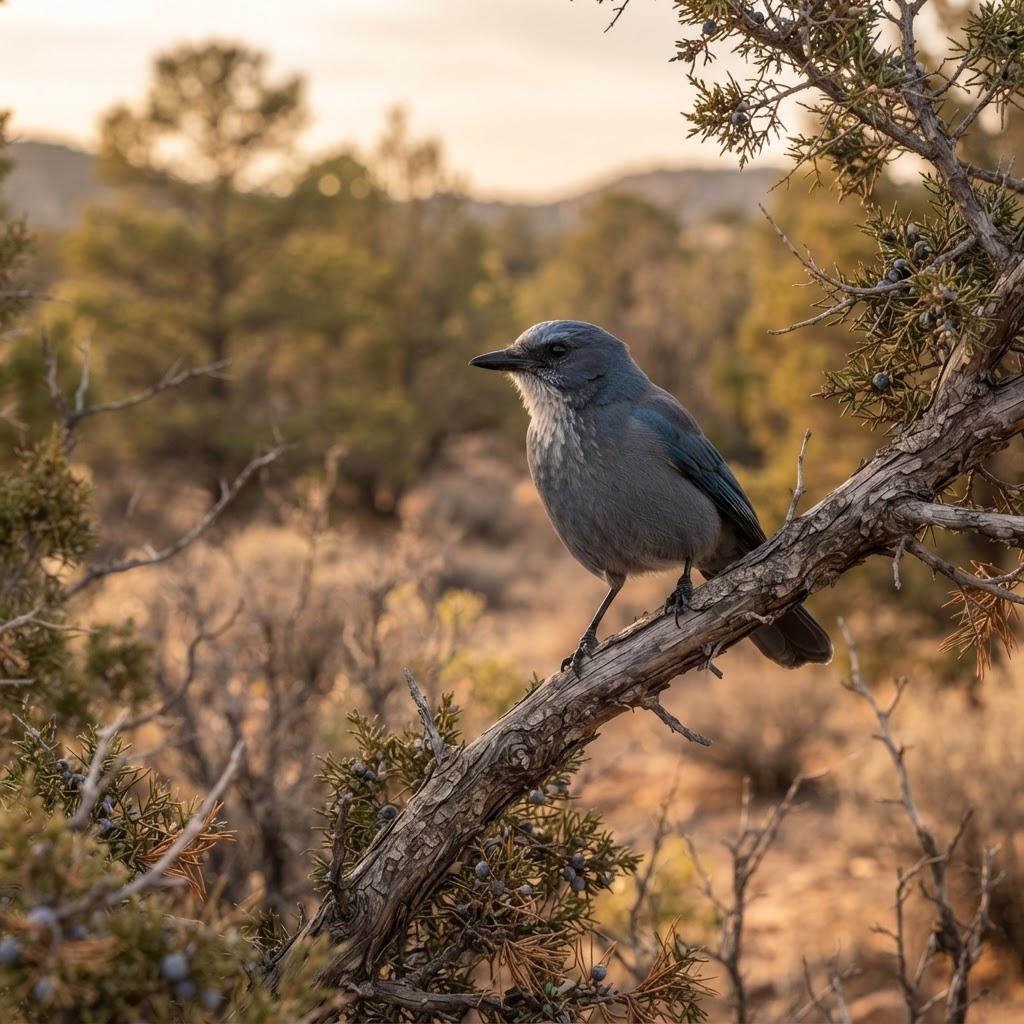
Gymnorhinus cyanocephalus
Pinyon Jay
Meet the Pinyon Jay, the woodland equivalent of an obsessive accountant with a penchant for high-stakes hoarding. These blue-clad socialites are the ultimate forest gardeners, and they have more secrets buried in their backyard than a daytime soap opera.
Meet the Bird
Imagine a bird that looks like a Blue Jay went through a minimalist filter and then decided to join a high-functioning cult. That is the Pinyon Jay. Clad in a dapper, dusty-blue coat that perfectly mimics the haze of the desert mountains they call home, these birds are the true stars of the pinyon-juniper woodlands. They are not the flashy, look-at-me types that strut around garden birdbaths. Instead, they are the woodland equivalents of a secret society, moving through the canopy in boisterous, gossiping mobs. Their vibe is one of restless energy, always checking their watches, and constantly debating the best strategy for the next pine nut raid. They have a slightly elongated beak that makes them look like they are perpetually peering over a pair of invisible reading glasses, searching for their next snack. Unlike their cousin the Blue Jay, who is the noisy neighborhood bully, the Pinyon Jay is a team player, a communal thinker, and an absolute master of the forest landscape who wouldn't be caught dead without their entourage.
Superpowers & Weird Abilities
If you ever wondered if a bird could earn a PhD in spatial memory, the Pinyon Jay is your candidate. These feathered geniuses possess a biological superpower that makes modern GPS look like a crayon drawing. During the autumn, a single Pinyon Jay can cache, or hide, up to 20,000 individual pine seeds in a single season. They don't just dump them in a pile; they tuck them away in specific crevices, under rocks, or deep in the soil, scattered across miles of terrain. Then, when the dead of winter hits, they return to these exact locations with nearly perfect accuracy. Think of it like a giant, invisible game of hide-and-seek where the prizes are life-saving snacks. Their brains actually undergo a physical change during this time, with the hippocampus—the region responsible for memory—swelling to accommodate the massive map of hidey-holes they have created. They are the ultimate forest arborists, accidentally planting thousands of trees every year because they simply forget a few of their hidden treasures, which then sprout and grow into the next generation of woodland homes.
Drama, Personality & Feathered Chaos
Social life for a Pinyon Jay is not for the faint of heart; it is a full-time, high-stakes drama that would make a reality show look boring. They are obligate social animals, meaning they have essentially forgotten how to be individuals. If you see one, you are likely looking at a small fraction of a flock that can number from fifty to several hundred birds. There is no such thing as 'me time' in their world. They engage in constant, raucous communication that sounds like a cross between a squawking party and an intense boardroom debate. They are fiercely loyal, often helping to raise each other's chicks, but they are also absolute tyrants when it comes to territory. If a rival group enters their woodland patch, the entire mob descends like a blue wave of fury. They don't just hold grudges; they seem to pass information about threats through the flock, ensuring that anyone who has wronged them is blacklisted for the foreseeable future.
Bizarre Rituals & Quirky Habits
Pinyon Jays are not just smart; they are downright quirky. One of their most fascinating habits is their 'social foraging.' While many birds hunt alone, Pinyon Jays use their numbers to maximize efficiency. One bird will act as a sentry, perched high in a juniper tree, scanning the horizon for hawks, while the rest of the mob works the ground below. They rotate duties with the military precision of a well-drilled unit. Another odd behavior is their habit of 'bill-wiping,' where they compulsively clean their beaks on branches after handling sticky pine resins. But perhaps the weirdest sight is watching a group of them engage in a 'flutter dance,' where birds will land in a tree and perform a synchronized, wing-quivering display that seems to be a mix of group bonding and sheer, unadulterated joy. It is as if they are high on the sheer thrill of existing as a massive, blue, feathered unit in the middle of a vast, quiet desert landscape.
Legends, Folklore & Human Stories
For many Indigenous peoples in the American Southwest, the Pinyon Jay is more than just a bird; it is a symbol of the forest itself. In various tribal stories, the jay is often cast as the 'Keeper of the Seeds,' a role that acknowledges their crucial part in planting the pinyon pines that provide food and shelter for entire ecosystems. Human observers have long marveled at how these birds seem to know exactly when the pine cones will open, appearing like clockwork just as the harvest begins. Some old-timey prospectors and hikers in the Great Basin spoke of the 'blue scouts' that would follow them through the hills, chattering constantly as if curious about the strange, non-winged creatures invading their home. There is a sense of mutual respect between the desert dweller and this bird; where there are Pinyon Jays, there is life, sustenance, and the enduring resilience of the arid landscape.
Mating: The Ridiculous World of Avian Dating
Dating for a Pinyon Jay is a massive group production. They are colonial nesters, which means they prefer to keep their families close, like a giant apartment complex in the sky. During the courtship season, the male Pinyon Jay tries to impress the female not with a solitary dance, but by performing a 'feeding ceremony.' He will present her with the finest pine nuts he can find, like a man bringing chocolates, but the ritual is much more intense. He bows, fluffs his feathers, and makes a series of soft, buzzing calls. If she accepts the snack, she acts like a fledgling, fluttering her wings and begging for him to feed her. It is a strange, infantile display, but it is a vital step in cementing their bond. If the male’s courtship skills are subpar—or if his snack selection is lackluster—the female will simply reject the offering and move on to the next suitor, leaving him to search for better nuts and refine his moves.
Nesting: Master Architects and Lazy Slumlords
While some birds are content with a few twigs and a prayer, the Pinyon Jay is a dedicated construction worker. They build their nests in the thickest, most protective parts of the pinyon or juniper trees, usually well-hidden from predators. The nest is a sturdy cup made of twigs, bark strips, and lined with animal hair or feathers, making it quite the cozy retreat for the incoming family. Because they are colonial nesters, you will often find multiple nests clustered in the same general area, turning the tree into a noisy, bustling community center. It is a far cry from the 'toss-it-together' philosophy of a mourning dove. They work together to maintain the structural integrity of the colony, often sharing information about nesting success or failure. The result is a well-engineered fortress that can withstand the whipping winds of the high desert, protecting their precious cargo from both the elements and the occasional curious snake or hawk.
Raising Babies: The Screaming Food Disposals
Once the chicks hatch, the Pinyon Jay parents shift into a mode of relentless, high-octane parenting. A Pinyon Jay nest is filled with a squirming, ravenous group of chicks that seem to have only one purpose: to shout as loudly as possible. They are born naked and helpless, but they grow at an astonishing rate thanks to the protein-rich diet of pine nuts and insects that the parents bring back to the nest. The parents are absolute machines, flying back and forth in a constant loop of labor. Because these birds are colonial, you will often see other members of the flock assisting in the feeding, essentially acting as daycare providers. It is a 'it takes a village' parenting model that ensures the chicks get enough calories to survive. When they finally fledge, they don't just leave; they join the mob, learning the ropes of group survival from the experts immediately, essentially graduating from a screaming food disposal to a functioning member of the blue-feathered collective.
Bird-Watching Travel & Local Hotspots
If you are on a quest to see these blue wonders, you need to set your sights on the American Southwest. Your best bet is to head toward places like the Great Basin National Park in Nevada or the pinyon-juniper forests of New Mexico and Arizona. Look for them in the fall and winter when they move in larger, more noticeable flocks. The Mesa Verde National Park is another legendary spot, where the ancient cliff dwellings are often surrounded by the perfect habitat for these birds. If you find yourself in the high-desert mountains, keep your ears open for their distinct, bell-like calls—it is a sound that carries far across the dry landscape. Early morning is the best time to catch them at their busiest. Do not just look at the trees; scan the ground beneath them, as they are just as likely to be found foraging for seeds on the forest floor as they are hiding in the branches.
Food, Feeder Hacks & DIY Projects
In the wild, these birds are nut-crazed fanatics, specifically obsessed with the seeds of the pinyon pine. If you want to attract them to your yard, you have to play the long game. Installing a bird feeder filled with black oil sunflower seeds or raw, unsalted peanuts in the shell is your best move. Avoid the cheap, dusty 'filler' seeds you find in big-box stores; the Pinyon Jay is a connoisseur and will turn its beak up at sorghum or wheat. For a DIY project, take a large pinecone, coat it in natural peanut butter (the kind without xylitol!), and roll it in high-quality sunflower hearts. Hang this from a sturdy branch in a quiet part of your yard. To truly make your space a Pinyon Jay magnet, plant native pinyon or juniper trees. It is a generational investment, but there is no better way to signal to these birds that your backyard is a welcoming, permanent stop on their daily rounds.
Seasonal Guides & "Crisis" Management
Pinyon Jays are resilient, but the seasons dictate their lives. During the spring, they are busy nesting, and they will be quiet and secretive to avoid attracting unwanted attention. This is the time to leave them alone and observe from a distance. If you happen upon a fledgling—a young bird that looks like a clumsy, confused version of an adult—do not panic. It is not an orphan. It is a teenager going through a 'puberty' phase where it is learning to fly but is still being watched by its parents from the trees. Leave it exactly where it is. In the winter, the focus shifts to survival. If you maintain a birdbath, consider a simple heating element to keep the water liquid during freezing temperatures. The birds will thank you by staying nearby, turning your yard into a sanctuary during the harsh, frozen months when food sources are buried deep under the mountain snow.
Backyard Tech & Gadget Reviews
If you want to get up close and personal without being a nuisance, modern tech is your best friend. AI-powered smart feeders are surprisingly effective for documenting bird species in your area, and they are particularly good at catching the fast-moving, social behaviors of a Pinyon Jay flock. Place your camera-enabled feeder in an area with clear sightlines and minimal tree obstruction to get those crisp, high-definition shots. If you have large windows that attract curious birds, invest in bird-safe window films or screens that prevent collisions—they are nearly invisible to humans but look like solid objects to birds. For those interested in the nocturnal habits of the ecosystem, a simple, affordable motion-activated trail camera can be set up on a tree trunk near your feeding station. It is a fantastic way to see what happens in your yard after the sun goes down, turning your home into a base for citizen science.
How to Spot One & How It Is Doing
To identify a Pinyon Jay, look for that unmistakable, dusty-blue plumage and that long, probing bill. In flight, they look agile and purposeful, often traveling in a undulating wave. Their call is a loud, ringing 'krah' that sounds like a jay trying to be a raven. Conservation-wise, these birds are currently considered vulnerable due to habitat loss—specifically the clearing of pinyon-juniper woodlands for development or grazing. You can help by supporting conservation efforts that protect these vital Western landscapes. Simply planting native trees or advocating for habitat preservation can make a genuine difference. These birds are the living pulse of the high desert, and their survival is intrinsically tied to the health of the forests they call home. By learning their ways and appreciating their intelligence, you are not just a watcher; you become an ally for one of the most charismatic, complex, and misunderstood characters in the avian world.