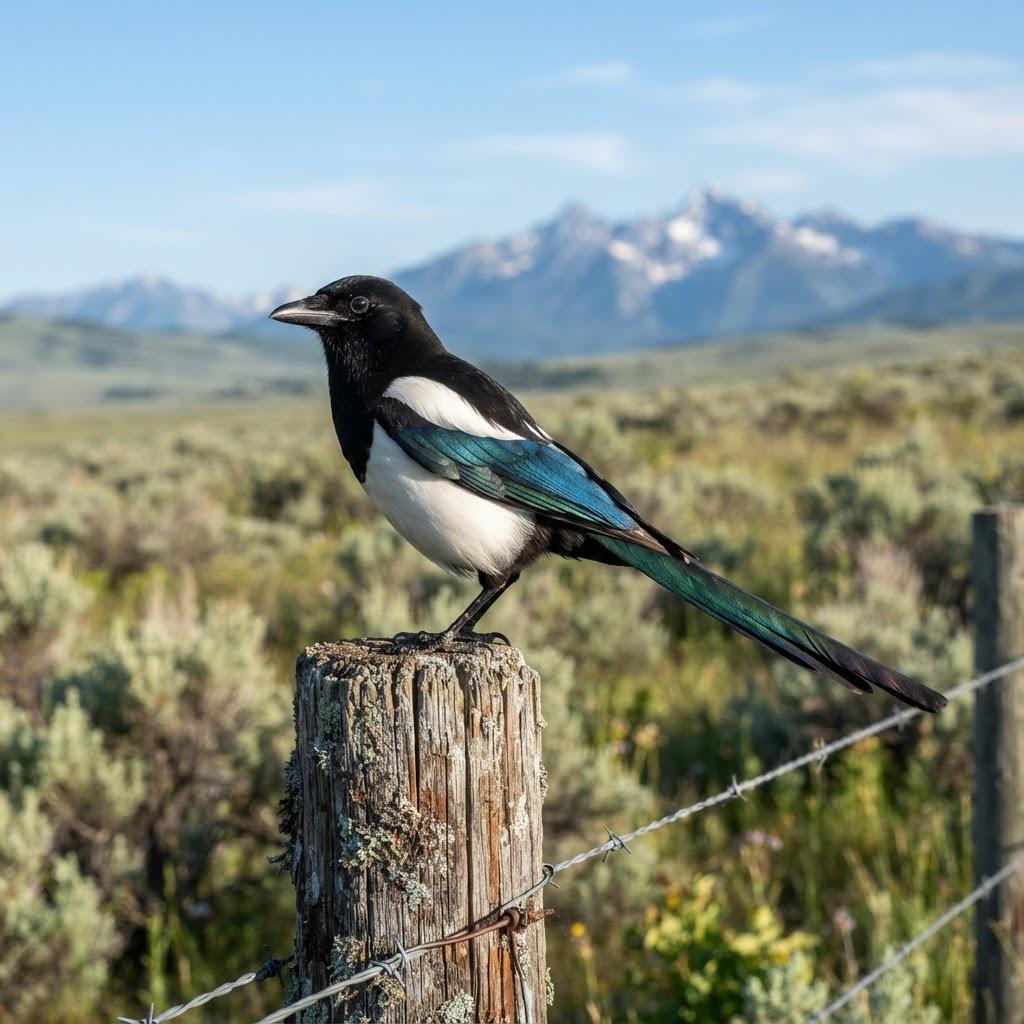
Pica hudsonia
Black-billed Magpie
The Black-billed Magpie is the tuxedo-wearing, trash-talking genius of the corvid world. With an IQ that rivals a toddler and a flair for the dramatic, this bird is the ultimate backyard celebrity you cannot help but love.
Meet the Bird
Imagine a bird that walked into a formal gala wearing a shimmering, iridescent tuxedo, but then started doing stand-up comedy and stealing the appetizers. That is the Black-billed Magpie. This isn't your average backyard visitor that just hangs around waiting for a handout; it is the charismatic lead character of the Western landscape. With its impossibly long tail, glossy black-and-white plumage, and a metallic green-blue sheen that looks like an oil slick under a neon sign, the magpie turns heads wherever it goes. They possess an air of haughty intelligence, as if they know exactly what you are thinking and find it vaguely amusing. Unlike those nervous songbirds that flit away at the slightest vibration of a leaf, the magpie struts through the world with the confidence of a bird that knows it has more brain cells than half the forest combined. It is a creature of high style and even higher drama, always ready to insert itself into whatever chaos is currently unfolding in your backyard.
Superpowers & Weird Abilities
If you think the Black-billed Magpie is just a pretty face, you are sorely mistaken. These birds are essentially the secret agents of the avian kingdom, possessing a cognitive toolkit that makes other species look like they are running on dial-up internet. Their most famous superpower is self-recognition. While most animals look into a mirror and see a threat or a rival, a magpie looks into a mirror and realizes, 'Hey, that’s me!' This puts them in an elite club of intelligent animals, including chimps, dolphins, and humans. They also have an uncanny ability to track and remember the locations of thousands of hidden food items, using what scientists call 'spatial memory.' Think of it as having a mental map that is constantly updating in real-time. They can even solve multi-step puzzles to get to a snack, showing a level of forward-thinking that makes a crow look like it’s just winging it. Their brain-to-body ratio is shockingly high, fueling their ability to plan, plot, and scheme their way through the day.
Drama, Personality & Feathered Chaos
Life with a magpie is never boring because a magpie is never bored. They are the quintessential neighborhood busybodies. If a hawk enters their territory, the magpie doesn't just cower; it rallies the troops and launches a coordinated, high-decibel harassment campaign until the predator is so annoyed it decides to find lunch in the next county. They are the feathered equivalent of a group chat full of drama queens who can't resist a good scandal. They are known to hold grudges, identifying specific humans who have slighted them and treating those individuals with vocal disdain for months. However, they are also deeply social, engaging in 'funerals' where they gather around a deceased member of their flock to make noise and perform what appears to be a somber ceremony. They are brilliant, bossy, and occasionally downright mean to the local songbirds at your feeder, behaving like the bouncers of the backyard club who decide exactly who gets to eat and who gets evicted.
Bizarre Rituals & Quirky Habits
Magpies are the kings of weird. Take, for example, their strange habit of 'anting.' This is when a magpie will intentionally find a busy anthill, squat down, and let the ants crawl all over its feathers. Why? It turns out the ants spray formic acid, which acts as a natural pesticide and mite-remover. It’s like a birdy spa day, but with tiny, angry insects. They are also notorious for their obsession with shiny objects. While the idea that they only hoard jewelry is a bit of a myth, they definitely have an eye for anything that glitters—foil, plastic, bits of glass—which they often incorporate into their nests. It is their way of 'blinging out' their architecture. They also engage in strange, stiff-legged walks, looking like they are marching to a secret beat only they can hear. When they feel threatened or just want to assert their dominance, they puff up their feathers and engage in a strange, clicking chatter that sounds like someone trying to start a lawnmower in a library.
Legends, Folklore & Human Stories
Across history, the magpie has been a polarizing figure. In some European folklore, they were seen as harbingers of doom or witches in disguise—mostly because they have such a distinct, piercing call and seem to know too much. In parts of Asia, however, they are considered symbols of happiness and good fortune, often called the 'bird of joy.' Their tendency to scavenge and follow hunters has led to stories of them guiding people to food, or perhaps just waiting for the leftovers. They have appeared in classic literature, music, and fairy tales, always as the clever, chatty trickster figure. The reality is that humans have always been fascinated by them because they feel like mirrors of ourselves. They are loud, nosy, smart, and opportunistic. We have a love-hate relationship with them because we recognize our own complex, sometimes annoying traits in their behavior. Whether they are considered lucky or cursed, they have definitely secured their place in our cultural landscape.
Mating: The Ridiculous World of Avian Dating
Dating for a magpie is less about candlelight and soft music and more about a high-stakes, competitive dance-off. The males spend weeks showing off to potential mates, which involves a series of complex aerial maneuvers. They will puff up their plumage, spread their wings wide to show off the white flashes, and bob their heads in a synchronized rhythm that is frankly absurd to watch. It is basically the avian equivalent of an elaborate flash mob. If a female isn't impressed, she literally flies away, and the male is left standing there looking like he just practiced a TikTok dance for an audience of zero. Once they are a pair, they are fiercely committed, often staying together for years. They spend their courtship building 'display' nests, which aren't even the ones they plan to use for their eggs—it is all about showing off their construction skills to potential rivals and proving to their lady that they have the best building materials in the neighborhood.
Nesting: Master Architects and Lazy Slumlords
When a magpie finally commits to a serious nesting project, they don't mess around. Their nests are like the fortresses of the bird world. They build huge, spherical structures out of mud, sticks, and anything else they can find, often including a domed roof and a side entrance to keep out predators. It’s essentially a gated community for chicks. Inside, they line the bowl with soft grass, hair, and maybe a stolen shiny bit of tinfoil for decoration. It is an engineering marvel that can take weeks to finish. Compare this to a dove, which just drops three twigs on a flat surface and calls it a home, and you realize the magpie is an overachiever. They will use these nests year after year, reinforcing them and patching them up, so eventually, you get a massive, multi-story bird condo. They are the ultimate home-improvement enthusiasts who never stop renovating, even if they have to kick out a few unwelcome tenants along the way.
Raising Babies: The Screaming Food Disposals
The parenting phase for magpies is a chaotic, high-volume operation. Once those eggs hatch, the nest becomes a screaming factory of hunger. Because magpies are intelligent and need to grow fast, those chicks are perpetually famished. The parents are on a constant, frantic circuit: fly out, find an insect or a piece of carrion, fly back, shove it down a gaping, yellow-rimmed beak, and repeat. From dawn until dusk, it is a non-stop delivery service. The chicks, meanwhile, are not exactly appreciative. They stretch their long, featherless necks and vibrate with intensity, chirping so loudly it sounds like a car alarm malfunction. Watching the parents try to maintain order while feeding a nest full of demanding teenagers is comedy gold. They are incredibly protective parents, and if you get too close to their nest, they will dive-bomb you with surgical precision, making it very clear that you are not welcome in their nursery.
Bird-Watching Travel & Local Hotspots
If you are itching to see a magpie in its natural, dramatic habitat, head West. They are the quintessential birds of the Rocky Mountains and the Great Plains. Places like Yellowstone National Park, Rocky Mountain National Park, and Glacier National Park are practically magpie theme parks. They are everywhere—hanging out near picnic areas, stalking along the roadsides, and perching atop the tallest pines. They love the edge of forests where the trees break open into meadows. If you are in the Pacific Northwest, look for them in open agricultural fields or parkland. They are not shy, so you don't need a high-end lens to spot them; just look for the bird that looks like it is judging you. They are most active in the early morning and late afternoon. If you see a flash of iridescent black and white diving into a thicket, stop and wait. Within five minutes, they will usually pop back out, curious to see if you have anything worth stealing.
Food, Feeder Hacks & DIY Projects
Magpies are the ultimate foodies; they will eat literally anything. In the wild, they are scavengers, feasting on insects, small rodents, eggs, and fruit. To attract them to your yard, skip the cheap, dusty millet that songbirds ignore anyway. Magpies love variety. Offer them high-quality suet, peanuts in the shell, and mealworms. If you want a fun DIY project, take a pinecone, slather it in peanut butter, and roll it in birdseed or crushed nuts. Hang it from a branch and watch the magpie figure out how to disassemble it piece by piece—it is a great test of their intelligence. Because they are so large and aggressive, consider setting up a platform feeder specifically for them so they don't bully the smaller finches away from the tube feeders. Planting native berry-producing shrubs like serviceberry or chokecherry is the best long-term way to make your yard a magpie magnet, and it provides them with natural, healthy snacks that keep them coming back.
Seasonal Guides & "Crisis" Management
Seasonal changes bring out different sides of the magpie. In winter, they become more communal, forming large social groups that share information about the best food sources. This is the time to keep your suet feeders packed, as the high-fat content is crucial for them to stay warm during those freezing nights. In the spring, when the 'fledgling panic' hits, you might find a fluffy, short-tailed magpie hopping around your lawn. Resist the urge to 'rescue' it! It is almost certainly a fledgling that is learning to fly, and the parents are nearby, likely watching you with extreme annoyance. Unless it is clearly injured or in the middle of a road, leave it alone. The parents are experts at feeding their young on the ground. Your main job is to keep your cats indoors during this vulnerable period. It is nature’s way of teaching the kids the ropes, and your intervention usually does more harm than good.
Backyard Tech & Gadget Reviews
If you really want to get to know your local magpies, technology is your best friend. AI-powered feeders that send motion-alert notifications to your phone are perfect for these guys, because they are constantly moving and doing things. You will capture footage of them stealing food, interacting with other birds, and showing off their complex social behaviors. To protect your windows, avoid the common mistake of just putting up a sticker; use window film or UV-reflective decals that break up the reflection. Magpies are smart enough to learn that windows are barriers, but a confused fledgling might still take a hit. Trail cameras are also a fantastic, budget-friendly way to see what your magpies are up to when you aren't around. Set one up near your compost pile or a birdbath, and you will get a front-row seat to the daily soap opera of their lives. Seeing them splash in a bath is particularly hilarious, as they tend to take their hygiene very seriously.
How to Spot One & How It Is Doing
Spotting a Black-billed Magpie is easy if you know what to look for. Listen for a loud, grating, 'wack-wack-wack' call that sounds like someone laughing at a bad joke. Look for a bird that is clearly 'dressed up' but has a bit of a strut. Their silhouette is unmistakable due to that long, trailing tail that accounts for about half of their body length. The white shoulder patches are bright and flashy, perfect for identifying them mid-flight. Currently, the magpie is doing quite well. They are adaptable, smart, and willing to live alongside humans, which has helped their population thrive. The best way to help them and other birds is to keep your backyard natural—limit pesticide use so they have plenty of healthy insects to hunt, and keep your birdbaths clean. By respecting their space and appreciating their brilliance, you ensure these feathered clowns continue to brighten the landscape for generations to come. They are the living pulse of the wild, and having them in your life is a privilege.