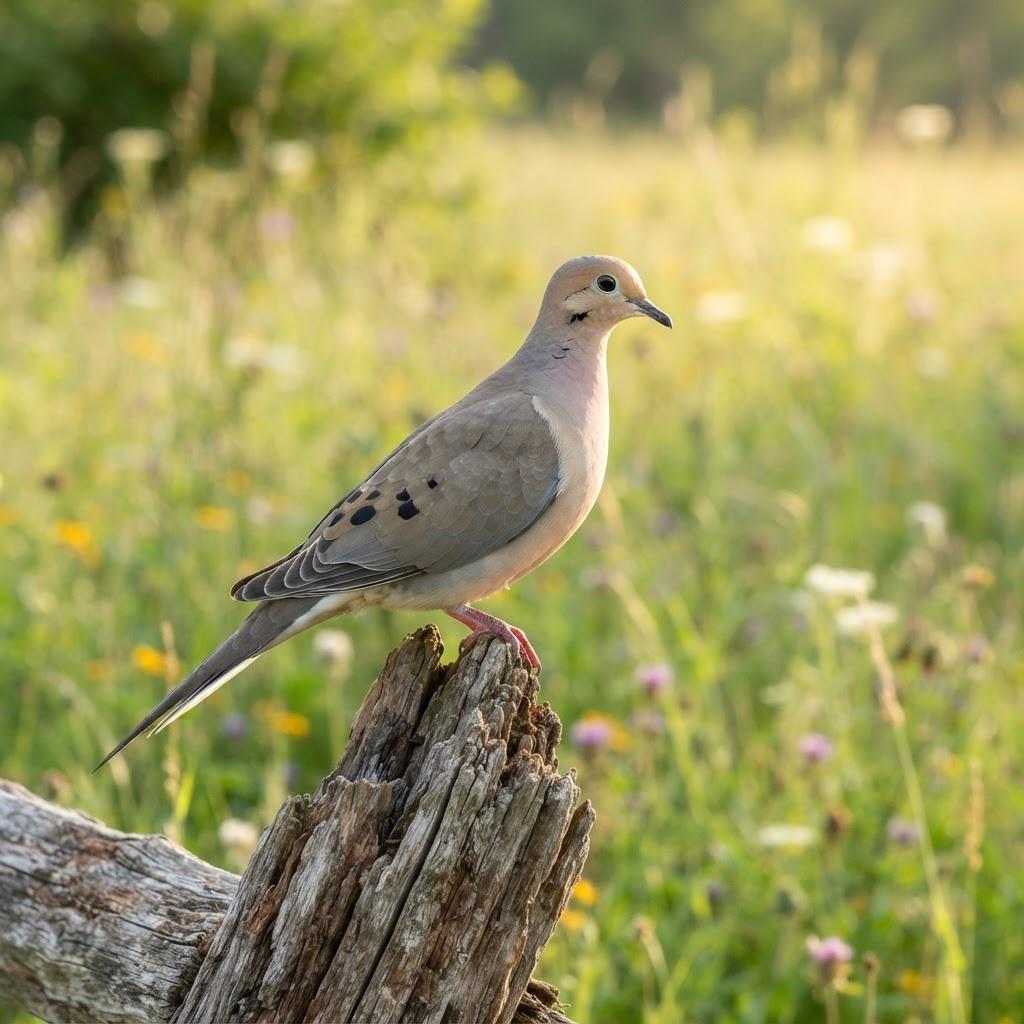
Zenaida macroura
Mourning Dove
Meet the Mourning Dove, the backyard equivalent of a melancholy poet who perpetually forgets where they left their keys. With their soft, ghostly coos and hilariously flimsy nests, these birds are the lovable, slightly confused icons of the American landscape.
Meet the Bird
Imagine a bird that looks like it was designed by a committee that couldn't decide between a sleek, aerodynamic racer and a plump, overstuffed sofa cushion. That is the Mourning Dove. They possess a soft, dusty-tan aesthetic that makes them look like they were airbrushed by a vintage photographer obsessed with sepia tones. Their vibe is perpetually startled, yet oddly Zen. While other birds are darting around like caffeinated toddlers, the Mourning Dove strolls through your yard with the unhurried grace of a person wearing socks on a freshly waxed floor. They are famous for that mournful, low-frequency 'cooo-OOO-oo-oo' sound that people often mistake for an owl, providing the unofficial, gloomy soundtrack to many a suburban afternoon. They are not the brightest bulbs in the avian Christmas tree, but their gentle demeanor and surprising speed make them a mainstay of the neighborhood bird-watching scene. If life were a sitcom, the Mourning Dove would be the character who constantly walks into screen doors but always does it with impeccable style.
Superpowers & Weird Abilities
Forget the high-speed maneuvers of a falcon; the Mourning Dove’s superpower is the ability to become a living, breathing jet engine on command. When they take flight, their wings produce a distinct, high-pitched whistling sound—a sonic alarm clock that alerts every predator within a three-mile radius that a buffet has just taken off. This whistling is caused by the vibration of their specialized primary feathers as air rushes over them. It acts as a startling mechanism, often confusing predators just long enough for the bird to zip away at speeds reaching 55 miles per hour. Furthermore, they possess an incredible anatomical trick known as 'crop milk.' Unlike mammals, they do not produce dairy, but both parents produce a nutrient-rich, cottage-cheese-looking substance in their esophagus. This liquid gold is essentially a high-protein, high-fat baby formula that allows them to raise chicks in environments where traditional insect food might be scarce, making them the ultimate survivalists of the bird world.
Drama, Personality & Feathered Chaos
If you observe a bird feeder for long enough, you will eventually see a Mourning Dove standing in the middle of a pile of spilled sunflower seeds, looking like they have absolutely no idea how they got there or what they are supposed to do next. They are not bullies; in fact, they are the polite, slightly awkward neighbors of the bird kingdom. They often let smaller, feistier birds like finches push them around, shifting their weight with a look of mild disappointment before waddling to the next spot. However, they are not entirely passive. When it comes to their own kind, they engage in rhythmic bobbing and aggressive wing-flapping, essentially engaging in a silent, high-stakes standoff. Their biggest social drama usually involves the persistent, slightly desperate search for a mate. You will often see three or four males trailing a single female, all puffing out their chests and making their best cooing sounds, trying to impress her while she maintains the cool, detached aura of a celebrity avoiding the paparazzi.
Bizarre Rituals & Quirky Habits
The Mourning Dove is a creature of habit, and their habits are delightfully strange. One of the most common sights in spring is the 'sunbathing session.' A dove will find a nice patch of dirt, lie down on its side, spread one wing fully across the ground, and fan out its tail. They look completely dead—a sight that has caused many a well-meaning homeowner to rush outside, only to have the bird snap awake and fly off in a burst of ruffled feathers and confusion. They do this to expose their skin to the sun, likely as a way to control parasites or simply to absorb heat. Another bizarre habit is their tendency to drink by sucking water up like a straw, rather than tipping their head back like most birds. This allows them to stay in the water for mere seconds, minimizing the time they spend vulnerable to predators. They are the fast-food drinkers of the avian world, gulping down moisture in a single, efficient, and slightly ridiculous-looking burst.
Legends, Folklore & Human Stories
For centuries, the Mourning Dove has held a special place in the human imagination, largely due to that haunting, melancholic call. In many North American Indigenous traditions, the dove is seen as a symbol of peace, love, or even a messenger between the living and the spirit world. The name itself reflects the human tendency to project our own emotions onto nature; we hear that long, descending coo and assume the bird is sad, leading to the nickname 'mourning' dove. In various folk tales, they are depicted as faithful partners who would die of grief if they lost their mate. While they aren't actually prone to tragic romantic demises, they do form strong pair bonds, which has cemented their image as icons of devotion in poetry and song. They appear in art and literature as emblems of gentleness, standing in stark contrast to the aggressive raptors or the noisy, boisterous crows that often share their territory.
Mating: The Ridiculous World of Avian Dating
Courtship for a male Mourning Dove is a full-time job that requires the athleticism of a gymnast and the passion of a soap opera star. It begins with the 'bowing display,' where the male puffs out his chest, bobs his head, and spreads his wings to show off his iridescent neck feathers. If the female shows interest, the male launches into a flight display, ascending steeply and then circling back down in a wide, elegant arc with his wings set in a V-shape. He lands, struts toward her, and repeats the routine, all while making little cooing noises that seem to say, 'Look at me, I am the most aerodynamic bachelor in this parking lot.' If the female remains unimpressed, she simply takes off, leaving him to watch her fly away with an expression that can only be described as profound confusion. If she says yes, they engage in a ritual of preening each other's heads, cementing their bond before they set out to build their notoriously terrible home.
Nesting: Master Architects and Lazy Slumlords
If you were to rank birds by their construction abilities, the Mourning Dove would likely finish in last place, right behind the bird that just throws twigs into a bush and hopes for the best. Their nests are, to put it mildly, pathetic. They usually consist of a handful of thin, brittle sticks precariously balanced on a branch, or sometimes just an old robin’s nest that they have decided to move into because they cannot be bothered to start from scratch. Sometimes, they forgo trees entirely and build their nests on flat surfaces like the tops of porch lights, windowsills, or even on the ground. Because the structure is so loose and transparent, the eggs are often visible from below, and it is a minor miracle that the babies don't fall through the gaps. Despite this structural incompetence, they are prolific breeders, often raising up to six broods in a single season, because their 'good enough' strategy allows them to start the next family as quickly as possible.
Raising Babies: The Screaming Food Disposals
Once those eggs hatch, the parents enter the high-stress, high-reward phase of their lives. The chicks, known as squabs, start off looking like bizarre, yellow-fuzzed aliens with oversized beaks. They are basically digestive tubes with wings, demanding a constant flow of that specialized crop milk. As they grow, their appetite becomes truly impressive. The parents work in shifts, with the male often taking the day shift and the female the night shift, returning frequently to pump nutrients into the demanding youngsters. The squabs express their gratitude by flapping their wings violently and emitting a high-pitched, insistent squeak that sounds like a rusty gate hinge. After about two weeks of this relentless feeding schedule, the squabs are ready to leave the nest. They spend their first few days on the ground, looking like fluffy, confused pincushions, as they learn the ropes of being a bird before finally gaining the confidence to take flight.
Bird-Watching Travel & Local Hotspots
If you are on a quest to see a Mourning Dove, you are in luck—you probably don't have to go further than your own front porch. However, if you want to see them in a truly spectacular setting, head to the vast, open grasslands of the Great Plains or the sprawling agricultural fields of the Midwest. Places like the Quivira National Wildlife Refuge in Kansas provide a perfect backdrop, where you can watch dozens of them gathering at water sources during the late afternoon. If you prefer the coast, the barrier islands of the Atlantic shore are also prime real estate for these adaptable travelers. The key is to find open areas where they can easily spot potential predators while foraging for seeds. They are most active during the early morning and late afternoon, so plan your birding trips around these 'golden hours' when they are most likely to be out and about, shuffling along the ground in search of their next meal.
Food, Feeder Hacks & DIY Projects
Mourning Doves are the ground-crew of the bird world. They love seeds, and they are not particularly picky. To turn your yard into a Dove haven, avoid the high-up hanging feeders that require delicate perching; instead, look into platform feeders or simply scatter seed on a clean patch of dirt. They go absolutely wild for white proso millet, cracked corn, and black oil sunflower seeds. Avoid the cheap, dusty 'mixed seed' bags filled with red milo, which most birds—including doves—will simply kick to the side. For a fun DIY project, create a 'ground table' by attaching a piece of hardware cloth to a wooden frame, allowing rain to pass through while keeping the food dry. If you want to go the extra mile, plant native sunflowers or coneflowers; not only are they beautiful, but they provide a natural buffet once the flower heads go to seed. Doves will thank you by lingering in your garden, turning your lawn into their personal breakfast nook.
Seasonal Guides & "Crisis" Management
As the seasons turn, the Mourning Dove’s behavior shifts predictably. In the winter, their main goal is warmth and hydration. If you live in a cold climate, a heated birdbath is a game-changer; it keeps water from turning into a skating rink and provides a much-needed drink on freezing days. Spring brings the 'fledgling panic' season. If you find a fluffy, short-tailed bird on the ground in May, do not jump into hero mode immediately! It is likely a fledgling—a bird that has left the nest but is still learning to fly. Unless it is obviously injured or being stalked by a cat, leave it alone. The parents are almost certainly nearby, watching from a tree and bringing it snacks. If you are worried, keep your dog inside for a few days. The best thing you can do for a bird in this state is to provide a 'safe zone' and stay back, allowing the family to reunite and get the youngster back into the sky.
Backyard Tech & Gadget Reviews
Technology can bring you closer to the Mourning Dove than ever before. Smart feeders are a blast, especially if you set them up on a low post near the ground; they will catch the doves in high-definition as they waddle in to feed. When choosing a camera, look for one with 'motion-blur reduction,' as the doves' sudden movements can turn a photo of a beautiful bird into a blurry brown smudge. If you are worried about window collisions—a common hazard for birds that sometimes get spooked—consider applying subtle UV-reflective decals or patterns to your glass. These are invisible to humans but look like a solid wall to birds. For those who want to see the evening shift, a cheap motion-sensor trail camera placed near a water feature will often capture the secret, nocturnal activity of your local doves, revealing a side of their life that is usually hidden behind the mask of daylight.
How to Spot One & How It Is Doing
To identify a Mourning Dove, look for that slender, pointed tail and the soft, grayish-tan plumage with those iconic black spots on the wings. Listen for the 'whistle' of their wings when they take off, a sound that is as distinct as a fingerprint. They are remarkably resilient and have adapted beautifully to human expansion, which is why their populations remain stable and widespread. They are truly one of the great success stories of urban wildlife. You can help them continue to thrive by providing consistent access to clean water, keeping your outdoor cats inside during the nesting season, and resisting the urge to 'clean up' every single stick or seed head in your garden. By leaving a little bit of 'mess' for them to work with, you are providing a home for one of the most charming, reliable, and character-filled birds you could ever hope to host in your backyard. They ask for so little, yet they offer so much joy.