Icterus spurius
Orchard Oriole
The Orchard Oriole is the pint-sized, chestnut-colored rockstar of the orchard world that somehow packs enough personality into its tiny frame to put its larger cousins to shame. This high-energy acrobat brings a sweet, bubbly soundtrack to your backyard while mastering the art of being both incredibly elusive and surprisingly charming.
Meet the Bird
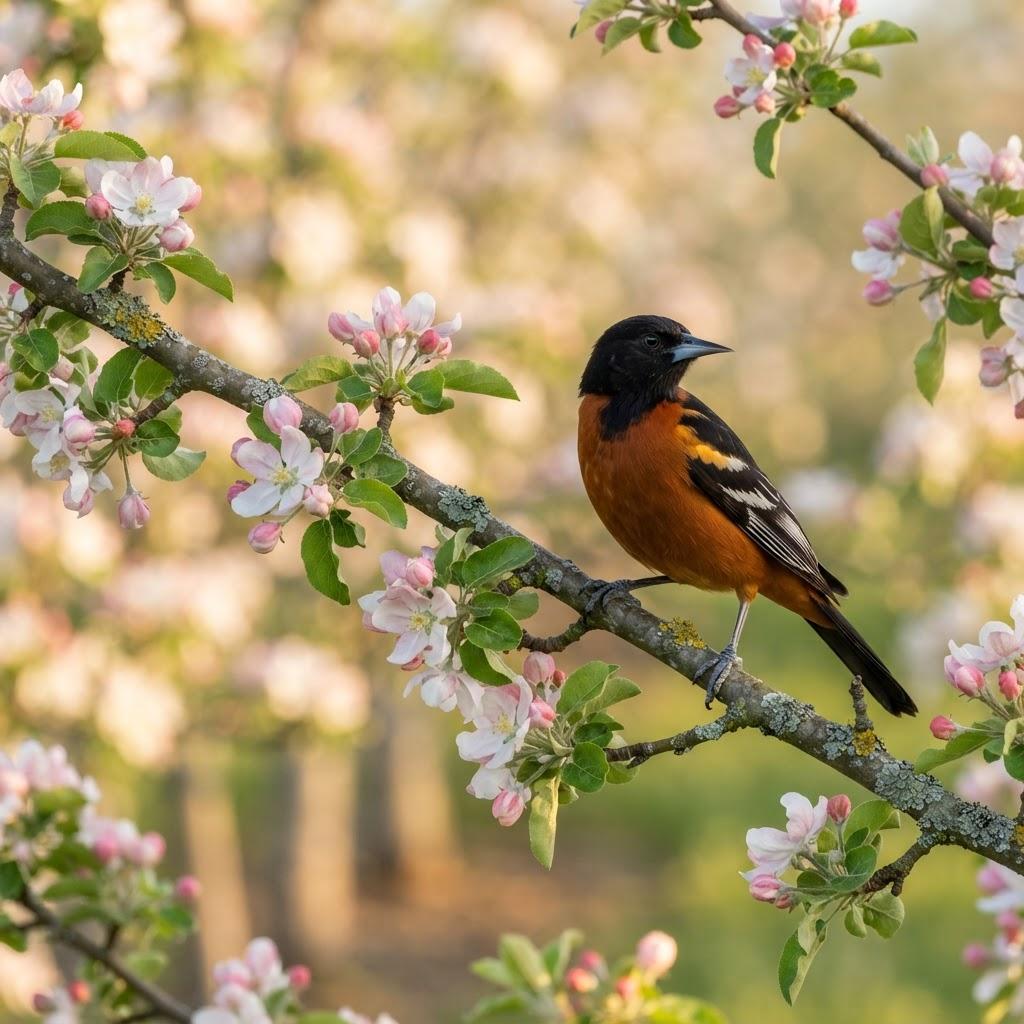
If the Orchard Oriole were a character in a high school comedy, it would undoubtedly be the quiet, intensely focused genius who hides in the back of the library but manages to win every debate team competition without ever breaking a sweat. Unlike their flashy, neon-orange Baltimore Oriole cousins who act like they are auditioning for a Las Vegas variety show, Orchard Orioles are the masters of the 'quiet luxury' aesthetic. Dressed in deep, rich chestnut and black, the males look like they are wearing a tailored velvet suit to a casual picnic. They are small, sleek, and incredibly fast, darting through tree canopies with the precision of a fighter pilot on a coffee binge. Their vibe is one of sophisticated mystery—you know they are there because you can hear their bubbly, complex songs rattling through the leaves, but spotting them is like trying to find a specific sock in a very large, very leafy dryer. They do not demand your attention with bright colors; they earn it with their sharp wit and incredible athleticism.
Superpowers & Weird Abilities
The Orchard Oriole possesses a biological superpower that puts standard avian abilities to shame: the sheer engineering mastery of their digestive system. While most birds are perfectly content picking at a pile of seeds, these birds are essentially high-octane nectar-processing machines. They have a tongue that is specially adapted with brush-like fringes at the tip—think of it like a natural, microscopic sponge that acts as a capillary tube. When they dip their beaks into a flower or a feeder, that tongue springs into action, soaking up nectar with rapid-fire suction that would put a Dyson vacuum to shame. Beyond the tongue, their internal metabolism is like a turbocharged engine; they convert sugars into flight energy so efficiently that they can perform mid-air maneuvers that look like something out of a physics-defying animation. They are also masters of ultraviolet navigation, seeing light spectrums that are completely invisible to humans, which allows them to track down nectar-rich blooms that look like glowing neon signs in the middle of a mundane, green forest.
Drama, Personality & Feathered Chaos
In the world of the backyard, the Orchard Oriole is the equivalent of that one coworker who is exceptionally talented but avoids office politics at all costs. While hummingbirds are throwing tantrums at the feeder and Blue Jays are screeching like banshees, the Orchard Oriole swoops in, grabs a quick sip of nectar, and leaves before the drama even starts. However, do not mistake their quiet nature for weakness. If another bird tries to encroach on their specific patch of the orchard, the male turns into a feathered buzzsaw. They are surprisingly territorial for their size and will dive-bomb intruders with the intensity of a squadron of angry fighter jets. They don't engage in long, drawn-out brawls; they prefer a 'hit and run' tactic, swooping in to deliver a sharp peck before vanishing back into the shadows. They are the silent assassins of the bird feeder world, maintaining a cool, detached persona that belies their absolute dedication to defending their leafy kingdom from any winged interloper.
Bizarre Rituals & Quirky Habits
Orchard Orioles have a penchant for the strange, particularly when it comes to their dietary choices. While they are primarily insectivores and nectar-drinkers, they have been observed participating in 'fruit-napping,' which is exactly what it sounds like. They will aggressively defend a particularly ripe mulberry tree, chasing off any bird larger than themselves just to have sole access to the fermenting bounty. On hot summer days, they engage in a behavior that looks like a nervous breakdown but is actually a sophisticated cooling mechanism. They will sprawl out on a branch, fluffing their feathers and drooping their wings in a way that suggests they have completely given up on life. This is actually 'sun-bathing' combined with thermal regulation—by maximizing surface area and letting the breeze hit their skin, they manage to keep their body temperature stable in the sweltering heat. It looks incredibly dramatic and lazy, but it is just another day in the life of a bird that knows exactly how to pace itself.
Legends, Folklore & Human Stories
For centuries, the small, chestnut-colored orioles of the Americas have been viewed by indigenous cultures as symbols of hidden wealth and seasonal change. In some folk traditions, because they arrive just as the fruit trees begin to bud and disappear exactly when the harvest is in full swing, they were treated as the 'gatekeepers of the garden.' There are old stories of farmers who would leave out bowls of sugared water or overripe fruit in hopes that the birds would stick around and perform a kind of magical protection over the crops. While the birds weren't necessarily casting spells, they were definitely acting as top-tier pest control, devouring the caterpillars and beetles that would have otherwise ruined the harvest. To see an Orchard Oriole in your yard was traditionally seen as a sign of a prosperous growing season—a little bit of good luck delivered on a pair of fast-moving, chestnut-colored wings that seemed to bring the vitality of spring right to your doorstep.
Mating: The Ridiculous World of Avian Dating
Courtship for an Orchard Oriole is a high-stakes performance art piece that requires more dedication than a Broadway lead. The male starts his campaign by singing a frantic, bubbly, and incredibly complex song that sounds like a bubbling brook if the brook were auditioning for a jazz band. He does not just stand on a branch and croon; he performs a synchronized aerial dance that involves fluttering, swooping, and showing off his chestnut plumage in the best possible light. The female is the ultimate critic. She watches from a distance with an expression of intense judgment. If his song is a little off-key or his flight display lacks that specific, sharp snap of energy she is looking for, she will simply fly away, forcing the male to reset and try his luck on a different branch. It is a harsh world where a single stutter in a trill can lead to a bachelor season, but when it works, the pair bonds with a level of focus that is frankly enviable.
Nesting: Master Architects and Lazy Slumlords
When it comes to home building, the Orchard Oriole is a literal genius. Their nests are essentially the high-end condos of the bird world—tightly woven, pendant-style baskets that look like tiny, hanging sacs made of green grass and fine plant fibers. They prefer to build these in the outer branches of trees, hanging them in a way that makes them nearly impossible for predators like snakes or jays to reach. They take their architectural duties very seriously, weaving the nest until it is flexible enough to sway in the wind without the eggs rolling out. Contrast this with the mourning dove, which basically dumps three sticks on a flat surface and calls it a day, and you can see why the Orchard Oriole deserves an engineering degree. They are meticulous, choosing the perfect shade of green fibers to ensure their nest blends in perfectly with the surrounding foliage, making their home an invisible masterpiece of bird-based construction.
Raising Babies: The Screaming Food Disposals
Once the eggs hatch, the peace and quiet of the orchard are officially over. The chicks are, for the first few weeks, nothing more than tiny, ravenous vacuums that are permanently set to the 'screaming' mode. The parents transition from elegant acrobats into exhausted, caffeine-deprived commuters, flying back and forth from the nest to the best insect hunting grounds dozens of times per hour. A single baby oriole can consume an astronomical amount of caterpillars, aphids, and spiders, effectively cleaning an entire section of a tree in just a few days. The parents show zero sign of rest, often feeding the young even as they begin to flutter at the edge of the nest. It is a frantic, high-pressure operation where the primary goal is to turn insects into feathers as quickly as possible. The chicks, for their part, show absolutely zero gratitude, just flapping their wings and demanding more bugs until the very second they are kicked out of the nest.
Bird-Watching Travel & Local Hotspots
If you are dying to catch a glimpse of these chestnut-clad speed demons, you need to head to places where the trees meet the water. River corridors and edge habitats are the absolute best places to start your search. During the spring migration, hotspots like the Point Pelee National Park in Ontario or the various nature preserves along the Gulf Coast of the United States are legendary for their high concentrations of orioles. If you find yourself in the Great Plains, look for cottonwood groves along creek beds. The key is to arrive early—these birds are early risers and do most of their foraging during the first three hours of daylight. Bring a good pair of binoculars, but more importantly, bring a healthy dose of patience. Listen for that distinctive, rapid, bubbly warble; it is often the only way to track them down before they dive into the thick of the canopy.
Food, Feeder Hacks & DIY Projects
Attracting Orchard Orioles to your backyard requires a shift in strategy. They are not interested in your standard, dusty bag of mixed millet; that is basically bird-flavored sand. Instead, they want the 'good stuff.' If you want to see them on your deck, you need to provide a high-quality oriole feeder filled with grape jelly or sliced, fresh oranges. A simple DIY hack involves taking a wooden board, mounting a small, shallow plastic ramekin for the jelly, and inserting a couple of galvanized nails that can be used to spear orange halves. This is the ultimate, low-cost buffet. Avoid the cheap, store-bought nectar mixes that are dyed bright red—birds don't need the food coloring, and it’s actually better to make your own with a simple 1:4 ratio of sugar to water. Planting native fruit-bearing shrubs like serviceberry or wild cherry will turn your yard into a literal five-star resort that will keep them coming back year after year.
Seasonal Guides & "Crisis" Management
Spring is the 'Big Arrival' time, and if you want to be a top-tier host, you need your feeders cleaned and filled with fresh jelly by the second week of April. As summer peaks and the babies fledge, you might encounter the 'fledgling panic.' This is when a fluffy, slightly uncoordinated bird is found hopping around on your grass. Do not touch it! It is not abandoned; the parents are watching from the trees, likely screaming at you to back off. Just keep your pets inside for a few days and let nature do its thing. Winter management for these birds is essentially a non-issue, as they are long-distance travelers that head south to the tropics to avoid the snow. While they are gone, keep your feeders maintained for the year-round residents, but prepare to be overwhelmed with excitement when the first chestnut flash of an oriole returns to the neighborhood in early spring.
Backyard Tech & Gadget Reviews
If you want to get high-definition photos of an Orchard Oriole without sitting in a bush for six hours, the current crop of AI-powered smart feeders is a game changer. Devices like the Bird Buddy are perfect for these birds because they use high-resolution cameras to trigger photos based on motion. Because orioles are fast and jittery, a camera that captures video is superior to one that just takes still shots. For protecting your windows, skip the cheap stickers that look like plastic owls; they don't work. Instead, use 'window film' or external insect screens to break up the reflection. If you really want to level up, a cheap motion-sensor trail camera mounted near a birdbath will show you a side of these birds that you would never see with your naked eye—the way they socialize, bathe, and compete for space when they think no one is watching.
How to Spot One & How It Is Doing
Spotting an Orchard Oriole comes down to looking for the 'chestnut chevron.' Males are unmistakable with their deep, reddish-brown bodies and black heads and throats. Females and first-year males are a bright, lime-yellow that can look like a warbler, but their slightly longer, more pointed beaks give them away. They are a common sight across most of their range, and their conservation status remains 'Least Concern,' which is the best possible news for a bird enthusiast. They are doing well precisely because they are adaptable to suburban life as long as there are enough native trees and fewer chemicals. You can help them thrive by planting native fruit trees, keeping your cats indoors during the nesting season, and skipping the pesticides that kill their primary food source: the insects. Every backyard is a potential piece of habitat; with a little bit of care, you can ensure that the bubbly, complex song of the Orchard Oriole remains the soundtrack of your summer.