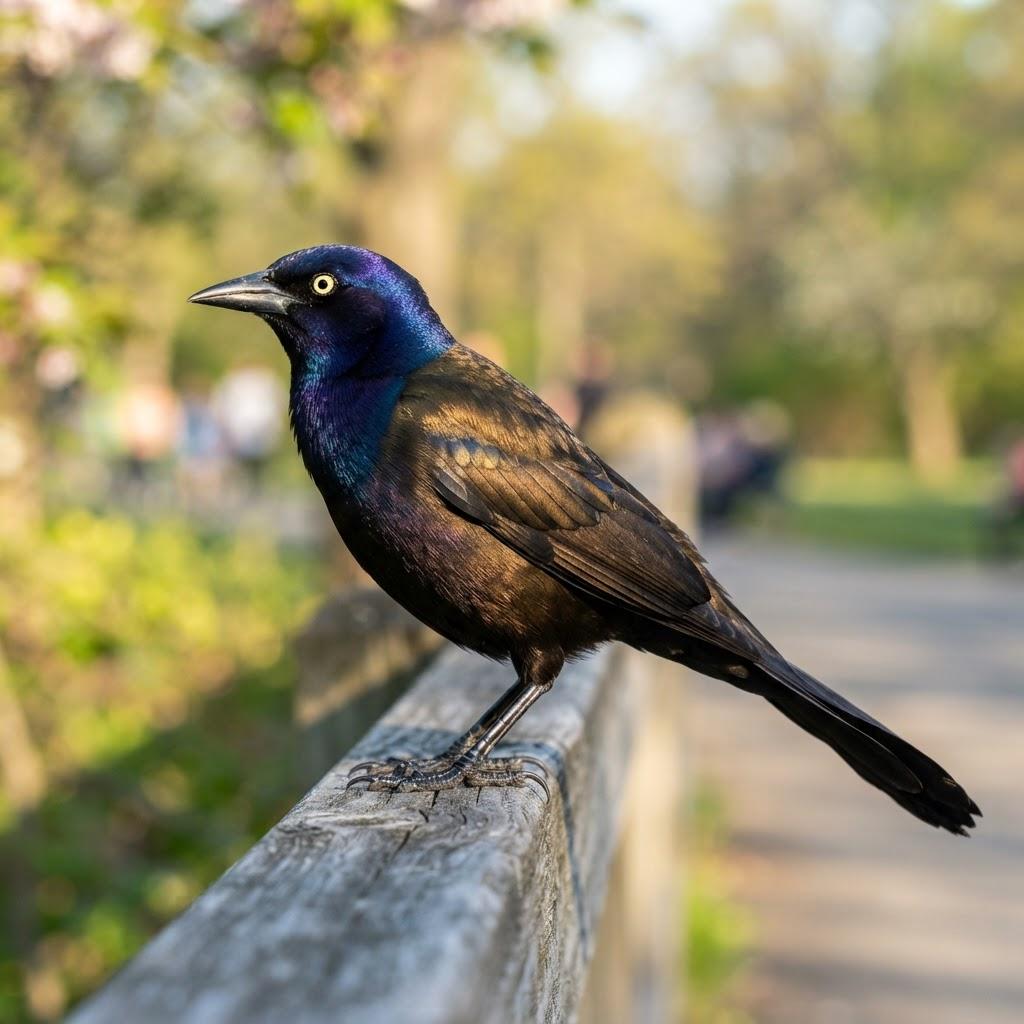
Quiscalus quiscula
Common Grackle
Meet the Common Grackle, the backyard's most misunderstood brawler with a flair for the dramatic. Part iridescent fashion icon and part neighborhood tough guy, this bird is the ultimate party guest that refuses to leave.
Meet the Bird
Picture a bird that stepped out of a tuxedo shop but has the attitude of a bouncer at a dive bar. That is the Common Grackle. While other birds are busy being cute and musical, the grackle arrives in an iridescent suit of oil-slick colors, shimmering with blues, purples, and bronzes that would make a drag queen jealous. They are sleek, sharp-eyed, and slightly terrifying, with golden eyes that seem to be constantly judging your choice of lawn ornaments. These birds are the rockstars of the avian world; they don't just show up to the feeder, they arrive in a boisterous gang, ready to take over the snack bar and rewrite the rules of the yard. If you have ever seen a bird strut across your driveway like it owns the mortgage, you have been visited by the charismatic, often chaotic, Common Grackle. They are not merely birds; they are the neighborhood characters everyone talks about.
Superpowers & Weird Abilities
The Common Grackle possesses a biological secret weapon that sounds like something out of a superhero flick: the ability to process food with a built-in kitchen tool. Their bills are adapted for a variety of tasks, but their real superpower lies in their keel-shaped ridge on the roof of the mouth, known as a culmen. This isn't just for show; they use this structure to saw open tough items like acorns or even to crack through the shells of crayfish. It is essentially a serrated blade built into their skull. Furthermore, they are masters of 'anting,' where they stand over anthills and purposefully let ants crawl all over them. The ants, feeling threatened, spray formic acid onto the bird’s feathers. This sounds miserable, but the grackle is playing 4D chess. The acid acts as a natural pesticide and mite-killer, essentially giving the bird a DIY deep-cleaning session that keeps their plumage in tip-top shape.
Drama, Personality & Feathered Chaos
If there is a hierarchy in your backyard, the grackle sits firmly at the top, usually by sheer force of personality. They are the ultimate social butterflies with a heavy dose of 'main character energy.' At the feeder, they are not subtle. They swoop in with wings flapping, scattering finches and sparrows like bowling pins to get to the good stuff. Grackles are highly intelligent and notoriously grump-prone, often holding petty grudges against anything they perceive as a threat. They are the 'mean girls' of the bird kingdom, prone to elaborate squabbles over a single sunflower seed, even when the rest of the feeder is completely full. Their social circles are vast and noisy, characterized by a constant stream of vocalizations that sound like a rusty gate hinge trying to sing a power ballad. They thrive on drama, making them the most entertaining, if occasionally frustrating, guests a gardener could ask for.
Bizarre Rituals & Quirky Habits
Beyond the aggressive feeder-takeovers, grackles possess a repertoire of behaviors that are downright weird. Consider their 'keel-displaying' dance: a male will puff up his feathers until he looks like a vibrating, iridescent marshmallow, then spread his tail into a V-shape, all while emitting sounds that mimic a wet sneeze or a creaking door. It is a spectacle of avian awkwardness that somehow works. Then there is their obsession with soaking bread or dry food in water before eating it. They will take a perfectly good piece of kibble, fly it to a birdbath, dunk it repeatedly until it is a soggy, unappealing mess, and then feast. Whether this is for easier digestion or just a personal preference for mushy textures remains a mystery to researchers, but it is certainly one of the most puzzling and consistent habits they exhibit in the backyard.
Legends, Folklore & Human Stories
Throughout history, the grackle has been viewed with a mix of awe and suspicion. Due to their striking appearance and habit of congregating in massive, noisy flocks, they have occasionally been linked to omens in local folklore. In some regions, their dark, reflective plumage was seen as a sign of transition, while in others, their intelligence led to stories of them acting as messengers or clever tricksters. Farmers, in particular, have a complicated history with the grackle; while they help control pest populations by eating grubs and beetles, their love for corn crops has led to centuries of tense standoffs. They appear in literature as symbols of the untamable spirit of the wilderness, standing in stark contrast to the polite, soft-singing birds of the meadows. Humans have long recognized that the grackle is not a bird you can easily ignore; they demand attention and respect.
Mating: The Ridiculous World of Avian Dating
When it comes to courtship, the male grackle basically turns his entire body into a musical instrument and a gymnastics prop. To win a lady's favor, he will puff up his feathers to maximize his shimmer and then perform a series of strange, contorted poses. He fans his tail into a sharp V-shape, arches his neck, and leans forward while releasing a series of raspy, metallic clicks and whistles. It is essentially the bird equivalent of a heavy metal solo performed in a glittery jumpsuit. The female, meanwhile, plays the role of the ultimate critic. She will watch, unimpressed, as he goes through his routine. If he messes up a note or his feathers aren't reflecting the light just right, she will simply fly away, leaving him to look foolish in front of the rest of the flock. It is a high-stakes, high-cringe theater that happens on suburban fences every single spring.
Nesting: Master Architects and Lazy Slumlords
Grackles are not known for building the most elegant homes, but they are incredibly practical, which is a nice way of saying they are utilitarian. They often build their nests in the crotches of trees or tucked into dense shrubs, using a chaotic mix of twigs, mud, and whatever plastic or string they can scavenge from human trash. They are not shy about their living arrangements; they often nest in loose colonies, which basically means they have turned your neighborhood tree into a high-density, very loud apartment complex. Their construction technique favors speed and durability over aesthetics. If a branch is handy, they will shove some grass around it, slap some mud on top, and call it a day. It might not win any awards for interior design, but it keeps their chicks safe from the elements and high above the reach of ground predators, which is all that really matters.
Raising Babies: The Screaming Food Disposals
Once the eggs hatch, the grackle nest transforms into a high-volume, twenty-four-hour fast-food restaurant with terrible customer service. The chicks are born as little more than hungry, featherless, wobbling heads that seem to exist solely to scream for more insects. Parents are constantly in flight, dashing back and forth with beaks stuffed with caterpillars, spiders, and the occasional stolen snack. The babies are remarkably demanding; they will stretch their scrawny necks and flap their tiny, useless wings, creating a cacophony that alerts every predator in the woods to their location. It is a frantic, exhausting period for the parents, who must keep the nest clean and the bellies full. Watching a grackle parent return to the nest with a mouthful of food while being assaulted by three or four demanding, screeching toddlers is a lesson in patience and endurance that every human parent can sympathize with.
Bird-Watching Travel & Local Hotspots
If you are on a mission to witness the grandeur of the grackle, you don't need a plane ticket to the Amazon. They are practically everywhere. To see them in their element, head to large municipal parks or wildlife refuges with a mix of open lawns and water features, such as the Central Park in New York or the Chicago lakefront parks. During the spring migration, they form massive, sweeping flocks that look like black clouds against the sky. Visit places like the Chesapeake Bay area or any large agricultural field in the Midwest during late summer. These areas are magnets for grackles as they gather in pre-migration groups. Keep an eye on tall, dense conifer trees or thick hedgerows near water. They are creatures of habit and are often found in the same spots year after year, making them remarkably easy to locate for even the most casual observer.
Food, Feeder Hacks & DIY Projects
Grackles have a healthy appetite and will eat almost anything. To attract them, skip the cheap, dusty millet that just sits at the bottom of the feeder and goes to waste. Instead, go for high-quality black oil sunflower seeds, which are the gold standard for backyard birds. If you want to get fancy, offer suet blocks in a wire cage; they find the high fat content irresistible. For a fun DIY project, take a pinecone, slather it in peanut butter mixed with oats, and roll it in birdseed. Hang it from a sturdy branch. The grackles will love it, though you might find them hogging it entirely. To turn your yard into a paradise, plant native shrubs like serviceberry or dogwood. These provide the natural fruits and nesting cover they crave. By offering natural options, you ensure your yard remains a destination spot without having to fill the feeders every single hour.
Seasonal Guides & "Crisis" Management
Grackles are seasonal commuters. In spring, your yard becomes a high-activity zone as they prepare for the nesting season. Keep your feeders clean to prevent the spread of disease as the flock density increases. Winter is the time for high-energy foods; make sure your birdbaths are not frozen over by using a small, solar-powered heater, as birds need to hydrate even in the cold. If you encounter a 'fledgling panic' in late spring, keep calm. If you see a feathered bird on the ground hopping around, it is likely a teenager learning to fly. Leave it alone! The parents are almost certainly nearby, watching from the shadows. Unless the bird is visibly injured or in immediate danger from a cat, the best thing to do is walk away and let the young bird finish its flight school training under the watchful eye of its parents.
Backyard Tech & Gadget Reviews
Modern technology has changed the birding game entirely. Smart feeders that use AI to identify visitors are fantastic for those who want to know exactly which grackle is bullying the others, providing a front-row seat to their personality quirks. If you are dealing with window collisions, try applying decorative, UV-reflective window clings. They are invisible to the human eye from the inside but look like a solid warning to birds, helping them avoid your glass entirely. For a low-tech but high-reward option, consider setting up a motion-sensor trail camera on your feeder pole. It allows you to catch the late-night antics or early morning arrivals that you might otherwise miss. It is an affordable way to gain a deeper understanding of the secret lives of the birds in your yard, and you might just get some hilarious photos of grackles doing their best 'tough guy' poses.
How to Spot One & How It Is Doing
Spotting a Common Grackle is simple: look for the bird that walks with a strut and has eyes like polished gold. If the light hits their feathers, they will look like a shimmering rainbow; if it doesn't, they will look like a sharp, dark silhouette. Listen for their signature song, which sounds like a door hinge struggling to open—a series of raspy, metallic screeches and clucks that are unmistakable. They are currently thriving, as they have adapted incredibly well to human-modified landscapes. Their conservation status is 'Least Concern,' meaning they are doing quite well, thank you very much. You can help them stay that way by keeping your local environment clean and supporting native plant initiatives in your community. They may be the 'loud neighbor' of the bird world, but they are a vital, vibrant, and fascinating part of our shared landscape.