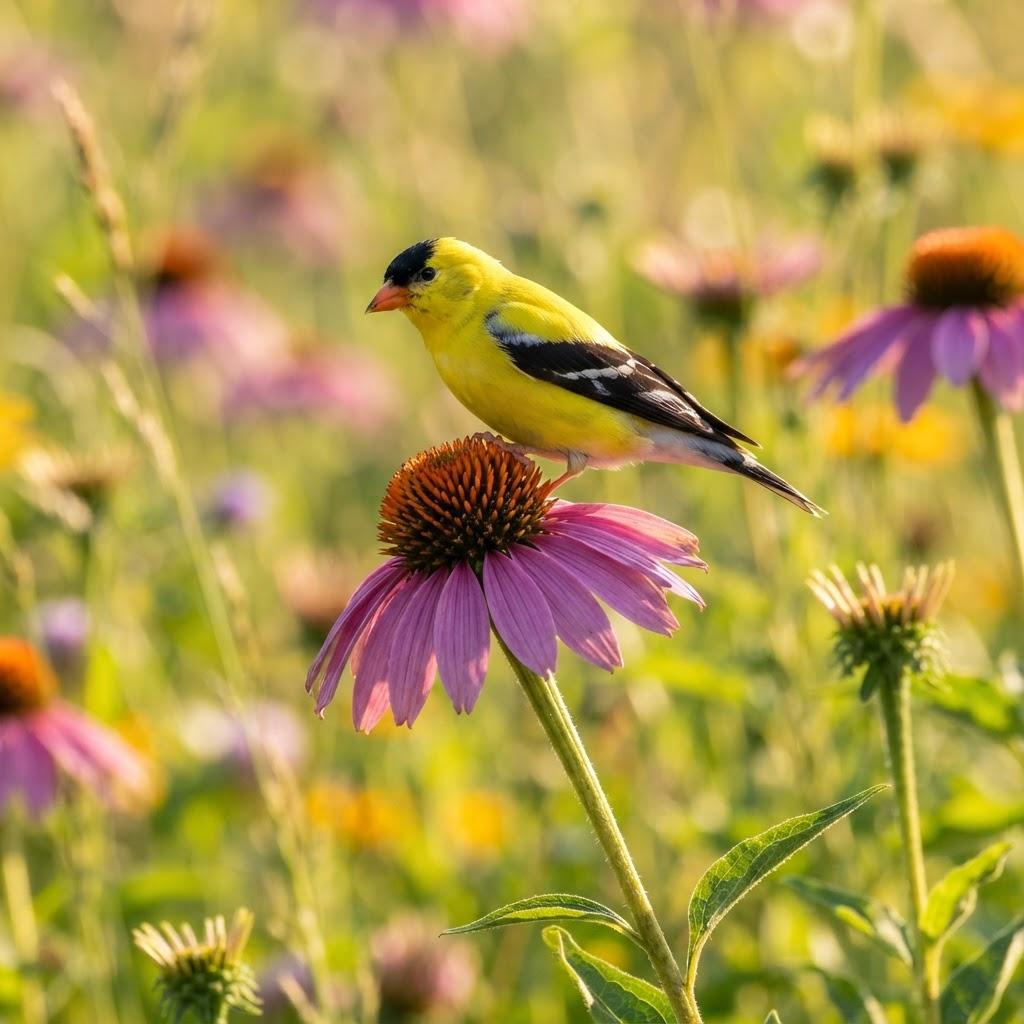
Spinus tristis
American Goldfinch
Meet the American Goldfinch, a vibrant, seed-loving acrobatic gymnast that turns into a dull, mysterious loner once the party season ends. This charismatic little lemon-drop of the bird world is the undisputed king of backyard feeders and a master of botanical timing.
Meet the Bird
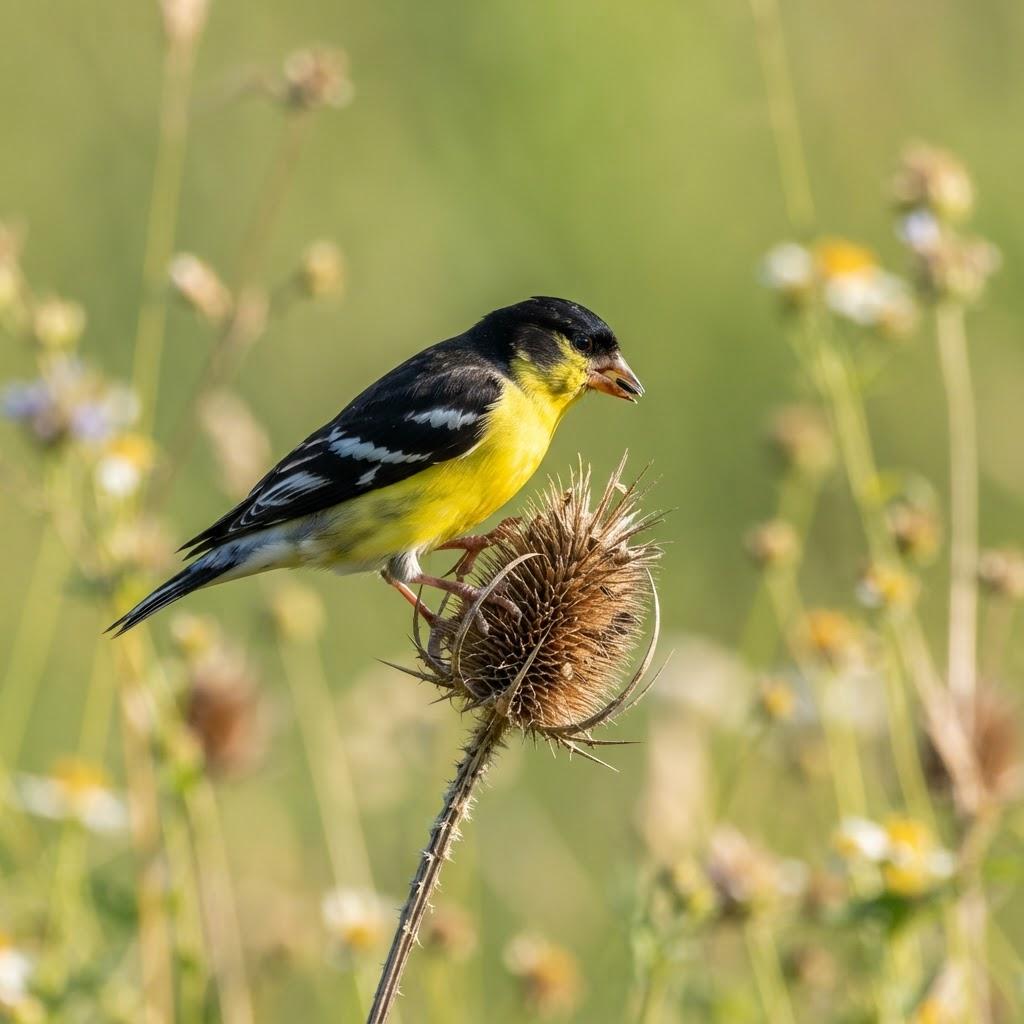
Imagine a tiny, feathered lemon drop dropped from the sky into your backyard. That is the American Goldfinch. In the prime of summer, the male is an impossible, electric yellow creature with a black cap and wings that look like they were dipped in ink. They are the exuberant, upbeat pop stars of the avian world, bouncing through the air in a roller-coaster flight pattern that is essentially their way of shouting, 'Look at me, I am fabulous!' They are not built for elegance; they are built for pure, high-octane joy. They do not walk; they hop. They do not just fly; they undulate like a wave in a stadium. You will know them by their distinct, metallic 'per-chik-o-ree' call, which sounds like they are telling you a secret in Morse code while mid-flight. These birds are the life of the party, provided that party serves high-quality sunflower seeds and is located near a thistle patch.
Superpowers & Weird Abilities
The American Goldfinch possesses a superpower that sounds like a cruel joke played by Mother Nature: it is one of the few birds that undergoes a full, complete molt twice a year. Think of it as a seasonal wardrobe change that would make a fashion influencer weep with envy. During the winter, the males shed their flashy 'look-at-me' yellow feathers and swap them for a drab, mousy olive-brown ensemble, perfectly camouflaged to blend into the barren winter landscape. It is not just a style choice; it is survival. By mimicking the colors of dead leaves and frost-bitten stems, they dodge predators like a master of disguise. Furthermore, their beaks are finely tuned precision instruments. Because they are strictly vegetarians—a rarity in a world of bug-eating birds—their beaks have evolved to be the perfect shape for prying open stubborn seeds. They are the locksmiths of the bird world, possessing a grip and tongue dexterity that allows them to extract nutrition from husks that would baffle a more primitive bird.
Drama, Personality & Feathered Chaos
If you have ever seen two Goldfinches arguing at a bird feeder, you have witnessed the avian equivalent of a tiny, high-pitched sword fight. While they are generally social and hang out in 'charms'—which is the delightfully fancy word for a group of goldfinches—they are fiercely protective of their personal bubble. They are the passive-aggressive neighbors of the bird kingdom. When another bird dares to land on their preferred perch, they don't just leave; they engage in a ritualized standoff. They tilt their heads, open their beaks, and perform a slow-motion dance of dominance. It is entirely posturing. They rarely come to actual blows because, frankly, they are far too busy eating. They are the ultimate foodies. While a crow might hold a grudge against your entire family line for an perceived insult, a Goldfinch just wants to know why you haven't refilled the thistle feeder in three days. They are demanding, opinionated, and utterly delightful in their neurotic hunger.
Bizarre Rituals & Quirky Habits
Goldfinches have a very peculiar habit that makes them the eccentric gardeners of the bird world: they are obsessed with thistle. Their lives are dictated by the schedule of seed-bearing plants. While most birds are frantically looking for insects to feed their young, Goldfinches are waiting for the perfect moment when the thistle goes to seed. They are so picky that they are often the last birds to nest, waiting until mid-summer to ensure there is a buffet of soft, downy thistle seeds available for their offspring. They are essentially the 'farm-to-table' movement incarnate. Another quirky habit is their communal roosting. During the colder months, they gather in groups to share body heat. They become a huddled mass of feathers in the middle of a dense thicket, creating a tiny, feathered heat-bank. It is the avian equivalent of a sleepover, and it is a fascinating bit of community cooperation that helps them survive the bitter chill of a northern winter without losing their minds.
Legends, Folklore & Human Stories
Because of their brilliant summer plumage, the Goldfinch has long been viewed as a harbinger of sunshine and warmth. In various historical traditions, the appearance of a Goldfinch in the garden was interpreted as a sign that the winter gloom was officially over. Unlike birds that were associated with storms or ill omens, the Goldfinch was almost universally considered a 'good news' bird. Some European folklore held that because of their association with seeds and thistles, they possessed a certain spiritual resilience, able to pull goodness from the prickliest of situations. While they lack the massive, sprawling myths of the raven or the eagle, their presence in art and poetry is undeniable. They are the bright spot on a grey canvas, the symbol of summer's peak. They have spent centuries being the bird that brings a smile to the tired gardener, a testament to the idea that sometimes the most 'legendary' bird is simply the one that makes you feel happy on a Tuesday morning.
Mating: The Ridiculous World of Avian Dating
Courtship for the American Goldfinch is essentially an Olympic-level display of showing off, featuring aerial acrobatics that would make a fighter pilot dizzy. The male spends his spring days performing 'flight songs,' which involve flying in a rhythmic, circling pattern while singing his heart out to demonstrate that he is both fit and well-fed. It is a loud, chaotic, and very public spectacle. If the female is impressed by his lung capacity and his ability to fly in perfect, rhythmic loops, she might give him the time of day. However, if his song is a bit off-key or his flight pattern is too erratic, she will simply fly away, leaving him to continue his solo show for an audience of one. Once they bond, they perform synchronized flights that look like a perfectly choreographed ballet. It is a test of coordination, stamina, and commitment, proving that in the Goldfinch world, you only get the girl if you can keep up with her high-speed, sky-bound pace.
Nesting: Master Architects and Lazy Slumlords
When it comes to home construction, the American Goldfinch is the overachieving architect who refuses to cut corners. They don't just throw together a pile of twigs; they build a masterpiece. The nest is a tightly woven cup made of plant fibers, bark strips, and grass, and here is the kicker: they line the inside with plant down—usually from milkweed or thistle—to create a pillow-soft interior for their future chicks. It is so well-constructed that it is often waterproof. They are the artisans of the nesting world, spending up to a week weaving these structures together with their beaks. While other birds are happy with a rickety stick-bundle, the Goldfinch creates a cup so sturdy it could survive a small hurricane. It is a labor of love that highlights just how much they value comfort and safety. When you see a nest made with such precision, you realize that for a Goldfinch, a home isn't just a place to sleep; it is a meticulously engineered fortress.
Raising Babies: The Screaming Food Disposals
Once the chicks hatch, the nest becomes a bustling, high-volume kitchen. Because Goldfinches are vegetarians, they have to be creative. They regurgitate a specialized paste of half-digested seeds to feed their young. It is a far cry from the worm-and-bug diet that most other baby birds receive, but it is exactly what they need to thrive. The parents are tireless, commuting back and forth from the seed supply to the nest all day long. The chicks, meanwhile, are basically vibrating, screeching balls of downy feathers that seem to have only one setting: 'GIVE ME MORE.' They grow incredibly fast on their high-fiber, high-protein seed diet. Watching the parents perform their duties is a lesson in extreme exhaustion; they are the ultimate helicopter parents, constantly tidying the nest and ensuring their babies have the highest quality thistle-paste available. By the time the chicks fledge, the parents look like they haven't slept in a month, and the babies are ready to join the flock as hungry, demanding members of society.
Bird-Watching Travel & Local Hotspots
If you want to catch these little yellow acrobats in their element, you need to head to places that embrace the 'wild' side of landscaping. National wildlife refuges are goldmines for Goldfinches, particularly those with restored prairie lands or abundant meadow habitat. Places like the Neal Smith National Wildlife Refuge in Iowa or any of the various Audubon centers throughout the Midwest are fantastic spots to find them during the height of the summer. Look for areas where wildflowers like coneflowers, sunflowers, and black-eyed Susans are allowed to go to seed—that is where the action is. Mid-to-late summer is the prime window, as the thistle is finally ripening and the birds are actively foraging. Bring a pair of decent binoculars, find a nice spot near a patch of tall, seed-heavy weeds, and just wait. They are not shy, and once you spot the first yellow flash, you will likely see a dozen more follow, as they rarely travel alone.
Food, Feeder Hacks & DIY Projects
If you want to turn your yard into a Goldfinch mecca, forget the cheap, dusty bags of millet—it is basically bird-filler that just attracts pests. Goldfinches are the connoisseurs of the feeder world. Your best bet is 'Nyjer' seed, also known as thistle seed. You will need a specialized mesh sock feeder or a tube feeder with tiny holes, as their beaks are small and delicate. They find the mesh easy to cling to, which lets them feed in their natural, hanging-upside-down position. For a DIY project, take a pinecone, coat it in a mix of peanut butter and high-quality sunflower hearts, and roll it in some nyjer. Hang it from a branch, and watch as your yard turns into a Goldfinch circus. If you really want to make them happy, plant native perennials like purple coneflower or bee balm. These plants provide natural, high-quality nutrition that is better for the birds and easier on your wallet than buying endless bags of store-bought seed every single season.
Seasonal Guides & "Crisis" Management
The Goldfinch year is a tale of two seasons. In spring, they are the harbingers of joy, returning to your feeders with a ravenous hunger after a long winter. This is the time to clean your feeders thoroughly to prevent disease—a quick rinse with diluted vinegar goes a long way. As summer hits, you might notice fewer birds at the feeder; do not panic, they are just out enjoying the natural feast provided by wildflowers. Then comes 'fledgling panic' season. If you find a fluffy little bird on the ground in July, check its feathers. If it has feathers and is hopping around, it is a fledgling—a teenager learning to fly. Leave it alone! The parents are nearby, watching and calling to it. Only if the bird is injured or clearly too young (naked skin, eyes closed) should you intervene by contacting a local wildlife rehabilitator. In winter, keep your birdbath from freezing with a simple heater, and they will stay around your yard even when the temperatures plummet.
Backyard Tech & Gadget Reviews
Technology has changed the bird-watching game forever. Smart feeders are a blast, especially for a bird as active as the Goldfinch. These cameras allow you to capture high-definition, slow-motion footage of them performing their aerial balancing acts at the feeder. It is a fantastic way to appreciate just how much agility they pack into that tiny body. However, as fun as gadgets are, the most important tech is actually 'window film.' Goldfinches are fast, and they can accidentally strike clear glass if they are spooked. Applying simple, aesthetically pleasing UV decals or bird-safe window film to your windows is the single best piece of 'tech' you can buy for your backyard birds. It saves lives without blocking your view. If you are serious about monitoring your visitors, a simple trail camera pointed at your feeder station can also reveal the nocturnal visitors who stop by to scavenge the dropped seeds, giving you a full 24-hour view of your own private nature reserve.
How to Spot One & How It Is Doing
Spotting a Goldfinch is easy if you know what to look for: look for the 'roller-coaster' flight. When they are in the air, they sing 'per-chik-o-ree' with every rise and fall. In the summer, they are unmistakable, glowing like miniature suns against the green foliage. In the winter, look for the 'drab' version—a brownish, streaky bird with dark wings and a clear, notched tail. They are doing quite well, population-wise, mostly because they are incredibly adaptable to the suburban 'disturbed' landscapes that humans create. They love our gardens, our feeders, and our parks. To help them continue to thrive, the best thing you can do is keep your yard 'messy.' Leave the seed heads on your flowers in the fall, stop using harsh pesticides that kill the insects and plants they rely on, and keep those feeders clean. They are a resilient, cheerful species that proves that even in a world that is constantly changing, a little bit of yellow can go a long way in brightening the day.