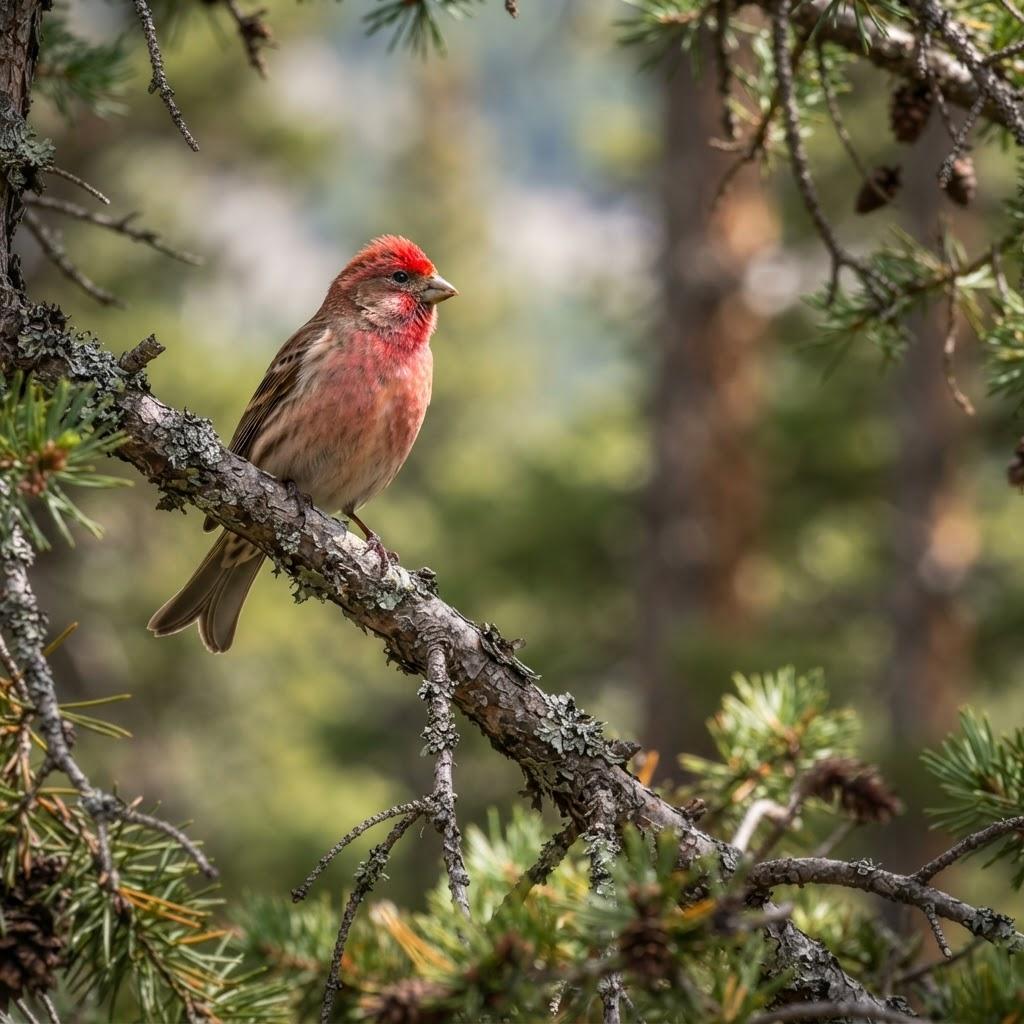
Haemorhous cassinii
Cassin's Finch
Meet the Cassin's Finch, the high-altitude rebel of the finch world who swaps trendy backyard feeders for the rugged peaks of the West. With a look that says 'I just woke up like this' and a song that could charm a mountain goat, this little bird is the ultimate mountain icon.
Meet the Bird
Imagine a bird that treats a blizzard like a light dusting of powdered sugar and considers a 9,000-foot elevation the ideal 'starter home' neighborhood. Enter the Cassin's Finch, the brooding, rock-star cousin to your standard backyard House Finch. If the House Finch is the guy who works a cubicle job and worries about his lawn, the Cassin's Finch is the wilderness trekker who spends his weekends hanging off cliffs in the Sierras. He has a distinct 'I am not here for your nonsense' vibe, characterized by a jaunty, messy-looking crest atop his head that suggests he hasn't combed his hair since the last glacial period. This bird is the embodiment of high-altitude grit. While other birds are busy debating whether to migrate south for the winter, the Cassin's Finch just pulls his metaphorical parka tighter and digs into some pine seeds. He is small, stout, and possesses a color palette that looks like someone dipped a sparrow into a glass of raspberry juice and then decided to leave it in the sun just long enough to fade into a classy, muted crimson. He is not a bird that asks for attention; he is a bird that demands you respect his choice of scenery.
Superpowers & Weird Abilities
The Cassin's Finch possesses a biological superpower that would make a marathon runner weep: the ability to thrive in thin, oxygen-poor mountain air that would leave most creatures gasping for breath. These birds are effectively the high-altitude Olympians of the forest, possessing a specialized respiratory system that allows them to extract oxygen with maximum efficiency while flying through thin alpine air. It is not quite magic, but it is as close as evolution gets. Their beak, which looks like a simple tool for seed-cracking, is actually a precision instrument—a built-in industrial clamp. It is specifically engineered to twist apart the tough, woody scales of pinecones to reach the nutritious, oily seeds buried deep inside. Think of it as having a pair of heavy-duty pliers permanently attached to your face. They can exert a surprising amount of pressure, allowing them to turn a seemingly impenetrable pinecone into a snack buffet in seconds. This specialized anatomy is why you won't find them in your average city park; they have evolved to be the masters of the coniferous canopy, where only the most determined (and well-equipped) can survive the winter.
Drama, Personality & Feathered Chaos
Do not let the cute, berry-colored exterior fool you—the Cassin's Finch is a pint-sized pugilist. In the world of high-altitude birding, they are the undisputed kings of the 'look but don't touch' territory. If another bird approaches a particularly delicious stash of ponderosa pine seeds, the Cassin's Finch does not hold a committee meeting or file a formal complaint. Instead, they unleash a series of high-pitched, aggressive 'chitter' noises that sound like a tiny, angry alarm clock. They are territorial to a fault, guarding their patch of forest with the intensity of a dragon protecting a gold hoard. When they descend into lower elevations during the winter, their personality remains just as prickly. At a bird feeder, they are not the polite guests who wait their turn; they are the guy who pushes to the front of the line at the buffet and looks at everyone else like they are stealing his chips. They have a chaotic, impatient energy that keeps the forest floor—and any backyard lucky enough to host them—constantly buzzing with minor, high-stakes avian squabbles.
Bizarre Rituals & Quirky Habits
One of the most peculiar habits of the Cassin's Finch is their 'song-learning' mimicry. They are the impressionists of the pine forest. While many birds have one or two standard tunes, the Cassin's Finch is known to borrow riffs, trills, and whistles from their neighbors, including the local jays or other finch species. They effectively go to the 'jam session' of the forest, listen to what the cool kids are playing, and then incorporate those sounds into their own complex song. It is a bit like a musician who listens to a new album and decides to start using a new style of chord just because it sounds fancy. Beyond their musical mimicry, they exhibit a strange behavior of 'prospecting'—flying in tight, erratic formations that look like a coordinated dance troupe gone wrong. They do this to scout for food sources over vast areas, effectively communicating with their flock through movement. It is as if they are whispering to each other using synchronized flight patterns, letting everyone know that the best pinecones are definitely located two miles to the west.
Legends, Folklore & Human Stories
In the folklore of the mountain ranges they call home, the Cassin's Finch has often been dubbed the 'Harbinger of the High Country.' Indigenous cultures in the Sierra Nevada and Rocky Mountains viewed these birds as the sentinels of the forest. Because they move to lower elevations when the mountains are about to experience a particularly harsh, heavy-snow winter, they served as a living weather report for human inhabitants. If the Cassin's Finch arrived in your valley earlier than usual, you knew it was time to chop extra wood and stock the larder because the peaks were going to become uninhabitable. They are the 'early warning system' of the avian world. While they do not have a massive mythology surrounding them like the raven or the eagle, they occupy a special place in the human story of mountain survival. To see a Cassin's Finch in the dead of winter is to see a survivor that has earned its keep in one of the most unforgiving environments on the planet, a living testament to the endurance required to live life at high altitudes.
Mating: The Ridiculous World of Avian Dating
Bird dating is essentially an extreme sport, and the Cassin's Finch male approaches it with the flair of an amateur gymnast. When the breeding season rolls around, the male starts his 'butterfly flight' display. This is exactly what it sounds like: he takes to the air with slow, rhythmic wing beats, soaring upward and then gliding down while singing his heart out in a frantic, melodious stream of notes. He looks less like a graceful eagle and more like a bird who has had a bit too much nectar at the local feeder. He is trying to show off his physical prowess, hoping to convince the female that his genes are the best ones in the mountain range. If the female is unimpressed—perhaps she thinks his song is a little off-key or his flight pattern is too wobblly—she simply flies away, leaving him to hang in the air, mid-note, looking rather foolish. He has no choice but to start the entire, exhausting song-and-dance routine all over again for the next lady who happens to fly by.
Nesting: Master Architects and Lazy Slumlords
When it comes to home construction, the Cassin's Finch falls firmly into the category of 'organized minimalism.' They don't go for the overly engineered, mansion-style nests of some other birds, but they definitely do not fall into the 'I just dropped three sticks in a tree' category of the Mourning Dove. The female takes the lead on building, weaving together a sturdy, cup-shaped home made of twigs, pine needles, and strips of bark. She lines the interior with fine grasses and hair, creating a surprisingly cozy nest that is often tucked high up in a coniferous tree, shielded from the wind by thick boughs. It is a humble, functional structure designed to withstand the volatile weather of the mountains. It is not an architectural marvel that will win awards for beauty, but it is perfectly engineered to keep the eggs warm during a sudden spring frost. They essentially build a reliable, insulated mountain cabin, proving that they prioritize substance over style every single time.
Raising Babies: The Screaming Food Disposals
Raising a brood of Cassin's Finches is a logistical operation that would challenge a military general. Once the chicks hatch—usually three to five of these tiny, featherless, wide-mouthed monsters—the parents shift into overdrive. A parent bird is basically a high-speed delivery service that never takes a break. The chicks are essentially living, breathing, screaming food disposals. They demand constant attention, stretching their necks so far they look like they might tip over, all while emitting a high-pitched, incessant begging sound that makes it impossible to think about anything else. The parents, meanwhile, look increasingly disheveled as the weeks go by, their feathers slightly rumpled and their energy levels rapidly depleting. They spend every waking minute foraging for seeds and insects to shove into the gaping maws of their offspring. It is a period of pure parental chaos, where the only goal is to pack on as much weight as possible so the youngsters can survive their first solo winter. By the time the chicks fledge, the parents look like they desperately need a long, silent vacation.
Bird-Watching Travel & Local Hotspots
If you are dying to see a Cassin's Finch in his element, skip the city parks and set your GPS for the high-country pines. The best way to find these birds is to visit places like Yosemite National Park in California or the higher elevations of the Rocky Mountain National Park in Colorado. During the summer, head to the coniferous forests above 5,000 feet. Look for trees that are heavily laden with pinecones; that is the Cassin's Finch's version of a Michelin-starred restaurant. The best time to go is during the early morning hours, when the air is crisp and the forest is quiet enough to hear their distinct, melodic, and occasionally frantic song. If you are in the Pacific Northwest, look for them in the Cascades, especially near burned forest areas where new, younger growth is starting to fill in. These are not 'easy' birds to spot like a robin, but the reward is seeing one of the most beautiful and hardy residents of the mountain wilderness.
Food, Feeder Hacks & DIY Projects
If you live in the mountain west, you can lure these beauties to your yard by being smart about your menu. Skip the cheap bags of milo and millet—these are the bird equivalent of flavorless rice cakes and usually just draw in house sparrows and squirrels. Instead, invest in black-oil sunflower seeds. It is the gold standard for finches, offering the high fat and protein they need for mountain survival. For a fun DIY project, make a 'pine-cone suet bar.' Take a large, natural pinecone, tie a string to the top, and smear it with a mix of peanut butter and high-quality sunflower seeds. Hang it in a sturdy tree away from the main feeder. This mimics their natural feeding habit and will make them feel right at home. Adding native plants like elderberry or mountain mahogany will also make your yard look like a paradise to a passing flock. Remember, bird food is an expense, so keep your feeders clean to prevent disease and focus on high-energy, quality seeds rather than filler-heavy blends that go to waste.
Seasonal Guides & "Crisis" Management
Spring is the time for patience. When the snow melts, you might see these birds at your feeder more often as they shift their diet. If you find a 'fledgling' on the ground that looks like a ball of fluff with an attitude problem, do not panic! It is likely just learning to fly. Unless it is injured, leave it alone. The parents are almost certainly watching from a nearby branch, screaming their heads off at any predator that comes near. They are much better parents than humans could ever be. As winter sets in, the challenge shifts to survival. If you maintain a birdbath, keep it from freezing by using a simple heater accessory or by putting a small, dark-colored stone in the water to absorb the sun's heat. High-fat suet is a lifesaver during freezing months, providing the extra calories they need to maintain their body temperature throughout the long, dark nights. Keep your feeders stocked and your birdbaths fresh; the local birds will definitely appreciate the effort during the coldest parts of the year.
Backyard Tech & Gadget Reviews
In the modern age, technology can make you a bird-watching wizard. Smart feeders with AI cameras, like the popular Bird Buddy, are fantastic for the Cassin's Finch because they capture high-resolution images that help you distinguish these beauties from their lookalike cousins, the House and Purple Finches. The subtle difference—the Cassin's slightly more intense, peaked crest and the straighter, sharper beak—becomes immediately obvious in a slow-motion video. To prevent window collisions, skip the tiny hawk decals that birds usually ignore anyway. Instead, use UV-reflecting window film or simple, aesthetic exterior screens. These allow you to keep your view of the mountains while letting the birds see that the 'air' in front of them is actually a solid barrier. For the nocturnal crowd, a cheap motion-sensor trail camera placed near your feeder can reveal secret visitors like owls or flying squirrels, adding a whole new level of drama to your backyard wildlife theater.
How to Spot One & How It Is Doing
To identify a Cassin's Finch, look for the 'peaks.' The male has a distinct, peaked crown that looks like a mohawk that has seen better days. His chest is a bright, raspberry-red that fades into a streaky white belly, while the female is a masterpiece of brown, buff, and white stripes, looking like a masterclass in camouflage. Their flight is fast and direct, often accompanied by a sharp 'pip-pip' call. Currently, the Cassin's Finch is classified as 'Least Concern,' which is great news! Their populations remain stable because they have a habitat that is largely remote and difficult for humans to mess with. To help them, simply protect the native trees in your area and keep your local environment pesticide-free. Every bird, no matter how small, is a crucial part of the mountain ecosystem. By providing a safe space for them, you are participating in the grand, chaotic, and beautiful story of the American West. Enjoy the watch, appreciate their grit, and keep that feeder full.