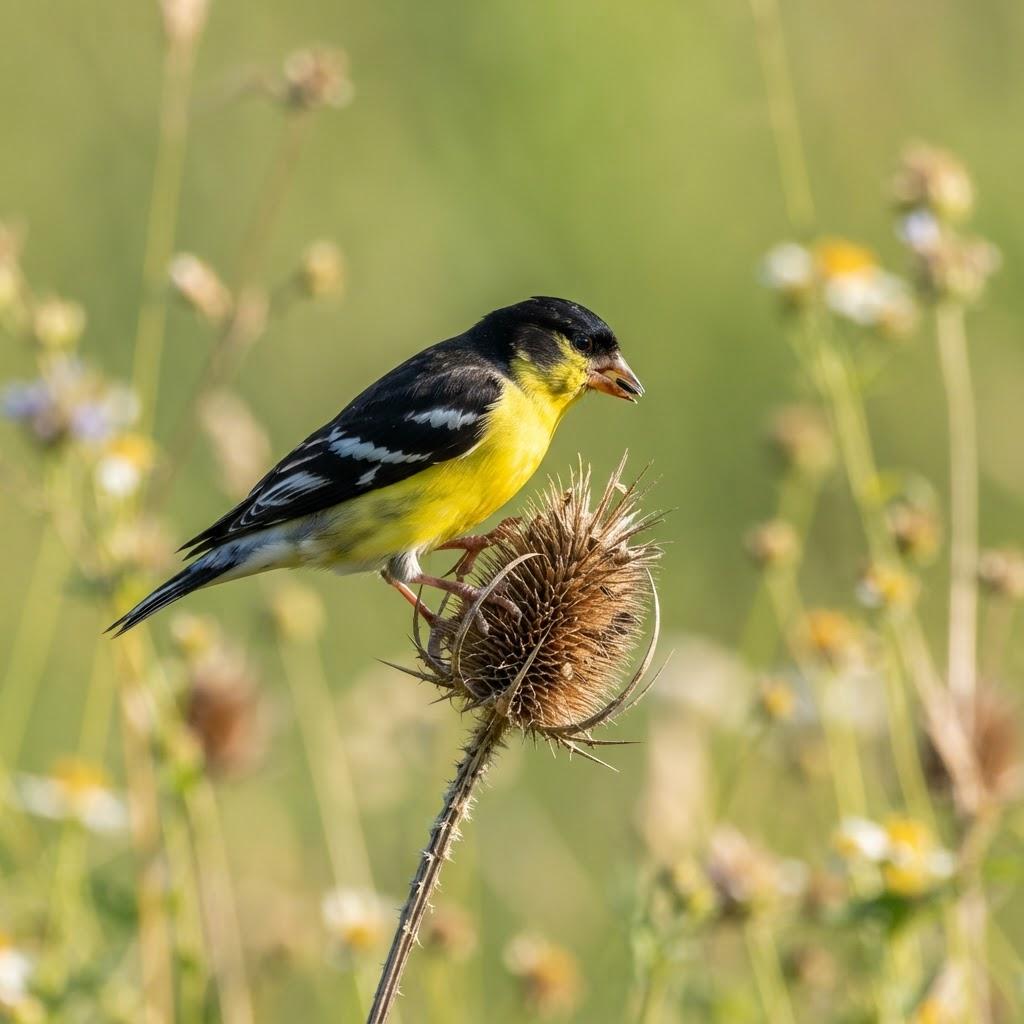
Spinus psaltria
Lesser Goldfinch
Meet the Lesser Goldfinch: a tiny, vibrant bird that's like a pocket-sized rockstar of the backyard. With its dazzling yellow rump and surprisingly complex social life, this finch proves that good things—and a whole lot of sass—come in small packages.
Meet the Bird
Alright, folks, gather 'round and let's talk about a bird that’s basically the feathered equivalent of a perfectly brewed espresso shot: the Lesser Goldfinch. Forget your sleepy pigeons and your overly dramatic peacocks; this little guy is all about vibrant energy and a dash of unexpected attitude. Imagine a tiny, dynamo of a bird, sporting a lemon-yellow rump that’s so bright it might just cause temporary blindness on a sunny day. These pint-sized performers are often found flitting about in groups, a flurry of chirps and quick movements, looking like they’ve got a million important finch-related errands to run. They’re the kind of birds that don’t just enter a room; they burst in, grab everyone’s attention, and then immediately start gossiping about the quality of the local thistle seeds. Their vibe? Think of a pint-sized surfer dude who’s just caught the most epic wave of his life, or a tiny opera singer hitting that perfect high note – pure, unadulterated joy with a hint of mischief. If you’re looking for a bird that brings instant sunshine and a spark of life to your feeders, the Lesser Goldfinch is your feathered superstar. They’re not shy, they’re not boring, and they certainly aren't whispering; they’re practically shouting, 'Look at me! Aren't I fabulous?' And honestly, they kind of are.
Superpowers & Weird Abilities
Now, let’s dive into the secret life of the Lesser Goldfinch, where biology gets wilder than a toddler after a sugar rush. These little guys might seem like your average chirpy backyard dwellers, but they’ve got some seriously cool biological tricks up their tiny sleeves. First off, their eyesight is something else. While you might need reading glasses to decipher the tiny print on a menu, a Lesser Goldfinch can spot a single seed from what feels like miles away, and distinguish between a hawk and a harmless cloud with uncanny accuracy. It’s like having built-in binoculars that also function as a threat-detection system. Then there’s their metabolism – it’s basically a tiny, feathered furnace. To fuel their non-stop zipping and flitting, their bodies work at an astonishing pace, converting food into energy faster than you can say 'seed snack.' This high-octane lifestyle means they need to eat almost constantly, which is why you’ll often see them meticulously picking at seeds, performing what looks like a microscopic excavation on a thistle head. And get this: they have this incredible ability to regulate their body temperature in a way that’s frankly amazing. When it’s freezing, they can fluff up their feathers, trapping air like a down jacket to create a super-insulating layer. When it's sweltering, they can pant and spread their wings to dissipate heat, much like a tiny, feathered air conditioner. It’s a biological superpower that lets them thrive in environments that would send most of us running for the nearest heated car or air-conditioned mall. They're tiny survival ninjas, equipped with evolutionary superpowers that are both practical and utterly fascinating.
Drama, Personality & Feathered Chaos
Let’s be real, birds have drama, and the Lesser Goldfinch is no exception. While they might not be orchestrating elaborate avian soap operas, they certainly have their moments of social intrigue and personality quirks that are a hoot to observe. Think of them as the energetic, slightly gossipy cousins of the bird world. They tend to hang out in flocks, and when you get that many small, energetic creatures together, things are bound to get interesting. They’re not typically bullies in the way a larger, more aggressive bird might be, but they can certainly be assertive at a crowded feeder. Imagine a tiny flash mob descending upon a sunflower seed buffet, each one jostling for the best spot with a determined chirp. They’re like a group of friends deciding where to go for pizza – there’s a lot of enthusiastic discussion and a bit of polite (or not-so-polite) nudging. One of the most fascinating aspects of their social life is their flock dynamics. They’re not just a random collection of individuals; there are often subtle hierarchies and partnerships that form. You might see pairs that stick together, preening each other’s feathers in a public display of affection, or groups that mob a perceived threat with a cacophony of alarm calls, like a tiny, feathery neighborhood watch. And then there are the juveniles. Picture awkward teenagers, still figuring out their feather patterns and their place in the world, often sticking close to adults, looking a little lost but full of potential. Their social interactions are a constant, low-level hum of activity, a delightful spectacle of communication, cooperation, and the occasional squabble over a prime perch. It’s a mini-drama playing out in real-time, proving that even the smallest creatures have complex lives filled with personality and purpose.
Bizarre Rituals & Quirky Habits
If you thought birds were all about singing pretty songs and building nests, think again! The Lesser Goldfinch, like many of its feathered brethren, has some seriously quirky habits that would make you scratch your head and chuckle. For starters, have you ever seen a bird rubbing itself with ants? It’s called 'anting,' and while the Lesser Goldfinch might not be the most famous practitioner, many finches do it. They’ll pick up live ants and rub them all over their feathers. The ants, in their defense, release formic acid, which is a natural insecticide and fungicide. So, our little goldfinches are essentially giving themselves a spa treatment with bug spray. Who needs fancy grooming products when you’ve got a colony of ants ready to go? Another habit that can lead to some truly amusing situations is their fondness for fermented berries. Yes, you read that right. When certain berries start to ferment in the fall, they produce a tiny amount of alcohol. Birds that gorge on these can get a little tipsy, leading to wobbly flights, uncoordinated landings, and generally looking like they’ve had one too many at a birdy happy hour. It’s a hilarious spectacle, though not ideal for the bird in question, as it makes them vulnerable to predators. They also have a peculiar fascination with specific types of seeds, often visiting their favorites with an almost obsessive dedication. It's not just about sustenance; it’s about enjoyment. They’ll meticulously work over a thistle or a dandelion seed head, their tiny beaks moving with astonishing speed and precision, extracting every last bit of goodness. It's a delicate dance of focus and finesse, a testament to their specialized diet and their highly evolved feeding techniques. These oddities and rituals are a reminder that the avian world is full of surprises, and our little goldfinches are definitely keeping things interesting.
Legends, Folklore & Human Stories
While the Lesser Goldfinch might not have ancient myths woven around its every chirp, it has woven itself into the tapestry of human experience in quieter, more everyday ways. Think of it less as a creature of epic legend and more as a beloved character in the ongoing story of nature that unfolds in our backyards and local parks. In many Native American cultures, small, vibrant birds like the goldfinch were often seen as messengers or symbols of good fortune and joy. Their bright colors and cheerful songs were interpreted as signs of a healthy environment and a promising season. While specific legends about *Spinus psaltria* might be scarce, the general reverence for such birds infused them with a positive aura. Imagine an elder telling a child, 'When you see the yellow flash of the goldfinch, it means the sun is smiling upon us.' Their presence was a reminder of the beauty and bounty of the natural world. Beyond folklore, these birds have been companions to humans for centuries, especially as agriculture spread and created more open, brushy habitats that they favor. They were the constant, cheerful soundtrack to rural life, a familiar sight for farmers and homesteaders. Their tendency to gather in flocks also made them a noticeable presence, a collective sign that life was teeming. And in more modern times, they’ve become beloved inhabitants of backyard bird feeders across North America, sparking joy and curiosity in countless people. They are the small, consistent wonders that remind us to appreciate the nature right outside our doors, making them quiet, feathered heroes in the grand narrative of our shared planet. Their story is one of subtle connections, of finding meaning in the flash of yellow and the trill of a song.
Mating: The Ridiculous World of Avian Dating
Forget Tinder and awkward first dates; bird mating rituals are where the real, unadulterated absurdity happens, and the Lesser Goldfinch is no exception. These tiny titans of flirtation have their own unique brand of avian courtship that’s both hilarious and incredibly earnest. When a male Lesser Goldfinch decides it’s time to find a mate, he doesn’t just put on his best feather duster; he pulls out all the stops. He’ll puff up his chest, flash his vibrant yellow plumage like a tiny, feathered disco ball, and launch into a series of aerial acrobatics that are part ballet, part drunken stumble. He might perform loops and dives, zig-zagging through the air as if he’s trying to escape an invisible predator, all while singing a complex, warbling song that sounds like a tiny, enthusiastic kazoo concert. The female, meanwhile, is the ultimate judge, jury, and executioner of this feathered performance. She’ll sit there, looking unimpressed, perhaps tilting her head as if to say, 'Is that all you’ve got?' If his song isn't quite on key, his dives are a little too wobbly, or his yellow isn't quite bright enough, she might just flutter off, leaving him to ponder his life choices and try again. It’s brutal, it’s comical, and it’s highly effective. The male is essentially putting his entire reproductive future on the line with every flap of his wings and every warble of his song. It’s a high-stakes performance where only the most dazzling, most energetic, and perhaps luckiest males get to pass on their genes. The female is looking for a partner who not only has good genes (indicated by bright colors and strong flight) but also has the stamina and vocal talent to survive and thrive. So, next time you see a Lesser Goldfinch zipping about, remember: he might just be rehearsing for the biggest audition of his life, with a very discerning audience.
Nesting: Master Architects and Lazy Slumlords
When it comes to bird nests, the spectrum ranges from architectural masterpieces to what looks like a bird threw up a few twigs and called it a day. The Lesser Goldfinch? They fall somewhere in the realm of meticulous, but decidedly compact, craftsmanship. These little birds are not about building sprawling mansions; think more along the lines of a cozy, well-appointed studio apartment. They construct neat, cup-shaped nests that are surprisingly sturdy for their size. The materials are a curated selection of fine grasses, plant down, spider webs, and bits of lichen, all woven together with remarkable precision. The spider webs are a particularly ingenious touch – they act like elastic, allowing the nest to expand as the baby birds grow, preventing them from being too cramped. It’s like having a built-in crib that magically gets bigger! They often build these nests high in the fork of a branch, tucked away in trees or shrubs, providing a safe and concealed haven for their precious cargo. They’re not lazy freeloaders like the Brown-headed Cowbird, who cheekily lays its eggs in other birds’ nests and skips out on all parental duties. Nor are they the notoriously haphazard builders who might construct a nest that looks like it’s held together by sheer optimism (looking at you, Mourning Dove). The Lesser Goldfinch’s nest is a testament to their dedication and their finely tuned instincts. It’s a small, functional marvel, a secure and comfortable nursery designed with the future generation in mind. It showcases their ability to find the best materials and assemble them with skill, proving that even the smallest birds can be masters of their domestic domain, creating a perfect little world for their offspring.
Raising Babies: The Screaming Food Disposals
Once the eggs hatch, it’s no longer about courtship dances or nest construction; it’s about the 24/7 hustle of raising a brood of tiny, insatiable demands. For the Lesser Goldfinch, this means becoming a high-speed, all-you-can-eat delivery service for their offspring. A typical clutch might consist of three to six eggs, and once those little beaks pop open, the parenting marathon begins. The parents, especially the female who often does the bulk of incubation, will take turns flying back and forth to bring food. And when we say food, we mean regurgitated seeds. Yep, it’s not exactly gourmet dining, but it’s what these little ones need to grow. The chicks, in their fuzzy, featherless glory, are basically screaming food-disposal units. They have insatiable appetites, and their primary goal in life is to open their mouths as wide as humanly possible whenever a parent approaches. Imagine a tiny, feathered factory line where the raw materials (seeds) are processed, and the output is a constant, deafening chorus of cheeps and chirps demanding more. The parents work themselves ragged, their little bodies flying with purpose, driven by an instinct to feed their demanding offspring. They’ll be visiting their nest every few minutes, bringing beakfuls of mashed seeds. This intense period lasts for about two weeks, until the chicks are ready to fledge – that magical moment when they leave the nest, still looking a bit clumsy and dependent, but ready to begin their own learning curve. The parents will continue to feed them for a while after they fledge, teaching them the finer points of seed extraction and predator avoidance. It’s a chaotic, exhausting, but ultimately successful operation, all fueled by parental love and the relentless hunger of baby birds.
Bird-Watching Travel & Local Hotspots
Dreaming of seeing that flash of yellow and olive-green flitting through the trees? The Lesser Goldfinch is a pretty widespread character, especially across the western half of North America, making it a relatively accessible star for your bird-watching adventures. If you’re on the West Coast, you’re in luck. California, Oregon, Washington, and Arizona are prime territories. Places like the Anza-Borrego Desert State Park in California, with its diverse habitats, or the riparian corridors along rivers in Arizona, are fantastic spots. Head north towards Oregon’s Willamette Valley or Washington’s Puget Sound lowlands, and you’ll often find them in parks and open woodlands. Their cousins, the American Goldfinch, are more common east of the Rockies, but Lesser Goldfinches are making more frequent appearances in the central and southeastern U.S. as well, so keep an eye out! They favor open woodlands, brushy fields, shrubby areas, and even suburban gardens and parks with scattered trees. Basically, anywhere with good seed-producing plants and a bit of cover will do. The best time to spot them is generally year-round in many parts of their range, but they can be more noticeable during breeding season (spring and summer) when their songs are more active, and they're busy with nesting. During migration or winter, they might move around more, often forming larger flocks. So, pack your binoculars, grab a field guide, and head to your local parks, nature preserves, or even just a backyard with some trees. You might just find yourself face-to-face with one of these dazzling little birds, making your birding trip a golden success.
Food, Feeder Hacks & DIY Projects
To attract the vibrant Lesser Goldfinch to your yard, think 'small seeds, high quality.' These birds are picky eaters, preferring the tiny, nutritious seeds of thistles, sunflowers (especially black oil sunflower seeds, but smaller sizes are preferred), niger (thistle seed), and certain native plants. Forget those cheap filler seeds like red millet and milo; they’re more likely to attract aggressive House Sparrows, House Finches, or starlings, and frankly, they’re a waste of your money. Lesser Goldfinches love thistle feeders, those mesh sock-like feeders filled with niger seed. They’ll cling to them and meticulously pick out each tiny seed. For sunflower seeds, a good-quality feeder with small openings will work best, or simply offer black oil sunflower seeds in a tray feeder. If you want to go the DIY route, get yourself a plain pinecone, slather it with some unsalted peanut butter (a little goes a long way), and roll it in a mix of finely chopped sunflower seeds and niger seed. Hang it from a tree branch, and watch the magic happen! Native plants are your secret weapon for a truly goldfinch-friendly yard. Plants like native thistles (e.g., Scotch Thistle, California Thistle), sunflowers, asters, coneflowers, and various native grasses are natural food sources that will draw them in and keep them coming back. They also appreciate a water source, so a bird bath with a gentle bubbler or dripper will be a huge hit. Remember, consistency is key. Keep your feeders clean and full, and your native plants thriving, and you’ll soon have a regular cast of golden characters gracing your garden.
Seasonal Guides & "Crisis" Management
The life of a Lesser Goldfinch is a dance with the seasons, and understanding their rhythm helps us become better backyard hosts. In spring, as days lengthen and warmth returns, these birds become more active. This is the perfect time to clean and refill feeders, especially with niger seed and sunflower chips, and to ensure native plants are healthy to provide natural food sources. If you’re in areas where they migrate, this is when you’ll see them returning in earnest. Summer is breeding season, and while they’re busy raising their young, they’ll still visit feeders for a quick snack. Keep feeders clean to prevent disease transmission in their busy season. As autumn arrives, Lesser Goldfinches may form larger flocks, becoming more visible and vocal as they forage for the abundant seeds available. It’s a great time to enjoy their lively presence. Winter can be challenging, especially for birds in colder climates. High-fat foods like suet (especially suet blocks with nuts and seeds) become incredibly important for energy. Keep feeders clear of snow and ice. If you have a bird bath, a heater can prevent it from freezing, providing a vital water source. Now, let’s talk about the annual 'Fledgling Panic.' Every spring and summer, well-meaning people find fluffy baby birds on the ground and assume they’re abandoned. For Lesser Goldfinches, like most songbirds, fledglings leave the nest before they can fly well. They are often wobbly, stay low to the ground, and look rather helpless. Their parents are almost always nearby, watching and waiting for the right moment to feed them. The *absolute best thing* you can do if you find a fledgling is to leave it alone, unless it’s in immediate danger (like on a busy road). If it’s in danger, gently move it a short distance to cover under a bush or shrub. Resist the urge to 'rescue' it; the parents are probably its best chance of survival. Unless the bird is visibly injured or clearly orphaned (no parents in sight after a prolonged period), let nature take its course. Your well-intentioned intervention can do more harm than good.
Backyard Tech & Gadget Reviews
For those of us who love watching our feathered friends, technology has stepped up its game, and even a tiny bird like the Lesser Goldfinch can be the star of your smart backyard. Let's talk about AI bird feeders, like the popular Bird Buddy. These feeders have built-in cameras that snap photos or record short videos when a bird visits. They send these images and notifications directly to your phone, allowing you to identify visitors and learn about them. For the Lesser Goldfinch, this means getting instant notifications of those dazzling yellow flashes at your feeder and a permanent record of their visits. It’s like having a personal bird paparazzi. They can be a bit pricey, but for serious bird enthusiasts, they offer an amazing way to connect with nature. Now, a perennial problem: window collisions. Birds, especially during migration or when startled, can fly into windows, mistaking their reflection for open space. There are numerous solutions, from decorative decals to specialized window films. For a more natural look, consider UV-patterned decals that are visible to birds but nearly invisible to us. Another, more DIY approach, is to simply use a bit of window marker to create a pattern of dots or lines on the outside of the glass, breaking up the reflection. For a more advanced setup, trail cameras or motion-activated cameras placed in your yard can capture incredible footage of both daytime visitors like our goldfinch friends and nocturnal visitors you might never see otherwise. Place one near a feeder or a water source, and prepare to be amazed by what you discover, perhaps even catching a glimpse of a Lesser Goldfinch’s busy foraging or a surprising nocturnal visitor.
How to Spot One & How It Is Doing
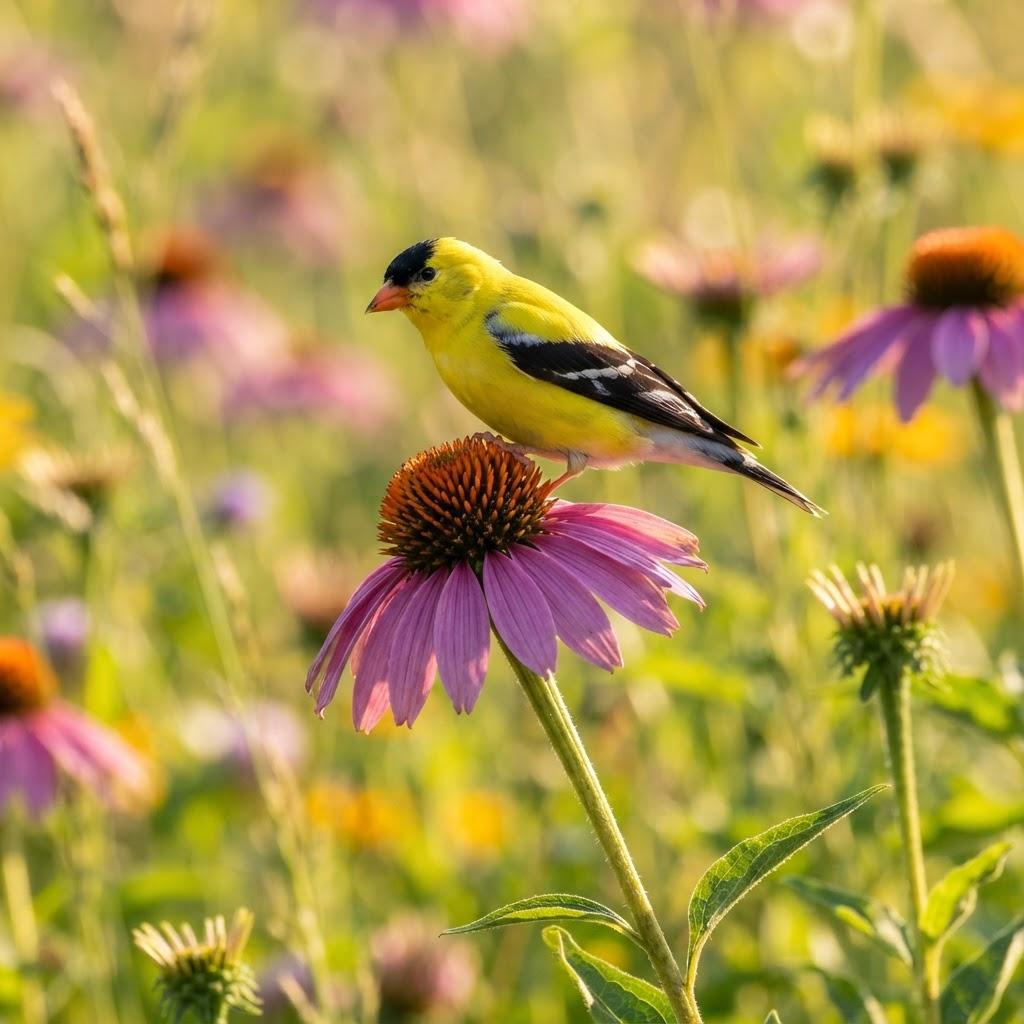
Spotting a Lesser Goldfinch is like finding a little nugget of sunshine. Look for a small, finch-like bird, typically about the size of a chickadee. The most striking feature, especially in the males during breeding season, is that intense, bright yellow rump and belly. They have blackish wings with white bars, and the rest of their body is usually a dusky olive-green or grayish-olive. Females are a bit more subdued, with duller olive-green and less prominent yellow. They are highly active birds, constantly flitting from perch to perch or from seed head to seed head. Listen for their calls – a distinctive, buzzy 'chip' or a rapid, twittering song that often sounds like a miniature, enthusiastic warble. They tend to hang out in small flocks, especially outside the breeding season, so if you see one, there are likely more nearby. Habitat-wise, they love open areas with scattered trees, shrubs, brushy fields, parks, and gardens. They're often found near thistle or sunflower plants. As for how they're doing, the good news is that the Lesser Goldfinch is currently listed as 'Least Concern' by conservation organizations. This means their populations are generally stable and widespread, thriving in a variety of habitats, including human-altered landscapes like suburbs. However, this doesn't mean they don't need our help. You can make a real difference by planting native, seed-producing plants in your yard, providing clean feeders with high-quality seeds (especially niger and black oil sunflower), and offering a reliable water source like a bird bath. Reducing pesticide use in your garden also helps, as they rely on insects for food, especially when feeding young. By creating a welcoming habitat, you’re not only enjoying these delightful birds but also contributing to their continued success.