Lanius ludovicianus
Loggerhead Shrike
Meet the Butcherbird, a pint-sized songbird with the soul of a medieval knight and the habits of a horror movie villain. While it looks like a cute, masked bandit, this feathered assassin creates terrifying pantries of skewered prey that will change how you look at your backyard fence forever.
Meet the Bird
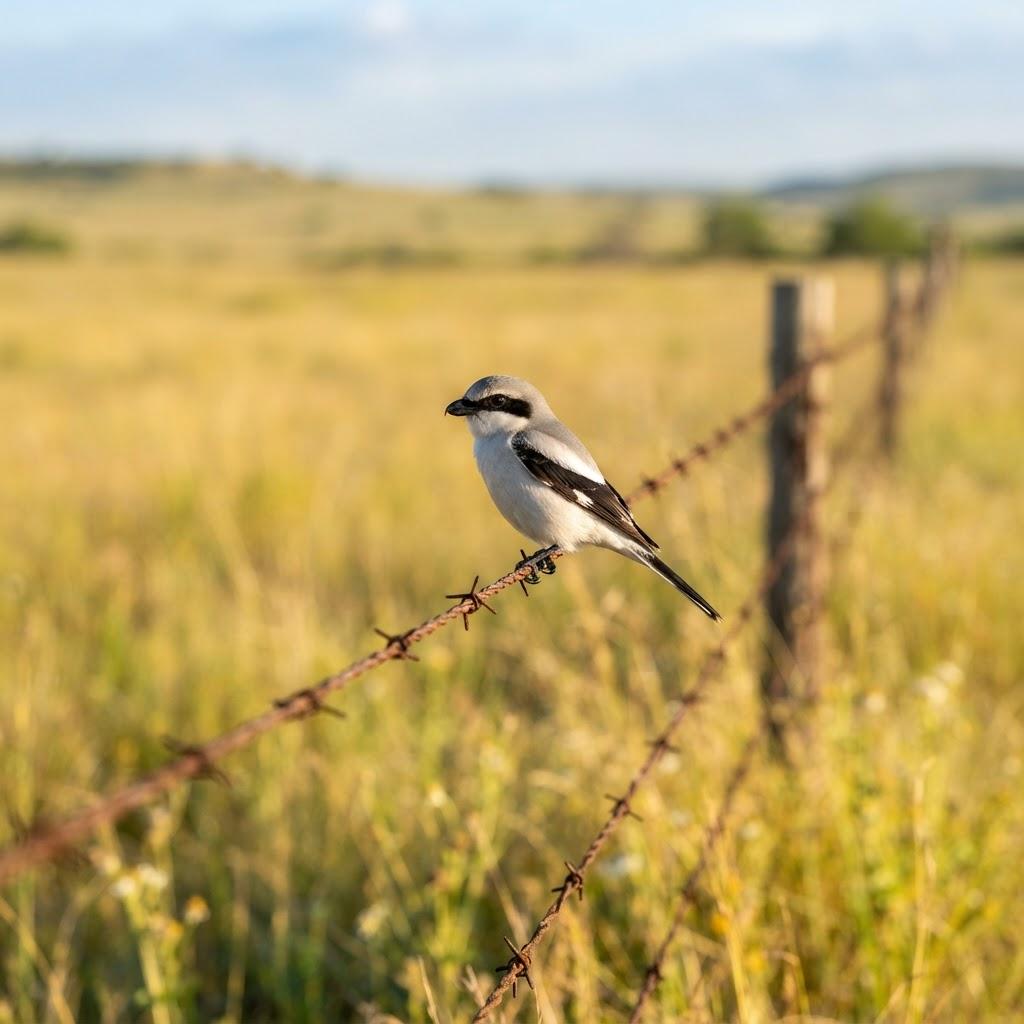
Imagine a bird that wears a sleek, black Zorro mask and has the audacity to take on prey three times its size. Meet the Loggerhead Shrike, a songbird that clearly skipped the memo about being soft and cuddly. To the naked eye, it looks like a harmless, stout little bird with a dignified grey back and a sharp, business-like beak. But don't let the dapper attire fool you. This isn't your average backyard visitor seeking sunflower seeds; this is a raptor in a songbird’s clothing. They sit perfectly still on telephone wires or fence posts, scanning the grass with the intensity of a sniper, waiting for a grasshopper, lizard, or unsuspecting mouse to make a single mistake. They are the tough guys of the open range, small enough to fit in your palm but possessing the cold, calculated attitude of a bird that has seen it all and isn't afraid to put it on a thorn.
Superpowers & Weird Abilities
The most legendary superpower of the Loggerhead Shrike isn't flight or song, but their complete lack of talons. Raptors—like hawks and eagles—have big, curved claws for grabbing dinner. The Shrike? It’s a songbird, so its feet are strictly for hopping and perching. So, how does it catch things? It uses a hooked, predatory beak designed for tearing, but its real genius is in its landscape modification. Because it can't hold its food down with feet, it uses the environment as a set of hands. They rely on thorns, barbed wire, or even the jagged edges of a broken branch to impale their catch. It’s like having a superpower that turns the entire world into a giant kitchen prep station. They’ve essentially evolved to treat nature like a hardware store, turning every fence line into a terrifyingly organized buffet for later consumption.
Drama, Personality & Feathered Chaos
If there were a reality show featuring bird personalities, the Loggerhead Shrike would be the contestant who refuses to make alliances and instead spends the whole time building a private collection of carnage. They are notoriously territorial and possess the confidence of a bird the size of a raven. They don't mind shouting at intruders, and their aggressive stance is enough to send a mockingbird packing. They are the ultimate solitary geniuses of the bird world, preferring a life of quiet (and occasionally macabre) productivity over the noisy social clubs of starlings. They aren't looking for friends; they are looking for a nice, sharp piece of wire to hang their afternoon snack on. While other birds are busy singing about love, the Shrike is busy ensuring its larder is well-stocked, proving that in the game of survival, being a bit of a loner with a sharp plan pays off.
Bizarre Rituals & Quirky Habits
The habit that truly defines the Shrike is something biologists call 'caching,' but most people call 'impaling.' It’s the ultimate quirky habit that has earned them the nickname 'Butcherbird.' A Shrike will catch a prey item, fly it over to a thorn or a piece of barbed wire, and shove it onto the spike. Why? Sometimes it’s to store food for later, essentially keeping a fresh supply of beetles or mice in the freezer. Other times, it’s a bit of an aesthetic choice. Males use these displays of impaled victims to show off their hunting prowess to potential mates. It is the avian equivalent of an expensive luxury car parked in the driveway to signal high status. If you see a dead grasshopper stuck to a fence, don't blame a ghost; blame a Shrike who is simply trying to prove he’s the best hunter on the block.
Legends, Folklore & Human Stories
Throughout history, the Shrike has been viewed with a mix of awe and mild horror. Early naturalists were genuinely confused by them; they didn't know whether to classify them as songbirds or tiny, flightless-style predators. In some rural folk tales, the Shrike was seen as a harbinger of change, perhaps because their arrival signaled the shift in seasons when prey became scarce and the 'butchery' had to become more efficient. They are rarely painted as heroes in folklore, usually taking on the role of the stern, unfeeling landlord of the meadow. Humans have often stood in disbelief when discovering a 'Shrike pantry,' a cluster of thorns decorated with dried bugs and lizards. It is a moment of connection that reminds us that nature isn't always pretty, but it is always incredibly interesting, forcing us to reconcile our love for songbirds with the reality of their survival strategies.
Mating: The Ridiculous World of Avian Dating
Dating for a Loggerhead Shrike is a performance that would make a Broadway director blush. The male starts by putting on an aerial show, fluttering and performing high-speed maneuvers designed to show off his flight skills. If the female shows interest, he transitions into his next act: the display of his pantry. He leads her to his collection of impaled prey, acting like a real estate agent showing off the kitchen upgrades of a new home. 'Look at this beetle,' he chirps, 'and this cricket—aged to perfection.' If the female likes the quality and variety of his hoard, she stays. If she doesn't think his collection is up to snuff, she moves on. It is a ruthless meritocracy where the most organized hunter wins the heart of the female, proving that in this species, a well-stocked pantry is truly the way to a partner's heart.
Nesting: Master Architects and Lazy Slumlords
When it comes to home construction, the Shrike takes a pragmatic approach. They build a sturdy, cup-shaped nest tucked deep into the center of a dense, thorny shrub or a thick tree. This isn't just for comfort; it’s a strategic choice. By nesting in the middle of a hawthorn or an osage orange tree, they gain a natural security system—the thorns act as a deterrent against snakes and other nest-raiding predators. They use twigs, bark, and grass, lining the inside with soft materials like feathers or animal hair to create a cozy sanctuary. While some birds opt for precarious, slapdash nests that wobble in the wind, the Shrike’s home is a fortress. They are careful, intentional builders who understand that when you have a reputation as a predator, you better make sure your own home base is absolutely impenetrable from outside threats.
Raising Babies: The Screaming Food Disposals
Once the chicks hatch, the nest becomes a non-stop, high-stakes daycare. There are usually five to seven of these little monsters, and they are masters of the 'open-mouth, scream-loudly' technique. The parents are absolute workhorses, constantly flying back and forth with a rotating menu of insects and small vertebrates to keep the screaming to a minimum. Because the chicks grow rapidly, they demand a massive caloric intake. The parents have to balance hunting, feeding, and defending the territory, all while training the youngsters to recognize a good thorn when they see one. Watching a Shrike parent try to feed a gaggle of hungry fledglings is like watching a frantic caterer at a wedding where every guest is demanding a steak at the same time. By the time the young birds fledge, they are nearly as loud as their parents and twice as demanding.
Bird-Watching Travel & Local Hotspots
If you want to see a Loggerhead Shrike, don't look up into the dense canopy; look out at the power lines along open country roads. The best hotspots are often vast, grassy areas with low-growing vegetation. Places like the Wichita Mountains Wildlife Refuge in Oklahoma or the sprawling prairies of the American Midwest are prime Shrike territory. Look for fence lines—they are the Shrike’s favorite perches. If you are in Florida or California, check out open agricultural land where the insects are plentiful and the telephone wires are plentiful. Early morning is your best bet, when the air is crisp and the Shrike is doing its first sweep of the day. Patience is key; park your car, crack the window, and wait. If you spot a grey, masked bird sitting perfectly still for an unusually long time, you’ve found your quarry.
Food, Feeder Hacks & DIY Projects
Attracting a Shrike to a standard backyard bird feeder is, let’s be honest, almost impossible. They are hunters of live prey, not fans of commercial seed blends. If you want to support them, focus on habitat rather than hanging feeders. Plant native, thorny shrubs like wild plum or hawthorn, which provide both nesting sites and the natural 'kitchen' tools they need. Avoid pesticides at all costs; if you kill the grasshoppers and beetles in your yard, the Shrike has no reason to visit. Instead of fancy feeders, consider a 'bug hotel' to boost the insect population. If you really want to help, leave dead tree branches in parts of your yard—these serve as perfect, natural perches for them to sit and survey their kingdom. By creating a wild, insect-rich environment, you become a partner in their survival rather than just a dispenser of sunflower seeds.
Seasonal Guides & "Crisis" Management
Shrikes don't really do the 'bird feeder' season, but they do handle the winter with grit. In cold months, they stick to open areas where they can still spot movement on the frozen ground. If you find a 'fledgling' in your yard during spring, please resist the urge to 'rescue' it. Young Shrikes are clumsy and often spend a few days on the ground learning to fly while the parents feed them from above. Unless the bird is clearly injured—like an obvious wing drooping or bleeding—leave it alone. The parents are almost certainly watching from a nearby fence. Keep your cats inside during this period, as the ground-dwelling babies are prime targets. By letting nature take its course, you are doing more to help the population than any direct intervention could possibly achieve. Give them space and let them grow up.
Backyard Tech & Gadget Reviews
Modern tech like motion-activated wildlife cameras is a game-changer for spotting Shrikes. Set up a camera near a fence post or a thorny bush, and you might capture the rare moment of a Shrike caching its food. Regarding window collisions, the best tech is actually low-tech: decals or UV-reflective film. Because Shrikes hunt with such intense focus, they sometimes misjudge their speed when chasing a bug. Anything that breaks up the reflection of the sky on your windows helps. Skip the AI feeders for this species—they are programmed for birds that eat seeds and nuts. Instead, invest in a good pair of binoculars. Being able to see the fine detail of that black face mask from thirty yards away is infinitely more rewarding than a grainy, automated photo alert on your phone. Technology is great, but your eyes remain the best tool for the job.
How to Spot One & How It Is Doing
To identify a Loggerhead Shrike, look for the 'mask'—a thick black band that extends from the bill, through the eye, to the ear patch. They are about the size of a robin, but they sit much more upright, often looking like a tiny, feathered soldier. Their flight is low and undulating, swooping down from a perch and then popping up onto another. Sadly, their numbers have declined significantly due to habitat loss and pesticide use. They are considered Near Threatened, which is a nudge for us to keep our grasslands wild and our insects safe. By protecting open spaces and avoiding the overuse of chemicals in your own backyard, you help ensure these masked assassins continue their vital role in the ecosystem. Every Shrike on a fence post is a sign that the local environment is healthy and thriving. Keep your eyes on the wires, keep your spaces wild, and appreciate the Butcherbird for the complex, fascinating character it is.