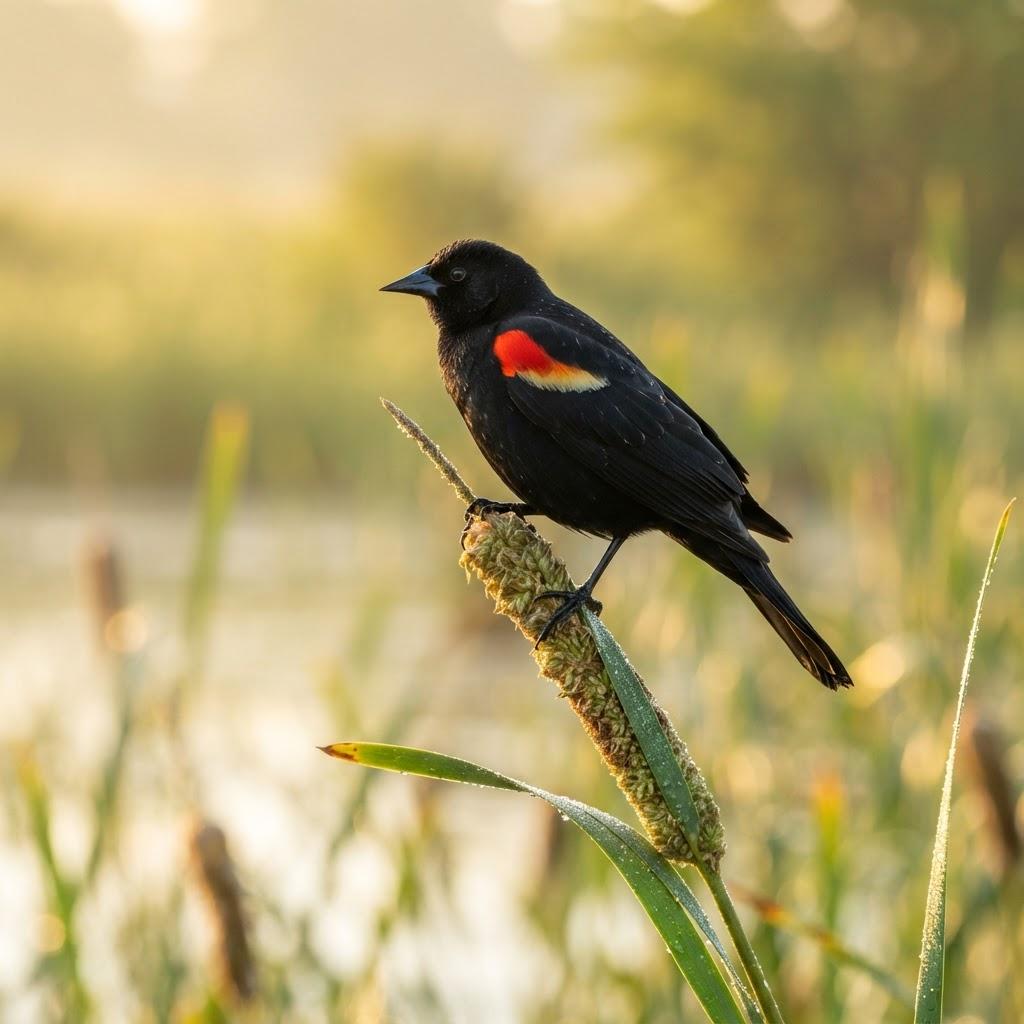
Agelaius phoeniceus
Red-winged Blackbird
The Red-winged Blackbird is the tuxedo-wearing, swamp-defending local celebrity of the bird world. With a flash of scarlet shoulder pads and a voice like a rusty gate, this bird proves that attitude is everything in the animal kingdom.
Meet the Bird
Imagine a bird that treats your local neighborhood park like its personal kingdom and doesn't care who knows it. Meet the Red-winged Blackbird, a feathered brawler who struts around the wetlands with the confidence of a heavyweight boxer entering the ring. They are sleek, obsidian-colored characters with vibrant red and yellow epaulets—think of them as high-fashion military patches on a bird that spends its day yelling at cars and pedestrians. Unlike the shy, retiring songbirds that hide in the deep canopy, this bird wants to be seen. It will perch on the tallest cattail available, puff its chest out, and scream its iconic 'conk-la-ree!' at anyone passing by. It is the quintessential neighborhood tough guy, but beneath that aggressive exterior lies a fascinating, complex creature that dominates the social scene of North American marshes with a flair for the dramatic that would put a Broadway star to shame.
Superpowers & Weird Abilities
While they might not have laser eyes or super strength, Red-winged Blackbirds possess a mastery of acoustic warfare that is basically a biological superpower. Their territorial calls are perfectly tuned to cut through the messy, chaotic noise of a windy marsh, ensuring that rivals hear their message loud and clear. Even more impressive is their ability to change their appearance in a split second. Those signature red shoulder patches—called epaulets—are kept hidden under black feathers most of the time. When a male decides it is time to throw down, he flares his wings to reveal that striking red and yellow display. It is essentially the bird equivalent of popping your collar to show off a brand-name logo before a fight. They also exhibit remarkable spatial memory, allowing them to navigate back to the same precise breeding territory year after year with the navigational precision of a pilot, despite being no bigger than a heavy-duty stapler.
Drama, Personality & Feathered Chaos
If there were a reality television show for birds, the Red-winged Blackbird would be the star, the producer, and the person starting all the fights at the reunion. They are aggressively territorial, often taking on birds ten times their size, including hawks and crows, with absolutely zero regard for their own safety. If you are walking your dog near a nest during breeding season, do not be surprised if you get dive-bombed by a male who thinks you are a threat to his offspring. They are the ultimate chaotic good of the avian world; they keep the peace in the marsh by terrorizing everyone who enters it. They have been known to gang up on predators, creating a wall of feathers and noise that is impossible to ignore. Their personality is best described as 'loud and proud,' and they absolutely refuse to stay in the background of any environmental setting.
Bizarre Rituals & Quirky Habits
One of the most peculiar habits of the Red-winged Blackbird is its obsession with posturing. They will spend hours of the day perched in highly visible locations, just making sure everyone remembers who owns the territory. When they aren't posturing, they are performing 'wing-flashing' rituals that involve a complex dance of opening and closing their wings to reveal colors. It is not just for the ladies; it is a way to communicate social status to other males. Scientists have observed that they seem to engage in a form of 'social eavesdropping,' watching the behavior of neighbors to determine who is weak and who is a threat. It is essentially a high-stakes game of keeping up with the Joneses, but instead of worrying about the lawn, they are worried about who has the brightest red shoulder patches on the block. It is delightfully weird and fundamentally human in its social complexity.
Legends, Folklore & Human Stories
Across many North American indigenous cultures, the Red-winged Blackbird holds a place of respect and myth. In some folklore, they are seen as protectors of the wetlands, the sentinels who warn other animals of approaching danger. Their tendency to scream at anything that moves makes them excellent alarm systems, a fact not lost on early observers who lived alongside them. They appear in stories as symbols of persistence and defense, representing those who stand their ground regardless of the odds. Humans have long interacted with them in agriculture, where their habit of eating insects has been seen as both a boon and a curse, given their equal love for fresh corn kernels. They are the constant, familiar voice of the spring thaw, signaling the end of the long, dreary winter for many generations of humans who look forward to that first 'conk-la-ree' call as a sign of life returning to the landscape.
Mating: The Ridiculous World of Avian Dating
Avian dating for a Red-winged Blackbird is less about romance and more about a high-stakes audition. The male is a polygamist in the truest sense, maintaining a 'harem' of females within his territory. To attract these females, he puts on a performance that is equal parts terrifying and impressive. He will puff up, spread his tail, and shriek his song while displaying those red patches for all he is worth. If a female is unimpressed, she will fly off without a second glance, leaving him to look like a feathered balloon trying to be an opera singer. It is a harsh world, and the females are notoriously picky. They evaluate the male based on the quality of his territory—is it well-defended? Is it safe from predators? If he fails to provide, she moves on. He puts his heart, soul, and vocal cords into it, hoping to build his dynasty before the season ends.
Nesting: Master Architects and Lazy Slumlords
When it comes to home construction, the female Red-winged Blackbird is the true hero, while the male mostly just stands around yelling at shadows. The female weaves a complex, sturdy cup-shaped nest out of cattails, grass, and mud, usually placing it low in a cluster of dense vegetation. It is a marvel of structural engineering, designed to stay dry even if the water levels in the marsh rise. It is not a casual, 'three sticks in a tree' situation like a mourning dove might build. These nests are carefully lined with soft grass and rootlets to provide a comfy, secure bunker for the eggs. She does all the heavy lifting, crafting a home that can withstand wind, rain, and the occasional curious raccoon. It is an impressive display of architectural skill that ensures the next generation has a fighting chance against the elements, built with a precision that defies their small size.
Raising Babies: The Screaming Food Disposals
Once the eggs hatch, the nest becomes a non-stop, high-intensity catering service. The babies are born with a singular instinct: scream until food appears. They are essentially giant, gaping mouths attached to tiny bodies, demanding protein-rich insects at a pace that would exhaust a professional triathlete. Both parents spend every waking second hunting for bugs to jam into those insistent beaks. Watching the nest is like watching a hectic restaurant kitchen during the dinner rush, only with more feathers and significantly louder noise. The babies grow at an alarming rate, nearly doubling in size in the span of a few days. They are demanding, loud, and utterly ungrateful for the hard work being put into their survival. It is a chaotic, messy, and loud period of roughly two weeks before the fledglings finally decide to launch themselves into the world, usually with all the grace of a falling rock.
Bird-Watching Travel & Local Hotspots
If you are dying to see a Red-winged Blackbird in action, you don't need a passport or a plane ticket. Just find the nearest wet patch of land. They are remarkably common, but for the full experience, head to major wildlife refuges like the Montezuma National Wildlife Refuge in New York or the Horicon Marsh in Wisconsin. During the spring migration, these places become a symphony of blackbird activity. Walk the wooden boardwalks during the early morning hours, and you will be surrounded by dozens of males competing for territory. It is birding on easy mode. You don't need expensive optics or extreme stealth; you just need to stand near a patch of cattails and wait for the show to start. The best time to visit is mid-April, when the air is filled with their songs and the marsh is buzzing with nesting drama. Bring a camera, because the contrast of the red wings against the green foliage is a classic shot.
Food, Feeder Hacks & DIY Projects
Red-winged Blackbirds are not picky eaters, but they do have preferences. While they love seeds, they are also avid insect-hunters, which makes them great for your backyard pest control. To attract them to your feeders, skip the cheap fillers like milo or wheat, which they will just kick to the ground in frustration. Instead, offer them black oil sunflower seeds or cracked corn on a platform feeder. They aren't huge fans of hanging tube feeders; they prefer a flat surface where they can strut around. A fun DIY project involves taking a large pinecone, rolling it in peanut butter mixed with birdseed, and hanging it from a low branch near your garden. Not only will the birds love the high-calorie feast, but it is also a fantastic way to introduce kids to the joys of observing backyard nature. Just be prepared: once they find your yard, they will invite all their friends.
Seasonal Guides & "Crisis" Management
Spring is the busiest time for these birds, and it is when you are most likely to see the famous 'fledgling panic.' If you find a fluffy, awkward-looking bird on your lawn, don't rush to pick it up. It is likely a fledgling, a teenager who has just left home and is still figuring out how to be a bird. Its parents are definitely watching from a nearby tree, ready to swoop in if a cat or a dog comes too close. Leave it alone unless it is clearly injured. As winter sets in, these birds don't disappear; they often join massive, swirling flocks that migrate south or huddle together to conserve heat. If you keep a heated birdbath, you will be the most popular person in the neighborhood. High-fat suet cakes in the winter provide the extra fuel they need to survive freezing nights, and they will thank you by sticking around for the spring return.
Backyard Tech & Gadget Reviews
Modern technology has changed the birding game, and for a species as active as the Red-winged Blackbird, it is a blast. AI-powered feeders that send high-definition photos to your phone are perfect for catching their dramatic poses. You will be able to see the detail in those red epaulets that you might miss with the naked eye. If you want to stop window collisions, put up bird-safe decals that look like frost or patterns; they break up the reflection that confuses birds. For the more adventurous, a cheap motion-sensor trail camera placed near your platform feeder can capture incredible, intimate footage of their feeding behaviors that you would never see standing at the window. It turns your backyard into a documentary studio, providing hours of entertainment as you watch the local birds navigate the challenges of life with a camera lens documenting every hilarious encounter.
How to Spot One & How It Is Doing
Spotting a Red-winged Blackbird is easy once you know what to look for. The males are unmistakable: jet-black, shiny, with a splash of red and yellow on the shoulder. The females are actually quite different, sporting a streaky brown coat that looks like a giant sparrow, which helps them blend in while sitting on the nest. Listen for that distinctive 'conk-la-ree' sound, and look for a bird perched prominently on a reed. Regarding their status, they are doing exceptionally well—in fact, they are one of the most abundant birds in North America. Their ability to adapt to human-altered landscapes, like farm fields and roadside ditches, has kept their numbers high. To help them out, focus on preserving native wetland plants in your local area and supporting conservation efforts for marshes. They are the tough, resilient heart of our wetlands, and ensuring they have a place to live is a small price for such incredible daily entertainment.