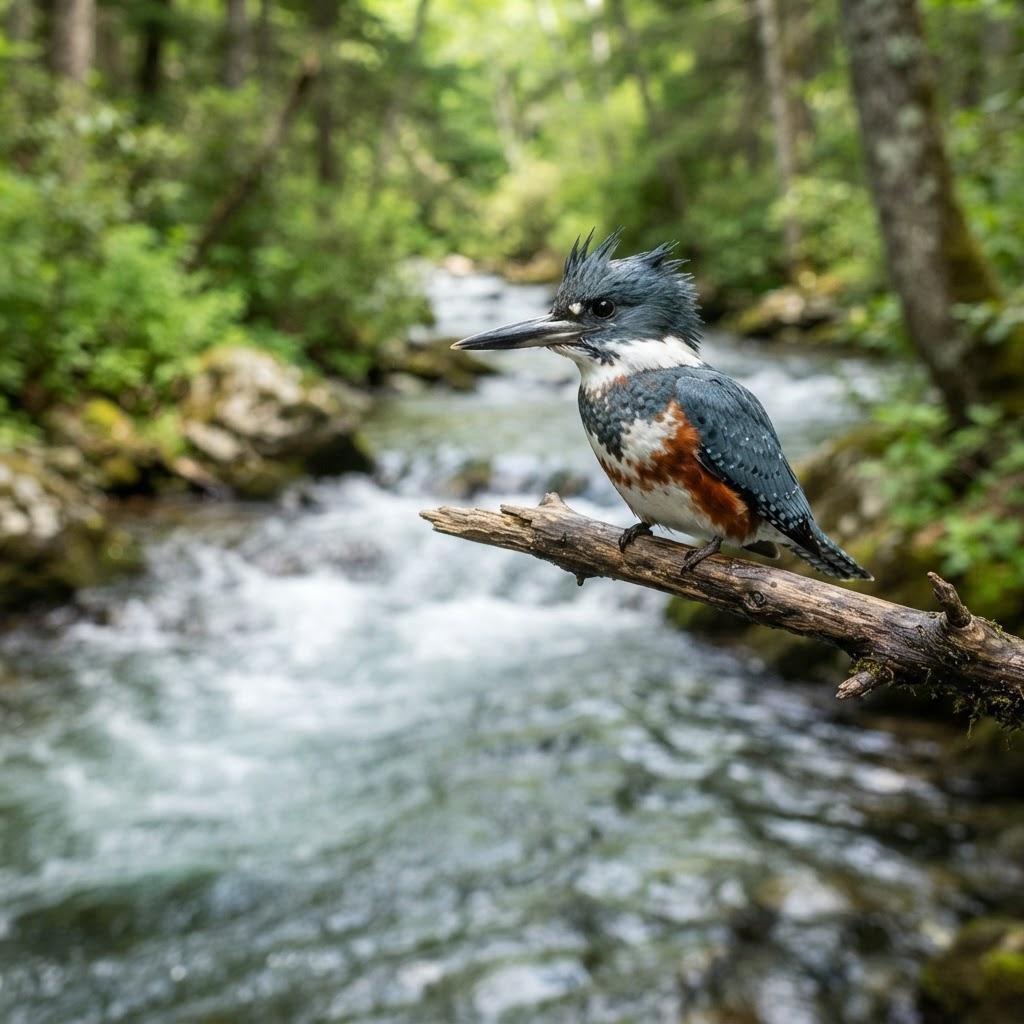
Megaceryle alcyon
Belted Kingfisher
The Belted Kingfisher is the eccentric, loud-mouthed punk rocker of the riverside, known for its iconic mohawk and impeccable diving precision. This feathered fisherman is a master of patience and a chaotic performer that turns every fishing trip into a high-stakes action movie.
Meet the Bird
Imagine a bird that decided to skip the subtlety of songbirds and went straight for a look that screams, I live on the edge and I do not care what you think. That is the Belted Kingfisher. With a jagged, spiky crest that looks like it spent a little too much time in a wind tunnel and a rattle-like call that sounds like a lawnmower struggling to start, this bird is impossible to ignore. They are essentially the neighborhood grump of the riparian world, often seen perched high on a dead branch overlooking the water, silently judging every fish that swims by. Unlike most birds that politely flutter from flower to flower, the Kingfisher is a dedicated, blue-gray aviator that brings a sense of high-octane drama to even the calmest suburban lake. They are compact, stocky, and carry a look of permanent, focused intensity that suggests they have a very important appointment with a minnow in approximately three seconds. If birds were characters in an action franchise, the Belted Kingfisher would be the sharpshooter who sits quietly on the rooftop, waiting for the perfect shot, completely uninterested in small talk. They do not blend in, they do not soften their edges, and they definitely do not sing pretty lullabies. They exist to dominate the shoreline, look cool doing it, and leave behind a wake of splash-drenched ripples as a signature.
Superpowers & Weird Abilities
To understand the Kingfisher, you have to appreciate the physics of its hunt. When these birds dive, they are not just aiming for a fish; they are calculating refraction. You know how when you look into a swimming pool, a person's legs look bent? That is refraction, and it is a fish’s best defense. The Kingfisher, however, has evolved to see through the surface tension of water with unnerving accuracy. They have a specialized nictitating membrane, which is basically a built-in pair of underwater goggles. As they hit the water at speeds that would give a human a concussion, this translucent, secondary eyelid slides over their eye, protecting the cornea from debris while allowing them to lock onto their target with laser-like focus. They are also masters of the hover. While hummingbirds hover to sip nectar, Kingfishers hover to execute a tactical strike. They flap their wings at a frantic pace to stay suspended in mid-air, scanning the depths like a drone pilot before dropping like a stone. It is a high-speed, high-impact maneuver that requires incredible core strength and perfect spatial awareness. Their bills are essentially oversized, serrated daggers designed for one thing: snagging slippery prey and holding on for dear life. They are built for the dive, and they do it better than almost anyone else in the avian kingdom.
Drama, Personality & Feathered Chaos
If you look up the word 'territorial' in a bird dictionary, you might find a picture of a Belted Kingfisher. These birds operate on a strict 'do not touch my stuff' policy that extends for hundreds of yards along a waterway. They are not the type to share a feeder or tolerate a neighbor hovering too close to their favorite fishing rock. When another Kingfisher accidentally drifts into their designated zone, the reaction is immediate and loud. They erupt into a chaotic, rattling display of aerial maneuvers, chasing the intruder away with a fury that suggests the fate of the world depends on it. They are known for being incredibly noisy, especially when annoyed, utilizing a sharp, grinding rattle that echoes across the water. It is a sound that essentially says, 'Hey, buddy, there is an entire lake, go find your own snacks!' This personality makes them the bullies of the riverbank, but it is a drama that keeps the ecosystem in check. They are the ultimate loners of the bird world, preferring the solitary pursuit of perfection over the social chaos of a flock. There is something almost admirable about their commitment to their own personal space, even if it makes them a bit of a nightmare to deal with if you happen to be another Kingfisher looking for a lunch spot.
Bizarre Rituals & Quirky Habits
Kingfishers have a habit that would baffle any human observer: they love to play with their food in a way that feels almost cruel. Once they successfully snag a fish, they do not just gulp it down. They return to their favorite perch and proceed to beat the fish against the branch repeatedly. This is not out of malice; it is a practical, if slightly jarring, way of subduing their meal and breaking down the bones before swallowing. It is a common sight to see a Kingfisher thumping its dinner against a tree, an act that looks surprisingly like a miniature, feathered percussion solo. Furthermore, they are obsessed with grooming. You would think that spending so much time diving into water would make them disheveled, but they keep their plumage in pristine condition. They spend hours preening, using oil from a gland near their tails to keep their feathers waterproof. It is a survival necessity, of course, but it gives them an air of being constantly dressed for a gala, even though they spent their morning face-planting into a muddy creek. They are also known to fly in what looks like a frantic, erratic pattern, zig-zagging across the water to confuse potential predators—or perhaps just because they are caffeinated by pure adrenaline and the thrill of the hunt.
Legends, Folklore & Human Stories
Historically, the Kingfisher family has been linked to the Greek myth of Alcyone, a woman who was turned into a bird and told to calm the seas during her nesting period. This gave rise to the term 'Halcyon days,' representing a period of peaceful, calm, and prosperous times. While the North American Belted Kingfisher is far less interested in calming the seas and far more interested in terrorizing minnows, the name remains a testament to our fascination with their beauty and behavior. In various Indigenous cultures across North America, the Kingfisher is often viewed as a symbol of patience, concentration, and successful hunting. Their habit of sitting motionless for hours before making a strike has been immortalized in stories that highlight the value of waiting for the right moment rather than acting in haste. Unlike some birds that are cast as harbingers of doom or luck, the Kingfisher is generally respected as a master craftsman of its environment. Human stories involving Kingfishers usually involve a moment of stillness—someone standing by a riverbank, frustrated by a lack of luck, only to watch a Kingfisher dive and emerge with a fish in seconds, teaching the observer a humble lesson about who the true professional is in that particular habitat.
Mating: The Ridiculous World of Avian Dating
When it comes to finding a partner, the Kingfisher does not waste time with long, flowery courtship songs. They prefer the dramatic, high-stakes game of 'catch me if you can.' The male will perform a series of aerial displays, flying in tight, complex circles around the female, showing off his plumage and his ability to navigate with reckless abandon. If the female is impressed by his speed and his persistence, she might engage in a chase that looks like a high-speed game of tag. But the real clincher is the gift-giving. A male Kingfisher who wants to seal the deal will often present the female with a freshly caught fish. It is the avian equivalent of an engagement ring, but significantly slimier. If she accepts the fish, it is a sign that she believes he is a provider capable of handling the rigors of family life. If she rejects the gift, the male is left holding his dinner, feeling the stinging weight of rejection, and has to go back to the drawing board—or, in this case, the river. It is a cold, calculated, and entirely fish-based economy, proving that in the world of Kingfishers, the way to a lady’s heart is definitely through her stomach.
Nesting: Master Architects and Lazy Slumlords
While many birds spend weeks weaving intricate grass baskets high in the canopy, the Belted Kingfisher says, 'Why build a nest when you can just dig a hole in the dirt?' They are essentially the underground bunker specialists of the bird world. Both parents work together to excavate a tunnel into a steep, exposed dirt bank near a body of water. These tunnels can stretch anywhere from three to six feet into the earth, ending in a slightly wider chamber where the magic happens. It is a dark, damp, and somewhat claustrophobic living situation, but it provides incredible protection from predators like hawks or curious neighborhood cats. They do not use fancy materials or soft feathers; they rely on the architectural integrity of hard-packed earth. It is a functionalist design that lacks aesthetic flair but excels in defense. They are not slumlords in the sense that they ignore their home, but they certainly do not care about interior decorating. The floor of their chamber eventually becomes lined with regurgitated fish bones and scales from the meals they consume, turning their nursery into a bio-hazard masterpiece of recycled leftovers. It is not pretty, but it is effective, and it keeps their offspring safe from the harsh elements of the outside world.
Raising Babies: The Screaming Food Disposals
Once the chicks hatch in their subterranean bunker, the real work begins. If you think your toddlers are loud when they are hungry, you have never stood outside a Kingfisher burrow. The chicks, though blind and featherless at first, quickly develop a talent for making a sound that resembles a chorus of angry static. They are voracious, bottomless pits that demand fresh fish delivered directly into their gullets multiple times an hour. Both parents are exhausted, constantly zooming back and forth between the fishing hole and the tunnel, providing a non-stop buffet of small fish and aquatic insects. As the chicks grow, the burrow becomes increasingly crowded, and the sound of their combined begging becomes intense enough to hear from the trail. They spend about a month in the dark, developing their feathers and learning to scream, before finally bursting out of the burrow to face the world. The transition from the safety of the dirt tunnel to the open, predator-filled world of the river is a high-pressure moment. The parents have to quickly teach these youngsters how to dive, how to hover, and how to spot danger, all while making sure they do not accidentally drown themselves while practicing their first attempts at fishing.
Bird-Watching Travel & Local Hotspots
If you are ready to witness the Kingfisher in its natural element, you need to head toward the water—any water, really, as long as it is clear enough for them to see their dinner. For a spectacular experience, try the Everglades in Florida during the winter months, where the concentration of activity is high and the birds are active daily. If you are in the Pacific Northwest, look for them along the rocky banks of the Columbia River or the many forested streams in Olympic National Park. They are everywhere in North America, but they favor areas with quiet, calm water and plenty of exposed perches like tree snags or power lines hanging over a lake. The best time to spot them is early morning or late afternoon, when the light is low and the fish are closer to the surface. Bring a good pair of binoculars, but do not expect them to wait around while you fiddle with your gear. Patience is the name of the game here—find a nice spot on the edge of a pond, sit perfectly still, and scan the dead branches hanging over the water. Eventually, you will see a flash of blue and hear that unmistakable rattle, and you will know you have found your target.
Food, Feeder Hacks & DIY Projects
Here is the honest truth about Kingfishers: they are not interested in your sunflower seeds. You cannot lure them to a backyard feeder with a bag of cheap millet or a standard platform tray. They are specialized predators that require live, moving water to thrive. To attract them to your property, you need to turn your yard into a mini-ecosystem. If you have a property near a creek, leave the dead branches and logs standing; these are the essential perches they use to survey their hunting grounds. If you have a private pond, keep the water clear and add native aquatic plants that harbor small fish or amphibians. You can try installing a specialized 'Kingfisher perch'—a tall, sturdy pole with a crossbar placed near your water feature. It is a simple DIY project that can make your pond more appealing to a passing hunter. If you do not have water, you might see them passing through, but you will never have them as residents. Avoid buying expensive commercial suet if you are just looking to attract Kingfishers; save your money for native planting projects that encourage a healthy insect and small fish population in your local water source. They value a good view and a deep pool over any high-end bird seed mix you can buy.
Seasonal Guides & "Crisis" Management
Kingfishers are fascinating to track through the seasons because their presence often dictates the health of your local waterway. In the spring, they are busy nesting, so keep your distance from steep, sandy, or dirt banks near water to avoid disturbing their tunnels. This is also the time of year when people often call rescue centers about 'abandoned' fledglings. If you see a young Kingfisher on the ground near a riverbank, do not immediately assume it is in trouble. It might just be a fledgling practicing its jump. Observe from a distance for at least an hour; the parents are almost certainly nearby, keeping a sharp eye on their youngster and waiting for you to leave so they can feed it. In the winter, if the water freezes, the Kingfishers are forced to move. They will migrate toward open water, so do not panic if your local resident vanishes when the thermometer drops below freezing. They are just going where the fishing is easier. If you live in an area where the water remains open, they will tough out the cold, but they will be more desperate for food, making this the best time to appreciate how hard they have to work just to survive the season.
Backyard Tech & Gadget Reviews
Modern technology has revolutionized the way we observe birds, but Kingfishers present a unique challenge for the average backyard enthusiast. While AI-powered smart feeders are great for songbirds, they are largely useless for a Kingfisher. However, if you are lucky enough to have a Kingfisher visiting your private pond, a weatherproof motion-activated trail camera is your best friend. Set it up on the shore aimed at a favorite perch or a designated 'fishing spot.' You can get incredibly high-quality, slow-motion footage of the dive—a feat that is nearly impossible to capture with the naked eye. Regarding window collisions, the Kingfisher’s size and flight speed make them vulnerable if they are chasing prey near your home. Use window films with UV-reflective patterns to break up reflections on large panes of glass. These are invisible to humans but look like solid obstacles to birds. Do not rely on those cheap, plastic owl silhouettes; they are about as effective as a paper sign that says 'No Entry.' Invest in high-quality UV decals that actually signal 'do not fly here' to the bird's eye. Your backyard is a transit route, and making it visible is a small way to ensure your local Kingfisher stays safe while hunting.
How to Spot One & How It Is Doing
Spotting a Belted Kingfisher is all about listening for the rattle and watching the tree lines. Look for that distinct, oversized head, the spiky crest, and the slate-blue back. Males have a single blue chest band, while females add a dash of rust-colored flair to their waist, making them one of the few bird species where the female is actually more colorful than the male. Their conservation status is 'Least Concern,' meaning they are doing quite well across their range, largely because they are hardy and adaptable as long as there is water to be found. However, their reliance on clear, healthy water means they are vulnerable to pollution and habitat destruction. You can help them by participating in local stream cleanup events or supporting organizations that focus on water quality. Every time you pick up a piece of plastic trash along a riverbank, you are essentially helping keep a Kingfisher’s grocery store open for business. They are a sign of a vibrant, working ecosystem, a living, rattling, diving testament to the power of nature. So the next time you are by the water and hear that raucous call, stop, look up, and enjoy the show—you are in the presence of a master.