Spizella passerina
Chipping Sparrow
Meet the Chipping Sparrow, a diminutive backyard superstar that rocks a dapper chestnut cap like it is the latest fashion trend. This tiny, energetic bird is the undisputed king of suburban lawns and the ultimate life-of-the-party at your local bird feeder.
Meet the Bird
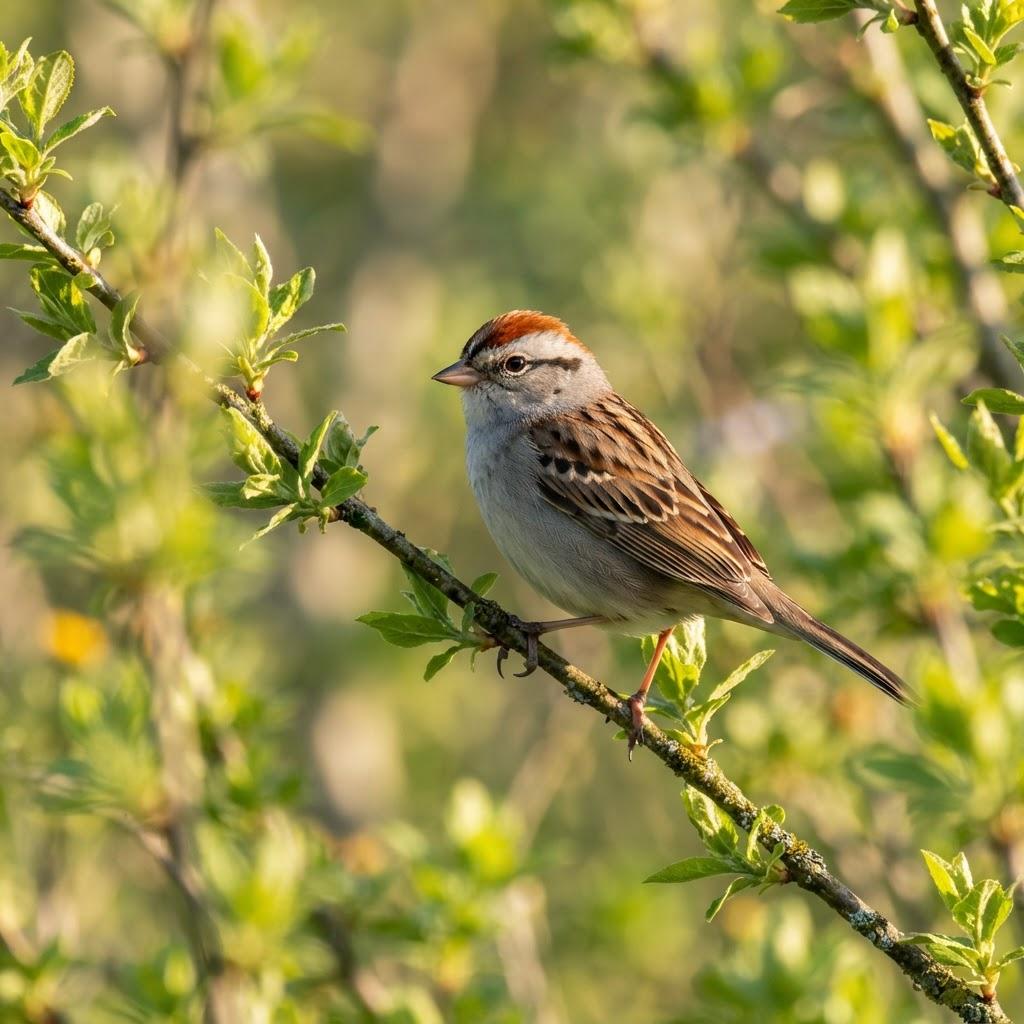
If you imagine the avian world as a high school, the Chipping Sparrow is the reliable, sharp-dressed kid who sits in the front row of class but is secretly plotting an escape to the playground the second the bell rings. These birds are tiny, clocking in at just a few grams, yet they carry themselves with the confidence of a raptor. With a distinct, bright chestnut-colored cap that looks like they spent way too much time perfecting their morning hair, they are easily recognizable even to the most amateur bird watcher. They are not the flashy, neon-colored tropical parrots of the world; they are the understated, chic professionals of the bird kingdom. Their vibe is strictly 'business-casual-cool.' You will often find them hopping across your manicured lawn with the frantic energy of someone who just realized they left their oven on at home. They have a gaze that seems to imply they know exactly where you hid the sunflower seeds, and they are not afraid to use their intense, black-striped eyes to judge your choice of garden landscaping.
Superpowers & Weird Abilities
While they might look like simple lawn-dwellers, Chipping Sparrows possess internal biological software that would make a smartphone engineer weep with envy. Their most impressive superpower is an internal magnetic compass that allows them to navigate thousands of miles during migration with the precision of a high-end GPS unit. They likely detect the Earth’s magnetic field through specialized proteins in their eyes that literally allow them to 'see' magnetic lines of force. Think of it as having an augmented reality map permanently overlaid on the physical world. Furthermore, their metabolism is a miracle of efficiency. These tiny creatures can process food and generate heat at rates that allow them to survive in environments that would send a human shivering for the radiator. Their wings beat at a frequency that allows for sudden, erratic changes in direction, essentially giving them the equivalent of sports-car-level handling in a vehicle the size of a ping-pong ball. It is high-octane biological performance in a very small package.
Drama, Personality & Feathered Chaos
Do not let the cute chestnut cap fool you; the Chipping Sparrow is an absolute titan of backyard drama. They operate with a level of territorial intensity that defies their actual body mass. If another sparrow dares to land on 'their' specific patch of clover, the Chipping Sparrow turns into a feathered buzzsaw, launching into a high-speed chase that looks like a miniature dogfight from a World War II movie. They are the ultimate back-seat drivers of the bird world, frequently hanging out near other, larger birds just to see if they can snag a dropped morsel of food. When the Cowbirds come around—those notorious birds that dump their eggs in other people’s nests—the Chipping Sparrow goes into full-blown 'defensive security detail' mode. They are remarkably vigilant, often spotting the infiltrators before they can pull off their parenting heist. It is a constant cycle of suburban skirmishes, and the Chipping Sparrow is almost always in the middle of the argument, loudly asserting their right to every crumb of millet in the ZIP code.
Bizarre Rituals & Quirky Habits
Chipping Sparrows have a social life that is arguably more complex than a prime-time soap opera. One of their most peculiar habits is 'anting,' where they will deliberately find a colony of ants and allow the frantic insects to climb all over their feathers. To the human eye, this looks like a bird having a very bad day, but in reality, they are using the formic acid produced by the ants to help rid their feathers of pesky parasites. It is essentially an all-natural, bug-fueled spa treatment that smells slightly like a vinegar factory. Furthermore, during the warmer months, you might catch them engaging in what looks like a frantic game of hopscotch across your patio. This is actually a tactical foraging maneuver; they jump into the air and snap at insects mid-flight with a precision that would impress a major league outfielder. They are weird, they are frantic, and they are constantly performing these odd little rituals that serve to keep their tiny, high-metabolism lives running smoothly.
Legends, Folklore & Human Stories
Throughout history, the small brown bird has been a constant companion to humanity, though the Chipping Sparrow specifically has a reputation as the quintessential 'neighbor.' While they might not be the heroes of grand ancient myths like the eagle or the raven, they have held a special place in the hearts of orchard owners and suburban dwellers for centuries. In rural folklore, the arrival of these birds was often seen as a sign that the ground had finally thawed enough for planting to begin. They were viewed as the 'farmers' friends' because of their voracious appetite for the pests that plague vegetable gardens. People used to tell stories of how the Chipping Sparrow would follow the farmer as they plowed the fields, waiting for the freshly turned earth to reveal a hidden buffet of grubs. They are the quiet, working-class heroes of the backyard, and their presence has always been a welcome, reliable indicator that life is blooming and the earth is doing exactly what it needs to do.
Mating: The Ridiculous World of Avian Dating
Dating in the world of the Chipping Sparrow is not for the faint of heart—it is a high-stakes performance art piece set to a soundtrack of rhythmic chipping. The male starts his campaign by establishing a singing perch that essentially acts as his professional stage. He will belt out a dry, mechanical trill that sounds remarkably like a sewing machine having an existential crisis. If a female deigns to show interest, the male launches into a bizarre 'butterfly-flight' display, where he flutters his wings with exaggerated, slow-motion grace to show off his plumage. If the female is impressed, they form a bond that lasts for the season. If not, she simply flies off to find a more melodious bachelor, leaving the poor male to continue his sonic construction work until someone else shows up. It is a ruthless, fast-paced dating scene where the most persistent singers generally get the best territories and the most impressive nesting sites.
Nesting: Master Architects and Lazy Slumlords
When it comes to construction, Chipping Sparrows are the perfectionists of the neighborhood, and they definitely do not fall into the 'lazy slumlords' category. They build incredibly delicate, cup-shaped nests that are masterpieces of engineering. Using a precise blend of fine rootlets, grasses, and occasionally animal hair—they have a real affinity for stealing hair from your neighbor's dog during grooming time—they weave a structure that is remarkably sturdy yet lightweight. They typically tuck these architectural marvels into the crotch of a tree branch or a thick hedge, making them notoriously hard to find even if you are standing two feet away. They are not into flashy decorations or grandiose designs; they are all about utility, strength, and structural integrity. Every twig is placed with calculated intent, resulting in a cozy, protective bowl that keeps their future offspring safe from the elements and the wandering eyes of local predators.
Raising Babies: The Screaming Food Disposals
Once the eggs hatch, the Chipping Sparrow household transforms into a chaotic, non-stop catering service. The babies are, in technical terms, essentially screaming, featherless stomachs on sticks. They are born with an insatiable hunger that requires the parents to make hundreds of trips back and forth from the nest every single day. The parents are the unsung heroes of the backyard, looking increasingly disheveled and frantic as they lug mouthfuls of caterpillars and beetles back to the nest. The chicks, for their part, show absolutely zero appreciation for the gourmet insect service, constantly opening their beaks wide and chirping with a volume that defies their size. This period of 'screaming food disposal' lasts for about two weeks before the fledglings finally decide to jump from the nest and face the world, usually with a level of coordination that suggests they learned how to fly approximately five minutes before takeoff.
Bird-Watching Travel & Local Hotspots
If you are on a quest to spot the elusive yet common Chipping Sparrow, you do not necessarily need a plane ticket to the middle of the Amazon. These birds are suburban connoisseurs. Your best bet is to hit up local botanical gardens or established city parks during the late spring. The Morton Arboretum in Illinois or the various birding hotspots along the Atlantic flyway offer fantastic opportunities to see them in their element. If you are in the western United States, check out the edges of fruit orchards or pine groves, where they congregate in large numbers to take advantage of the dense cover. The golden rule for spotting them is to listen for that rhythmic, monotone trill—it stands out against the more complex songs of other birds. Go early in the morning when the dew is still on the grass; they are most active when the ground is buzzing with the first wave of daily insect life.
Food, Feeder Hacks & DIY Projects
To turn your backyard into a Chipping Sparrow mecca, you have to ignore the cheap, dusty bags of birdseed filled with red milo—it is the bird equivalent of flavorless cardboard, and they know it. They are obsessed with black oil sunflower seeds, white proso millet, and crushed peanuts. If you want to get fancy, skip the mass-produced feeders and create a DIY 'stump feeder' by drilling shallow holes into a fallen log and packing them with a mixture of suet and seed. It mimics their natural foraging environment perfectly. Another pro-tip: leave a patch of your lawn slightly overgrown with tall grasses. They love the security of tall cover near a source of food. If you want to save money, buy seeds in bulk from local agricultural supply stores rather than expensive boutique shops. Native plants like sunflowers or native grasses provide a permanent, sustainable buffet that keeps them coming back without needing your constant intervention.
Seasonal Guides & "Crisis" Management
Seasonal changes mean a shift in the Chipping Sparrow’s lifestyle, and you should adjust your yard accordingly. In the spring, keep your feeders topped up because migration burns an incredible amount of fuel. As winter approaches, if you live in a colder region, these birds usually head south, but in temperate areas, providing high-fat suet is a life-saver for them. The biggest 'crisis' most people face is the annual 'fledgling panic.' Around mid-summer, you will see a fluffy, awkward-looking bird hopping around your yard that cannot fly well and seems totally lost. Please, leave it alone! It is a fledgling, not an orphan. The parents are watching from a nearby branch, screaming at you to keep your distance. Unless the bird is clearly injured or in immediate danger from a cat, the best thing you can do is back away, keep pets indoors, and let the parents handle the flying lessons.
Backyard Tech & Gadget Reviews
The world of backyard tech has exploded, and it is a game-changer for observing Chipping Sparrows. Smart feeders equipped with motion-activated cameras are fantastic for capturing high-definition footage of these fast-moving birds. Since Chipping Sparrows are shy around humans, an AI-powered camera can give you a 'spy-eye' view that you would never get with binoculars. However, be wary of cheap, poorly sealed cameras—bird feeders are wet, messy places, and moisture will kill cheap electronics fast. For window collisions, the biggest danger to these small birds, install simple, unobtrusive decals or UV-reflective film. It breaks up the reflection that confuses them into thinking your living room is a continuation of the forest. If you really want to level up, set up a cheap trail camera near a shallow birdbath; Chipping Sparrows love a clean, splashing water source, and you will get some incredible, candid photos without ever leaving your house.
How to Spot One & How It Is Doing
To identify a Chipping Sparrow in the wild, look for the 'three-color pattern': the clean, chestnut-brown cap on the head, a crisp black eye-line that looks like they applied eyeliner, and a white eyebrow stripe. They are smaller and leaner than the common House Sparrow, and they lack the messy, brown-streaked chest of their bulkier cousins. Their song is the dead giveaway—it is a dry, rapid-fire 'chipping' sound that sustains for several seconds. In terms of conservation, they are doing surprisingly well, largely because they have adapted so perfectly to human-altered landscapes. While many species are struggling, the Chipping Sparrow has found a way to thrive in our backyards and parks. You can help keep their population stable by planting native shrubs, providing a clean water source, and keeping your outdoor cats indoors. They are small, resilient, and utterly charming additions to the ecosystem, and they deserve all the sunflower seeds we can provide.