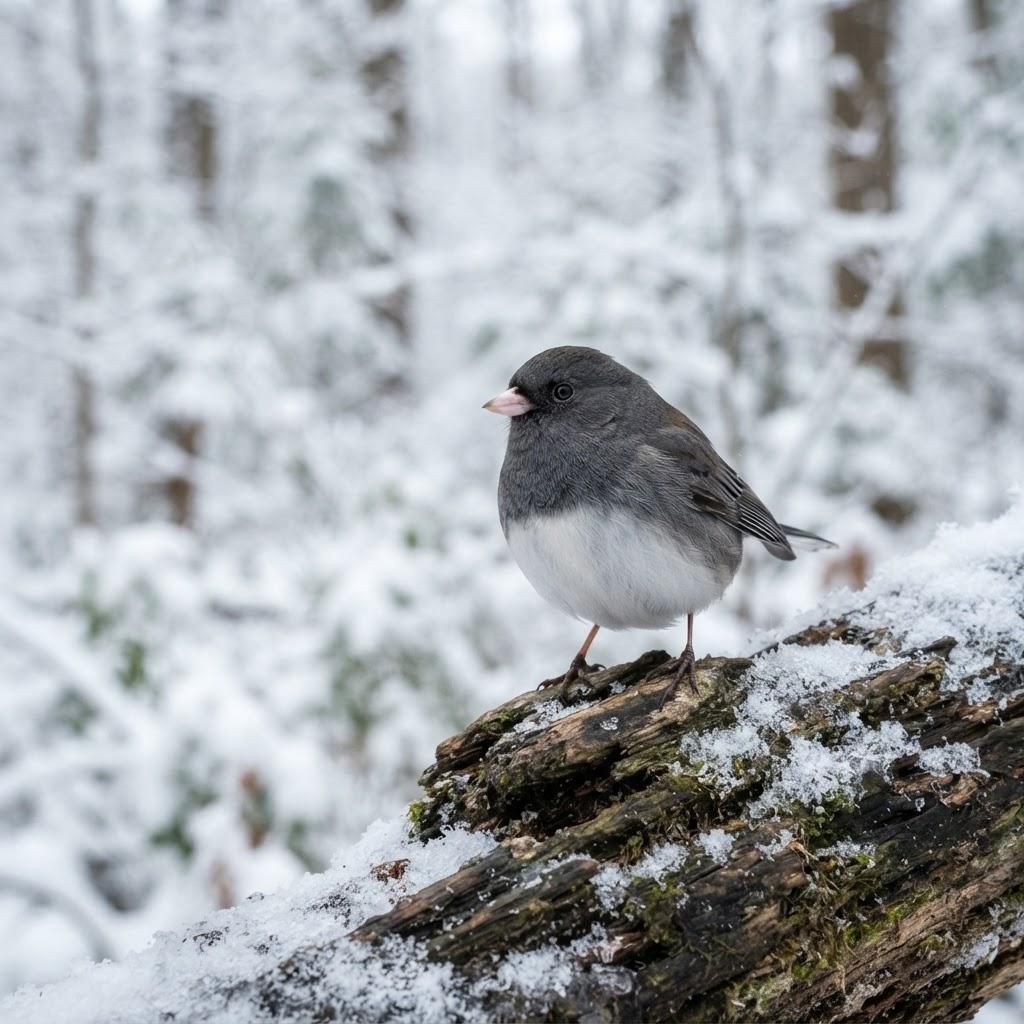
Junco hyemalis
Dark-eyed Junco
The Dark-eyed Junco is the ultimate winter houseguest that shows up when the weather turns cold and treats your backyard like a five-star dining resort. Known as the 'snowbird,' this dapper little charcoal-colored hopper is a master of blending in until it decides to hop right into your life.
Meet the Bird
Imagine a bird that looks like it is wearing a crisp, tailored charcoal-gray suit with a stark white vest—the Dark-eyed Junco is essentially the tiny, feathered businessman of the avian world. These birds are the unofficial heralds of the cold, famously referred to as 'snowbirds' because they seem to materialize on your lawn the exact moment the thermometer dips below freezing. They possess a delightful, bouncy personality that involves more hopping than flying, acting as if the ground is made of hot lava they simply cannot stay on for too long. While they might look like they are dressed for a formal gala, their vibe is pure, unpretentious backyard chaotic energy. They are perpetually busy, constantly foraging with a frantic intensity that suggests they have a very important board meeting to get to, yet they always find time to zip around the yard with their friends. You rarely see just one; they are the social butterflies of the winter birding season, preferring to hang out in small, gossiping gangs that constantly flick their white outer tail feathers like they are flashing secret morse code messages to one another.
Superpowers & Weird Abilities
While they might look like humble little sparrows who just wandered out of a monochromatic movie set, Juncos possess an internal navigation system that puts our best GPS technology to shame. They are migratory experts, utilizing a biological 'sixth sense' called magnetoreception. This essentially means they have tiny, specialized cells in their eyes or brain that allow them to actually 'see' the Earth's magnetic field lines, helping them navigate thousands of miles across the continent with the precision of a seasoned airline pilot. Furthermore, these birds are absolute masters of temperature regulation, a skill that is effectively their superpower. When the temperature drops, they don't just 'tough it out'; they engage in a process called shivering thermogenesis. By rapidly vibrating their pectoral muscles—think of it as a microscopic, high-speed gym workout—they generate significant body heat without moving a wing. It is like having a built-in furnace that turns their own muscles into a space heater, allowing them to survive nights that would freeze the wings off a less prepared creature.
Drama, Personality & Feathered Chaos
If you observe a feeder long enough, you will quickly realize that the Dark-eyed Junco is the local neighborhood drama queen, despite its unassuming size. While they are usually quite polite, once a high-quality sunflower seed is on the line, the gloves come off. You will often see them engaging in 'squeaky toy' arguments, where they puff up their feathers, spread their tails wide, and utter high-pitched, indignant chirps at anyone daring to get too close to their stash. They are not above a bit of light intimidation, especially when a fellow Junco accidentally invades their personal bubble. Their personality is a fascinating mix of gregarious group-think and intense, localized territorialism. They spend their days in a flock, chatting away like commuters on a train, but the second the group reaches a favorable seed pile, the camaraderie evaporates into a flurry of ruffled feathers and rapid-fire posturing. They aren't the bullies of the bird world, but they certainly know how to hold their own in a cafeteria-style food fight.
Bizarre Rituals & Quirky Habits
One of the most peculiar habits of the Junco is its obsession with ground-level exploration. Unlike birds that prefer the dizzying heights of the oak canopy, Juncos are essentially the floor-dwellers of the avian kingdom. You will frequently find them 'scratching'—a rhythmic, two-footed hop-kick maneuver they use to disturb leaf litter and reveal hidden seeds or bugs underneath. It looks like they are trying to do a complicated interpretive dance, but in reality, they are just professional foragers looking for a snack. Another bizarre behavior is their habit of 'dust bathing.' Instead of hopping into a puddle like a civilized bird, you might see a Junco throwing dry dirt over its back while frantically wiggling in a dry patch of sand. It might look like a messy disaster, but this is their way of keeping their feathers in tip-top, parasite-free condition. It is a quirky, dusty spectacle that showcases just how much these birds value their personal hygiene, even if they have to turn into a dirt-covered ball of chaos to achieve it.
Legends, Folklore & Human Stories
Throughout history, the arrival of the Dark-eyed Junco has served as a reliable, if somewhat ominous, calendar for rural communities. Because their migration is so tightly linked to the onset of winter, folklore often dubbed them 'snowbirds,' believing their appearance was a direct weather-prophecy sent by nature to warn of coming storms. In some old-timey agrarian cultures, the sudden appearance of a large flock of Juncos in the orchard was seen as a sign that the hearth fire needed extra logs and the root cellar needed extra vegetables. There isn't much in the way of grand mythology about them, which honestly fits their character; they are the 'working-class' heroes of bird folklore. They represent the quiet persistence of life through the harshest months. Unlike the grandiose eagle or the mysterious owl, the Junco is the bird of the people, a common visitor whose steady presence has provided comfort to generations of humans watching from their kitchen windows as the snow begins to pile up against the glass.
Mating: The Ridiculous World of Avian Dating
When spring finally rolls around, the Junco’s somber winter attitude undergoes a complete personality transplant. The males transition from quiet foragers into operatic crooners. Their courtship song is a fast, musical trill that sounds remarkably like a bouncing ping-pong ball—a sound that is surprisingly complex for such a small bird. During the dating phase, the male becomes an absolute show-off, performing a dance that involves dropping his wings, puffing out his chest, and performing a sort of 'side-step' shuffle to show off his white outer tail feathers, which he fans out like a miniature peacock. It is a high-stakes performance; if the female decides his trill isn't tuneful enough or his tail-fanning isn't symmetrical, she will simply fly away to the next branch, leaving him to trill his little heart out to an empty twig. It is a brutal, funny, and incredibly fast-paced dating game where the most persistent, loudest, and 'shiniest' dancer usually takes the prize.
Nesting: Master Architects and Lazy Slumlords
While some birds spend weeks obsessing over the structural integrity of their twig-mansions, the Junco is much more 'minimalist' in its architectural approach. They are strictly ground-nesters, which is a fairly bold strategy when you consider how many predators walk through the woods on four legs. They tuck their nests into shallow depressions in the ground, usually hidden under the drooping branches of a conifer, a log, or even a steep bank along a trail. The nest itself is a sturdy, cup-shaped structure made of grasses, moss, and rootlets, often lined with the softest materials they can find, like animal hair or fine grasses. Because the nest is on the ground, they have to be incredibly stealthy. They don't make a big show of entering the nest; instead, they often land a few feet away and walk the rest of the distance, trying to avoid creating a 'runway' that might tip off a hungry squirrel or a prowling neighborhood cat. It is a masterpiece of hidden engineering.
Raising Babies: The Screaming Food Disposals
Once the eggs hatch, the Junco parents effectively clock into a shift that lasts from dawn until dusk. A typical clutch produces three to four chicks, and these little balls of fluff are essentially walking, screaming stomachs. Because they grow at a blistering pace, they require a constant supply of protein-rich insects. The parents work in a tag-team rhythm, darting in and out of the nest site with their beaks stuffed with caterpillars, spiders, and beetle larvae. The chicks, meanwhile, haven't learned the meaning of manners; they spend their entire existence vibrating with excitement and gaping their bright-colored throats open whenever a parent arrives. It is a chaotic, frenetic period that lasts about two weeks before the fledglings are finally ready to hop out of the nest. The parents are absolute champions of multitasking, somehow keeping the nest clean, feeding the brood, and keeping an eye out for predators, all while trying not to lose their tiny bird-minds from sheer exhaustion.
Bird-Watching Travel & Local Hotspots
If you want to catch a Junco in its element, you have to follow the seasonal map. In the summer, you should head for the cooler, higher elevations of the Appalachian Mountains, the Rocky Mountains, or the vast, sprawling boreal forests of Canada. Great places to spot them during breeding season include the Great Smoky Mountains National Park or the thick, spruce-filled forests of Maine or the Pacific Northwest. If you are looking for them in the winter—which is their peak 'people-watching' season—they become widespread across almost the entire lower 48 states. Any local city park with a mix of pine trees and open lawn will host a flock during the cold months. Look for areas with leaf litter near the edges of wooded paths. They aren't hiding; they are everywhere, provided you bring a pair of binoculars and enough patience to stand still near a shrubby thicket while the temperature drops. They are the easiest birds to find, which is exactly why they are so beloved.
Food, Feeder Hacks & DIY Projects
Attracting Juncos is an exercise in catering to their specific 'ground-only' preferences. While some birds love hanging tubes, Juncos are much happier if you provide a tray feeder or even just scatter some high-quality seed directly on a clean patio or a large, flat rock. Avoid the cheap bags of mixed seed that contain mostly filler 'milo' or wheat, which Juncos will pick through and inevitably toss on the ground. Instead, splurge on white proso millet, black oil sunflower seeds, and hulled sunflower chips. To make a DIY 'Junco Magnet,' take a pinecone, slather it with bird-safe peanut butter, and roll it in a mixture of black oil sunflower seeds and cracked corn. Hang it low near a bush—not high in a tree—so they feel safe hopping over to grab a snack. If you want to go the natural route, planting native shrubs like serviceberry or dogwood provides a natural food source that will keep them coming back to your yard year after year.
Seasonal Guides & "Crisis" Management
The Junco calendar is a cycle of movement and adaptation. As winter hits, focus on keeping your birdbath from freezing; a solar-powered birdbath heater is a game-changer that makes your yard the most popular oasis in the neighborhood. When spring arrives and you notice the Juncos have suddenly vanished, don't worry; they are just retreating to their northern breeding grounds. Then comes the 'fledgling panic' season in mid-summer. If you see a young, awkward-looking bird on the ground that seems unable to fly, stop! Do not pick it up. It is likely a 'brancher,' a teenager of the bird world who is practicing its wing muscles. Unless it is clearly injured or in immediate danger from a cat, leave it alone. The parents are almost certainly nearby, watching from a tree and bringing it food. The best thing you can do is keep your distance, watch from a window, and let the cycle of nature do its beautiful, messy work.
Backyard Tech & Gadget Reviews
If you are a fan of 'birdie-tech,' the modern backyard is a goldmine. Smart feeders that use cameras to identify visitors are fantastic for Juncos because these birds are so common that you will get endless high-definition photos of their 'vests' and tail patterns. For those who want to see the action without interfering, a cheap motion-sensor trail camera placed near a brush pile or a ground-level feeder can provide hours of entertainment, catching the Juncos in their natural, secret life when you aren't around. The biggest tech-related issue is window collisions, which is a major risk for these fast-moving ground dwellers. To keep them safe, apply 'window film' or UV-reflective decals to your glass. These are invisible to humans but look like solid obstacles to birds, preventing them from trying to fly through what they think is a clear path to the forest. It is a simple, low-tech solution that saves lives and keeps your backyard a sanctuary rather than a hazard.
How to Spot One & How It Is Doing
Spotting a Dark-eyed Junco is remarkably easy once you know the 'tell.' Look for a bird that is clearly two-toned: gray on top, white on the bottom, with a distinct, pinkish-colored bill that looks like it has been dipped in berry juice. Listen for that signature 'clicking' sound or the rapid-fire trill when they are excited. Currently, the Dark-eyed Junco is listed as 'Least Concern' on the conservation scale, which is great news—they are thriving, highly adaptable, and doing quite well in human-altered landscapes. However, that doesn't mean we should take them for granted. The best way to help them is to keep your cats indoors, maintain some 'wild' areas in your yard with brush piles instead of obsessively cleaning every leaf, and provide clean water during the winter. By making these small adjustments, you ensure that these dapper little snowbirds will continue to brighten up your winter days for many seasons to come, one hop at a time.