Melospiza melodia
Song Sparrow
The Song Sparrow is the neighborhood troubadour with a voice that refuses to quit. This scrappy little master of melody is proof that you do not need to be big to run the backyard show.
Meet the Bird
If the bird world had a local pub, the Song Sparrow would be the regular sitting in the corner with a drink, singing songs about his glory days and looking for a fight with the guy at the next table. He is not the flashiest bird in the lineup—he does not have the neon plumage of a cardinal or the iridescent swagger of a hummingbird—but he possesses a kind of street-smart, brown-streaked charm that makes him a classic. Imagine a tiny, feathered brawler who wakes up at 4:00 AM not because he has a job, but because he is convinced the world needs to hear his latest experimental jazz composition immediately. He is the ultimate everyman of the avian world, found everywhere from high-end suburban gardens to the muddy, mosquito-ridden edges of a swamp. He is scrappy, opinionated, and has a fashion sense that can only be described as 'confused camouflage.' While other birds migrate thousands of miles to look for a better deal, the Song Sparrow is often a homebody who sticks around to guard his patch of weeds with the intensity of a suburban HOA president.
Superpowers & Weird Abilities
The Song Sparrow’s primary superpower is vocal versatility that would make a Broadway star weep with envy. While many birds have a singular, repetitive alarm clock chirp, the Song Sparrow is a musical polymath. Each individual male can learn and perform up to twenty distinct songs, each consisting of a complex arrangement of notes, trills, and buzzes. It is as if he is constantly juggling multiple playlists and deciding which one best suits his mood or the specific audience he is currently yelling at. This is not just a parlor trick; it is a vital biological adaptation. Their brains contain a highly specialized area called the High Vocal Center, which is literally enlarged during the breeding season to manage this massive musical library. It is like the bird equivalent of downloading a massive brain update right before a public performance. Furthermore, they can distinguish between their neighbors and complete strangers just by the rhythm of their songs, allowing them to save energy by ignoring the familiar guy next door while losing their minds over a new, unvetted intruder showing up in their shrubbery.
Drama, Personality & Feathered Chaos
If you look at the Song Sparrow and see a harmless little puffball, you have clearly never crossed one. These birds are the feathered equivalent of that tiny guy in a bar who starts a fight with the bouncer for no reason. During the spring, the Song Sparrow is the undisputed king of the shrubbery, frequently engaging in dramatic, aerial combat that looks less like a territorial dispute and more like a high-stakes, low-altitude dogfight. They are notoriously intolerant of other Song Sparrows invading their personal space, yet they have a weird, chaotic relationship with the Brown-headed Cowbird. The Cowbird is essentially the con artist of the bird world, sneaking into the Song Sparrow’s home to dump an egg and forcing the unsuspecting parents to raise a chick that will eventually grow up to be three times their size. The Song Sparrow knows something is wrong, but often they cannot stop the inevitable, leading to a hilarious and infuriating dynamic where the tiny parents scramble to feed a hungry giant who is effectively a roommate that refuses to pay rent or contribute to house cleaning.
Bizarre Rituals & Quirky Habits
One of the most peculiar habits of the Song Sparrow is their strange, bobbing flight pattern. When they move from one bush to another, they do not just glide elegantly; they flap their wings frantically and let their tail pump up and down like they are on a pogo stick. It looks incredibly inefficient, yet somehow it gets them exactly where they need to go. They are also masters of the art of 'skulking.' While they love to sing from high, exposed perches, the moment they feel watched, they drop into the tall grass and navigate through the underbrush like a spy in a B-movie. They also have a very distinct preference for water. While most birds are content with a quick splash in a birdbath, Song Sparrows often go into a state of total, frantic hydration. They will immerse themselves so deeply that they come out looking like a disheveled, soaking wet rag, seemingly unbothered by the fact that they can barely fly once they have successfully turned themselves into a soggy, brown tennis ball.
Legends, Folklore & Human Stories
Throughout history, the Song Sparrow has been the quiet witness to human existence. In some indigenous traditions, their persistent song was seen as a message from the earth, a reminder that the seasons are turning and life continues despite the challenges of winter. Unlike the loud, obnoxious crow or the brightly colored, mythologized robin, the Song Sparrow represents the 'ordinary' bird, the one that is always there for us. There is a certain humility in their lore—they are not the stars of the creation myths, but they are the background music to every legend. In the early 20th century, poets and naturalists often wrote about the Song Sparrow as the 'cheerleader' of the orchard, noting that even when the weather was grey and the mood was dour, the sparrow would still find a spot on a fence post to belt out a tune. They have become the unofficial mascot of resilience, a bird that proves you do not need to be a legendary eagle or a noble hawk to have your story told.
Mating: The Ridiculous World of Avian Dating
When a male Song Sparrow enters the dating market, his entire life becomes an intense, high-octane Broadway performance. He spends hours perched at the top of a twig, singing his heart out in a frantic attempt to prove to every female in a five-mile radius that he is the most genetically superior partner available. He creates a soundscape designed to impress, using complex trills that signal his fitness, his health, and his ability to hold a territory. If a female arrives, the courtship is not a subtle dance; it is a high-speed, fluttering chase through the thicket. He will fluff his feathers, spread his wings, and display his breast streaks like a guy showing off his new tattoo. The female is the ultimate critic. She wanders around the territory, inspecting the quality of the shrubbery and the potential food supply, effectively acting like a home inspector checking the foundation of a house. If she is not satisfied with his vocal range or the quality of his bush, she will simply fly away, leaving him to scream at the empty air until his next chance comes along.
Nesting: Master Architects and Lazy Slumlords
The Song Sparrow is a pragmatic builder. They do not strive for architectural beauty or complex, gravity-defying designs. Instead, they focus on stealth and utility. Their nest is typically a sturdy, cup-shaped structure tucked into a dense tangle of grass, a low shrub, or sometimes even hidden on the ground if the cover is thick enough. They use whatever is available: dried grasses, weeds, bits of bark, and occasionally some hair they managed to scrounge from a passing animal. It is not pretty, but it is effective. The interior is lined with fine, soft materials like rootlets or animal fur, making it a surprisingly cozy little den for the chicks. The cleverest part is the placement. By nesting deep within a thorn bush or a mess of vines, they create a natural fortress that is difficult for predators to penetrate. While the neighbors might build out in the open like they are trying to win an interior design award, the Song Sparrow is happy to live in a dark, messy, impenetrable bunker that keeps the kids safe from hungry neighbors.
Raising Babies: The Screaming Food Disposals
Once the eggs hatch, the parents are thrust into a world of relentless, high-speed servitude. A clutch of Song Sparrow chicks are essentially tiny, vibrating, featherless monsters that do nothing but beg for food from dawn until dusk. The parents are absolute heroes of efficiency, zipping back and forth with beaks full of caterpillars and insects, attempting to distribute food fairly while the chicks scream at the top of their lungs. The sheer volume of food a tiny bird consumes is staggering; it is essentially a game of 'how much biomass can I cram into this hole before it explodes.' The parents are constantly on edge, watching for hawks, snakes, and the dreaded cowbird. Once the chicks fledge, the chaos reaches its peak. You will see these awkward, stubby-tailed little balls of fluff tumbling through the bushes, unable to fly well, begging their parents for snacks while the parents try to teach them how to avoid becoming a cat’s dinner. It is a noisy, stressful, and messy couple of weeks that would make any human parent want to retreat to a spa.
Bird-Watching Travel & Local Hotspots
If you want to see a Song Sparrow, you do not need to book a flight to the Amazon or trek into the deep wilderness. In fact, if you go to a local marshland or city park anywhere in North America during the spring, you are almost guaranteed to hear one before you see one. They are the background noise of the continent. For a truly spectacular experience, head to the wetlands of the Pacific Northwest or the lush, green marshes of the Atlantic Coast. Places like the Bombay Hook National Wildlife Refuge in Delaware or the various wildlife management areas in the Willamette Valley in Oregon are hotspots where these birds thrive in the reeds. When you arrive, do not look for a bird standing prominently on a branch. Look for the movement in the lower third of the vegetation. Scan the fence lines that border wet meadows or the brambles at the edge of a garden path. They are creatures of the fringe, preferring the messy, neglected spaces where humans rarely tread, so leave the manicured trails and find the weediest spot you can.
Food, Feeder Hacks & DIY Projects
Song Sparrows are not the picky eaters of the bird world. They are the junk-food lovers who will settle for a balanced diet when they have to. In the wild, they consume a mix of seeds, grains, and an impressive amount of insects. If you want to lure them to your yard, skip the cheap, dusty millet that ends up on the ground and just attracts mice. Instead, invest in high-quality black oil sunflower seeds or white proso millet if you have a ground feeder. The best hack for attracting them is to create a 'brush pile' in the corner of your yard. Gather those fallen branches, old leaves, and dried stalks you were going to throw away and create a messy, natural habitat. They will flock to this because it feels like home. For a DIY project, take a pinecone, slather it in high-quality, xylitol-free peanut butter, and roll it in birdseed. Hang it near your low-lying shrubs. It is cheap, fun for kids, and provides the exact kind of high-energy snacks these busy little birds need to keep up their singing habits.
Seasonal Guides & "Crisis" Management
The Song Sparrow is a bird of all seasons. In the spring, they are the heralds, singing loudly to stake their claim before the competition arrives. As summer wanes, they become quieter, focusing on the grueling work of rearing multiple broods. When winter hits, you might notice their numbers seem to drop in northern areas, but many hardy individuals stay put. This is when your winter survival tactics really matter. Keep your birdbath clear of ice; a solar-powered de-icer is a game changer for these little guys, as they need to stay hydrated to keep their metabolic furnace running. If you find a 'fledgling' on the ground in May, resist the urge to 'rescue' it. If the bird has feathers, is hopping around, and looks slightly grumpy, it is likely a fledgling that is simply learning how to exist. The parents are almost certainly watching from a nearby tree, ready to bring it a mouthful of bugs. Unless it is clearly injured or in immediate danger from a cat, leave it alone. Your intervention is likely more stressful than the bird's situation.
Backyard Tech & Gadget Reviews
Modern technology has revolutionized the way we stalk—I mean, observe—our local birds. AI-powered feeders that send high-definition photos to your smartphone are fantastic for documenting the specific characters in your yard. Seeing a Song Sparrow in glorious 4K resolution reveals the intricate, russet-brown streaks on their chest that you might miss with the naked eye. However, the best tech is often the simplest. A cheap, weather-proof trail camera strapped to a stake near a birdbath will give you a private window into their daily rituals without you needing to stand outside in the rain. As for window collisions, which are a major danger for small, skittish birds like the Song Sparrow, the best solution is to break up the reflection. If your windows are essentially giant mirrors, the birds will fly into them. Use inexpensive window film, exterior screens, or even simple white tempera paint to create patterns on the glass. It is a small price to pay to ensure your yard remains a sanctuary rather than a death trap.
How to Spot One & How It Is Doing
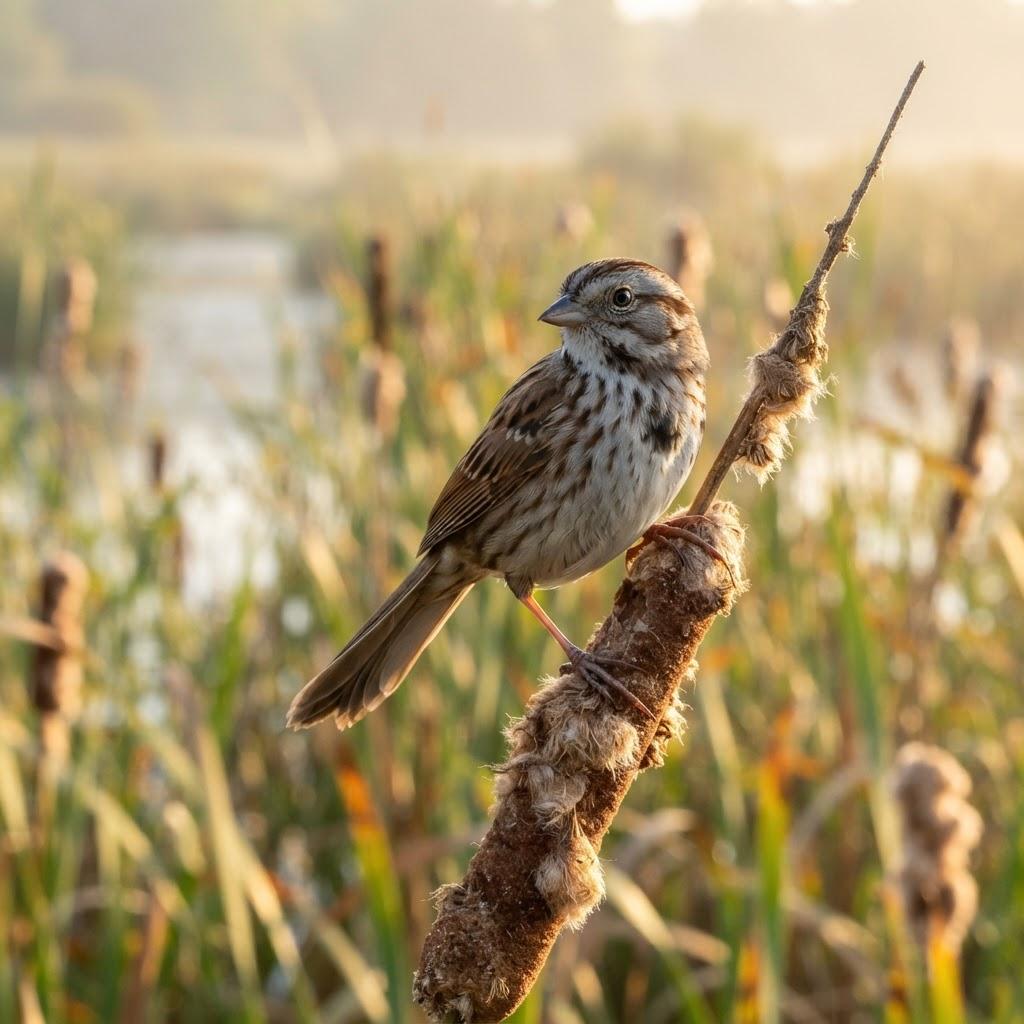
Identifying the Song Sparrow is a test of observation. Look for the 'messy' bird—a brownish, streaky sparrow with a central dark spot on its chest that looks like a smudge of mud. They have a stout beak, long, rounded tails, and a nervous, twitchy energy. If you hear a song that starts with two or three clear, loud notes followed by a jumbled, buzzy trill, you have found your culprit. Currently, the Song Sparrow is doing remarkably well, classified as 'Least Concern' globally. Their ability to adapt to human-altered landscapes, from backyards to suburban parks, has allowed them to thrive even as other species struggle with habitat loss. Their numbers are stable, which is a rare success story in the modern era. To help them continue their reign, simply leave a bit of your yard wild, avoid pesticides that wipe out their food supply, and keep providing fresh water. They are the tiny, constant, melodic heartbeat of the backyard, and with a little bit of space, they will continue to put on a show for free, every single morning.