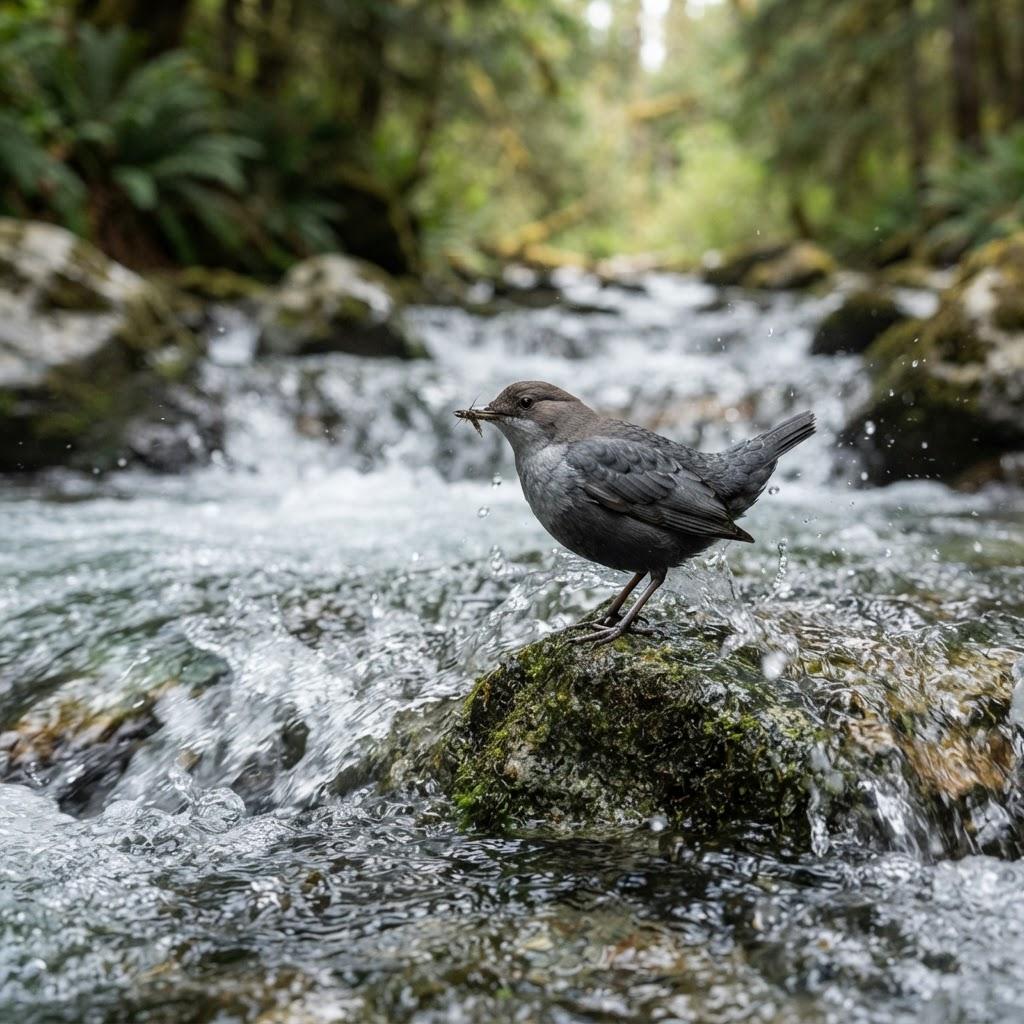
Cinclus mexicanus
American Dipper
Meet the American Dipper, a feisty, gray songbird that defies all avian logic by diving, swimming, and even walking on the bottom of icy mountain streams! Discover the extraordinary "superpowers" that allow this feathered rebel to hunt aquatic insects and small fish in its frigid, fast-moving world, proving that some birds truly march to the beat of a different drum—or, in this case, the rush of a mountain river.
Meet the Bird
Picture this: a small, unassuming gray bird, no bigger than a robin, perched on a rock amidst the roaring chaos of a frigid mountain stream. Now, prepare for the plot twist. This isn't just any bird; this is the American Dipper, and it's about to make every other bird look like a total wimp. While its feathered cousins are busy preening in trees or politely sipping from birdbaths, our dipper hero is about to plunge headfirst into the icy torrent, swim against the current, walk along the riverbed, and emerge moments later, completely unbothered, with a wriggling caddisfly larva in its beak. Yes, you read that right. This is a songbird that swims like a penguin, dives like a duck, and bobs like it's auditioning for a spot on a perpetually vibrating rock band. It’s the aquatic daredevil of the avian world, the feathered iconoclast who apparently missed the memo that songbirds are supposed to be delicate, tree-dwelling creatures. The American Dipper is a character straight out of an action movie, but instead of a cape, it wears a sleek, waterproof coat of feathers, and its 'lair' is a mossy nest tucked behind a waterfall. If you've ever thought birds were all fluff and tweets, prepare to have your mind blown by this pint-sized, stream-diving legend.
Superpowers & Weird Abilities
How exactly does a creature built for air conquer the unforgiving realm of rushing water? The American Dipper isn't just splashing around; it's practically a feathered submarine, and its biology is packed with 'superpowers' that would make James Bond's Q envious. First, its bones are denser than your average bird's, giving it built-in ballast, like tiny lead weights, to help it submerge without floating away. Second, its preen gland (also known as the uropygial gland) is gargantuan, producing an oily substance that it meticulously smears over every single feather. Think of it as a natural, industrial-strength waterproofing agent, creating a feathery wetsuit that keeps its skin perfectly dry and insulated even in icy depths. As if that weren't enough, it has a special transparent eyelid, called a nictitating membrane, that slides horizontally across its eye like a built-in pair of swimming goggles, allowing it to see clearly underwater while protecting its peepers from debris and the current's sting. And for propulsion? It 'flies' underwater! While most birds use their wings for aerial acrobatics, the dipper’s short, powerful wings become miniature paddles, flapping with incredible force to propel it against the fiercest currents. It’s like watching a feathered torpedo navigate an aquatic obstacle course, a truly mind-bending feat for a bird that also sings a lovely tune. Who needs a jetpack when you have specialized wings and a super-sized oil gland?
Drama, Personality & Feathered Chaos
When it comes to drama and personality, the American Dipper isn't exactly the life of the party, nor is it a feathered tyrant. Instead, it's more of a rugged individualist, a solitary prospector of the riverbed, fiercely devoted to its chosen stretch of churning water. Unlike the raucous squabbles of jays at a feeder or the sneaky theatrics of cowbirds, the dipper's 'chaos' is primarily internal—an unwavering commitment to its aquatic hunting grounds. Dippers are notoriously territorial, and while they might not engage in elaborate aerial dogfights, they will certainly make their displeasure known with a sharp call if another dipper dares to encroach on their prime fishing spots. Their most noticeable behavioral quirk, and the source of their common name, is the constant, rhythmic bobbing or 'dipping' motion they perform while perched. It’s like they’re perpetually doing tiny, avian squats, an almost involuntary act that makes them look like they're on a caffeine high or have an endless supply of nervous energy. Scientists aren't entirely sure why they do it – maybe it helps them spot prey in the turbulent water, or perhaps it's a way to signal their presence, or perhaps it's just their way of staying limber. Whatever the reason, this ceaseless dipping, combined with their solitary nature and unwavering focus on their watery domain, gives them the vibe of a dedicated, slightly eccentric, but undeniably tough, river guardian. They're not here for your drama; they're here to catch bugs.
Bizarre Rituals & Quirky Habits
The American Dipper’s life is a masterclass in embracing the weird, making it a truly captivating subject for any nature enthusiast. Beyond their famous underwater expeditions, their most apparent and utterly charming 'quirk' is that ceaseless, almost compulsive bobbing. Imagine a miniature feathered boxer, constantly on its toes, bouncing with nervous energy, or perhaps a tiny punk rocker headbanging to the roaring soundtrack of the stream. This isn't just a casual twitch; it's a continuous, almost trance-like dip and rise of their entire body, making them instantly recognizable. While the exact purpose remains a topic of scientific debate (is it to improve underwater vision by breaking the surface tension? A communication signal? Just a tic?), it adds immense character to an already extraordinary bird. But wait, there's more! While most songbirds fall silent or migrate south when winter's icy grip descends, the American Dipper says, 'Nope!' and actually sings *more* often. Its loud, warbling, and surprisingly complex song can often be heard echoing over the roar of a partially frozen waterfall or alongside snow-choked riverbanks. It’s like a tiny feathered troubadour defiantly serenading the bleakest of winter landscapes, a bizarre and beautiful ritual that speaks volumes about its resilience and unique spirit. This year-round vocal enthusiasm, combined with its constant dipping and aquatic hunting, solidifies the dipper's status as one of nature's most endearing and wonderfully eccentric performers.
Legends, Folklore & Human Stories
Unlike charismatic megafauna or birds with striking plumage, the humble American Dipper often flies under the radar of widespread human folklore. It doesn't feature prominently in ancient European myths or widespread fables, perhaps due to its rather specific, rugged habitat and unassuming gray attire. However, its quiet tenacity and unique lifestyle have certainly earned it respect, if not grand mythological status, among those who live alongside it. Indigenous peoples of the American West, who have long depended on the same pristine mountain streams as the dipper, undoubtedly held a deep awareness of this fascinating bird. While specific widespread legends are hard to pinpoint, its presence would have been a strong indicator of clean, healthy water—a vital resource. Early naturalists and mountain explorers, often braving harsh conditions, would have been struck by the dipper's resilience, a small bird thriving where others would perish. Imagine a solitary prospector, panning for gold in a remote stream, finding a moment of quiet camaraderie with a dipper diving nearby, a shared understanding of the unforgiving beauty of the wilderness. Today, the dipper serves as a living barometer for environmental health. Birdwatchers and conservationists see its presence as a testament to clean, unpolluted waterways. Its relatively stable conservation status (for now) is a quiet human story of successful, albeit often unseen, efforts to protect the wild places it calls home. So, while it may not have its own constellation or a grand epic poem, the American Dipper’s story is woven into the fabric of mountain life, a symbol of wildness and the purity of untamed rivers.
Mating: The Ridiculous World of Avian Dating
Forget the elaborate tail feathers of a peacock or the intricate dances of a bowerbird; American Dipper dating is more about proving your worth in a rugged, watery world. This isn't some flamboyant avian disco; it's more like a subtle, yet intense, demonstration of resourcefulness and dedication. The male dipper, like a true riverfront property mogul, stakes out a prime territory along a fast-flowing stream, ensuring it has abundant food and suitable nesting sites (often a rocky overhang or a sheltered spot behind a waterfall). His primary pick-up line? A robust, clear, and surprisingly loud song that he broadcasts frequently, often perched atop a prominent boulder, attempting to cut through the roar of the rushing water. He’s essentially saying, 'Hey, lady dipper, listen to my pipes! I've got prime real estate and a steady supply of aquatic snacks!' When a female arrives, he might engage in a brief, rather understated courtship display, perhaps a slight fanning of the tail or a deeper bow. The female isn't looking for flashy moves; she's assessing his ability to provide, protect, and survive in this challenging environment. If she approves of his song, his territory, and his general 'dipper-ness,' she might join him, and together they'll embark on the next phase of their aquatic romance: building a home that can withstand the fiercest mountain elements. No silly love songs, just a serious commitment to a life by the water's edge.
Nesting: Master Architects and Lazy Slumlords
When it comes to nesting, the American Dipper is definitely in the 'Master Architect' category, but with a clever twist: its engineering genius is all about camouflage and strategic placement. You won't find these birds slapping together a flimsy three-stick platform like some avian slumlords (looking at you, mourning doves). Oh no, the dipper builds a fortress, a veritable secret hideout worthy of a spy thriller. Their nests are large, dome-shaped structures, crafted primarily from lush green moss, often lined with grass and leaves on the inside. The brilliance lies in their location: almost always right beside or over the water, frequently tucked into crevices in rock faces, under bridges, or, most spectacularly, *behind* waterfalls. Imagine the sheer audacity! A bird building its nursery where it’s perpetually misted and dampened by a roaring cascade, perfectly camouflaged against the wet, mossy rocks. It’s like setting up your nursery behind Niagara Falls, but somehow making it cozy and secure. This strategic placement offers incredible protection from predators like raccoons, snakes, and even some birds of prey, who are less likely to brave the treacherous, slippery, and noisy environment. The mossy exterior isn't just for looks; it helps the nest blend seamlessly into its damp surroundings, making it incredibly difficult for prying eyes to spot. These dipper domes are marvels of natural engineering, ensuring the next generation of aquatic acrobats has the safest, most dramatic start to life possible.
Raising Babies: The Screaming Food Disposals
Once the dipper's mossy fortress is complete, and the 3-6 pristine white eggs hatch, the real chaos begins. Forget quiet contemplation; raising baby dippers is a full-throttle, 24/7, high-stakes culinary delivery service. These tiny chicks, initially blind and helpless, quickly transform into insatiable, gaping maws, whose sole purpose in life is to loudly demand more food. It's like having a miniature, highly demanding, feathered food disposal unit that never stops screaming for refills. Both parent dippers become a blur of activity, tirelessly diving into the icy stream, snatching up caddisfly larvae, mayfly nymphs, and tiny fish, then whisking them back to the nest. They're constantly battling the strong currents, dodging obstacles, and performing their underwater ballet, all to satisfy the relentless appetites of their offspring. The parents will make hundreds of foraging trips a day, burning through calories at an astonishing rate. Imagine performing Olympic-level swimming, diving, and hunting for 16 hours a day, just to keep your demanding teenagers fed! The chicks grow at an astounding pace, fueled by this endless stream of protein. In just about 20-25 days, these once-helpless fluffballs will fledge, already possessing the innate dipping motion and, soon after, the incredible ability to plunge into the very same icy waters that their parents call home. It’s a testament to extreme avian parenting in an extreme environment, proving that even the most serene-looking birds have a chaotic, demanding family life.
Bird-Watching Travel & Local Hotspots
So, you're ready to witness this feathered marvel in its natural element? Excellent choice! Unlike your average backyard bird, the American Dipper isn't going to show up at your feeder. To find this aquatic adventurer, you need to think clear, cold, and moving water. Your best bet is to head to the majestic mountain streams and rivers of Western North America. They stretch their range from the snowy reaches of Alaska and Canada, through the spine of the Rocky Mountains in the United States, all the way down into Mexico and Central America. Think national parks like Rocky Mountain National Park in Colorado, where the Big Thompson River or Fall River offer prime dipper viewing opportunities, or the breathtaking scenery of Yosemite National Park in California, particularly along the Merced River. Many streams throughout the Pacific Northwest, like those in Olympic National Park or along the Columbia River Gorge, are also fantastic spots. The key is to look for pristine, fast-flowing water, often with rocky banks, waterfalls, or even just plenty of submerged boulders where their invertebrate prey likes to hang out. The best times are generally year-round, as these birds don't migrate, but autumn and winter can be particularly rewarding as their gray plumage stands out more against snow-dusted landscapes. Just remember to bundle up, bring your binoculars, and be patient. Find a quiet spot by a rushing stream, listen for its surprisingly loud song over the water’s roar, and scan the rocks—that constant bobbing motion is often the first giveaway.
Food, Feeder Hacks & DIY Projects
Alright, here's the crucial 'feeder hack' for the American Dipper: there isn't one. Don't waste your precious birdseed, suet, or even that fancy nectar concoction. This isn't a bird that's going to casually drop by your backyard feeder for a snack. The dipper is a highly specialized aquatic hunter, and its diet consists almost exclusively of invertebrates found in the cold, clear, fast-moving water it inhabits. We're talking caddisfly larvae, mayfly nymphs, stonefly nymphs, small fish, and fish eggs. Think of it as a gourmet chef who only prepares meals from ingredients harvested from a specific, high-altitude river. So, what *can* you do? Instead of trying to lure them to your feeder, your efforts should be focused on supporting their natural pantry: healthy, unpolluted mountain streams. This means advocating for clean water initiatives, avoiding the use of pesticides and herbicides that can wash into waterways, and promoting the preservation of riparian (riverbank) habitats. While you can't put out a dipper-specific feeder, you can still be a bird hero! For your other backyard birds, ditch the cheap filler seeds like red milo that only attract aggressive starlings and squirrels. Invest in black oil sunflower seeds, Nyjer (thistle) for finches, and good quality suet cakes. Want a fun DIY? Make a natural suet log by drilling holes in a fallen branch and stuffing them with a mixture of peanut butter, cornmeal, and birdseed. But for the dipper, the best 'DIY project' is simply appreciating and protecting the pristine wild rivers they call home.
Seasonal Guides &
Crisis