Turdus migratorius
American Robin
The American Robin is the charismatic neighborhood celebrity of the bird world, known for its iconic orange chest and relentless lawn-patrolling antics. Far from a simple garden visitor, this bird is a tough, berry-loving survivor that treats every suburban lawn like its own personal treasure hunt.
Meet the Bird
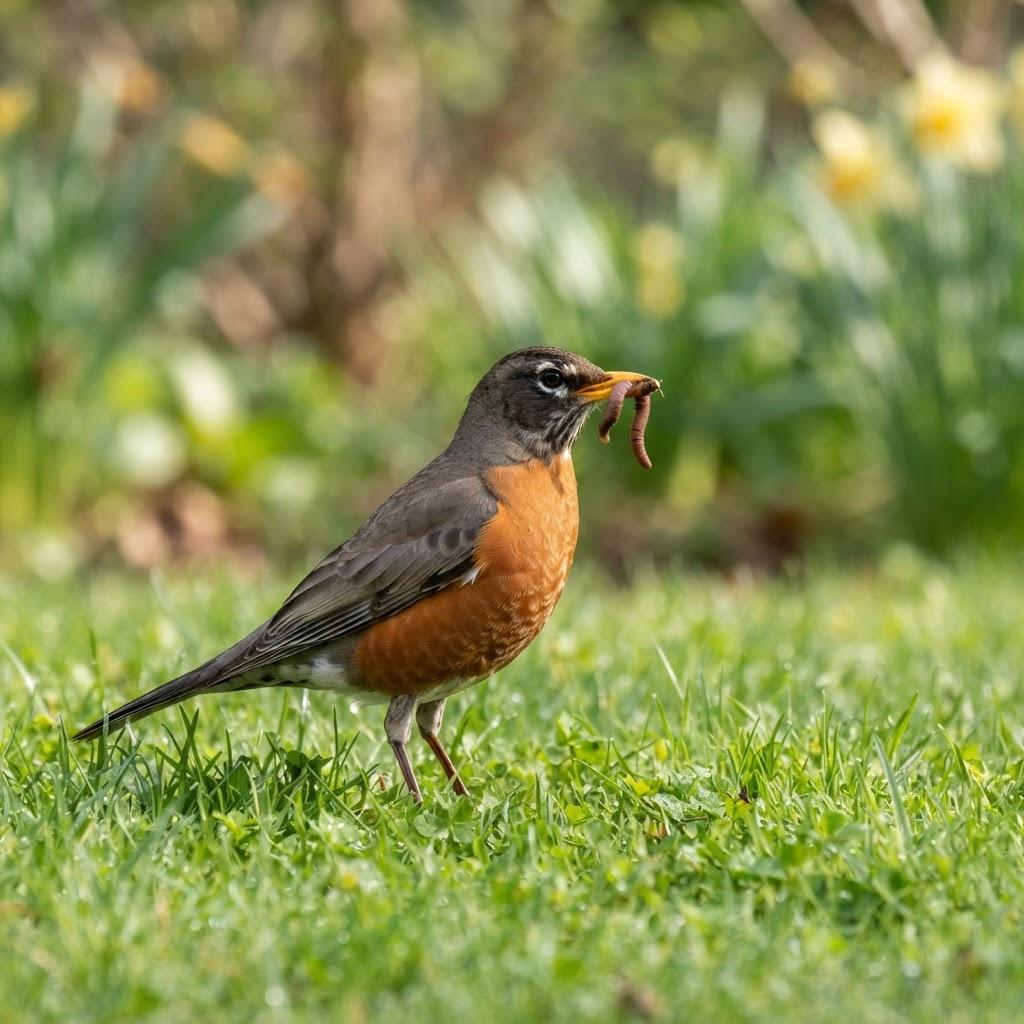
If the American Robin were a character in a high-stakes neighborhood drama, it would be the busybody resident who knows everyone’s business and spends all day aggressively patrolling the property line. With a bright, brick-red chest that acts like a flashy neon sign and a confident, head-cocked swagger, the robin is the quintessential sign that winter has finally kicked the bucket. These birds aren't just pretty faces; they are essentially feathered lawn mowers that never take a day off. Whether they are frantically tugging an earthworm out of the soil like a game of tug-of-war or shouting their cheerful 'cheerily-cheer-up' song at dawn, they command attention. They are the bird world’s equivalent of a reliable morning alarm clock that you can’t hit snooze on. While other birds might play it cool and elusive, the American Robin is out there in the open, owning the sidewalk and staring you down as if to ask if you’re going to finish that sandwich.
Superpowers & Weird Abilities
While it might seem like just a regular neighborhood bird, the American Robin possesses a biological toolkit that would make a secret agent blush. Their most impressive feat is their 'worm-vision'—and no, it isn't just about sharp eyesight. Robins have a keen ability to detect vibrations and subtle soil movements, allowing them to pinpoint exactly where an earthworm is hiding beneath the grass. Their eyes are placed perfectly on the sides of their head to provide a massive field of vision, which is great for spotting predators, but they often tilt their heads to the side to use their best eye to inspect the dirt for movement. They also have an incredibly efficient digestive system that acts like a high-speed processor, allowing them to turn a massive volume of berries and bugs into pure energy for flying and singing. It’s like having a jet engine inside a body the size of a tennis ball, built entirely for speed and stamina.
Drama, Personality & Feathered Chaos
Robins are the neighborhood tough guys who aren't afraid to throw down if a rival steps onto their turf. During the breeding season, a male robin will look at its own reflection in a window or a shiny car bumper and decide that this 'intruder' is the enemy. They will spend hours attacking the glass, wings flapping and beak tapping, trying to defend their territory from a bird that literally doesn't exist. It is pure, high-octane drama. They are also incredibly protective parents, and if a stray cat, a hawk, or even a curious human gets too close to their nest, they will sound the alarm with a high-pitched, frantic chattering noise that sounds like a tiny feathered siren. This bird isn't just surviving in your backyard; it is actively managing it, monitoring the perimeter, and engaging in petty territorial disputes that would make a reality show producer weep with joy.
Bizarre Rituals & Quirky Habits
Have you ever seen a bird acting like it had one too many margaritas? That’s likely a robin that found a stash of fermented berries. In late winter and early spring, robins often feast on leftover fruits like holly berries or crabapples that have started to ferment, leading to some truly hilarious wobbling and erratic flight patterns. It’s a bird’s version of a Friday night party gone wrong. Another weird habit is 'anting,' where a robin will purposefully find a colony of ants and sit right on top of them, letting the ants crawl over its feathers. Why? It sounds miserable, but the ants release formic acid, which acts as a natural pesticide and helps the bird rid itself of mites and parasites. It is basically the avian equivalent of an expensive trip to the spa, only much pricklier and significantly more aggressive.
Legends, Folklore & Human Stories
The American Robin has long been heralded as the official harbinger of spring. In folklore, seeing that first robin of the year was a major cultural event, signaling that the grip of frost was finally broken and life was returning to the land. Native American legends often depict the robin as a hero or a bringer of fire, and European settlers famously named the robin after the European Robin, even though they aren't actually closely related at all—they just happened to share the same ruddy, orange-breasted vibe. This naming mix-up is one of the most famous identity crises in bird history. Throughout the centuries, humans have looked to the robin as a symbol of hope and renewal. It is a bird that bridges the gap between the wild forest and the manicured suburban lawn, acting as a constant, colorful companion to our domestic lives and reminding us that nature is always just outside the front door.
Mating: The Ridiculous World of Avian Dating
The courtship ritual of the American Robin is a dramatic affair that puts human dating apps to shame. It begins with the male puffing out his chest to show off those vibrant orange-red feathers, essentially saying, 'Look at my fitness, look at my glow.' He’ll perform a series of dances, fluttering his wings, singing melodious songs, and chasing the female around the yard in a high-speed game of tag. The female, however, is the one in charge. She plays it cool, observing the male’s song quality and his ability to find food. If he isn't providing enough high-quality snacks or if his singing voice doesn't have that 'x-factor,' she will simply fly away, leaving him to perform his routine for an empty lawn. It is a harsh, fast-paced dating scene where only the most energetic, well-fed, and persistent males stand a chance at securing a long-term partner for the season.
Nesting: Master Architects and Lazy Slumlords
When it comes to home building, the female robin is an absolute engineering genius. She constructs her nest using a sturdy foundation of coarse twigs and grass, but here’s the kicker: she uses a specialized cup of mud to act as 'bird concrete.' She gathers mud from your driveway or a local puddle, spreads it into the nest with her breast, and packs it down until it creates a rock-solid, waterproof structure. It is a masterpiece of structural engineering that keeps her babies warm and dry during spring thunderstorms. While some birds are notorious for throwing together a pile of sticks that falls apart at the first gust of wind, the robin’s nest is built to last. It is a sophisticated, bowl-shaped nursery lined with soft, dried grass to ensure maximum comfort for the upcoming brood. They truly put the 'home' in 'home sweet home,' even if that home happens to be tucked into the crotch of a tree.
Raising Babies: The Screaming Food Disposals
Once the eggs hatch, the peace and quiet of your backyard vanishes, replaced by the relentless, high-pitched squawking of baby birds. A pair of robins might raise two or even three broods in a single season, meaning they are working overtime throughout the spring and summer. The chicks are essentially bottomless pits with feathers. Both parents engage in a frantic relay race, flying back and forth with beaks stuffed full of earthworms and insects to shove into the gaping yellow maws of their offspring. The babies are remarkably loud, acting as if they haven't eaten in weeks even though they were fed ten minutes ago. Parenting for a robin is a test of sheer exhaustion. Within about two weeks, these tiny, screaming monsters are ready to hop out of the nest as fledglings, spending a few awkward, clumsy days on the ground learning how to be birds while the parents hover nearby, ready to dive-bomb anyone who gets too close.
Bird-Watching Travel & Local Hotspots
If you are on a mission to see the American Robin, you honestly don't have to go far. This bird is arguably the most successful urban bird in North America, thriving in almost any environment with trees and grass. If you want to see them in their absolute glory, head to a large public park in the midwestern United States during the early spring. Places like Central Park in New York or the green spaces of Chicago are absolute magnets for migrating robins. Look for fresh, green lawns—that’s their favorite buffet. Early morning is the golden hour for robin spotting, as they are most active when the ground is cool and the worms are near the surface. You’ll find them running a few feet, stopping abruptly to listen to the dirt, and then pouncing. It is a spectacle that happens on millions of lawns every single day, turning every local city park into a world-class birding destination.
Food, Feeder Hacks & DIY Projects
While robins are famous for loving worms, they are actually omnivores that spend a huge portion of their lives eating fruit. If you want to attract them to your yard, skip the cheap bags of millet that just attract starlings and house sparrows. Instead, offer them things they actually crave. You can set out mealworms in a flat tray feeder, which is like a five-star steak dinner for a robin. During the colder months, they go crazy for fruit, so try putting out halved apples, orange slices, or even dried berries on a platform feeder. A great DIY project is to plant native shrubs like serviceberry, holly, or dogwood; these provide a natural, year-round grocery store for the birds. A simple birdbath is also a must-have, as robins love to splash around, and a clean, shallow bath will bring them into your yard even when there are no feeders around.
Seasonal Guides & "Crisis" Management
The robin’s year is a seasonal roller coaster. In spring, they are the first to arrive at the party, and you can help them by keeping your birdbath ice-free. When summer hits, the biggest 'crisis' is the fledgling panic: you might see a fuzzy, short-tailed bird hopping on your lawn, looking like it’s struggling. Don't panic and try to 'rescue' it! This is a fledgling learning to fly, and the parents are almost certainly watching from a nearby branch, ready to defend it. Leave it alone unless it is clearly injured or in immediate danger from a pet. During winter, robins often move into large, nomadic flocks, roaming the countryside looking for fruit trees. To help them survive freezing temps, keep your birdbaths clear of ice, as birds need to keep their feathers clean to maintain their natural, built-in insulation against the cold.
Backyard Tech & Gadget Reviews
If you want to get up close and personal without spooking the birds, modern tech has your back. AI-powered smart feeders, like the ones that notify your phone when a visitor arrives, are fantastic for robins because these birds are bold enough to land right on the camera lens. Just make sure to keep the food tray clean! For window collisions, which are a major danger for birds, skip the hawk silhouettes—birds aren't that easily fooled. Use window decals or 'bird tape' that creates a pattern visible to birds but barely noticeable to you, allowing them to see the glass as a solid barrier. If you really want to see what happens in your yard at night, a cheap, motion-activated trail camera pointed at a pile of berries or a suet log can show you a secret world of nocturnal creatures, though the robin will likely be the first one back at the camera's station the moment the sun comes up.
How to Spot One & How It Is Doing
Spotting an American Robin is easy once you know what to look for: look for that unmistakable rusty-orange chest, a dark gray-brown back, and a white, broken eye-ring that makes them look perpetually surprised. They aren't particularly shy, so you can often get a decent look if you remain still. Their song is a classic, flute-like whistle that is often transcribed as 'cheerily-cheer-up, cheer-up.' Conservation-wise, the American Robin is doing fantastic. In fact, they are thriving alongside humans, benefiting from our love of lawns and berry-producing shrubs. They are one of the most common birds in North America, which is a rare success story in the modern world. To help them keep thriving, minimize pesticide use on your lawn—you want those worms to be healthy for your backyard celebrity—and keep creating habitat by planting native trees. They are our neighbors, our alarm clocks, and our connection to the wild, and they aren't going anywhere anytime soon.