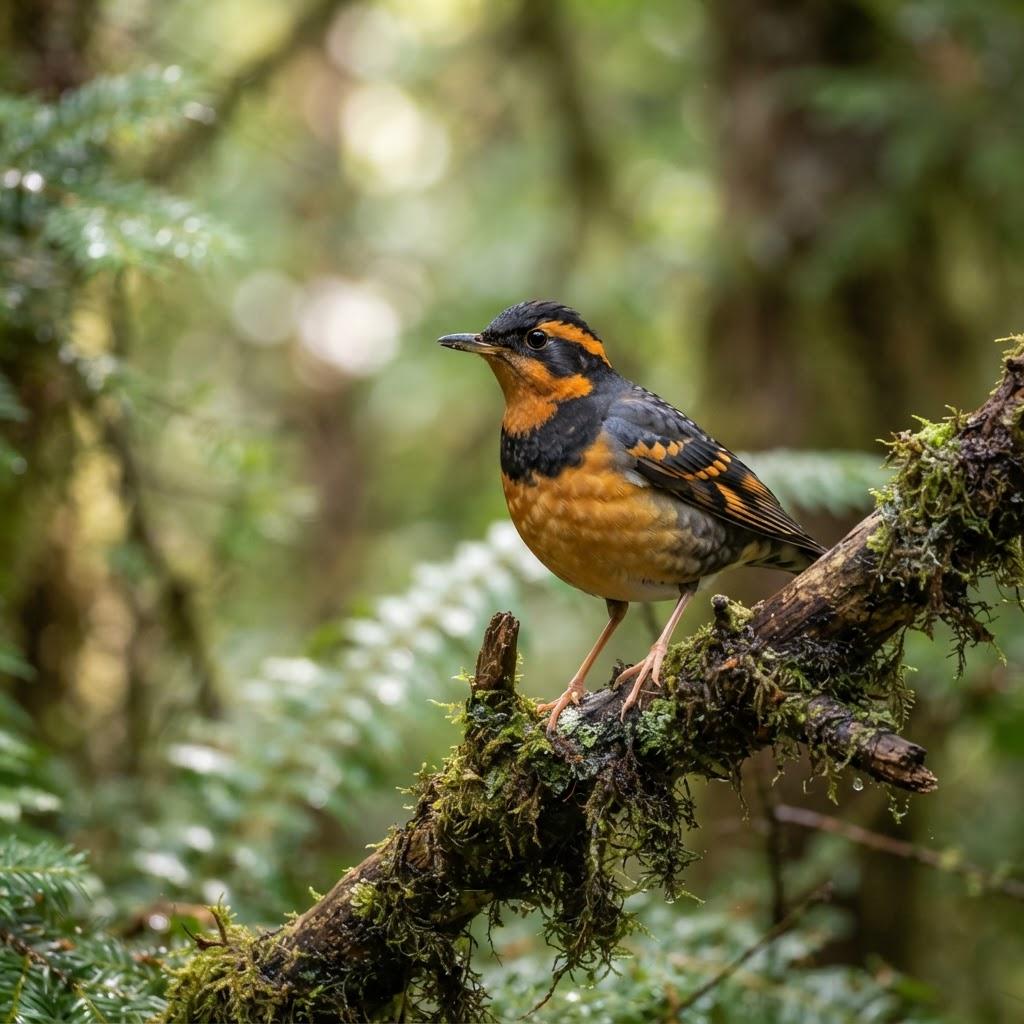
Ixoreus naevius
Varied Thrush
The Varied Thrush is a striking, orange-and-black woodland phantom that looks like a fancy, paint-splattered cousin of the American Robin. With a haunting, otherworldly whistle, this forest-dweller brings a touch of mysterious elegance to the damp shadows of the Pacific Northwest.
Meet the Bird
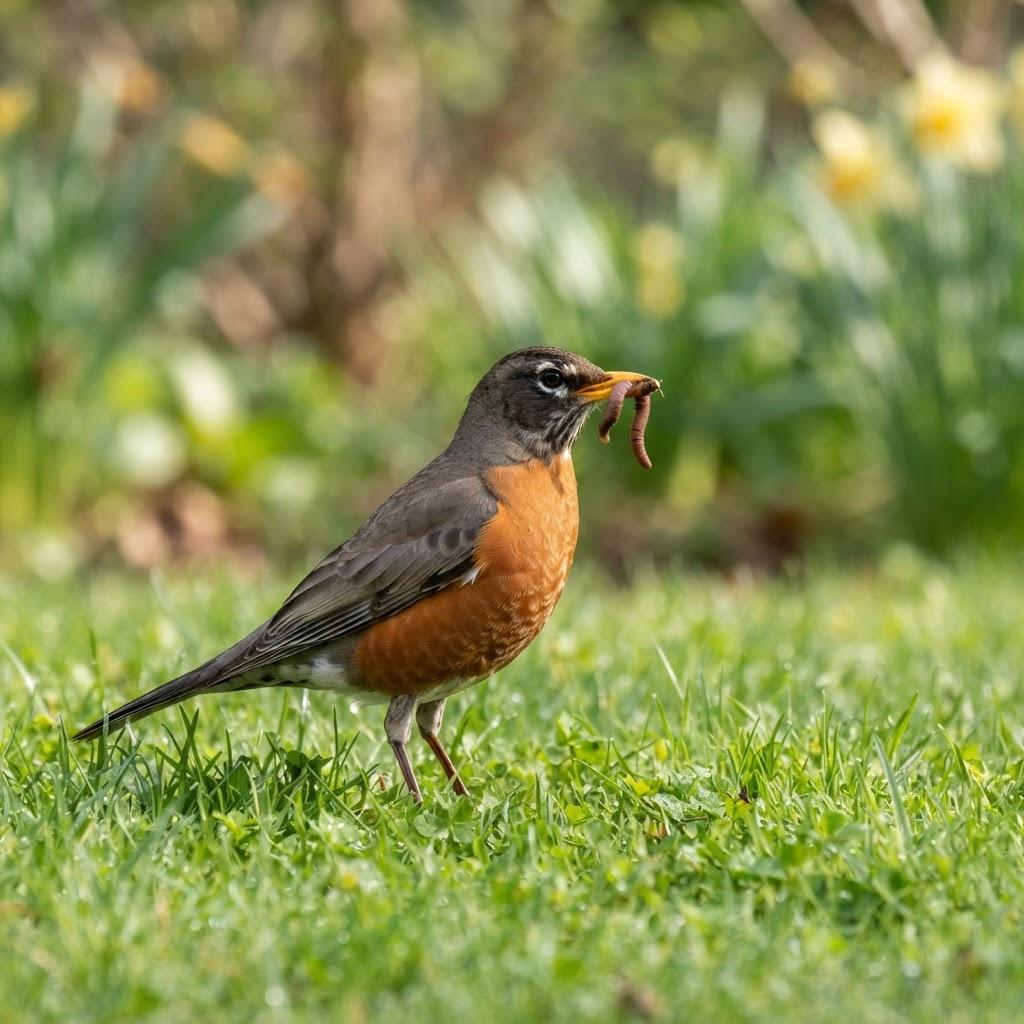
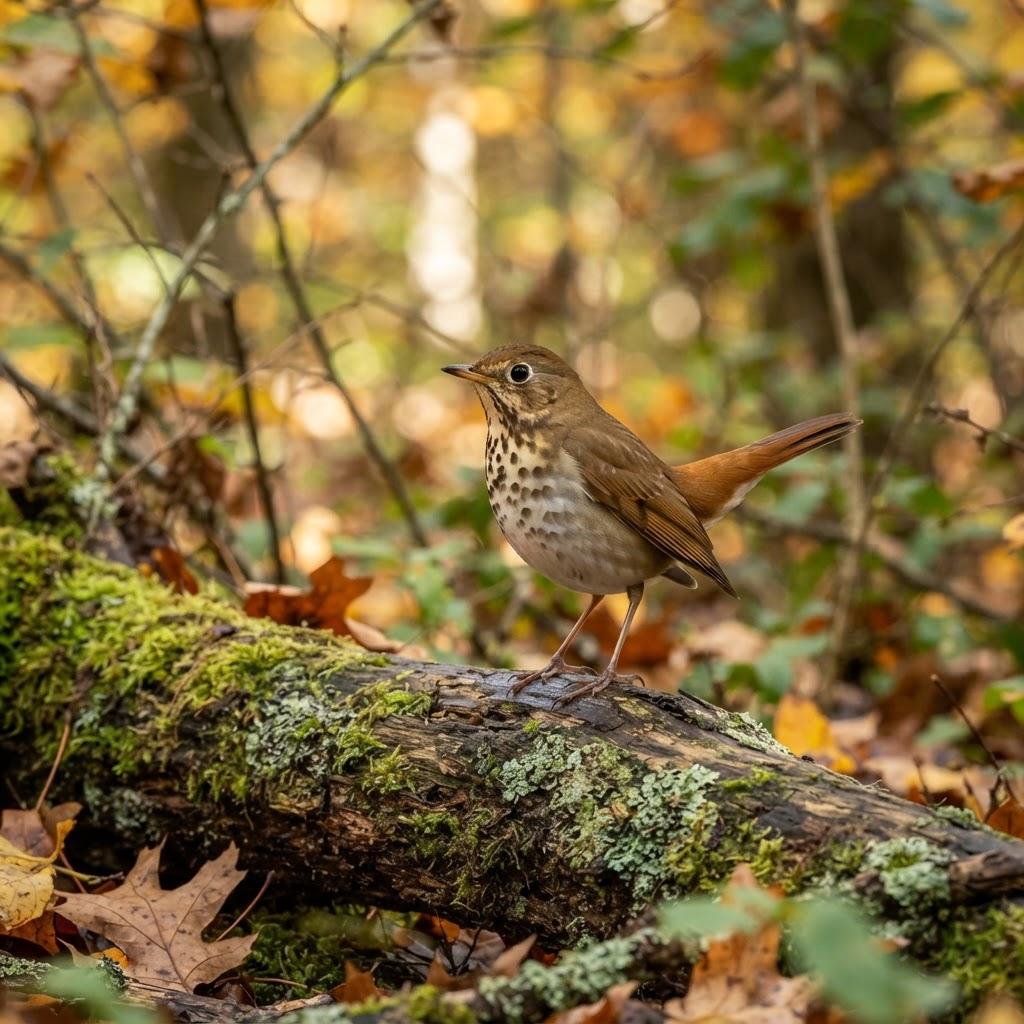
Imagine you are strolling through a dark, mossy rainforest, the kind that looks like a set from a gothic fairy tale. Suddenly, a flash of neon-orange and charcoal-gray streaks across your vision, landing perfectly on a fern-covered log. Meet the Varied Thrush, the forest’s most fashionable recluse. While its cousin, the American Robin, is out there brazenly strutting across manicured lawns and yelling at worms in the morning, the Varied Thrush prefers the moody, dramatic lifestyle of an indie-film protagonist. It sports a distinctive black breast band, looking like it is wearing a stylish vest over an orange shirt, and its eyes are framed by black stripes that give it an air of mystery. It is not just another pretty face; it is a creature that feels like it belongs in a dark, magical woodland where the shadows stretch long and the trees grow thick. It does not just walk through the woods; it haunts them with an air of dignified aloofness.
Superpowers & Weird Abilities
The Varied Thrush possesses a superpower that, while not involving laser vision, is perfectly suited for its environment: it is a master of living in low-light, high-humidity, wet-heavy conditions. Its plumage is dense and possesses a unique structural quality that acts like a built-in raincoat, allowing it to forage in the driest corners of the rainforest floor while everything else is literally dripping. Perhaps more impressively, this bird emits a song that defies standard acoustics. It produces a single, long, melancholy, buzzing whistle that seems to echo from nowhere and everywhere at once. Scientists have analyzed this call and found that it is a 'monotone' note that creates a strange, jarring, yet beautiful sound that travels through dense fog and thick tree trunks better than complex trills. It is basically the avian equivalent of an acoustic bass guitar playing a single, haunting note that cuts through the noise of a crowded forest floor, allowing it to signal to its rivals or romantic interests without being easily located by predators.
Drama, Personality & Feathered Chaos
If you put a Varied Thrush at a dinner party, it would be the character sitting in the corner, nursing a drink, refusing to speak to anyone who doesn't understand fine art. They are famously territorial, especially in winter when they descend from the high mountains into lowland backyards. They aren't the chaotic, brawling jays that steal nuts, nor are they the flighty, manic finches. They are the 'grumpy old men' of the feeder world. A single Varied Thrush will often stake its claim on a birdbath or a patch of ground and spend the entire afternoon chasing away anything that dares to land within three feet. They have a particular distaste for other members of their own species; if two Varied Thrushes meet, it is a high-stakes standoff of glaring, chest-puffing, and frantic fluttering. They aren't necessarily mean, they are just incredibly protective of their personal bubble, and they expect you to respect their space, their silence, and their food supply.
Bizarre Rituals & Quirky Habits
One of the most peculiar habits of the Varied Thrush is its commitment to 'leaf-tossing.' Unlike birds that peck at the ground with surgical precision, the Varied Thrush acts like an archaeologist digging for gold in a pile of rotting autumn leaves. It will hop toward a layer of forest debris, then perform a rhythmic, two-footed hop-and-flick motion that sends leaves flying in all directions. It essentially turns the forest floor into a chaotic mess just to see what kind of tasty bug or berry it can unearth. There is a comedic quality to watching it; it seems to get genuinely frustrated when the leaves aren't cooperating. Additionally, they have been observed performing strange, semi-frozen poses where they stand perfectly still for several minutes if they sense danger. It is not a graceful blend-in-with-the-background camouflage; it is a 'statue' act that makes them look like they are waiting for a bus that is never going to come, until they suddenly explode into flight.
Legends, Folklore & Human Stories
In the indigenous cultures of the Pacific Northwest, the Varied Thrush is often seen as a spirit of the deep woods, a bringer of both solitude and clarity. Because they appear so suddenly in winter and disappear into the dense, dark peaks in summer, they are often linked to the seasonal transitions—the 'herald of the quiet.' There are stories of lonely hikers who, upon hearing that long, echoing, eerie whistle in the middle of a thick, impenetrable fog, felt as though the forest itself was speaking to them. While not as overtly mystical as the Raven, the Varied Thrush holds a place in the local imagination as a companion to the rain. People who live in the Pacific Northwest view them as the unofficial mascots of the gloomy, grey, drizzly days, where their vibrant orange chests provide the only pop of color in a world of endless, muted shades of mossy green and slate grey.
Mating: The Ridiculous World of Avian Dating
When spring rolls around and the hormones start surging, the normally stoic Varied Thrush decides to try its hand at 'performance art.' The courtship ritual is a spectacle of aerial chases and intricate hopping displays. The male will puff out his feathers to look twice his actual size, emphasizing that brilliant orange chest, and follow the female in a sort of 'follow the leader' game through the canopy. If the female is unimpressed, she will simply fly to a higher branch, forcing the male to repeat the display. It is essentially an avian version of a slow-motion pursuit in a rom-com where the guy is trying way too hard. He will flutter his wings in a very specific, rhythmic motion that vibrates the surrounding leaves, creating a soft, rustling percussion to accompany his long, mournful mating songs. If she accepts him, it is almost anticlimactic; they go from frantic, high-energy dancing to quietly building a house together, as if the entire ordeal never happened.
Nesting: Master Architects and Lazy Slumlords
Building a nest is serious business, and the Varied Thrush is an architect who values utility over aesthetics. They build robust, cup-shaped nests located, naturally, in the thickest part of a coniferous tree or a dense shrub where no one can find them. The nest is a complex structure of moss, twigs, pine needles, and mud. They are the 'contractors' of the bird world; they plaster the inside with a mud-cup that dries to be as solid as a bowl, lining it with soft grasses and rootlets to make it cozy. It isn't particularly fancy—no decorative moss wallpaper here—but it is built to survive the torrential downpours of the Pacific Northwest. It stays dry, it stays warm, and it is hidden so well that you could walk past a nesting Varied Thrush a dozen times and never even know it was there. They take their structural integrity seriously, likely because they know the forest is an unforgiving place for sloppy engineering.
Raising Babies: The Screaming Food Disposals
Once the eggs hatch, the peace and quiet of the forest is replaced by the relentless, high-pitched demands of the 'screaming food disposals.' The chicks are voracious, growing at an alarming rate that requires the parents to bring a constant stream of caterpillars, insects, and berries to the nest. Both parents split the duty, looking increasingly haggard as the weeks go by. The chicks are essentially bottomless pits. By the time they are ready to fledge, they are nearly the size of their parents but possess the coordination of a drunk toddler. Watching them leave the nest is a hilarious affair; they usually tumble out, bounce off a few branches, and land on the forest floor with a surprised 'thump,' where they continue to demand food while trying to figure out how their wings work. The parents spend the final days of the nursery phase frantically shushing them, which, predictably, never works.
Bird-Watching Travel & Local Hotspots
If you want to track down this elusive orange phantom, you have to go where the trees are tall and the moss is thick. Head toward the Olympic National Park in Washington or the temperate rainforests of Vancouver Island in British Columbia. The best time is during the winter months, when they are pushed down from the higher elevations to lower, more accessible spots. Look for them in areas where old-growth cedar and hemlock trees meet with salmonberry bushes. They are most active during the misty, grey mornings. If you go to a place like the H.J. Andrews Experimental Forest in Oregon or the trails around Stanley Park in Vancouver, just find a quiet spot near a stream and wait. Don't move, don't talk, and listen for that singular, buzzing, ghostly whistle. Once you hear it, look for the flash of orange near the ground. They aren't hiding from you, they are just being their naturally reserved selves.
Food, Feeder Hacks & DIY Projects
Feeding a Varied Thrush is a test of patience, but a rewarding one. They love berries and insects, so native plants are your best bet. Planting serviceberry, huckleberry, or elderberry in your yard is basically a five-star hotel invitation for these guys. If you are using a feeder, avoid the cheap, dusty millet mixes—the Varied Thrush will look at those like you would look at a bowl of flavorless cardboard. Instead, offer them high-quality suet, halved apples, or dried mealworms. A great DIY hack is to take a hollowed-out log, stuff it with peanut butter mixed with oats and raisins, and hang it near a tree trunk. They love foraging on vertical surfaces. They also appreciate a ground-level feeding station where they can pretend they are back on the forest floor. Keep the area around the feeder clear of debris, but leave a nearby pile of leaves so they can perform their leaf-tossing rituals to their heart's content.
Seasonal Guides & "Crisis" Management
In the spring, when the Varied Thrush heads back to the deep mountains to breed, your yard might feel a bit quiet. This is the time to switch your focus to native plant gardening. When winter returns and the first frost hits, that is when the magic happens; they will reappear in your garden looking for high-fat fuel. If you find a 'fledgling' on the ground in the summer, stay calm. It is likely a baby bird that has just left the nest and is going through a 'ground-bound' training phase. It isn't abandoned. The parents are usually watching from the branches above, keeping an eye on their clumsy kid. Do not pick it up. Do not put it in a box. Just keep your pets inside and give it space. It is a natural part of their life cycle, and intervention is almost always the wrong move unless the bird is clearly injured, in which case you should call a local wildlife rehab center.
Backyard Tech & Gadget Reviews
For the modern birding enthusiast, capturing a shy, forest-dwelling bird like the Varied Thrush requires some tech savvy. Smart bird feeders that use AI are great, but the Varied Thrush is a bit shy of large, glowing plastic boxes. If you use a camera feeder, consider camouflaging it with a bit of moss or burlap to make it look less 'techy' and more like a part of the tree. Motion-activated trail cameras are the secret weapon here; you can strap one to a tree trunk near a patch of berries and catch the Thrush in its natural, undisturbed element. When it comes to window collisions, remember that birds see the reflection of the forest in your glass and think it's a flight path. Use external screens or UV-reflective decals. They are simple, cost-effective, and ensure that your feathered guests don't end up with a headache while trying to reach your suet station.
How to Spot One & How It Is Doing
Spotting a Varied Thrush comes down to scanning the bottom three feet of the woods. Look for that charcoal-black mask and the bold orange breast band—it's like they've been painted by a master artist. Listen for the sound of a long, sustained, buzzy note that sounds like a cross between a harmonica and a ghost. Their conservation status is currently 'Least Concern,' which is great news, but their reliance on old-growth forest means they are vulnerable to habitat loss. You can help by supporting the preservation of mature forests and keeping your backyard native-plant friendly. By protecting the dark, damp, mossy corners of the world, you are ensuring that this orange-chested forest phantom always has a place to sing its haunting, solitary song. They are not asking for much—just a bit of forest, some berries, and a little bit of respect for their moody, solitary lifestyle.