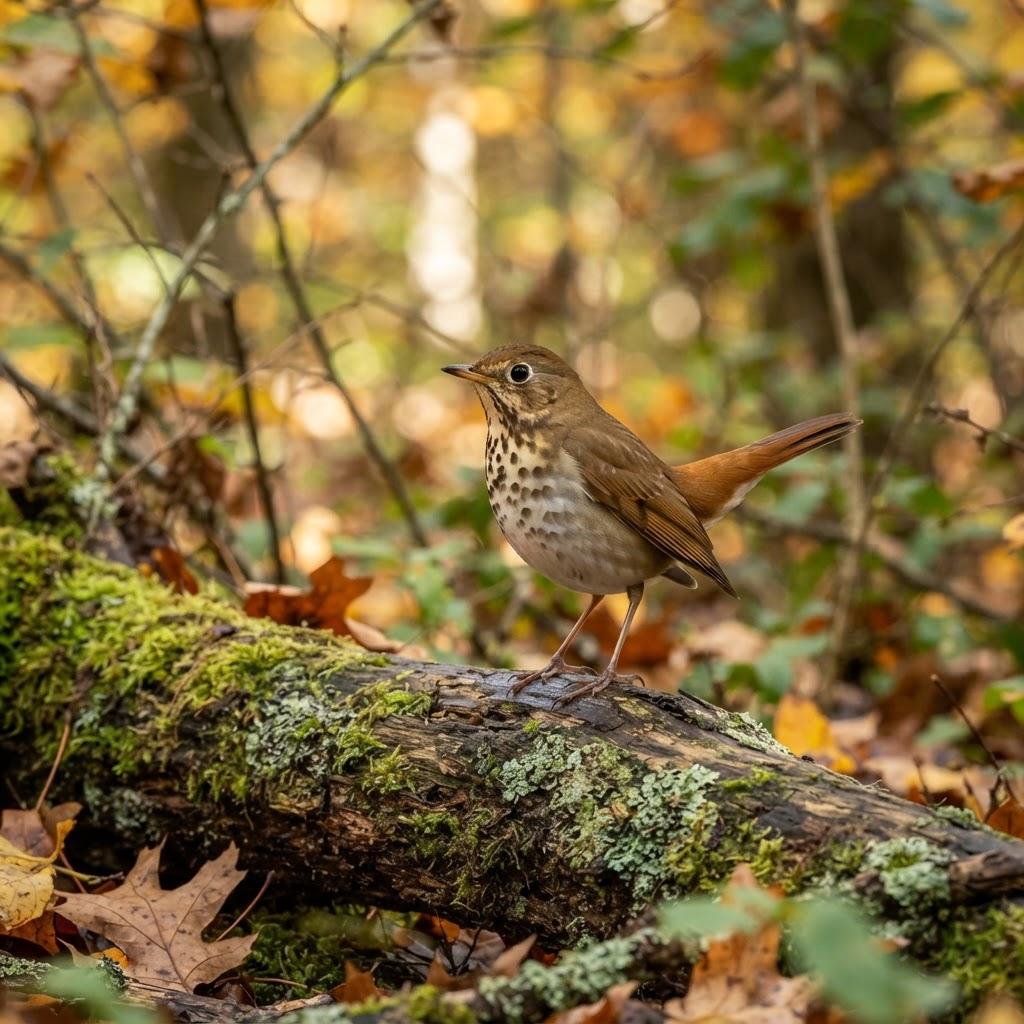
Catharus guttatus
Hermit Thrush
This shy, woodland dweller is a master of camouflage and a surprisingly beautiful singer. Think of the Hermit Thrush as the quiet artist of the bird world, a brooding poet whose melodious song can stop you in your tracks. Learn how to find this elusive gem and maybe even bring its tranquil vibe to your backyard.
Meet the Bird
Picture this: you’re strolling through a quiet forest, the air thick with the scent of pine and damp earth. Suddenly, a flash of brown catches your eye. Is it just a leaf skittering across the path? Nope, it’s the Hermit Thrush, a bird that seems to have perfected the art of being present yet entirely unnoticed. It’s the enigmatic loner of the bird world, the one who might occasionally grace you with a breathtaking performance but generally prefers its own company. Its vibe? Think of a thoughtful, slightly reclusive musician who lives in a cozy cabin and only emerges to share their soul-stirring melodies. They aren’t the flashy peacocks of the avian party scene, nor the boisterous gossips of the feeder. Instead, they are the quiet observers, the deep thinkers, the ones with a hidden, profound beauty. Its most striking feature, and perhaps the source of its charm, is that warm, rusty-red tail that looks like it’s constantly dipped in a sunset. This isn’t just a bird; it’s a mood, a whisper of wilderness in the rustling leaves. Keep an eye out, and you might just catch this elusive character in its natural habitat, a fleeting moment of feathered introspection.
Superpowers & Weird Abilities
The Hermit Thrush might seem like just another brown bird, but don’t let its understated appearance fool you. This feathered philosopher possesses some truly astonishing abilities that sound straight out of a sci-fi novel. For starters, they have an incredible sense of hearing, allowing them to pinpoint earthworms and insect larvae hidden beneath leaf litter or even inches of soil. It’s like having X-ray vision for bugs! Imagine being able to hear a single juicy grub wiggling a foot underground – that’s the Hermit Thrush’s everyday reality. They’re also masters of camouflage, blending so seamlessly into the dappled light of the forest floor that they can practically vanish. This isn't just good luck; it's evolutionary art. Their streaky, mottled plumage acts like a living camouflage suit, breaking up their outline and making them incredibly difficult for predators – and us birdwatchers – to spot. And then there’s their incredible endurance. These birds migrate thousands of miles, often navigating by an internal compass that uses the Earth’s magnetic field. It’s as if they have a built-in GPS that’s far more reliable than your phone’s, guiding them through storms and across continents with uncanny precision. They are nature’s navigators, braving the elements with a determination that’s truly awe-inspiring. It’s this blend of sensory prowess and navigational genius that makes the Hermit Thrush a quiet marvel of the natural world.
Drama, Personality & Feathered Chaos
When it comes to social life, the Hermit Thrush is less of a ballroom dancer and more of a solitary jazz musician. They are, as their name suggests, rather solitary creatures. You won’t find them flocking in raucous gangs or engaging in elaborate social hierarchies at the bird feeder. Their drama is more internal, a quiet brooding rather than a public spectacle. While some birds engage in epic feeder battles, squawking over sunflower seeds like disgruntled commuters on a packed train, the Hermit Thrush tends to hang back, observing from a distance. They prefer to forage alone, quietly sifting through leaf litter for their next meal, minding their own business. This isn’t to say they’re antisocial; they just operate on a different frequency. During the breeding season, males will defend small territories, but it’s often done with song rather than aggressive displays. Think of it as a quiet landlord asserting their boundaries with a stern, yet beautiful, melody. They aren't the backyard bullies, nor are they the easily bullied. They are the independent spirits, the ones who seem to have their own inner compass and don’t need the validation of a crowd. Their personality is one of quiet self-reliance, a calm strength that allows them to thrive in the often-chaotic avian world. They are the philosophers of the forest, content in their own company, which, let’s be honest, is a pretty enviable trait.
Bizarre Rituals & Quirky Habits
The Hermit Thrush, while seemingly reserved, has its own set of peculiar habits that add to its mystique. One of the oddest, shared by many thrushes, is a behavior called 'anting.' Imagine feeling an itch or a bit of irritation on your feathers. Instead of reaching for a tiny feather brush, these birds will actively seek out ants. They’ll often pick up a live ant and rub it all over their feathers. Now, why would they do this? Scientists believe ants, particularly certain species, secrete formic acid. When rubbed on feathers, this acid can act as a pesticide, de-lousing their plumage, or perhaps it helps condition their feathers, keeping them in tip-top shape. It’s like a bird giving itself a weird, acidic spa treatment. Another quirky habit relates to their diet. While they primarily eat insects and berries, they aren't above a bit of fermented fruit. If they come across overripe berries that have begun to ferment, they might indulge, leading to a slightly tipsy and wobbly demeanor. Imagine a normally reserved bird suddenly doing a little jig on a branch after a berry bender – it’s a side effect of nature’s own boozy buffet. These peculiar practices, from ant baths to berry buzzes, reveal a more eccentric side to this otherwise understated bird, reminding us that even the quietest creatures have their bizarre moments.
Legends, Folklore & Human Stories
While the Hermit Thrush doesn't have the dramatic mythological presence of an eagle or the widespread recognition of a robin, it holds a quiet significance in human stories and cultural perceptions. Its name itself, 'Hermit,' evokes images of solitude, introspection, and a connection to the wild, untamed places. In many indigenous cultures, thrushes, in general, are seen as messengers or spirits of the forest, often associated with intuition and inner wisdom. The Hermit Thrush, with its preference for secluded woodlands and its ethereal song, fits this narrative perfectly. It's the bird you might hear before you see it, its melody weaving through the trees like a sacred chant, guiding those who are open to its subtle presence. There aren't many grand legends of Hermit Thrushes directly intervening in human affairs, but their enduring presence in the wild spaces has made them a symbol of nature's quiet resilience. Think of it as the bard of the deep woods, whose songs have been heard by countless generations of people who sought solace and inspiration in the natural world. Their story is less about epic deeds and more about the profound, often unspoken, connection between humanity and the wild places they inhabit. To many, simply hearing the Hermit Thrush’s song is a spiritual experience, a reminder of the ancient rhythms of the earth, a hushed blessing from the heart of the forest.
Mating: The Ridiculous World of Avian Dating
When it comes to romance, the Hermit Thrush might not build elaborate, glittering bowers like their bowerbird cousins, but their courtship is still a delicate dance of sound and subtle display. The male’s primary weapon in the dating game is his voice. Forget cheesy pick-up lines; this guy is a virtuoso. He’ll perch in a secluded spot, often in the twilight hours of dawn or dusk, and unleash a song so pure, so hauntingly beautiful, it can make even the most jaded birdwatcher pause. It’s a complex, fluting melody, full of whistles and trills, designed to enchant potential mates. Think of it as the avian equivalent of a world-class opera singer serenading their beloved under a moonlit balcony, but with a lot more trees involved. The female, meanwhile, is the discerning critic. She’s listening, observing, assessing. Is the song complex enough? Is the male holding a prime territory? He might also offer subtle visual cues, puffing up his chest or flicking his tail, but it's the song that truly seals the deal. If she’s impressed, she’ll stick around. If not, well, she’s free to fly off and find another crooner. It’s a high-stakes performance where only the most melodically gifted (and well-positioned) males get the gig. The pressure is on, and a single off-key note could mean a lonely breeding season for our feathered Romeo. It’s a testament to the power of a beautiful voice in the wild, untamed world of bird romance.
Nesting: Master Architects and Lazy Slumlords
The Hermit Thrush takes its nesting duties seriously, employing a blend of artistry and practicality that results in a cozy, well-hidden home. Unlike the notoriously slapdash pigeon who seems to think three twigs is a stable foundation, or the freeloading cuckoo who uses other birds' nests as free childcare, the Hermit Thrush is a meticulous builder. The female does most of the heavy lifting, constructing a cup-shaped nest that is a marvel of natural engineering. She’ll typically choose a spot on the ground, often at the base of a tree or shrub, or sometimes in a low fork of a tree, blending it seamlessly with the surrounding environment. The outer structure is usually made of twigs, grasses, and bark strips, bound together with mud. But here’s where it gets truly ingenious: the inner lining is a smooth, tightly woven layer of fine grasses, rootlets, and sometimes even animal hair. This creates a perfectly formed, snug cradle for the eggs. The exterior camouflage is key; they want their home to disappear into the leaf litter and undergrowth, making it invisible to predators like snakes, foxes, or even other birds. It's not quite the gravity-defying masterpiece of a hummingbird’s nest woven with spider silk, nor is it the chaotic mess of some backyard nesters, but it's a perfectly functional, beautifully camouflaged, and sturdy home built with precision. It’s a testament to their dedication to creating a safe haven for their future offspring, a quiet testament to their role as responsible architects of the forest.
Raising Babies: The Screaming Food Disposals
Once the eggs hatch – usually a clutch of three to five pale blue, speckled gems – the Hermit Thrush household transforms into a 24/7, high-intensity fast-food operation. The parent birds, primarily the female who incubates the eggs and the male who helps with feeding, embark on a grueling schedule that would make a marathon runner weep. The chicks, fresh from their cozy nests, are little more than gaping mouths with insatiable appetites. They are born blind, naked, and utterly dependent, their primary function being to scream for sustenance. And oh, how they scream! It’s a chorus of high-pitched demands, a constant symphony of 'Feed me! Feed me! Feed me!' that echoes through the undergrowth. The parents, driven by instinct and a healthy dose of exhaustion, work tirelessly. They forage for insects, spiders, and small berries, gulping them down and then making hundreds of trips a day back to the nest. Imagine flying the distance from New York to Los Angeles and back, multiple times a day, with a beak full of snacks – that’s the kind of dedication we’re talking about. This relentless cycle continues for about two weeks, until the chicks are almost fully feathered and ready to take their first wobbly flights. It's a period of intense labor, constant vigilance against predators, and a constant battle against the chicks' never-ending hunger. The parents are masters of efficiency, a blur of motion dedicated to ensuring their offspring survive and eventually join the ranks of independent, if slightly neurotic, adult birds.
Bird-Watching Travel & Local Hotspots
If you’ve been captivated by the Hermit Thrush’s quiet charm and beautiful song, you’re in luck: they are widely distributed across North America. To catch a glimpse of this elusive resident, your best bet is to head to its preferred haunts during the right seasons. During the breeding season, which typically runs from spring through summer, look for them in mature forests, especially those with a dense understory and plenty of coniferous trees. National Forests across the United States and Canada are prime locations. Think places like the Olympic National Forest in Washington, the White Mountains National Forest in New Hampshire, or Algonquin Provincial Park in Ontario. During migration, these birds are more widespread, appearing in woodlands and even suburban gardens across the continent. Fall migration is a fantastic time to spot them, as they are on the move, searching for food before winter. For winter viewing, head south. They spend their colder months in the southeastern United States, Mexico, and Central America, favoring dense thickets and the edges of woodlands. Wildlife refuges like the Aransas National Wildlife Refuge in Texas or the Everglades National Park in Florida can be good spots. The key is quiet observation: find a patch of forest, stand still, and listen for that distinctive song or watch for that tell-tale rusty tail flicking among the leaf litter. Patience is your best tool when searching for this wonderfully reclusive bird.
Food, Feeder Hacks & DIY Projects
Attracting a Hermit Thrush to your yard requires a slightly different approach than wooing a boisterous Blue Jay. These birds are primarily insectivores and frugivores, meaning they love bugs and berries. They aren't typically big seed-eaters, so those massive bags of cheap mixed seed that attract squirrels and pigeons will likely be ignored by our shy friend. The best way to get them visiting is to create a habitat they love. Plant native berry-producing shrubs like serviceberry, elderberry, or viburnum. These provide natural food sources that are far more appealing than anything you can offer in a feeder. They also forage on the ground, so letting a portion of your lawn grow a little wild with leaf litter and low-lying plants will make it an attractive buffet. If you do want to offer something at a feeder, consider a high-quality suet mix with insects and fruits, or mealworms. Hermit Thrushes will readily take mealworms, which are like bird crack, offering high protein. You can even make a simple DIY mealworm feeder: get a shallow dish, place it on the ground in a sheltered spot, and fill it with mealworms. For a fun project, try a 'berry log' feeder. Find a fallen log, drill holes in it, and stuff them with suet and dried berries. Hang it from a tree, and watch for visitors. Remember, the goal is to mimic their natural environment, creating a haven of insects and berries, and they'll happily stop by for a snack. Avoid cheap fillers; focus on quality and natural offerings.
Seasonal Guides & "Crisis" Management
The Hermit Thrush navigates the year with quiet grace, and understanding its seasonal rhythm can enhance your birding experience. In **spring**, as migration peaks (usually April-May in the northern US and Canada), males are re-establishing territories and singing their hearts out. This is a great time to set out mealworms and ensure your berry-producing plants are ready. Their arrival marks the true reawakening of the forest. **Summer** is nesting season. The parents are busy, and the young are fledging, often appearing on the ground. This brings us to **"fledgling panic" season**. If you find a young Hermit Thrush out of the nest, looking fluffy and a bit clumsy, resist the urge to 'rescue' it immediately. Its parents are almost certainly nearby, keeping a watchful eye and bringing food. Unless the chick is in immediate danger (like in the middle of a busy path or being stalked by a cat), the best course of action is to leave it be. Keep pets indoors and give the area a wide berth. The parents are its best chance of survival. As **fall** approaches (September-October), the birds prepare for their long journey south. They’ll be foraging heavily, and you might see them in more open habitats than usual as they fatten up. Keep those berry bushes and mealworm feeders stocked. In **winter**, they retreat to the southern US, Mexico, and Central America, where they favor dense undergrowth. If you live in their wintering grounds, providing suet and keeping birdbaths unfrozen (a heated birdbath is a winter marvel) can be a lifesaver. The key is providing food and shelter, and observing with respect, especially during the delicate fledgling period.
Backyard Tech & Gadget Reviews
In today's world, even our quiet Hermit Thrushes can be part of the digital age, though they probably couldn’t care less. For the tech-inclined birder, there are gadgets that can enhance your experience. **Smart bird feeders**, like the popular Bird Buddy, offer an AI-powered glimpse into your backyard avian life. These feeders have cameras that snap photos of visitors and send notifications to your phone, identifying the species. While a Hermit Thrush might not frequent a seed feeder, if it stops by for suet or mealworms, you could get a stunning close-up. The novelty is high, though the accuracy can sometimes be hit-or-miss, and they aren't always ideal for shy species. Another crucial tech consideration is **window collision prevention**. Birds, especially during migration, can be disoriented by reflections. Simple solutions include window decals (look for those with UV-visible elements birds can see), applying soap in a grid pattern, or using specialized window films that break up reflections. These are vital for the safety of birds like the Hermit Thrush, who might be startled into flight. For the truly dedicated, a **motion-activated trail camera** placed near a known foraging area or water source can capture incredible footage, especially of nocturnal visitors or shy daytime birds like thrushes, without disturbing them. It’s like having a private nature documentary streaming right in your backyard, albeit with a slightly more rugged aesthetic than a smart feeder.
How to Spot One & How It Is Doing
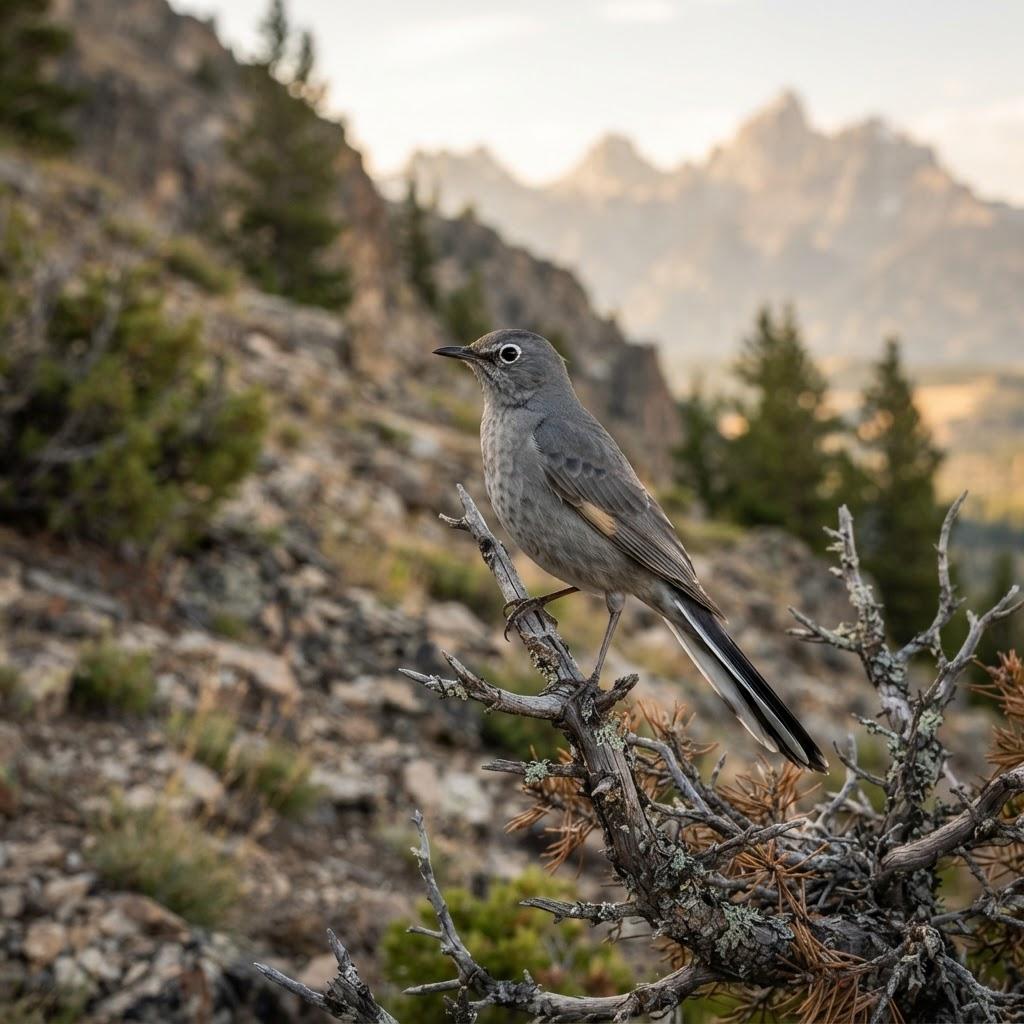
Spotting a Hermit Thrush is an exercise in patience and observation. Look for a medium-sized, plump bird, mostly dull brown on its back, with a distinctly warmer, rusty-red tail that it often flicks upward like a nervous tic. Its underside is streaky, with a pale belly and a breast marked with dark spots. The most distinctive feature is that rusty tail, which contrasts with its browner back. They are most often seen on or near the ground, hopping through leaf litter in forests, woodlands, and shrubby areas. Listen for its song, especially in spring and early summer: a clear, flute-like series of whistles, often described as ethereal or haunting, rising and falling in pitch. It’s one of the most beautiful bird songs in North America. While they can be found in suburban gardens, especially those with mature trees and a good understory, they generally prefer quieter, more natural settings. Their conservation status is **Least Concern**, which is great news! Their populations have been relatively stable, thanks to their adaptability and presence in large, wild areas across the continent. However, habitat loss and degradation are always ongoing threats. To help, you can create a bird-friendly habitat in your yard by planting native trees and shrubs that provide food (berries!) and shelter. Avoiding pesticides, which harm their insect food sources, and keeping cats indoors also makes a big difference. Every little bit helps ensure these quiet, melodic wonders continue to grace our forests for years to come.