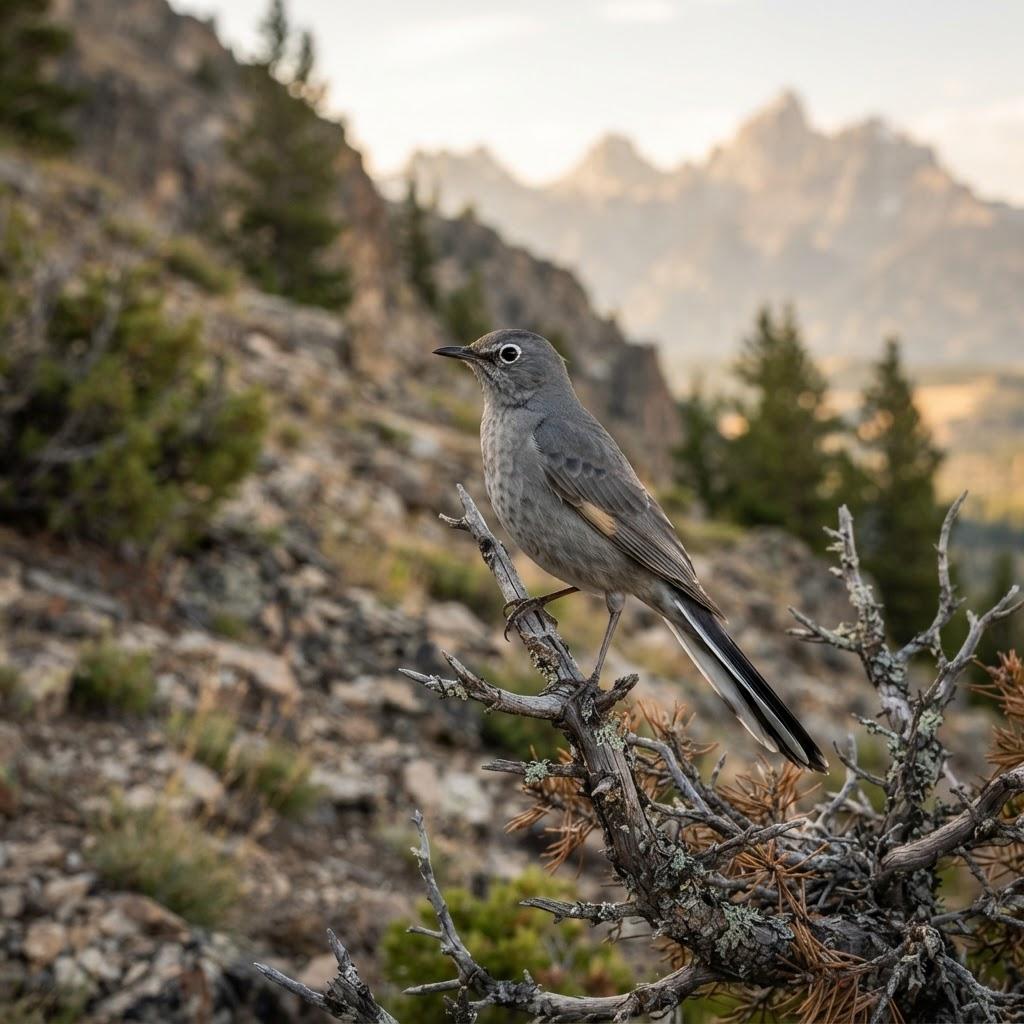
Myadestes townsendi
Townsend's Solitaire
Meet the Townsend's Solitaire, a bird that sounds like an opera singer and lives like a hermit. This sleek, gray phantom of the mountains has a voice that will make you weep and a diet that might make you gag. Prepare for a journey into the heart of avian melodrama!
Meet the Bird
Imagine a phantom, a specter, a bird that glides through the dense forests of the West like a whisper on the wind. This is the Townsend's Solitaire, and it’s not your typical chirpy, backyard buddy. This bird is the introverted artist of the avian world, a creature of refined taste and a voice that could silence a choir. With its sleek, unassuming gray plumage and piercing dark eyes, it looks like it’s perpetually deep in thought, probably contemplating the existential angst of juniper berries or the precise moment to unleash a cascade of pure, unadulterated melody. It’s the kind of bird that doesn't need to shout to be heard; its presence is felt, its song is a revelation. You won't find it squabbling over seed at a feeder; it’s too dignified for that. Instead, it prefers its solitary existence, a feathered philosopher perched high in the pines, waiting for the perfect moment to reveal its hidden depths. It’s the ultimate enigma, wrapped in feathers, dusted with pine needles, and seasoned with an operatic soul. If birds had IMDb profiles, the Solitaire’s would list ‘mysterious,' ‘melancholy,' and ‘possessor of an impossibly beautiful voice’ as its top billing. It's less a bird you see, and more a bird you *experience*.
Superpowers & Weird Abilities
The Townsend's Solitaire might look like just another gray bird, but don't let its understated elegance fool you. This avian enigma possesses a sonic superpower that’s nothing short of miraculous: a voice capable of producing a continuous, clear, fluting whistle that can travel for miles through dense forests. It’s like having a built-in, natural loudspeaker that can serenade an entire mountain range. But the real mind-blower is its digestive system. While many birds are happy with seeds and bugs, the Solitaire has a penchant for berries – and not just any berries. These birds can gorge on juniper berries, which contain compounds that are mildly toxic to most animals. The Solitaire’s liver, however, is a biological superhero, perfectly equipped to neutralize these toxins, allowing it to feast on a food source that’s basically off-limits to its feathered neighbors. It’s like being able to eat spicy curry without any ill effects – a superpower for the culinary adventurous! This adaptation allows it to thrive in environments where other birds might struggle, giving it a unique edge in the wild. So, while it might not be able to fly through walls or turn invisible, its incredible vocal range and specialized diet are its own brand of extraordinary, making it a truly remarkable survivor and songster of the wild.
Drama, Personality & Feathered Chaos
Let’s be clear: the Townsend's Solitaire isn't about petty squabbles or backyard turf wars. This bird operates on a different level of existential drama. Its personality is that of the aloof, misunderstood artist. It’s not going to be the boisterous jay bullying its way to the feeder, nor the opportunistic robin hopping around your lawn demanding worms. The Solitaire is more of a lone wolf, or rather, a lone *bird*. Its interactions are sparse, often fleeting glimpses of a gray form flitting through the trees. This solitary nature can sometimes be mistaken for shyness, but it’s more about a deep-seated preference for its own company. Think of it as the bird equivalent of a reclusive writer or a brooding musician who only emerges for brief, impactful performances (like its breathtaking song). There's no inherent chaos here, no messy drama like cuckoos sneaking eggs into other nests or crows holding grudges. Instead, the Solitaire's 'drama' is internal, a quiet intensity that permeates its existence. It’s the drama of surviving harsh winters, of finding the perfect, solitary perch, of pouring its soul into its song when the mood strikes. If you see two Solitaires together, it’s usually a brief encounter, perhaps a territorial dispute that’s more of a tense standoff than a full-blown brawl, or a mating ritual that’s as understated as the bird itself. They aren't the life of the party; they are the introspective guest who surprises everyone with a profound statement or a haunting melody.
Bizarre Rituals & Quirky Habits
While the Townsend's Solitaire might seem like a bird of quiet dignity, it has its share of quirks that make it, well, interesting. For starters, its diet is a bit… intense. While many birds enjoy a varied diet, the Solitaire has a particular fondness for juniper berries and other small fruits. This isn't just a casual snack; these fruits form the *bulk* of its winter diet. Imagine subsisting almost entirely on a diet of slightly bitter, often very firm berries for months on end. It’s the avian equivalent of living on a diet of dried cranberries and tough kale chips. And the truly bizarre part? Some of these berries can ferment slightly, especially after a frost, meaning our Solitaire might occasionally indulge in a berry that’s a bit tipsy. While not to the extreme of some other species getting outright drunk, it adds a certain, shall we say, unpredictable sparkle to their winter foraging. Furthermore, their territorial habits are rather peculiar. Unlike many birds that aggressively defend a sprawling patch of land, the Solitaire often establishes a very specific, highly defended 'feeding territory,' usually centered around a productive berry bush or a patch of insects. They become the grumpy landlord of their personal fruit stand, chasing off any potential tenants. This focused territoriality means they can be surprisingly fierce defenders of their chosen foraging patch, making them seem even more solitary and self-sufficient than they already are. It's a life of refined taste, with just a hint of berry-induced revelry.
Legends, Folklore & Human Stories
The Townsend's Solitaire, being a creature of the wild, often evokes a sense of mystery, and as such, it has woven itself into the folklore of the western landscapes it inhabits. Because of its elusive nature and its striking, melodic song, it has been associated with themes of solitude, introspection, and even the spirit of the mountains themselves. Indigenous peoples of North America often viewed birds as messengers or spiritual guides, and the Solitaire, with its far-carrying song echoing through canyons and forests, was likely seen as a voice of the wilderness, perhaps a harbinger of good fortune or a stoic companion in the vast, untamed lands. There aren't many specific myths directly naming the Townsend's Solitaire in the way some more common birds are featured, but its presence in mountain folklore is undeniable. Its song, so pure and melancholic, has often been interpreted as a symbol of longing, beauty, and the enduring spirit of nature. Imagine early settlers or prospectors, alone in the vast western wilderness, hearing that haunting, ethereal song drift through the pines. It could be a moment of profound connection to the wild, a reminder that even in isolation, beauty and life persist. It’s the kind of sound that inspires reflection, poetry, and a deeper appreciation for the natural world. While not a bird directly involved in cooperative human-animal relationships like honeyguides, its influence is more subtle, embedded in the mood and spirit of the wild places it calls home, a constant, beautiful reminder of nature's artistry.
Mating: The Ridiculous World of Avian Dating
When it comes to romance, the Townsend's Solitaire doesn't do grand gestures. Forget elaborate dance-offs or magnificent nest-building competitions. Their mating ritual is more like a subtle, whispered proposal in a dimly lit forest. The male’s primary tool for attracting a mate is, predictably, his voice. He’ll perch on a high branch, often in a quiet, secluded spot, and unleash his magnificent, fluting song. It’s not just a random melody; it’s a carefully crafted performance, a sonic invitation designed to impress. He'll sing for hours, a continuous stream of clear, pure notes that seem to hang in the mountain air. It’s the avian equivalent of a virtuoso playing a violin concerto just for his intended. The female, meanwhile, is the discerning critic. She’s not easily swayed by flashy displays; she’s listening for quality, for purity, for that raw, emotional resonance in his song. If his performance is subpar, or if he’s just not hitting the right notes, she’s likely to just… walk away. There’s no awkward breakup conversation, just the silent departure of a unimpressed audience member. If she *is* impressed, the courtship might continue with a bit more vocalization, perhaps some soft chirps and chases, but it remains remarkably understated. There are no dramatic aerial acrobatics, no competitive displays of strength. It’s all about the song. It’s a stark reminder that in the bird world, sometimes the most powerful wooing comes not from grand displays, but from the sheer, breathtaking beauty of a perfectly executed melody. It’s the ultimate test of vocal talent, where the most beautiful voice wins the heart.
Nesting: Master Architects and Lazy Slumlords
The Townsend's Solitaire, true to its name and refined personality, is not one for ostentatious nest construction. You won't find them weaving elaborate, cup-shaped marvels out of moss and spider silk like some of their smaller cousins. Nor are they the notoriously lazy pigeons who slap together a few twigs and call it a day. Instead, the Solitaire opts for a more grounded, subtle approach. They are what you might call 'natural architects,' preferring to utilize pre-existing structures. Their nests are typically found in natural cavities, tucked away in the nooks and crannies of cliff faces, rock crevices, or even within dense thickets. They might also choose abandoned woodpecker holes or other sheltered spots in trees. Once they've selected their prime real estate, they then construct a relatively simple, cup-shaped nest *within* that chosen location. The materials are usually twigs, grass, rootlets, and moss, lined with finer materials like pine needles or soft plant down. It’s functional, well-hidden, and blends seamlessly with its surroundings. Think of it as 'curb appeal' in the wilderness – blending in to avoid unwanted attention. They aren't building a mansion; they're creating a discreet, secure hideaway. This choice of location and construction style is a testament to their survival instincts, prioritizing safety and concealment over elaborate design. It's a nest built for practicality, a hidden gem in the wild, far from the prying eyes of predators and the casual observer, a perfect reflection of the bird's own secretive nature.
Raising Babies: The Screaming Food Disposals
Once the eggs are laid and incubation begins, the Townsend's Solitaire transforms from a solitary singer into a diligent, albeit stressed, parent. The female typically handles the bulk of the incubation, while the male is responsible for bringing her food and, later, for helping with the feeding frenzy once the chicks hatch. A typical clutch consists of 2 to 4 eggs, which hatch after about 14 days. And then, the real show begins: parenthood. Baby solitaires are born altricial, meaning they are completely helpless, blind, and featherless, entirely dependent on their parents. They are, in essence, walking, talking (well, screaming) appetites. Their primary job in life for the first couple of weeks is to grow, and they do this by demanding food CONSTANTLY. Their parents, the male and female, become relentless delivery drivers, making trip after trip from foraging grounds to the hidden nest. They'll be bringing a diet rich in insects and berries to keep their growing brood well-fed. The sheer volume of food required is astounding; the chicks will stretch their little necks out of the nest cavity, their mouths gaping wide, emitting loud, insistent peeps and chirps that signal their unending hunger. It’s a full-time, exhausting job, requiring constant vigilance against predators and tireless foraging. The parents will work from dawn until dusk, their lives consumed by the singular goal of keeping those little mouths full. It’s a symphony of hungry chirps and a blur of parental activity, all happening in the quiet solitude of the forest, a testament to nature's enduring drive to perpetuate the species, one berry and bug at a time.
Bird-Watching Travel & Local Hotspots
If you've been captivated by the thought of the Townsend's Solitaire and fancy spotting this elusive songster in its natural habitat, pack your bags for the wild west! These birds are quintessential residents of mountainous regions and open coniferous forests across western North America. The prime time to find them is during their breeding season, which typically spans from late spring through summer, when their beautiful songs echo through the trees. Look for them in national parks like Yellowstone, Grand Teton, Glacier, and the Olympic National Park. Their breeding range extends north to Alaska and Canada, so areas in the Rocky Mountains of Alberta and British Columbia are also excellent hunting grounds. During winter, they tend to descend to lower elevations and migrate south, so areas in the southern Rockies, the Sierra Nevada of California, and the mountainous regions of Arizona and New Mexico can be good winter birding spots. The key is habitat: seek out open woodlands, forest edges, and areas with plenty of berry-producing shrubs, especially junipers and serviceberries. They often favor higher elevations, so don't be afraid to head up into the mountains. Listen carefully for that distinctive, clear, fluting whistle – it’s your best clue to their presence. While they aren't necessarily rare, their preference for quiet, expansive wilderness means you often have to venture off the beaten path to truly appreciate them. So, lace up your hiking boots, embrace the solitude, and keep your ears and eyes peeled; the Solitaire awaits in its majestic mountain kingdom.
Food, Feeder Hacks & DIY Projects
Attracting a Townsend's Solitaire to your backyard isn't quite like luring in a chickadee or a finch. These birds are not frequent visitors to typical bird feeders, preferring a more wild, natural diet. Their absolute favorite foods are small fruits and berries, particularly juniper berries, but they also dine on insects, especially in the warmer months. So, instead of a traditional seed feeder, think of your yard as a natural buffet. The best way to attract them is by planting native berry-producing shrubs and trees. Think serviceberry (Amelanchier spp.), hawthorn (Crataegus spp.), holly (Ilex spp.), and, of course, various species of juniper (Juniperus spp.). These plants provide both food and shelter, creating an inviting habitat. If you want to offer supplemental food, consider placing out a platform feeder with dried fruits like raisins, currants, or chopped cranberries, especially during the winter when natural food sources might be scarce. You can even try a suet feeder, as some insects are part of their diet. However, avoid cheap seed mixes; they are unlikely to appeal to the Solitaire and will probably just attract more common, less discerning birds, or worse, squirrels. For a DIY project, consider creating a 'berry bush' feeder: take a small, dead branch or a bundle of twigs and tie dried berries (raisins, currants) onto it with twine, then hang it in a sheltered spot. Another idea is a simple mesh bag filled with dried fruit, hung where you can easily observe. Remember, the Solitaire is a bird of the wild, so mimicking its natural environment is your best bet for a visit.
Seasonal Guides & "Crisis" Management
The life of a Townsend's Solitaire is a tale of seasons, each bringing its own challenges and opportunities. In **Spring**, as the snow melts and the world awakens, the Solitaire’s song begins to fill the mountain air again. This is prime time for them to establish territories and begin their courtship rituals. If you’re in their breeding range, this is when you might hear their beautiful calls most clearly. If you want to support them, ensure your native berry bushes are healthy and that there are plenty of insects around, perhaps by minimizing pesticide use. **Summer** is nesting and chick-rearing season, a busy time for the parent birds. The young will start to fledge, and you might see juvenile solitaires, which are a bit duller in appearance. **Autumn** brings a shift; berry crops ripen, and the birds begin to prepare for the lean months ahead. They might become more visible as they forage for these fruits. This is a good time to ensure your berry-producing plants are thriving for their winter sustenance. **Winter** is the Solitaire's ultimate test. They often remain in their mountainous territories, relying heavily on berries. This is when high-fat food sources are crucial. If you can provide a suet feeder or a feeder with dried fruit, it can be a lifesaver for them during harsh weather. *Fledgling Panic Crisis Management*: Every spring and summer, people find fluffy young birds on the ground and worry they’ve been abandoned. For the Townsend's Solitaire, this might look like a small, slightly awkward gray bird hopping around in the underbrush, still a bit clumsy with its wings. **Here's the crucial advice: DO NOTHING.** Unless the baby bird is in immediate danger (like about to be run over by a car or attacked by a cat), leave it be. Its parents are almost certainly nearby, keeping a watchful eye and ready to feed it. Interfering often does more harm than good. The parents are far better equipped to care for their young than well-meaning humans. Resist the urge to 'rescue' unless absolutely necessary, and then only move it a short distance to safety. Trust that nature, and those devoted Solitaire parents, know what they're doing.
Backyard Tech & Gadget Reviews
While the Townsend's Solitaire isn't exactly a feeder-hopper, technology can still enhance your appreciation of this wild spirit. Let’s talk about **Smart Feeders**. Devices like the popular 'Bird Buddy' can be a game-changer, even if a Solitaire doesn't visit it directly. These AI-powered feeders snap photos of visitors and send them to your phone, identifying the species. While you might get photos of jays, finches, or squirrels using it, the app’s database is a fantastic tool for learning about *all* the birds in your area. Plus, it can alert you if a rarer visitor makes an appearance. For window collisions, a perennial bird-watcher's heartache, simple solutions are best. **Window decals** are effective, especially if placed in dense patterns (think multiple dots or stripes, not just one picture). The Solitaire, being a bird of open spaces, often flies through areas where windows are a hazard. Another option is **paracord or string hung vertically** every few inches across the outside of the window. It breaks up the reflection and makes the glass visible. For the truly dedicated, **mildly opaque window film** can be applied to the exterior. If you're curious about what happens in your yard at night or when you're away, a basic **trail camera** or **motion-activated wildlife camera** placed near berry bushes or potential roosting spots can capture fascinating glimpses of nocturnal visitors or even daytime Solitaires passing through. You won't get identification like a smart feeder, but you'll get raw, unfiltered footage of nature's hidden moments. These gadgets can bridge the gap between observing from afar and feeling a more intimate connection with the wild visitors to your space.
How to Spot One & How It Is Doing
Spotting a Townsend's Solitaire is a rewarding experience that often relies more on listening than looking. Their scientific name, *Myadestes townsendi*, hints at their elusive, thrush-like nature. Look for a medium-sized, slender bird, uniformly gray above and paler gray below, with a subtle dark eye-ring and a longish tail. They lack the bright colors of many backyard birds, making them masters of camouflage. You'll most likely find them perched solitarily in open coniferous forests, woodlands, or shrubby areas, often on a high branch or a rocky outcrop, surveying their domain. The absolute best clue is their voice: a pure, clear, fluting whistle that is often described as one of the most beautiful bird songs in North America. Listen for long, melodious phrases that echo through the mountains. They are most active and vocal during the breeding season in spring and summer, but can be found year-round in some areas, especially in mountainous regions. In winter, they may descend to lower elevations and forage on berries, sometimes in loose flocks. Their conservation status is currently **Least Concern**, which is great news! Populations are generally stable, though like all birds, they face threats from habitat loss and climate change. However, their adaptability and preference for large, wild areas mean they are doing relatively well. To help them, focus on supporting healthy forest ecosystems, preserving berry-producing habitats, and minimizing pesticide use, especially in areas where they might forage. Every native berry bush planted is a small victory for these beautiful, solitary singers. So, keep listening, keep exploring, and appreciate the quiet beauty of the Townsend's Solitaire.