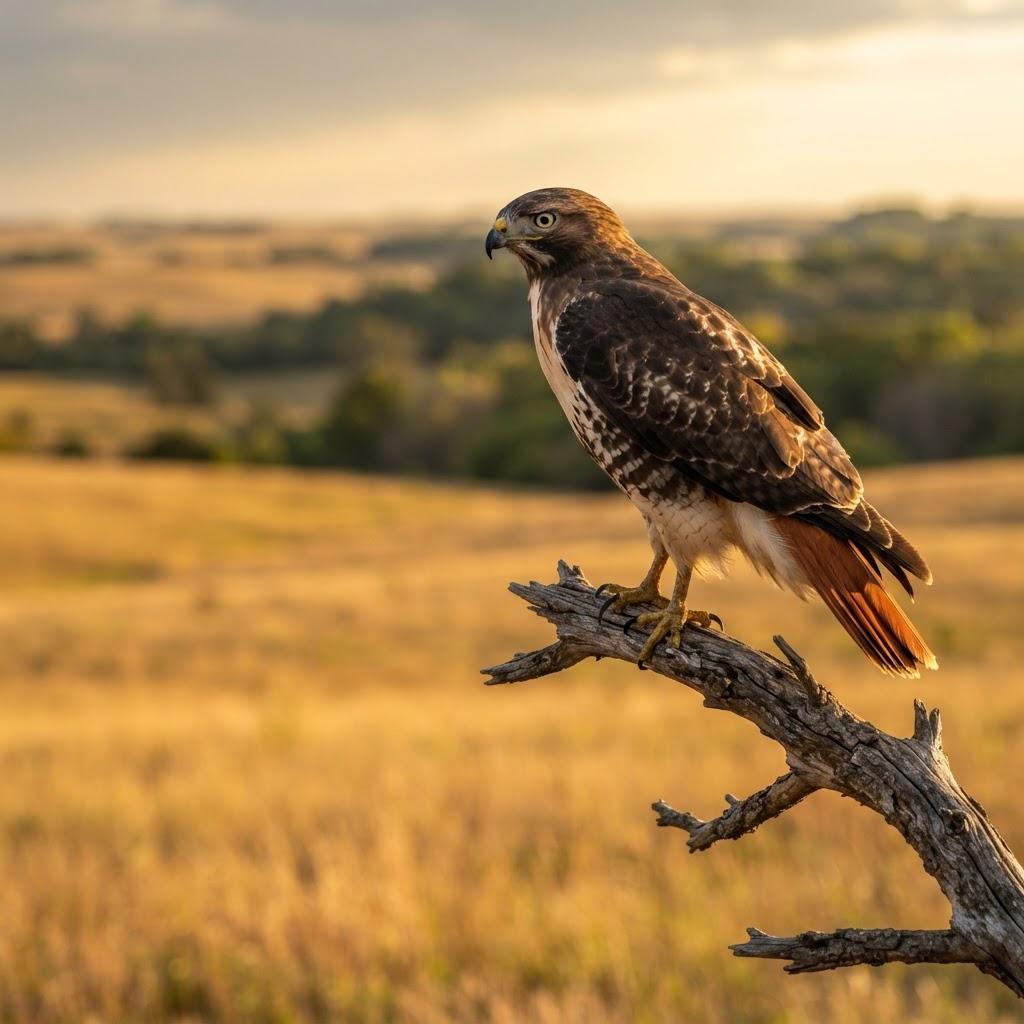
Buteo jamaicensis
Red-tailed Hawk
The Red-tailed Hawk is the king of the highway, a master of the thermal, and the bird that probably played the sound of an eagle in every movie you have ever watched. These regal predators turn boring commutes into wildlife documentaries if you simply look up.
Meet the Bird
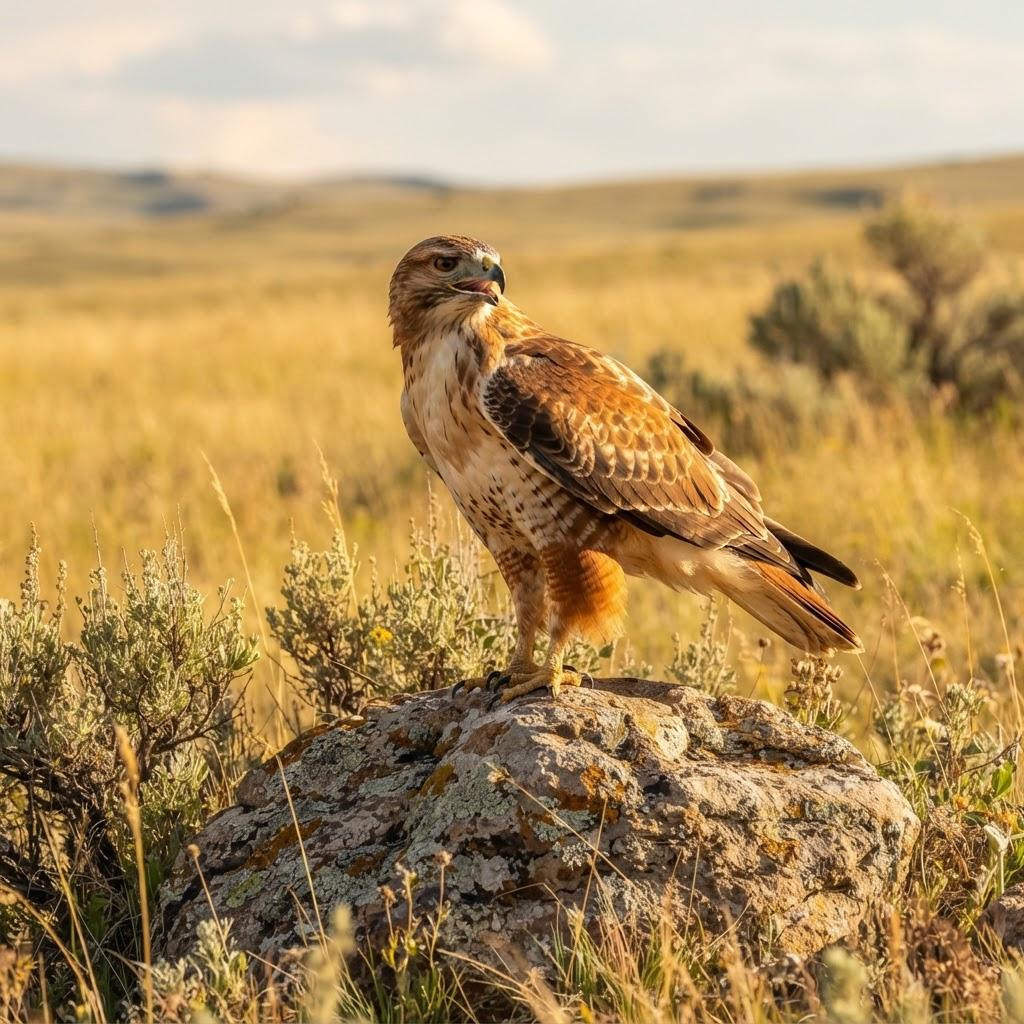
Imagine a bird that treats the entire sky like its personal kingdom, perched atop a utility pole like a gritty detective keeping watch over a city street. The Red-tailed Hawk is the quintessential cinematic raptor. If you have ever heard a movie sound effect featuring a majestic eagle screaming across a mountain range, you have actually been listening to the raspy, piercing call of a Red-tailed Hawk. They are the most common hawk in North America and arguably the most charismatic. With their brick-red tail feathers flashing like a stoplight as they bank through the air, these birds have an attitude that screams 'I own this zip code.' They aren't just birds; they are the heavy-duty machinery of the avian world, built for soaring, hunting, and looking incredibly cool while doing it. Whether they are scanning a suburban meadow or keeping an eye on traffic from a telephone wire, their vibe is pure, unadulterated confidence.
Superpowers & Weird Abilities
If humans had the vision of a Red-tailed Hawk, you could read a newspaper from three blocks away while sitting on your couch. Their eyes are essentially high-powered sniper scopes. They have a density of light-sensing cells that is staggering, allowing them to spot a tiny field mouse scurrying through thick grass from hundreds of feet in the air. This isn't just about sharp vision; they also see into the ultraviolet spectrum. Since many small rodents leave trails of urine that reflect UV light, these hawks are essentially following a glowing neon path directly to their next meal. Furthermore, they are masters of thermal dynamics. They don't just flap their way across the country; they ride invisible elevators of rising hot air called thermals. By banking in circles, they can stay airborne for hours without burning a single calorie of energy. It is basically the avian equivalent of finding an eternal slipstream.
Drama, Personality & Feathered Chaos
Do not let their stoic perching fool you; these birds are the kings of neighborhood drama. When two Red-tailed Hawks get into a territory dispute, it isn't just a squabble—it is a full-blown soap opera. They are known to engage in epic aerial battles where they lock talons and tumble toward the earth like a feathered tornado, only to break apart at the last second. They are also notoriously bold. They have been known to engage in stand-offs with much larger animals, including farm dogs and the occasional confused house cat. They are not bullies per se, but they are intensely protective of their hunting grounds. If you have a Red-tailed Hawk nesting in your vicinity, you can guarantee they are the neighborhood watch, though they tend to be far less concerned with your privacy and far more concerned with any squirrel that dares to cross their designated lawn.
Bizarre Rituals & Quirky Habits
Aside from their hunting prowess, these hawks exhibit some truly strange behaviors that would be considered eccentric in the human world. They are famous for their 'soaring dances,' which look like a complex ballet choreographed by a fighter pilot. They often perform sky-dives where they pull their wings in tight to reach blistering speeds before pulling up at the last possible second. Some observers have even reported them 'playing' with objects, dropping sticks or leaves mid-air and catching them again just for the fun of it. It’s hard to tell if this is a game or a training drill for catching prey, but watching a giant, fierce bird treat a dry twig like a toy is a hilarious reminder that even the most hardened predators have a silly side. They also seem to have a strange affinity for the most inconvenient places to perch, often choosing the most visible sign or chimney just to ensure everyone sees them.
Legends, Folklore & Human Stories
Throughout history, the Red-tailed Hawk has held a position of profound respect among many Indigenous cultures across North America. Often viewed as a messenger or a creature of deep wisdom, the hawk’s habit of soaring high above the ground associated it with the heavens and the ability to see the 'big picture' of life. In some traditions, the hawk is considered a guardian spirit, a watchful eye that protects the community. In modern times, they have become the unofficial mascots of the American highway system. They are the only bird that seems to have fully embraced the modern landscape, utilizing the artificial heat rising from asphalt and the convenient perches provided by highway light poles. They have woven themselves into the fabric of our daily lives, turning the monotony of long road trips into a chance to spot these masters of the sky.
Mating: The Ridiculous World of Avian Dating
The courtship of the Red-tailed Hawk is less 'dinner and a movie' and more 'top-tier stunt show.' When a male is trying to impress a female, he doesn't bring flowers; he performs a death-defying aerial display. They soar high into the clouds and begin a series of steep, dramatic dives, zig-zags, and rapid, plunging descents. If the female is interested, she will join him in this sky-ballet. They might even fly upside down or touch talons in mid-air, a maneuver that looks like they are holding hands while falling toward the ground at terminal velocity. It is a test of strength, precision, and mutual respect. If the male’s flying skills don't live up to her standards, she simply flies off to find a more competent pilot. Once they seal the deal, they are famously loyal, often staying together for years and returning to the same nesting site every single season.
Nesting: Master Architects and Lazy Slumlords
If you are looking for a masterpiece of architecture, look no further than a Red-tailed Hawk’s nest. Unlike the haphazard stick-piles of mourning doves, these birds build massive, multi-story fortresses. They are the heavy lifters of the avian world, constructing nests out of thick branches and sticks that can weigh as much as a small person. They place these behemoths high in the fork of a tall tree, on a cliff edge, or, predictably, on the highest ledge of a football stadium or skyscraper. Over years of use, they add more material until the nest becomes a sprawling, woody mansion. It is a cozy home for the chicks, but it is also quite the eyesore to anyone who prefers a minimalist aesthetic. They are not subtle, and they do not care. They want a sturdy, high-rise luxury apartment that will last through the harshest winter storms, and they build it with brute force.
Raising Babies: The Screaming Food Disposals
Once the chicks, known as eyases, hatch, the nest turns into a non-stop, high-pressure cafeteria. Both parents are completely tapped out, flying hundreds of miles over the course of a week to bring back a constant stream of protein. The babies are loud—they have a piercing, raspy begging call that is designed to be heard over the wind and rain. They grow remarkably fast, going from tiny, helpless fluff-balls to massive, intimidating teenagers in just a few weeks. The parenting strategy here is essentially 'keep them fed or they will scream until your head explodes.' During the later stages of growth, the chicks spend a lot of time testing their wings, jumping around the nest and flapping vigorously. It is a chaotic, messy, and fascinating period where the parents maintain a level of patience that would put any human parent to shame.
Bird-Watching Travel & Local Hotspots
If you want to see a Red-tailed Hawk in all its glory, you do not need to go to the deep wilderness; you just need to head to the nearest patch of open land near a major road. However, for a truly spectacular show, consider visiting places like the Bosque del Apache National Wildlife Refuge in New Mexico or the Cape May peninsula in New Jersey during migration season. These areas become literal highways in the sky for hawks. During the autumn months, birders flock to 'hawk watches'—specific lookout points where enthusiasts gather to count the thousands of raptors passing through. Any large, open nature preserve with scattered tall trees is a guaranteed win. Bring binoculars, find a comfy chair, and just stare at the sky. If you see a large bird circling slowly, follow it. It’s almost certainly a Red-tailed Hawk checking out the neighborhood.
Food, Feeder Hacks & DIY Projects
Let’s be clear: you cannot put out a bird feeder for a hawk. They are not interested in your sunflower seeds or suet cakes. If you want to attract a Red-tailed Hawk, you need to attract the food they actually want: small mammals. This means having a healthy, wild ecosystem in your yard. Planting native tall grasses and shrubs provides cover for mice, voles, and rabbits, which in turn brings the hawks to hunt. Avoid using poisons for rodents, as those chemicals travel up the food chain and can kill the very hawks you want to see. Instead, foster a 'wild' section of your property. If you want to get creative, setting up a tall, sturdy 'hunting perch'—a simple tall post in an open field area of your yard—might just give them a place to stop and scan for dinner. It is a bird-friendly project that keeps your backyard part of the food chain.
Seasonal Guides & "Crisis" Management
In the spring, you might find a fluffy, awkward-looking bird hopping around on the ground. Do not panic! This is likely a 'fledgling'—a teenager that has left the nest but hasn't quite mastered the art of flying yet. The parents are almost certainly watching from nearby. Keep your pets indoors, keep your distance, and let nature take its course. If you see an adult hawk struggling in winter, don't try to feed it; just ensure there is an open water source. Birds need water year-round, and a birdbath with a small heater keeps it from freezing. Winter is the time to spot them easily because the leaves are off the trees, and the hawks are often sitting on bare branches trying to stay warm. It is the perfect time to practice your identification skills without the camouflage of summer foliage getting in the way.
Backyard Tech & Gadget Reviews
The world of birding has been revolutionized by technology. While high-end AI feeders are great for songbirds, they won't help you with a hawk. Instead, invest in a quality trail camera—these are motion-activated cameras that can be strapped to a tree near a field edge. When a hawk lands to scope out the area, you get a high-definition video of the visitor. For window safety, which is crucial as these large birds occasionally mistake reflections for open space, use window decals or 'bird tape' that creates a pattern visible to birds but mostly invisible to us. It prevents nasty collisions and lets the hawks keep their dignity. Keep your tech simple: a decent pair of binoculars and a camera trap will yield much more interesting footage of a Red-tailed Hawk than a smartphone app ever could.
How to Spot One & How It Is Doing
To identify a Red-tailed Hawk, look for the 'belly band'—a patch of dark streaks across their otherwise pale underside. And of course, if they take flight and bank in the sun, you will see that rusty-red tail. They are doing exceptionally well in the modern world, as they are generalists that adapt to almost any environment we humans create. Their population is stable and even expanding in many areas because they thrive near our roads and fields. You can help them continue to flourish by advocating for open space preservation and avoiding harmful rodenticides. These birds are the survivors and the winners of the avian world; they don't need us to coddle them, but they do benefit from us being good stewards of the land. Take a moment on your next drive to look up—you are looking at one of nature's greatest success stories.