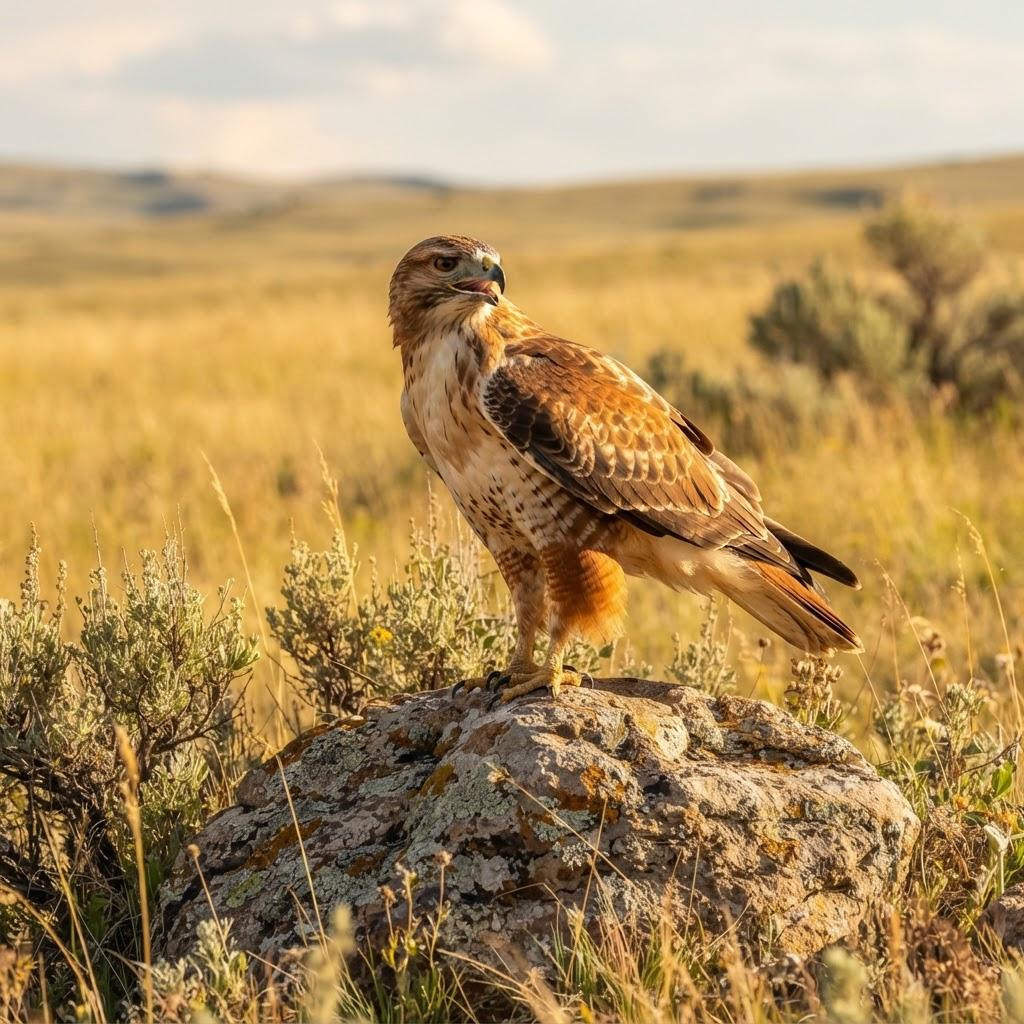
Buteo regalis
Ferruginous Hawk
Meet the Ferruginous Hawk, the heavyweight champ of North American hawks! This magnificent raptor is a master of the open skies, a stealthy hunter of the prairie, and a true avian titan. Get ready to be amazed by its power, grace, and surprisingly goofy side.
Meet the Bird
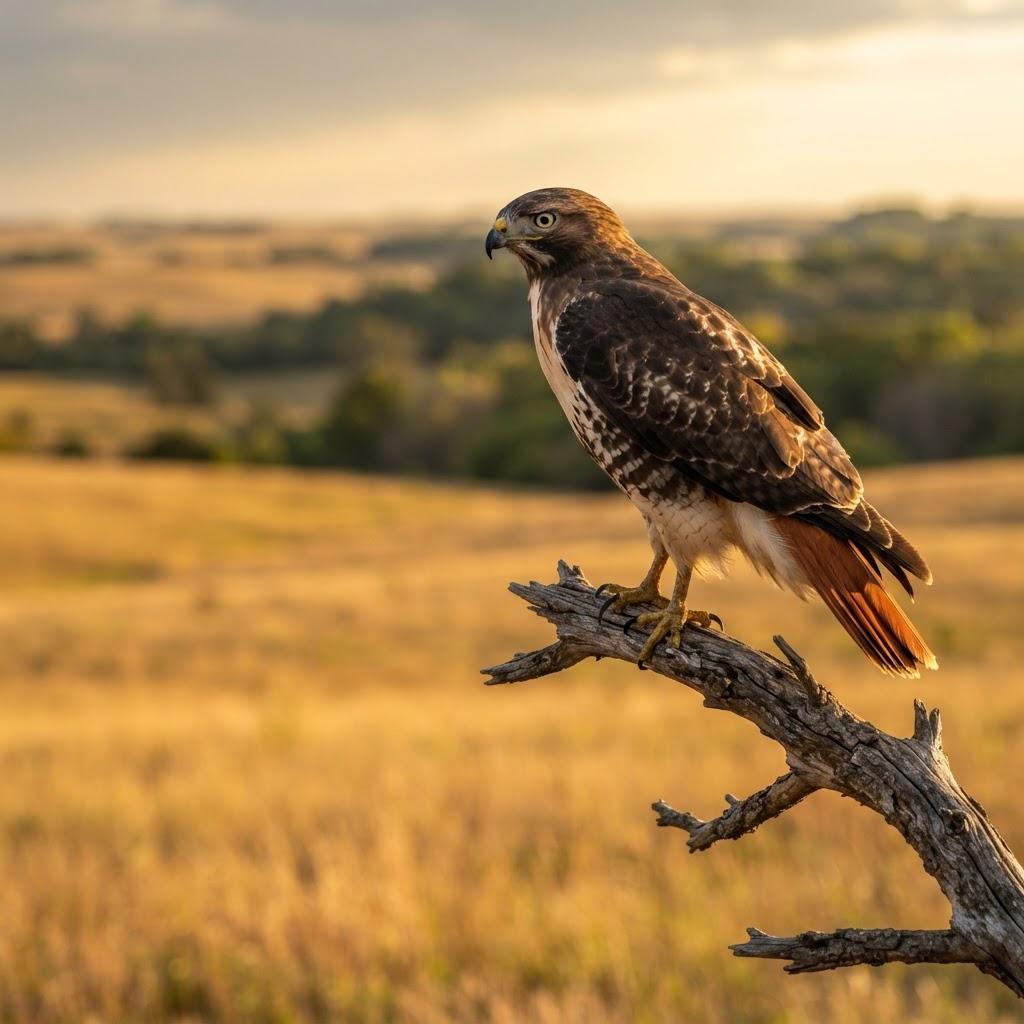
Imagine a hawk that decided to hit the gym and never leave. That’s the Ferruginous Hawk, folks! This is not your average, flitting-around sparrow hawk; this is a serious piece of aerial real estate. Its name, 'ferruginous,' might sound fancy, but it just means 'rusty-colored,' which you’ll notice if you catch a glimpse of its underparts. Think of it as nature’s tough guy, built for endurance and power, patrolling the wide-open spaces like a feathered sheriff. It’s the kind of bird that, if it could talk, would probably have a deep, gravelly voice and tell you to 'get off its lawn' – a lawn that happens to be thousands of acres of prairie. It’s the heavyweight champion of North American hawks, a majestic presence that commands respect and awe. When this bird soars, it’s not just flying; it’s making a statement. It’s the aerial equivalent of a pickup truck: rugged, reliable, and capable of handling serious business. And if you’re lucky enough to spot one, you’ll feel like you’ve just met a living legend of the plains. It’s big, it’s bold, and it’s utterly captivating.
Superpowers & Weird Abilities
The Ferruginous Hawk isn't just big; it's packing some serious biological upgrades that would make any superhero jealous. For starters, its eyesight is legendary. Think of it like having a telescope for eyes, but way, way better. A hawk can spot a tiny mouse scurrying in the grass from a mile away. That’s like you being able to read the fine print on a postage stamp from across a football field. They achieve this thanks to an incredible density of photoreceptor cells in their eyes, coupled with a unique fovea (that's the part of the eye that focuses) that’s almost like a double-barreled shotgun for vision, allowing them to see incredible detail and depth. But the real mind-blower is their ability to perceive ultraviolet light. Yep, they see a whole spectrum of colors we can only dream of. This helps them find prey because many small mammals, like voles and mice, leave urine trails that reflect UV light. So, to a Ferruginous Hawk, these trails glow like neon signs, marking a delicious dinner route. It’s like having a secret GPS system for hunting, guiding them directly to their next meal. And when they dive? Their body is streamlined for speed, with special muscles and bones that can withstand incredible G-forces, far more than a human could handle without blacking out. They’re basically living, breathing fighter jets, built for precision and power in the vast, open sky.
Drama, Personality & Feathered Chaos
While Ferruginous Hawks are often seen as solitary hunters, don't mistake their independence for a lack of personality. These birds are the stoic, quiet types of the bird world, but they have their moments. Think of them as the Clint Eastwood characters of the raptor scene: not overly chatty, but always observing, always calculating. They generally prefer to keep their own counsel, focusing on the serious business of survival. However, during the breeding season, things can get a little more dramatic. While they aren't known for the elaborate territorial squabbles of, say, jays or crows, they will defend their nesting sites fiercely. Imagine a large, powerful bird of prey giving you the 'evil eye' from its perch – it’s enough to make any potential intruder reconsider their life choices. They aren't usually the kind of bird to get into petty backyard feeder wars, but their presence alone can certainly clear the air of smaller, more skittish birds. Their power dynamic is less about social cliques and more about being the undisputed top dog (or hawk) of their territory. If you see two Ferruginous Hawks interacting, it's usually business – either a pair working together or a brief, intense territorial dispute settled with impressive aerial maneuvers rather than a lot of squawking. They’re the strong, silent types, but don’t underestimate the quiet intensity of their presence; it speaks volumes.
Bizarre Rituals & Quirky Habits
While Ferruginous Hawks might seem like no-nonsense hunters, they have their moments of oddity. One of their most curious habits, shared with many other bird species, is called 'anting.' This isn't about enjoying a crunchy snack; it's a peculiar behavior where birds pick up ants and rub them on their feathers. The ants, in turn, release formic acid, a chemical that can be quite irritating. Scientists aren't entirely sure why they do it, but the leading theory is that it acts as a pest control service. The formic acid might help to dislodge or kill feather parasites like mites and lice. So, think of it as a bird equivalent of a very strong, potentially stinging, medicinal bath. It’s nature’s bug spray, and it looks absolutely bizarre to witness a hawk meticulously rubbing an ant all over its wings. Another quirk is their hunting strategy. While they are apex predators, they are also opportunistic and incredibly patient. They’ll often sit and wait on a perch for hours, like a feathered statue, surveying their domain with intense focus. This patience can sometimes lead to them waiting for the *perfect* moment to strike, which might seem odd to us impatient humans but is a testament to their evolutionary success. They also have a tendency to line their nests with soft materials like animal fur, which not only provides insulation but might also contain pheromones from the prey animal that deter predators or attract mates. It’s a little bit like decorating your house with the scent of your favorite steak, only for birds.
Legends, Folklore & Human Stories
The Ferruginous Hawk, being a creature of the vast, open plains, has woven itself into the stories and traditions of the people who share those lands. Indigenous cultures of North America often viewed raptors like the Ferruginous Hawk with deep respect, seeing them as powerful messengers or symbols of strength and vision. Their ability to soar so high and see so far connected them to the heavens and the spirit world. In some Native American traditions, hawks were seen as guardians, protectors of the sky, and sometimes even tricksters. Their presence was often interpreted as a sign, a warning, or a blessing depending on the context and the specific tribe's beliefs. There aren't many widespread, specific myths about the Ferruginous Hawk itself compared to, say, the Bald Eagle, but its general magnificence as a large bird of prey would have certainly inspired awe and respect. Think of the many Native American stories where eagles or hawks carry prayers to the Great Spirit or act as guides through difficult times. The Ferruginous Hawk, with its impressive size and stoic demeanor, would have fit perfectly into these narratives of power and connection to the natural world. It’s a bird that embodies the spirit of the wild, untamed landscapes it inhabits, and that connection would have resonated deeply with people who lived in close harmony with nature.
Mating: The Ridiculous World of Avian Dating
Forget flowers and chocolates; bird mating rituals are often a high-stakes performance art, and the Ferruginous Hawk is no exception, though perhaps more in a 'power couple' way than a flamboyant dance-off. When these magnificent birds decide it's time to pair up, they engage in some pretty impressive aerial displays. This can involve synchronized soaring, where the male and female fly together in tight formation, sometimes dipping and weaving in unison. It’s like a graceful, high-altitude ballet, showcasing their coordination and fitness. The male will often perform dramatic dives and then pull up sharply, demonstrating his strength and agility to his potential mate. Think of it as him saying, 'Look at me! I can fly REALLY fast and I won't fall out of the sky, unlike that other guy!' Sometimes, they’ll even engage in a ritualistic 'sky-pointing,' where they fly high into the air, with the male grabbing the female’s talons and tumbling through the sky together. It looks utterly insane, like a mid-air wrestling match gone romantic. The female is essentially judging his physical prowess, his commitment, and his ability to survive the harsh environment. If she’s not impressed by his aerial acrobatics or if he seems weak, she might just fly off, leaving him to ponder his single status and maybe try again with the next eligible hawk. It's a tough dating scene out there in the wide-open skies, where only the fittest and most dazzling flyers get to pass on their genes. It’s less 'The Bachelor' and more 'Extreme Avian Olympics.'
Nesting: Master Architects and Lazy Slumlords
When it comes to building a home, the Ferruginous Hawk is decidedly in the 'master architect' category, though their style is less 'minimalist chic' and more 'fortified industrial complex.' These large hawks don't mess around with flimsy twig piles; they build substantial nests. Think of a sturdy platform, often constructed from large branches, twigs, and any other sturdy debris they can find. These nests are usually quite large, sometimes measuring several feet across and deep enough to house a small child. They prefer to build on top of large, flat surfaces. This often means using natural structures like cliff ledges, rock piles, or large, sturdy trees. When human structures are available and suitable, they might even build on abandoned buildings or power line towers – basically, anywhere that offers a stable, elevated foundation. The interior of the nest is then lined with softer materials, such as grasses, roots, and surprisingly, animal fur or feathers. This not only provides a cozy bed for the eggs and chicks but also helps to insulate the nest. These nests aren't just for a single breeding season; they are often reused and added to year after year by the same pair, or by subsequent generations of Ferruginous Hawks, growing larger and more robust with each passing season. It’s like owning a home that gets progressively more valuable and structurally sound the longer you live in it. They are serious about their real estate, creating durable, safe havens in the often-harsh environments they call home.
Raising Babies: The Screaming Food Disposals
Once those eggs hatch, the Ferruginous Hawk parents transition from skilled aerialists to hyper-efficient, exhausted delivery drivers. A typical clutch consists of 1 to 4 eggs, and as soon as the first chick hatches, the race is on. Baby hawks, or 'eyases' as they're known in the ornithology world (which sounds way cooler than 'chicks,' right?), are born completely helpless – blind, covered in fluffy white down, and utterly dependent. Their primary job is to grow, and their secondary job is to demand food with the vocal intensity of a thousand toddlers who have just discovered the word 'mine!' The parents, particularly the female who incubates and stays with the young chicks, work tirelessly. The male often takes on the primary role of hunter, bringing back prey like rabbits, ground squirrels, and snakes. He’ll deliver it to the nest, and then there’s a frantic scene as the female tears off pieces to feed the demanding eyases. If there are multiple chicks, there can be intense competition, with the strongest and loudest often getting the most food. Sometimes, if food is scarce, the last-hatched chick might not survive, which is a harsh reality of nature. The parents aren't just feeding; they're also diligently protecting their brood from the elements and predators. This high-energy, non-stop parenting gig lasts for about six to eight weeks until the young hawks are ready to fledge, meaning they can finally leave the nest and attempt their own wobbly flights. It's a period of intense dedication and can be quite a spectacle to observe if you're lucky enough to witness it from a distance.
Bird-Watching Travel & Local Hotspots
If you’re eager to witness the grandeur of the Ferruginous Hawk, you need to venture into the wild, open spaces where they reign supreme. Forget dense forests or bustling city parks; these birds are the kings and queens of the grasslands and prairies. Your best bet is to head west and central in North America. Prime locations include the vast plains of Montana, Wyoming, Colorado, North and South Dakota, Nebraska, Kansas, and Oklahoma. These states offer expansive ranches, nature preserves, and national grasslands that provide the ideal habitat for these majestic raptors. For a specific destination, consider the National Grasslands in Montana and South Dakota, like the Little Missouri National Grassland or the Oglala National Grassland. The Pawnee National Grassland in Colorado is another excellent spot, especially during the spring and early summer when they are actively nesting and raising young. For those in Canada, southern Alberta and Saskatchewan offer excellent opportunities. The best time to spot them is generally from late winter through summer, as many are resident birds in the southern parts of their range, while others migrate north for breeding. Look for them soaring high in the sky, perched on fence posts, utility poles, or scattered trees in open country. Keep your eyes peeled for their broad wings and pale undersides; they are truly a sight to behold in their natural kingdom.
Food, Feeder Hacks & DIY Projects
Attracting a Ferruginous Hawk to your yard with a traditional bird feeder is about as likely as getting a lion to visit a salad bar – they’re big predators, and feeders are for the little guys. These magnificent raptors primarily hunt live prey in their natural habitat. Their diet consists mainly of small mammals like rabbits, prairie dogs, ground squirrels, and voles, supplemented by birds, reptiles, and insects. So, if you're dreaming of a Ferruginous Hawk at your bird feeder, you'll need to think about creating a hawk-friendly habitat rather than putting out seed. This means maintaining open grassy areas and providing perching spots like scattered trees or even strategically placed logs. If you live in hawk territory, the best 'feeder hack' is to simply manage your landscape to support their natural prey. A yard that attracts lots of mice and voles, for example, might inadvertently make it a more appealing hunting ground. However, it's crucial to remember that Ferruginous Hawks are protected, and intentionally trying to feed large raptors can be problematic and sometimes even harmful due to habituation or disease transmission. Instead of trying to lure them with food, focus on enjoying them from a distance in their natural environment. The most 'DIY' you can do is create an ecosystem that supports their prey, or better yet, visit their natural habitats where they thrive. Think of it as earning their respect by providing an environment where they can be successful hunters, rather than trying to bribe them with a sunflower seed.
Seasonal Guides & "Crisis" Management
The Ferruginous Hawk’s life is a symphony of seasonal shifts. In spring, the northern populations begin their migration back to their breeding grounds in the vast prairies. This is a crucial time for them, as they prepare for nesting. If you live in their breeding range, you might notice more activity as they establish territories and begin their courtship rituals. As summer arrives, the focus shifts entirely to raising their young. The parents are incredibly busy, hunting relentlessly to feed their growing eyases. This is also when 'fledgling panic' might occur. If you find a young Ferruginous Hawk chick on the ground, resist the urge to intervene immediately! Fledglings often spend days on the ground, learning to fly and forage under the watchful eyes of their parents, who are usually nearby. Unless the bird is in immediate danger (like in the middle of a road) or visibly injured, the best course of action is to leave it be and observe from a distance. Your interference could do more harm than good. By fall, the young birds are becoming more independent, and the adults prepare for the leaner months. For resident hawks, this means continuing their hunt for prey, with winter often requiring them to adapt to harsher conditions and scarcer food. This is when high-fat foods become essential for survival. While you can't feed a Ferruginous Hawk directly, supporting their prey base in your area through natural landscaping can be a subtle but effective way to help them through these challenging seasons. Keeping your yard as a healthy ecosystem is the best form of 'crisis management' for these magnificent predators.
Backyard Tech & Gadget Reviews
While the Ferruginous Hawk is too wild and large to be a regular visitor to a standard backyard feeder, modern tech can still enhance your enjoyment of these magnificent predators. For starters, consider a good pair of binoculars or a spotting scope. These are your essential tools for observing hawks from a distance without disturbing them. Invest in something with good magnification (10x or higher) and a wide field of view, allowing you to scan the skies and spot distant silhouettes. If you're lucky enough to live in an area where Ferruginous Hawks are common, you might even consider a trail camera. Set one up near a known roosting or hunting spot (respecting private property, of course) and you might capture some incredible footage of them in action, or perhaps their prey. While high-tech AI feeders like the Bird Buddy are fantastic for songbirds, they aren't designed for large raptors. You're unlikely to get a Ferruginous Hawk to pose for an AI camera. However, there are hawk-specific nest box cameras available, though these are often expensive and require specific setup for nesting pairs. The best 'gadget' for a Ferruginous Hawk, however, is a well-maintained habitat. Think of it as the ultimate nature tech: creating open spaces, providing perching opportunities, and supporting their natural prey base. That's the most effective way to 'attract' them, not with electronics, but with ecological stewardship.
How to Spot One & How It Is Doing
Spotting a Ferruginous Hawk is a reward for patience and keen observation in the right habitat. Look for them in wide-open, dry grasslands, prairies, and deserts. They are big, broad-winged hawks. When soaring, they often hold their wings in a slight 'V' shape (dihedral). Key features to distinguish them are their pale undersides, often with a rusty or buffy wash, and dark 'wrist' patches on the underside of their wings. They can appear quite pale overall, especially when seen from below. Their legs are feathered all the way down to their toes, a distinctive feature of this species. They are usually silent hunters, so you’re more likely to spot them by sight than by sound. Listen for the calls of smaller birds that might be agitated by their presence, which can sometimes alert you to a hawk overhead. Conservation-wise, the Ferruginous Hawk is currently listed as 'Near Threatened.' While they are not in immediate danger of disappearing, their populations have declined due to habitat loss, particularly the conversion of native grasslands for agriculture and development. Pesticide use and direct persecution have also played roles in the past. The good news is that conservation efforts focused on protecting their grassland habitats are crucial. Supporting organizations that work to preserve prairie ecosystems, advocating for responsible land management, and simply appreciating these magnificent birds from a respectful distance can all contribute to their future. By understanding their needs and respecting their wild nature, we can help ensure these titans of the sky continue to soar.