Empidonax minimus
Least Flycatcher
Meet the Least Flycatcher, a pint-sized powerhouse of the bird world with a caffeine-addicted attitude and a voice that refuses to quit. This tiny tyrant is the ultimate backyard drama queen you never knew you needed to watch.
Meet the Bird
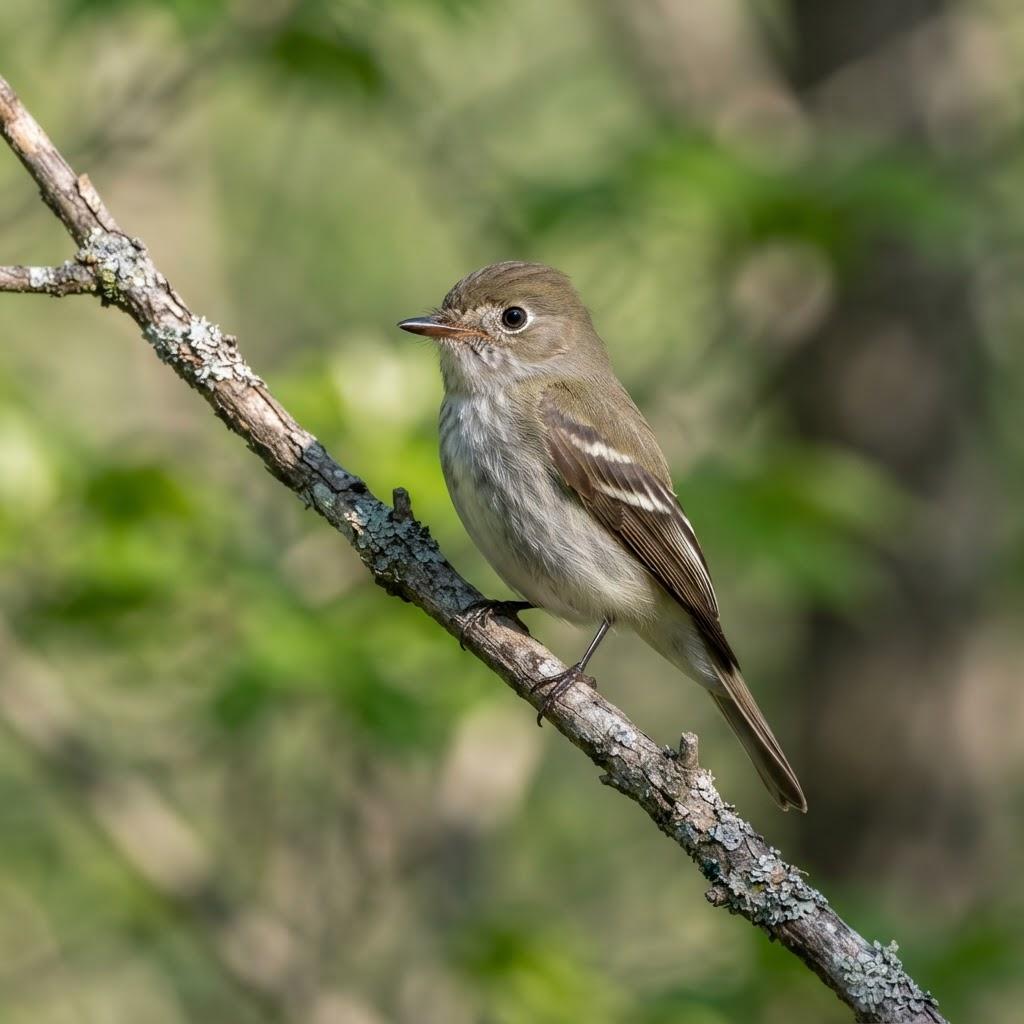
Imagine, if you will, an intern at a high-stakes law firm who has just chugged three espressos and is absolutely convinced that the entire fate of the universe rests on their ability to yell at a leaf. That is the Least Flycatcher. This bird is the smallest of its genus, which is exactly why it seems to have a Napoleonic complex the size of a redwood tree. It is a tiny, olive-draggled fluff-ball that sits motionless on a branch for hours, looking like a stuffed toy that fell into a pile of salad, until it suddenly explodes into action to snatch a gnat out of the air. It is not just a bird; it is a twitchy, high-energy surveillance drone equipped with wings and a relentless need to announce its presence to every other living creature within a three-mile radius. If you have ever felt like you are being judged by a piece of foliage, you have likely encountered the Least Flycatcher.
Superpowers & Weird Abilities
The Least Flycatcher possesses the superpower of 'sallying,' which sounds like a casual walk in the park but is actually a terrifying display of high-speed aerial acrobatics. Imagine a fighter pilot who can detect a tiny invisible speck in the air from twenty feet away, execute a 180-degree turn with zero radius, snatch that speck, and return to the exact same landing spot in under two seconds. Their eyes are essentially biological motion-capture cameras, evolved to track the erratic flight patterns of gnats and flies that move faster than the human eye can even register. Beyond the hunting, they have a metabolic rate that would make a marathon runner weep. They operate on a 'live fast, eat everything' philosophy, fueled by a nervous system that keeps them in a state of perpetual readiness. When they migrate, they do so with a physiological efficiency that allows them to cross massive geographic barriers despite weighing about as much as a loose handful of paperclips.
Drama, Personality & Feathered Chaos
If there is one thing a Least Flycatcher loves more than eating bugs, it is yelling about how much it loves eating bugs. They are famously vocal, characterized by a sharp, rhythmic 'che-bek!' sound that they will repeat until the end of time, or until you start contemplating the structural integrity of your eardrums. In the avian social hierarchy, they are the equivalent of the neighbor who insists on hosting a loud, karaoke-fueled block party every single morning at five o'clock. They are fiercely territorial, viewing any other bird—whether it is a cousin, a sparrow, or a hawk—as an existential threat that must be addressed with vigorous tail-flicking and intense staring contests. They do not care if you are bigger than them; they will happily dive-bomb a squirrel that dares to look at their tree the wrong way, proving that the size of the bird in the fight is significantly less important than the size of the fight in the bird.
Bizarre Rituals & Quirky Habits
One of the most peculiar habits of the Least Flycatcher is its pathological obsession with verticality and stillness. While many birds are constantly bustling about, the Least Flycatcher prefers the 'statue method' of hunting. It will perch perfectly still, looking like a disgruntled tennis ball, until a movement is detected. Then, like a coiled spring, it snaps. The flicking of the tail—a rapid, nervous twitch that happens every few seconds—is their signature move. It is as if they are constantly trying to shake off a static charge. They also exhibit a strange aversion to sharing space, often engaging in 'wing-snapping' displays where they forcefully pop their wings to create a sound that is meant to intimidate rivals. It is a classic move of 'do not come over here, I am busy being intense,' and honestly, it is an approach to social boundaries that many of us could probably learn from.
Legends, Folklore & Human Stories
While they do not have the sweeping epic poetry of an eagle or the ominous superstition of a raven, the Least Flycatcher has a special place in the lore of the backwoods naturalist. Often, they are the secret stars of birding journals, the birds that people 'discover' after years of ignoring the smaller, drab creatures in the trees. There is an old tradition among forest rangers and park guides: if you hear the 'che-bek' but cannot find the bird, you have officially passed the first test of becoming a competent birder. They are the gatekeepers of patience. There is a quiet respect for them among the birding community, viewed as the scrappy underdogs of the forest. They represent the idea that you do not need bright neon feathers or a haunting song to be a dominant force; you just need to be loud, consistent, and slightly unhinged.
Mating: The Ridiculous World of Avian Dating
The courtship of the Least Flycatcher is less about romance and more about a high-intensity audition for a dance-off you really do not want to lose. The males spend their spring days shouting their 'che-bek' anthem into the void, hoping that a female will find the pitch, volume, and frequency of their screech to be the epitome of virility. Once a female stops by, the male ramps up the intensity. He performs frantic flight displays, diving and spiraling through the branches while snapping his wings like he is trying to ignite a fire. If the female thinks he is too slow or his tail-flicking lacks that certain 'pizzazz,' she will fly off without a second glance, leaving him to continue shouting at trees. It is a harsh dating market where only the most energetic, loudest, and most bug-catching-proficient males get to secure a partner, while the rest just keep screaming into the abyss.
Nesting: Master Architects and Lazy Slumlords
Least Flycatchers are actually surprisingly competent when it comes to home improvement. Unlike the messy, pile-of-sticks approach used by some of their less-motivated avian neighbors, the Least Flycatcher builds a neat, compact cup of fine grass, bark fibers, and plant down, held together by the mystical power of spider webs. They are the minimalist architects of the forest. They tuck these cups into the forks of deciduous trees, often blending in so well that you would never know they were there unless you spent twenty minutes staring at the same branch. They prioritize structural integrity and camouflage over flashy decorations. It is not quite a five-star hotel, but for a bird that lives to fly around and yell, it is a perfectly cozy bunker that keeps the kids safe from the elements and wandering eyes.
Raising Babies: The Screaming Food Disposals
Once the eggs hatch, the nest becomes a chaotic, high-stakes refueling station. The chicks are basically tiny, vibrating stomachs with eyes, and their primary function is to scream until a moth is deposited into their gullets. The parents are absolute machines, working from dawn to dusk to keep up with the insatiable demand of their growing offspring. It is a constant, frantic cycle: fly out, snatch a beetle, shove it into a waiting mouth, clean up the 'waste,' and fly out again. By the time the chicks are ready to leave the nest, they have essentially turned into flying versions of their parents. The transition from 'screaming, helpless fuzzball' to 'aggressively territorial insect-hunter' happens remarkably fast, as they are thrust into a world where they must immediately learn the art of the 'che-bek' to avoid being bullied by their own siblings.
Bird-Watching Travel & Local Hotspots
If you are on a quest to witness the Least Flycatcher in its natural habitat, you need to head toward the deciduous forests of the Northeast or the Great Lakes region during the breeding season. Popular spots include the birding trails of Acadia National Park in Maine or the lush, leafy expanse of the Cuyahoga Valley National Park in Ohio. During the spring, look for areas where the forest canopy is interrupted by clearings, as these edge-habitats are the preferred real estate for these tiny flyers. The best strategy is to park yourself near a forest-edge trail around mid-morning, close your eyes, and listen for that distinctive, sharp, two-note call. Once you lock onto the sound, follow it slowly. They are not shy, but they are fast; keep your binoculars ready because they rarely stay in one spot for more than a few seconds before darting off to chase another bug.
Food, Feeder Hacks & DIY Projects
Here is the truth about feeding Least Flycatchers: they are not typical 'feeder' birds. They prefer the high-octane excitement of live insects to a bowl of dry, dusty sunflower seeds. You are not going to see them fighting for a spot at your local plastic birdfeeder. However, you can turn your yard into a bug-buffet, which is the only way to really attract them. Plant native trees like oak, birch, or maple—these are absolute magnets for the caterpillars and spiders that make up the flycatcher's dream diet. Avoid pesticides like the plague; if you kill the bugs, you kill the reason the flycatchers visit. For a DIY project, create a 'deadwood' pile in a corner of your yard. Let some branches rot. This creates a natural ecosystem for the exact insects that Least Flycatchers hunt, essentially building them a drive-thru window that is entirely organic and free of charge.
Seasonal Guides & "Crisis" Management
Spring is the time of the great 'che-bek' migration, when these birds arrive in the North, exhausted but ready to start the territorial games all over again. This is when you should ensure your trees have plenty of cover for them to hide in. By mid-summer, you will see the 'fledgling panic' phase, where young, uncoordinated birds end up on the ground looking like confused fluff-balls. Do not pick them up! Unless they are visibly injured or in the middle of a busy road, they are exactly where they need to be. The parents are nearby, watching, and will continue to feed them on the ground until they can get their wings under control. Leave them be, keep the neighborhood cats inside, and let nature do its awkward, fluttering thing. It is a stressful time for humans, but for the fledgling, it is just 'Flight School 101' in the school of hard knocks.
Backyard Tech & Gadget Reviews
If you want to monitor your Least Flycatcher without having to stand in the brush for hours, invest in a motion-activated trail camera. These devices have come down in price significantly and can be strapped to the trunk of a tree near a known hunting perch. When you check the footage, you get to see the flycatcher’s hunting style in slow motion, which is genuinely mesmerizing. As for window collisions, which are a major danger for small, fast-moving birds, the best solution is simple: apply external window film or patterned decals that break up the reflection. A window that looks like a mirror is a death trap for a flycatcher that is too busy looking for bugs to look where it is flying. Tech like smart-feeders is fun, but for this specific species, a high-quality camera trap is your best tool for getting to know their secret life.
How to Spot One & How It Is Doing
Spotting a Least Flycatcher comes down to recognizing that 'che-bek' call and looking for the constant, nervous tail-flicking. They are small, olive-gray on top, and have a white eye ring that makes them look perpetually surprised. They are doing quite well in terms of population, which is the good news! They have adapted reasonably well to human-modified landscapes like orchards and edge-habitats, which is a rare bit of success in the bird world. To help them out, focus on 'wilding' your yard—add native plants, stop using chemicals, and provide fresh water in a birdbath. You are not just feeding a bird; you are providing an arena for one of the most energetic, hilarious, and persistent characters in the forest. Keep your ears open and your eyes peeled, and you will eventually find yourself staring into the face of a creature that is, pound for pound, the most intense bird you will ever meet.