Tyrannus forficatus
Scissor-tailed Flycatcher
Imagine a bird that looks like a high-fashion runway model but acts like a caffeinated stunt pilot. The Scissor-tailed Flycatcher is the feathered equivalent of a tuxedo-wearing daredevil, and its aerial antics will change how you look at the sky forever.
Meet the Bird
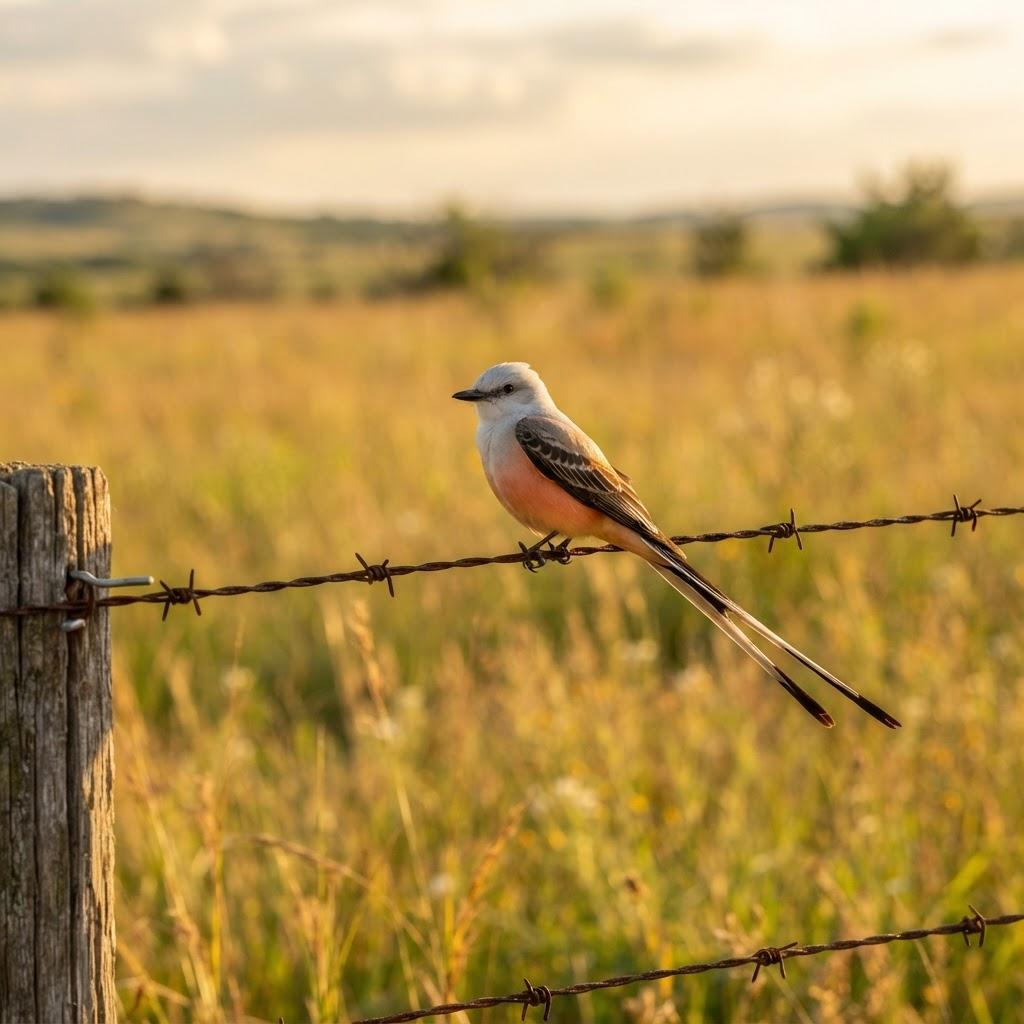
If the world of birds held an annual gala, the Scissor-tailed Flycatcher would be the guest who shows up in a floor-length, flowing gown just to see how much attention they could command. With their sleek, pearl-gray bodies, salmon-pink underarm accents, and a tail that is literally longer than their own body, these birds are the definition of avian drama. Imagine a bird that is part fighter jet and part silk ribbon. They do not just fly; they perform, darting through the air with the grace of a figure skater and the aggression of a seasoned gladiator. Their most iconic feature, that long, forked tail, is not just for show—it is a specialized steering mechanism that allows them to make impossible turns and sudden stops that would leave a hummingbird dizzy. They are the flamboyant royalty of the American prairie, usually found perching on telephone wires like tiny, elegant sentinels, watching the world with a cool, detached confidence that suggests they know exactly how good they look.
Superpowers & Weird Abilities
While most birds are content with simple flapping, the Scissor-tailed Flycatcher has evolved into a master of aerodynamics. Think of their tail as a high-tech rudder on a speedboat. By splitting those long outer feathers, they can manipulate airflow with surgical precision. This ability is what scientists call 'extreme maneuverability,' but in plain English, it means they can catch a bug in mid-air that was literally trying to dodge them a millisecond before. They can execute snap-turns, vertical ascents, and sudden stalls that would make a stunt pilot weep with jealousy. Their vision is equally tuned to this high-speed lifestyle; they have eyes designed to track movement against the bright backdrop of the prairie sky, allowing them to spot a tiny beetle from a hundred yards away. They are essentially biological interceptors, built for speed and efficiency, proving that evolution values both style and substance when it comes to aerial combat.
Drama, Personality & Feathered Chaos
Do not let the elegant look fool you; inside every Scissor-tailed Flycatcher beats the heart of a tiny, iron-fisted dictator. These birds are famously territorial and have absolutely no concept of 'mind your own business.' If a hawk, a crow, or even a confused human dares to enter their airspace, they will launch a full-scale aerial assault. They are known to dive-bomb birds much larger than themselves, squawking with indignant rage until the intruder flees in shame. In the neighborhood of the backyard, they are the bossy neighbors who constantly monitor the lawn for transgressors. They are not 'bullies' in the malicious sense, but they are certainly 'authorities' on who belongs where. They hold a deep, abiding grudge against any bird that considers itself a peer, and they are not afraid to use their impressive speed to prove exactly why they are the undisputed kings of the fence line.
Bizarre Rituals & Quirky Habits
One of the most peculiar things about these birds is their obsession with staying clean and sharp. You might catch one performing a series of strange, jerky motions on a branch, which is their version of a spa day. They are meticulous groomers, often using their beaks to straighten every single feather of that long, flowing tail, ensuring that not a single barb is out of place. They are also known for what bird nerds call 'fly-catching' in the most literal sense—they will sit on a fence post for hours, appearing to be doing nothing at all, before suddenly launching like a spring-loaded toy to snatch an insect from thin air. This 'sit-and-wait' strategy is interspersed with bouts of frantic, high-energy exercise. It is like they are bored out of their minds one minute and then competing in an Olympic event the next, a bizarre rhythm that defines their daily existence.
Legends, Folklore & Human Stories
In many parts of the Great Plains, the Scissor-tailed Flycatcher is more than just a bird; it is a symbol of the rugged, wide-open landscape. They have appeared in regional art and local lore as icons of resilience and beauty. There is a long-standing local appreciation for these birds, as they are fantastic at keeping grasshopper populations in check, which farmers have always appreciated. In some cultures, they were seen as messengers of the wind, given how their long tails seem to dance in the slightest breeze. Their presence is often a signal that the prairies are healthy and thriving. Stories of ranchers watching these birds for generations are common, creating a bridge between the wild energy of the bird and the human history of the region. They are effectively the mascot of the Southern Plains, representing a certain kind of untamed, elegant spirit that reflects the local identity.
Mating: The Ridiculous World of Avian Dating
When it comes to dating, the Scissor-tailed Flycatcher turns the sky into a theatrical stage. The male puts on a performance that puts Hollywood blockbusters to shame. He will sky-dance, flying high into the air and then tumbling, diving, and zig-zagging in a frantic, beautiful mess of feathers and motion, all while screeching his heart out to catch the attention of a female. It is essentially a high-speed, acrobatic proposal. If she is impressed by his agility and the sheer bravado of his dive, she might consider him; if she is bored, she simply flies off to find someone who does a better mid-air somersault. It is ruthless, competitive, and entirely based on how well he can handle his own tail feathers during a death-defying plummet toward the earth. It is a spectacle of pure, unadulterated passion in the air.
Nesting: Master Architects and Lazy Slumlords
Once a mate is secured, the real work begins, and the Scissor-tailed Flycatcher takes a surprisingly pragmatic approach to home construction. Unlike some birds that build elaborate woven mansions, these birds favor a sturdy, utilitarian cup nest. They pick a fork in a tree—often a mesquite or a telephone pole crossbar if they are feeling rebellious—and pack it with a mix of twigs, weeds, and occasionally string or bits of fluff they find lying around. They are not the most artistic builders, but they are incredibly efficient. The female does most of the heavy lifting, constructing a nest that is strong enough to survive the high prairie winds. It is not going to win any awards for interior design, but it is functional, safe, and built to survive the tumultuous weather that often plagues the regions where they reside, which is all that really matters.
Raising Babies: The Screaming Food Disposals
Raising chicks is where the Scissor-tailed Flycatcher transforms from a cool, detached individual into a frazzled, overworked parent. The chicks are essentially bottomless pits with wings. For the first two weeks, it is a constant rotation of fly-in, drop off a grasshopper or beetle, get swarmed by begging, peeping beaks, and fly-out for more. The parents are absolute machines, working from dawn until dusk. The babies grow at an alarming rate, and before long, the nest is overflowing with what looks like a bundle of chaotic, fuzzy energy. There is no such thing as silence in a Scissor-tailed nest; it is a non-stop chorus of 'feed me!' that only ends when the babies finally fledge. It is a grueling, exhausting process that highlights the incredible dedication required to keep a new generation of these high-energy acrobats alive.
Bird-Watching Travel & Local Hotspots
If you are ready to witness the show, head toward the Southern Plains during the late spring or summer. Texas and Oklahoma are the absolute gold standard for Scissor-tailed sightings. Places like the Wichita Mountains Wildlife Refuge in Oklahoma are practically crawling with them during the breeding season. In Texas, driving along almost any rural highway in the Hill Country offers a high probability of seeing them perched on barbed-wire fences. The key is to look for wide-open spaces with scattered trees or power lines. They are not particularly shy, so you do not need to hide in a blind; just pull over safely on a country road, look up at the wires, and wait. You will see them eventually, usually launching into the air to catch something delicious while you are still trying to focus your binoculars.
Food, Feeder Hacks & DIY Projects
Here is the honest truth: Scissor-tailed Flycatchers are insectivores, which means they are not going to show up for your standard bag of sunflower seeds. They want the good stuff—insects. If you want to attract them, stop worrying about feeders and start worrying about your lawn. By allowing a portion of your yard to grow wild with native grasses and flowers, you invite the insects they love. Skip the pesticides; they are the ultimate organic pest control. For a fun DIY project, consider putting up a 'bug box' or simply leaving a patch of bare, disturbed soil where insects can congregate. They are hunters, not scavengers, so if you want to see them, turn your yard into a buffet for beetles, grasshoppers, and crickets. It is cheaper than buying expensive seed and significantly more effective at drawing in these spectacular predators.
Seasonal Guides & "Crisis" Management
Scissor-tailed Flycatchers are seasonal visitors to their breeding grounds, arriving in spring and heading south when the temperatures drop. As summer fades, they congregate in large groups, which is a fantastic time to see dozens of them at once. If you find a 'fledgling' on the ground in early summer, please stay calm! Most of the time, the bird is just a teenager learning to fly. It is clumsy, uncoordinated, and looks like a disaster, but the parents are almost certainly nearby, watching and waiting for you to leave so they can feed it. Unless the bird is clearly bleeding or injured, just back away and let nature take its course. It is not a crisis; it is just the awkward teenage phase of a bird that is destined to become a master of the air.
Backyard Tech & Gadget Reviews
If you want to capture the high-speed drama of these birds, you need the right gear. AI-powered feeders are great for finches, but for a flycatcher, you are better off with a simple motion-activated camera mounted near a favorite fence post. Because they have such predictable perching habits, you can set up a trail camera to capture their 'launch' moments in high definition. Regarding windows, they are generally too fast to hit them, but adding simple window film or decals never hurts for safety. If you are serious about birding, a high-quality pair of 8x42 binoculars is your best piece of tech; it allows you to track their erratic flight paths much better than any automated camera ever could. Stick to the basics: patience, good optics, and a sharp eye.
How to Spot One & How It Is Doing
Spotting a Scissor-tailed Flycatcher is easy if you know what to look for: look for the bird on the wire that looks like it is wearing a tail two sizes too long. They are gray, white, and pink, and they have an unmistakable flight style that involves a lot of erratic, beautiful swerving. If you see a bird that looks like it is having a bad hair day in the wind, it is likely them. They are currently listed as Least Concern, which is great news! Their populations are relatively stable, provided we keep protecting those open-prairie habitats they love. You can help by supporting local land trusts and native plant nurseries. Keeping the prairie open and the insects plentiful is the best gift you can give these elegant masters of the air. Just enjoy them, watch the show, and appreciate having such a charismatic neighbor in the sky.