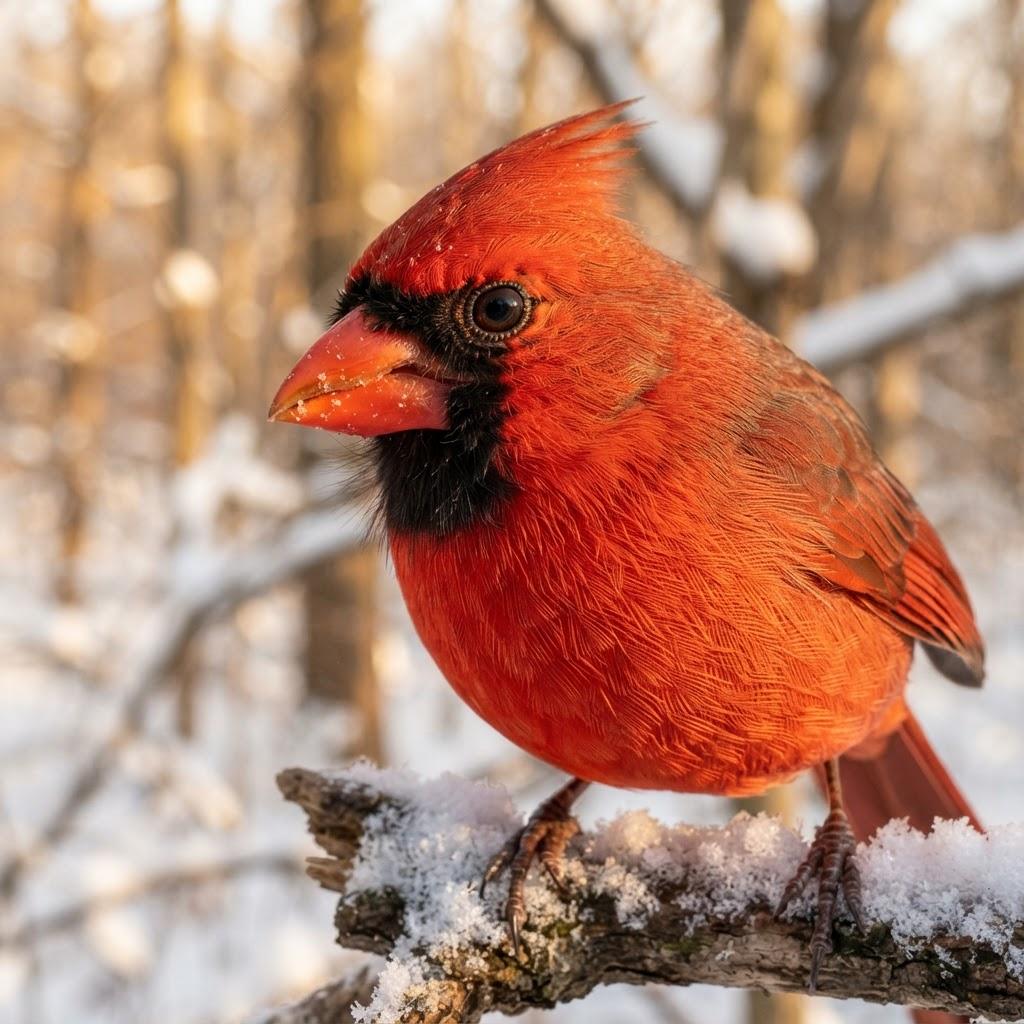
Cardinalis cardinalis
Northern Cardinal
The Northern Cardinal is the ultimate neighborhood celebrity, rocking a tuxedo of vibrant red and a permanent bad-hair-day mohawk. This feisty songbird is less of a shy woodland creature and more of a loud, proud backyard boss who demands premium seeds and absolute attention.
Meet the Bird
If the Northern Cardinal were a character in a high-stakes heist movie, it would definitely be the flamboyant leader who insists on wearing a bright red suit to a black-tie event. You simply cannot miss this bird. It is the quintessential backyard icon, boasting a crest that looks like it spent far too much money on hair gel and a personality that is somehow both elegant and delightfully aggressive. While other birds spend their day trying to blend into the shadows or camouflage with the bark of a tree, the male cardinal seems to have taken a vow to be as visible as a neon sign in a dark alley. He is a master of the dramatic entrance, often landing on a birdfeeder with an air of entitlement that says, 'Yes, the star of the show has arrived.' Meanwhile, the female cardinal, dressed in a muted, sophisticated tan with hints of crimson, is the silent partner who secretly runs the whole operation. They are not merely birds; they are the local celebrities of the avian world, and they fully expect you to keep their food bowl topped off.
Superpowers & Weird Abilities
While it might seem like their only skill is looking fabulous, cardinals are biological marvels. Consider the way they manage their internal temperature. Unlike a human who just puts on a parka, a cardinal has a complex network of blood vessels in its legs that act like a heat exchanger. When it is freezing outside, they can pull their legs up into their belly feathers to prevent heat loss, essentially turning themselves into a living, breathing thermos. Furthermore, their beaks are feats of evolutionary engineering; they are essentially heavy-duty, biological nutcrackers designed specifically to exert massive amounts of pressure on tough seed coats without snapping. They are also incredibly adept at 'singing' in a way that is designed for maximum acoustics. By carefully adjusting their pitch and rhythm, they can project their voices through dense foliage that would swallow the sound of a lesser bird, turning the woods into their own personal amphitheater. It is basically the avian equivalent of having a built-in megaphone and thermal-regulated space suit.
Drama, Personality & Feathered Chaos
If you have ever seen a cardinal puff itself up until it looks like a grumpy, feathered tennis ball and dive-bomb a reflection in your window, you have witnessed the intense, unhinged drama of the Northern Cardinal. They are notoriously territorial. To a male cardinal, a window reflection is not a mirror image—it is a mortal enemy who has dared to enter his kingdom. They will fight their own reflection for hours, peck at the glass, and scream their lungs out until they are exhausted. This isn't just vanity; it is pure, unadulterated territorial anxiety. They don't just bully other birds; they essentially act as the bouncers of the backyard. They will chase away goldfinches, sparrows, and even other cardinals if they feel the vibe is off. They are the feathered equivalent of that neighbor who complains to the HOA if your trash can is two inches out of alignment. Their drama is constant, loud, and undeniably entertaining.
Bizarre Rituals & Quirky Habits
Birds are weird, and cardinals are no exception to this rule. One of the strangest things you might witness is 'anting,' where a cardinal will pick up an ant—or a cluster of them—and rub it against its feathers. While this sounds like a bird having a meltdown, it is actually a clever bit of chemistry. The formic acid secreted by the ants acts as a natural pesticide or fungicide, helping the bird rid itself of pesky mites and parasites. It is basically an insect-based spa treatment. Another oddity is their love for fermented fruit in the late summer. You might see a cardinal stumbling around on your lawn looking suspiciously intoxicated after indulging in some overripe berries that have begun to turn into nature's version of a cocktail. They do not hold their liquor well, often resulting in uncoordinated flight and a general look of confusion. It is a stark reminder that even the most regal birds are prone to the same questionable life choices as the rest of us.
Legends, Folklore & Human Stories
The Northern Cardinal has long held a place in the human heart, often being cast in the role of a celestial messenger. In many cultural traditions, particularly throughout North America, the sight of a cardinal is said to be a sign from a departed loved one checking in from the great beyond. This creates a deeply emotional bond between the bird and the human observer; the cardinal is not just a bird at a feeder, it is a spiritual visitor. There is an undeniable comfort in seeing that flash of red on a bleak, grey winter morning, and folklore has solidified this bird's status as a symbol of hope and persistence. Even without the mysticism, the historical records of the early American settlers are filled with accounts of the 'red bird' being a beacon of familiarity for those far from home. It is a bird that has been woven into the fabric of our stories, standing as a permanent fixture of our collective emotional landscape.
Mating: The Ridiculous World of Avian Dating
If you think your Tinder profile is bad, wait until you hear about the cardinal dating scene. It involves a high-stakes ritual called 'mate feeding.' The male finds a particularly choice seed, struts over to the female, and presents it to her as if it were a gourmet meal delivered via helicopter. She, in turn, will often flutter her wings and open her mouth, acting like a helpless chick, to see if he is truly willing to provide for her. It is all part of a performance that tests his worthiness as a partner. If he succeeds, they form a bond that is actually quite sweet, often singing duets to strengthen their relationship. However, if the male brings a subpar seed or messes up the dance, the female is not afraid to let him know. She will literally ignore him and fly away, leaving him to sit on a branch, looking forlorn and questioning his life choices. It is the ultimate test of provider skills.
Nesting: Master Architects and Lazy Slumlords
When it comes to home construction, the female cardinal is the lead engineer, architect, and contractor all rolled into one. She builds a tidy, sturdy cup-shaped nest, usually tucked away in a dense shrub or a tangle of vines. She uses a variety of materials, including twigs, strips of bark, weeds, and occasionally some hair or grass she scavenges from your dog's shedding pile. The male's role is mostly to bring her materials and stand guard while she weaves the structure together. It is an impressive display of domestic teamwork, though it rarely lasts long. They aren't looking for a mansion that will stand the test of time; they want a practical, hidden nursery that can be completed in a few days. Once the eggs are laid, the nest becomes a fortress of secrecy, hidden so well that you could walk past it a hundred times without ever realizing there is a family of screaming mouths waiting inside.
Raising Babies: The Screaming Food Disposals
Once those eggs hatch, the cardinal parents are thrust into the most exhausting job in the natural world. The chicks, which start out as naked, blind, and pulsating piles of pink skin, quickly develop an insatiable demand for food. They are essentially biological alarms that go off every fifteen minutes, demanding insects, fruit, and seeds. The parents spend their entire day in a constant loop of foraging and delivering, flying back and forth until they look like they are about to keel over from exhaustion. The babies are notoriously ungrateful, stretching their necks out and shrieking for more as soon as the parent arrives. It is a masterclass in parental sacrifice. Watching the parents try to maintain their own energy levels while keeping their hungry, growing monsters satisfied is a humbling sight. These chicks grow incredibly fast, often leaving the nest in just about two weeks, at which point the parents likely collapse in a heap, only to start the process all over again.
Bird-Watching Travel & Local Hotspots
If you are on a quest to see a Northern Cardinal, you are in luck because they are arguably one of the most accessible birds in the Western Hemisphere. You don't need a massive budget or a trek through the Amazon; you just need to head to any park with a mix of woods and open spaces in the Eastern or Central U.S. Places like the Great Smoky Mountains National Park or the sprawling suburban park systems in the Midwest are gold mines for cardinal sightings. In the winter, they are even easier to spot because their bright red plumage stands out against the stark, white snow like a drop of ink on a clean page. Any wildlife refuge or even a local botanical garden that features thick shrubbery and bird feeders is a perfect place to set up your binoculars. Keep an eye on the low branches and the thickets; that is where the cardinal prefers to hang out, keeping a watchful, slightly suspicious eye on the world.
Food, Feeder Hacks & DIY Projects
Cardinals are not picky, but they do have refined tastes. If you want to be their favorite person, skip the cheap bags of milo and millet, which are essentially bird-world filler and usually end up on the ground as a buffet for rodents. Cardinals go absolutely wild for black-oil sunflower seeds and safflower seeds. Safflower is particularly brilliant because cardinals love it, but many of the more aggressive birds (and squirrels) find the bitter taste repulsive. For a DIY project, take a pinecone, coat it in natural, unsalted peanut butter, and roll it in black-oil sunflower seeds. Hang it on a sturdy branch, and watch as your neighborhood cardinals turn into acrobatic gluttons. If you want to make your yard a permanent cardinal base, plant native shrubs like serviceberry, dogwood, or viburnum. These provide both the high-quality food they crave and the perfect, dense cover they need to feel safe from predators.
Seasonal Guides & "Crisis" Management
Spring is the season of 'fledgling panic.' This is when well-meaning people find a fuzzy, short-tailed, and frankly, uncoordinated little bird hopping around on their lawn and assume it is an orphan in need of rescue. Stop! That is not a helpless baby in crisis; that is a fledgling—a teenager taking its first steps into the big, bad world. Its parents are almost certainly watching from a nearby tree, bringing it food and teaching it how to survive. Unless it is clearly injured or in immediate danger from a cat, leave it alone. The best thing you can do is keep your pets inside and observe from a distance. In the winter, the biggest favor you can do is maintain a birdbath with a heater or simply keep it clean and filled. Access to liquid water is often the biggest struggle for birds when temperatures drop, and a reliable water source can save their lives during a deep freeze.
Backyard Tech & Gadget Reviews
The modern birder has an incredible array of tools at their disposal. AI-powered feeders, like the Bird Buddy, are absolute game-changers for the cardinal observer. Because cardinals are creatures of habit—they tend to visit the same feeders at the same times every day—you can get some truly spectacular high-definition photos of their crests and beaks. It is a fun way to monitor the local 'red bird' hierarchy. As for window collisions, which are a major danger for these territorial birds, the best solution is to break up the reflection. Use window films, decorative decals, or even external screens. If you can see through it, the bird will think it can fly through it. Trail cameras are another affordable way to monitor your backyard; set one up on a low branch near your garden to catch what the cardinals are up to when you aren't looking. You might be surprised to see them participating in all sorts of quiet, clandestine bird business.
How to Spot One & How It Is Doing
To identify a cardinal in the wild, look for the 'red tuxedo' and that unmistakable, pointed crest. Listen for their sharp, metallic 'chip' note and their high-pitched, whistled song that often sounds like 'cheer-cheer-cheer' or 'birdy-birdy-birdy.' They are masters of the forest edge, so focus your search on those transitions between thickets and open grass. Conservation-wise, the Northern Cardinal is doing exceptionally well. Unlike many species struggling with habitat loss, these birds have actually thrived alongside human expansion. They love our messy gardens and our consistent, seed-filled feeders. To ensure they keep thriving, try to reduce your use of pesticides—after all, they need those insects to feed their chicks—and keep a bit of your yard slightly 'wild' to provide nesting cover. They are a resilient, adaptable, and endlessly entertaining species. Every time you fill your feeder, you are essentially paying rent to the most charming, dramatic, and colorful residents your backyard will ever have.