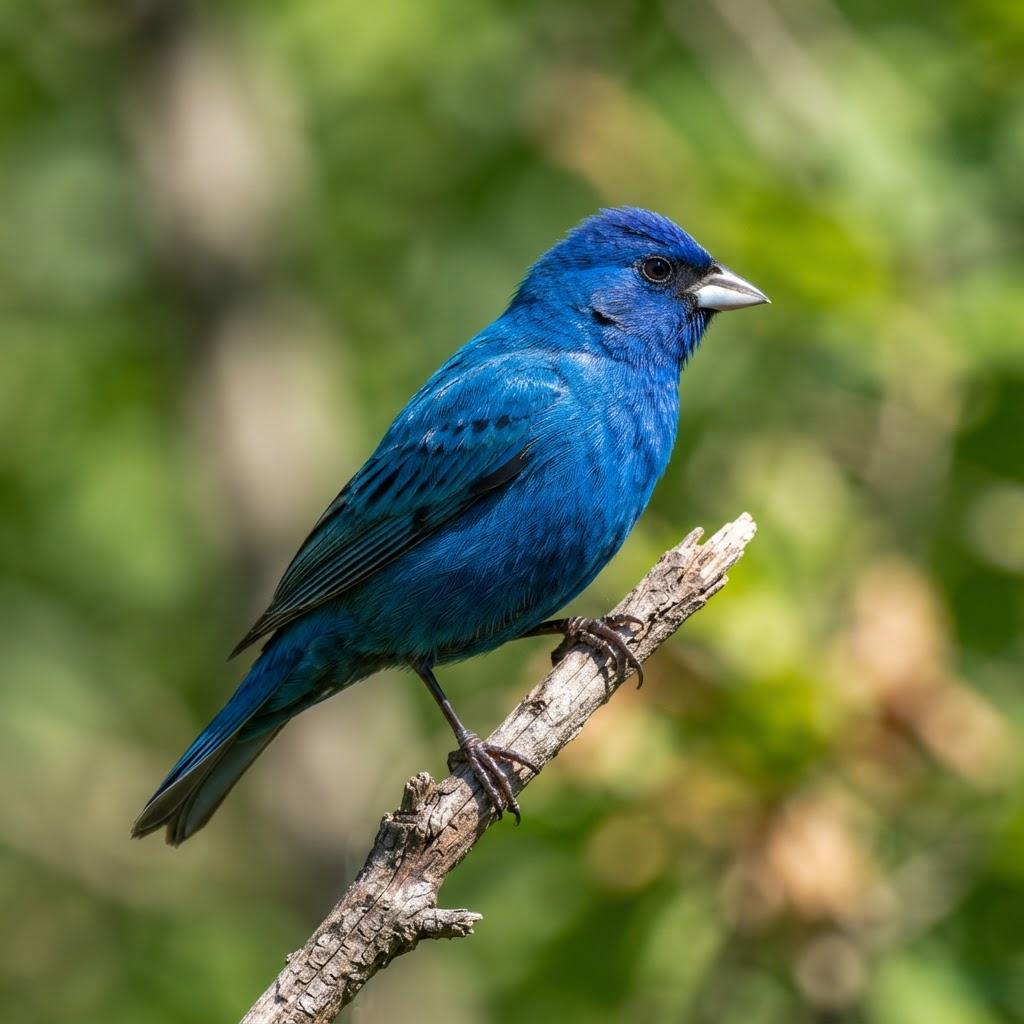
Passerina cyanea
Indigo Bunting
Meet the Indigo Bunting, a tiny, glowing blue marvel that proves nature uses high-definition paint. This bird is a master of migration and a backyard superstar that turns your garden into an art gallery.
Meet the Bird
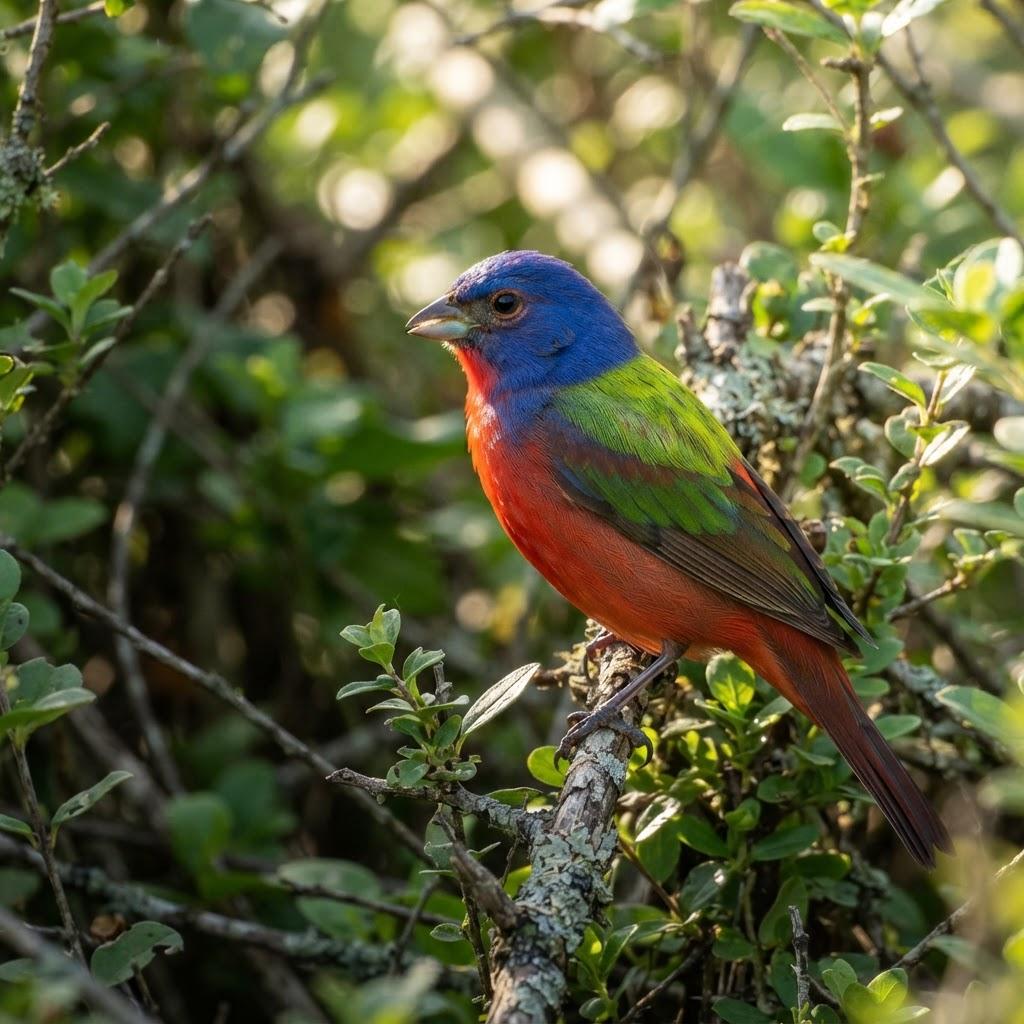
Imagine a bird that decided to take a bath in a vat of electric blue dye and then forgot to dry off before hitting the town. That is the Indigo Bunting. While most birds try to blend into their environment with drab browns and greens to avoid being a snack, the male Indigo Bunting looks like a neon sign blinking in a dense thicket. He is the ultimate show-off of the avian world, vibrating with a color so deep and intense it feels like he is glowing from within. You might see him perched prominently on a telephone wire or the top of a swaying weed, singing as if he is trying to compete with a heavy metal concert. The vibe is pure confidence mixed with a touch of eccentric mystery, a feathered daredevil who insists on being the center of attention in the middle of a humble meadow.
Superpowers & Weird Abilities
While looking like a sapphire come to life is impressive, the real magic happens at night. Indigo Buntings are nocturnal migrants, meaning they travel thousands of miles under the cloak of darkness. How do they know where they are going without a GPS or a smartphone? They use the stars. This bird has the incredible, sci-fi ability to memorize the rotation of the constellations. They basically map out the night sky like a celestial sailor, orienting themselves based on the center of rotation of the heavens. It is a biological superpower that puts our best navigation systems to shame. If you put one of these birds in a planetarium and changed the stars, it would try to fly in the wrong direction, proving that they are essentially tiny, feathered astronomers who look up to find their way home to your backyard.
Drama, Personality & Feathered Chaos
Do not let the pretty blue feathers fool you; the Indigo Bunting is a territorial tyrant in a very small package. When it comes to the mating season, the male acts like he owns the entire county. He will scream his 'sweet-sweet-chew-chew' song from dawn until dusk, often repeating phrases to make sure his rivals know exactly who is in charge. They are not necessarily bullies to other species, but they are certainly dramatic toward each other. You will often see two males chasing each other through the brush in a high-speed, frantic blur of blue, engaged in a dramatic aerial duel that looks like a miniature dogfight. It is classic soap opera behavior, played out on the stage of a roadside weed patch, where every perch is a throne and every intruder is a villain in their personal epic.
Bizarre Rituals & Quirky Habits
Indigo Buntings have some truly bizarre habits that would make a human look like a maniac. One of their most peculiar traits involves their reaction to sunlight. Because they are not actually blue—the color is a physical trick of light hitting their micro-structured feathers—they look different depending on the angle of the sun. But the weirdest quirk is their migration timing. They are remarkably specific about when they leave and arrive, almost like they have a calendar tattooed on their brains. They also exhibit something called 'site fidelity,' meaning they have a stubborn, irrational attachment to the exact same patch of bushes they visited last year. Even if you cut down their favorite shrub, they will sit there looking confused and annoyed, as if they are waiting for a customer service representative to explain why their luxury suite has been demolished.
Legends, Folklore & Human Stories
In the world of folklore, the Indigo Bunting has often been associated with truth and clarity because of its striking, unearthly hue. Some ancient cultural observers believed that seeing one was a sign to clear one's mind of trivial worries and focus on the 'true blue' nature of one's goals. They do not have the massive, heavy-handed mythology of ravens or owls, but they serve as the silent, beautiful guardians of the summer fields. There are stories from farmers about how the birds would 'sing the corn to sleep,' marking the transition from the frantic heat of July into the slower pace of late summer. They are the heralds of the mid-year shift, symbols of persistence and beauty that remind us that even the smallest, most frantic creatures play a vital role in the grand rhythm of the seasons.
Mating: The Ridiculous World of Avian Dating
Avian dating for the Indigo Bunting is an exercise in acoustic endurance. The male is essentially a jukebox that only knows one song, but he plays it with the intensity of an operatic tenor trying to save his career. He does not build a fancy house or offer gifts; he simply sings until the female is either completely smitten or completely deaf. The courtship dance involves a lot of fluttering, showing off his wings, and performing dramatic, steep dives toward the female to prove he has the stamina of a fighter pilot. If the female decides his singing is off-key or his aerial maneuvers are sloppy, she is off, and he is left singing to the empty wind. It is a high-stakes game of 'the bachelor' where the prize is a messy nest in a bramble bush.
Nesting: Master Architects and Lazy Slumlords
When it comes to home construction, the female Indigo Bunting is the sole architect, and she does not mess around with fancy, over-the-top designs. She prefers a sturdy, cup-shaped structure tucked deep within a thicket of weeds or low shrubs. Think of it as a hidden bunker built from grass, leaves, and bits of bark, all held together by the avian equivalent of duct tape: spider silk. It is not going to win any awards for interior design, but it is functional, discreet, and extremely safe from predators. She keeps the location a state secret, disappearing into the tangle of green so efficiently that you might walk past it ten times and never suspect a thing. It is a humble, utilitarian home for a bird that spends its life looking like a superstar.
Raising Babies: The Screaming Food Disposals
Raising baby buntings is essentially a frantic race against time and gravity. Once those eggs hatch, the parents are transformed into high-speed delivery drones. The chicks are blind, naked, and have one singular objective: to turn every single caterpillar and spider found in the vicinity into more bird. They are truly the world's most demanding roommates. As they grow, their mouths become giant, hungry craters, and they spend the entire day shouting their location to every predator within a three-mile radius. The parents have to be incredibly stealthy, sneaking in and out of the nest to avoid giving away their location, while the babies act like they are auditioning for a lead role in a high-decibel opera. It is exhausting, loud, and frankly, a miracle that any of them survive to fly.
Bird-Watching Travel & Local Hotspots
If you are desperate to see an Indigo Bunting, do not bother looking in deep, dark forests. You need to head to the messy, forgotten corners of the world. Look for utility rights-of-way, overgrown pastures, or the edges of suburban parks where the maintenance crew has been a little bit lazy. In the eastern U.S., places like the Great Smoky Mountains or the edges of the Shawnee National Forest are prime spots during the summer months. You want to look for them on warm, sunny mornings when they are perched high and exposed. If you are in the Midwest, a walk through a prairie restoration project in late June is a guaranteed winner. Bring binoculars and some patience, because while they are bright, they are also incredibly fast and notoriously good at hiding in the shadows of the leaves.
Food, Feeder Hacks & DIY Projects
Attracting an Indigo Bunting to a feeder is like trying to convince a celebrity to visit a dive bar. They prefer foraging for their own meals, mostly insects, but they will occasionally stop by a feeder if you offer the right stuff. Forget that cheap, dusty millet that ends up in the bargain bin; they have expensive tastes. They love tiny seeds like nyjer (thistle) or even small sunflower hearts. If you really want to bring them in, skip the feeder entirely and plant native shrubs like elderberry or blackberry, or let a corner of your yard grow into a 'weed patch.' A pile of brush in the back of your yard is better than any plastic feeder you can buy. They want a safe place to hide and a buffet of natural insects, which is the only way to get a consistent visitor.
Seasonal Guides & "Crisis" Management
Spring is a time of immense relief for birders, as the Indigo Buntings return from the tropics like colorful confetti falling from the sky. This is when they are at their most vocal. In the autumn, they start their silent departure, and by winter, they are long gone. The big crisis arises in mid-summer, the 'fledgling panic' season. You might see a fluffy, bouncing ball of feathers on the ground and assume it is abandoned. It is not. It is likely a fledgling taking its first terrifying steps into the world. Leave it alone! The parents are watching from the brush, likely complaining about their teenager's poor decision-making skills. Unless the bird is clearly injured, just walk away and let the bird learn how to be a bird. Interference is rarely helpful and often stressful for the whole family.
Backyard Tech & Gadget Reviews
If you want to document your visitors, skip the expensive, over-hyped 'smart' feeders that promise the world and just get a basic motion-sensor trail camera. Place it near a birdbath or a dense shrub where you have spotted activity. Because Indigo Buntings are shy, a trail camera captures their behavior without you looming over them with a tripod. Regarding windows: they are the biggest danger to our feathered friends. Use window film or patterned decals to break up the reflection, which turns your home from a 'death trap' to a 'safe landmark.' This simple tech is far more valuable than a high-tech feeder because it actually keeps the birds alive, allowing you to enjoy them for years instead of finding them stunned on your patio.
How to Spot One & How It Is Doing
To spot an Indigo Bunting, listen for a song that sounds like it is being played at double speed—a rhythmic 'what-what, where-where, see-see' pattern. Visually, look for a small bird that looks like it is covered in blue ink, sitting at the very top of a tall weed. Their population is currently stable, which is a rare bit of good news in the bird world. Their love for 'weedy' habitats actually helps them survive as more land is left fallow. To help, simply pledge to be a 'messy' gardener. Stop obsessively mowing every inch of your grass, leave the goldenrod and the milkweed, and keep your yard a bit wild. If you provide the mess, the Indigo Buntings will provide the color. You are essentially building a resort for one of the most beautiful creatures on the planet, all by doing less work.