Pitangus sulphuratus
Great Kiskadee
Meet the Great Kiskadee, a neon-yellow bird with the personality of a caffeinated toddler and the volume of a car alarm. This loud-mouthed tyrant is the undisputed king of the backyard, and it is here to make sure you never sleep in on a Saturday again.
Meet the Bird
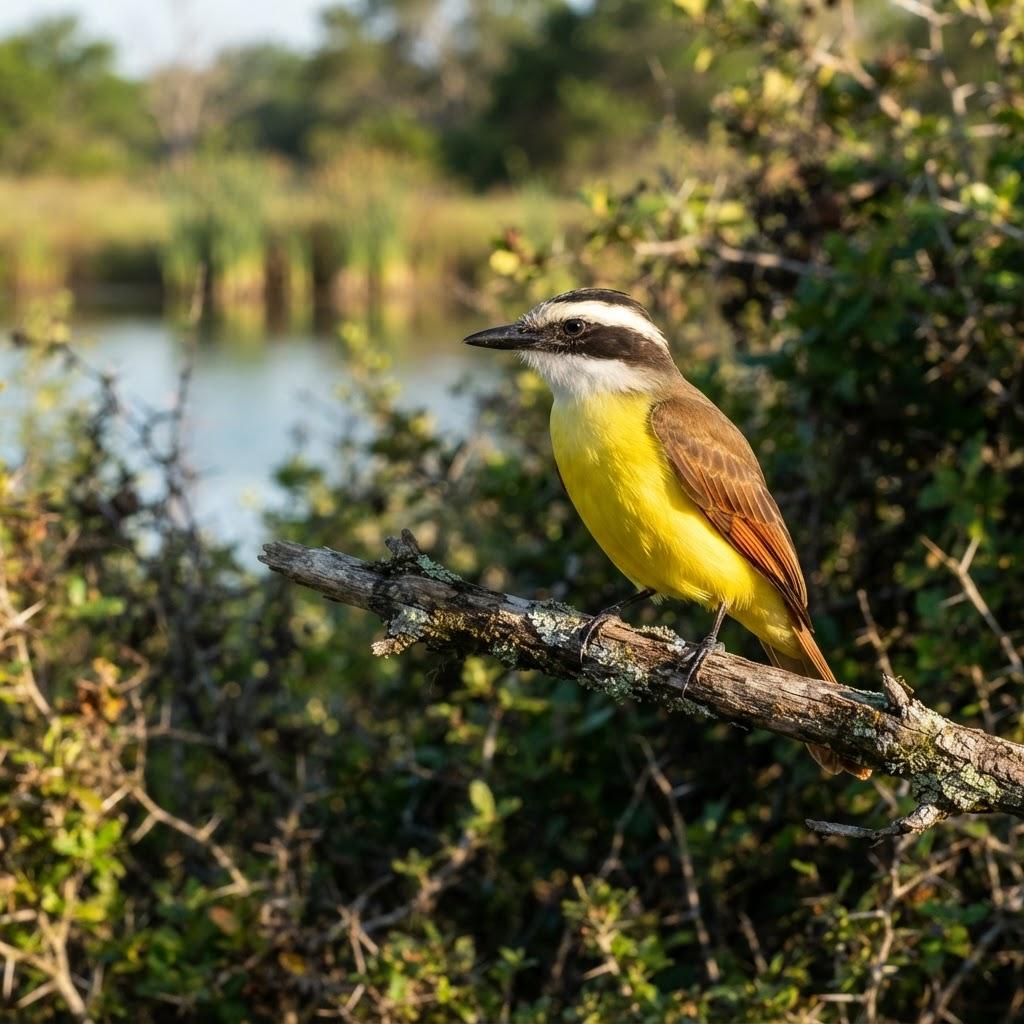
Imagine a bird that wears a striking black-and-white striped mask like a feathered Zorro, sports a belly as yellow as a highlighter, and has the audacity to announce its own name everywhere it goes. That is the Great Kiskadee. Standing out like a neon sign in the foliage, the Kiskadee is a member of the tyrant flycatcher family, and let us be honest, the name fits. It is not just a bird; it is an experience. It has a vibe that suggests it has had four espressos before sunrise. While other birds might shyly hide in the canopy, the Kiskadee chooses to perch right on the highest wire or the tip of a palm tree, chest puffed out, screaming its distinct 'kis-ka-dee!' call at everything that moves. It is the avian equivalent of the person at the party who is dancing on the table while everyone else is trying to enjoy a quiet conversation. It is bold, it is brassy, and it is absolutely impossible to ignore.
Superpowers & Weird Abilities
The Kiskadee is a biological Swiss Army knife. Its most impressive ability is its sheer, unadulterated versatility. While many birds are specialists, the Kiskadee is a generalist with an appetite that would make a dumpster diver jealous. It has incredible vision, capable of spotting a tiny beetle from a branch fifty feet away, but it can also spot a fish near the surface of a pond with equal precision. Its bill is thick and powerful, allowing it to perform a move called 'hawking'—launching off a perch to snatch flying insects in mid-air—or to dive-bomb the water surface like a tiny, feathered kingfisher to grab a minnow. Think of it as the ultimate tactical pilot of the bird world. It also has a secret weapon: agility. It can adjust its flight path in milliseconds, turning on a dime to pursue a butterfly or swat a lizard. It does not just fly; it maneuvers with the grace of a stunt pilot and the hunger of a linebacker.
Drama, Personality & Feathered Chaos
If the bird world had a neighborhood watch, the Kiskadee would be the one writing aggressive notes about your lawn height. These birds are absolute tyrants. They are known to bully birds twice their size, dive-bombing hawks and owls that dare to cross their territory. They are not afraid of anything, and they will happily chase away mockingbirds, squirrels, or even the family cat if it gets too close to their nesting tree. Their social drama is legendary. They aren't just loud; they are persistent. If a Kiskadee decides your backyard is its personal kingdom, you are merely a guest who is lucky to be allowed in. They are essentially the neighborhood loudmouths who believe they own the sidewalk. They don't just perch; they take up space with an attitude that says, 'I am here, I am yellow, and if you don't like it, we can have a very loud disagreement about it.'
Bizarre Rituals & Quirky Habits
Kiskadees have a bizarre habit of bathing that looks more like a ritualistic exorcism than personal hygiene. They love water, but instead of a polite splash, they perform a full-body kamikaze dive into a birdbath. They hit the water, submerge entirely, and then erupt into a spray of droplets, shaking their feathers with a wild, vibrating frenzy. It’s like watching a tumble-dryer filled with feathers. Additionally, they are known to spend an inordinate amount of time preening in a way that suggests they are preparing for a photoshoot. They will sit for ages, carefully smoothing every yellow breast feather, perhaps because they know that being the flashiest bird in the tree requires serious maintenance. They also possess a strange curiosity; they will investigate shiny objects, dangling garden decorations, or even your garden hose, often giving them a stern 'kis-ka-dee' as if they are demanding an explanation for why these things exist in their world.
Legends, Folklore & Human Stories
In many parts of South and Central America, the Kiskadee is so iconic that its name is literally the phonetics of its call in multiple languages. In Spanish-speaking regions, it is often called the 'Benteveo,' which means 'I see you well.' Folklore suggests that if a Kiskadee calls out near your home, it is a harbinger of change, or sometimes, a messenger from a departed loved one. In some rural communities, the bird is treated with a mix of reverence and annoyance; they are loved for their bright presence but mocked for their insistence on waking everyone up at the first hint of light. There is a story from the Amazon that these birds were once guardians of the forest floor, tasked by the sun to keep watch over all living creatures. Whether or not you believe in the legends, the Kiskadee is a permanent fixture in the cultural landscape, representing the vibrant, noisy, and unyielding spirit of the tropics.
Mating: The Ridiculous World of Avian Dating
Avian dating for a Kiskadee is essentially a high-energy dance competition. It starts with the male finding the highest point of his territory to put on a spectacle. He will flutter his wings in a rapid, vibrating display while letting out a series of frantic, chattering calls. He looks like a tiny, yellow helicopter that has malfunctioned. He doesn't just want to be seen; he wants to be the only thing the female notices. If she is interested, they engage in a 'wing-shivering' dance, bouncing toward each other on a branch. If she isn't interested? She will simply fly away without a second look, leaving the male to continue his frantic performance to an empty sky. It is brutal, it is fast-paced, and it is quite funny to watch these normally aggressive birds suddenly turn into soft-hearted suitors who seem to be trying way too hard to impress the girl of their dreams.
Nesting: Master Architects and Lazy Slumlords
When it comes to home construction, the Great Kiskadee is a bit of a maximalist. They don't just build a nest; they build a fortress. They construct large, messy, dome-shaped structures that look like a ball of twigs, grasses, and whatever else they can scavenge. It’s not elegant—it’s functional. These nests are often placed high in a fork of a tree, and they are built to last. A Kiskadee is not a lazy slumlord; they are a hardworking contractor who prefers substance over style. They will stuff the interior with soft feathers, moss, and stray pieces of string or plastic, making it a cozy, if somewhat chaotic, nursery for the chicks. They are territorial about the home base too, often adding extra padding to the entrance to keep out intruders. It is the bird equivalent of an impenetrable fort made entirely of neighborhood trash and twigs, proving that even a loudmouth can have a soft side when it comes to family.
Raising Babies: The Screaming Food Disposals
Once the eggs hatch, the peace and quiet of the forest end. Kiskadee chicks are the definition of demanding. From the moment they hatch, they have one mission: to scream for food. The parents are absolute champions, working from dawn to dusk to keep the mouths full. You will see a parent zip past with a large dragonfly or a small frog in its beak, only to be met with a chorus of high-pitched chirps from the nest. The chicks grow fast, and their appetite is legendary. It’s like trying to feed a fire hose. The parents show incredible stamina, balancing the need to feed their ravenous brood with the need to defend their nest from predators. It is a non-stop, high-stress operation that turns these typically boisterous birds into focused, selfless guardians. By the time the chicks fledge, the parents look exhausted, and you’ll find yourself rooting for them to finally get a break.
Bird-Watching Travel & Local Hotspots
If you are dying to see a Kiskadee in its natural habitat, head to the Rio Grande Valley in Texas. Places like the Santa Ana National Wildlife Refuge or Bentsen-Rio Grande Valley State Park are practically Kiskadee headquarters. These birds love areas with a mix of open field and water, so any park near a lake or river in Central or South America will likely yield a sighting. If you are in Costa Rica, keep your ears open; you will hear them in every town, garden, and canopy. The best time to see them is in the early morning when they are most active. Bring your binoculars, but honestly, you won't need them—they are bright yellow, loud, and usually sitting right in the open. Look for the tops of trees near the water, and just listen for that iconic, slightly repetitive shouting. They are almost impossible to miss, which makes them the perfect beginner bird for any traveler.
Food, Feeder Hacks & DIY Projects
Attracting a Kiskadee is like trying to feed a teenager; they want it all. While they are insectivores, they have a massive sweet tooth and won't turn down fruit. If you want to see them in your yard, skip the cheap, dusty millet that the sparrows fight over. Instead, put out high-quality suet, especially in the winter, or offer slices of orange, papaya, or banana on a platform feeder. A great DIY hack is to make a 'Kiskadee skewer'—take a long metal skewer, stick a piece of fruit on the end, and mount it to a tree limb. They love it! Also, planting native shrubs like Lantana or Yaupon Holly creates a buffet of insects and berries that they find irresistible. Avoid using pesticides in your yard; you want the bugs there so the Kiskadees have a reason to visit. It’s a win-win: you get a beautiful bird, and they get a bug-free garden.
Seasonal Guides & "Crisis" Management
During the spring, you might find a fluffy, uncoordinated ball of feathers on your lawn and think it’s a tragedy. Don't panic! This is a fledgling. Kiskadees often leave the nest before they are fully masters of flight. The parents are usually nearby, watching from a tree and still bringing food. Unless the bird is clearly injured or in the middle of a busy road, leave it alone. In the winter, keep your birdbath clean and free of ice; a heated birdbath is a game-changer. Since Kiskadees are not migrators in many of their ranges, they stick around through the cold, and having a consistent water source will make your yard the most popular hangout in town. If you see them acting slightly lethargic during a cold snap, provide high-fat foods like suet to help them keep their internal furnaces running. They are tough, but a little neighborly support goes a long way.
Backyard Tech & Gadget Reviews
Technology has made birding much more interesting. Smart feeders that use AI to recognize birds are excellent for Kiskadees because they help you track exactly which 'individuals' are visiting your yard. Since these birds are territorial, you might notice the same bird coming back day after day. For window collisions, which are a major danger for active birds like Kiskadees, invest in window decals or bird-safe netting. They are fast flyers and sometimes don't see the glass if they are chasing a moth. Another great tool is a motion-activated trail camera. Set it up near your birdbath, and you will get hilarious, high-definition footage of Kiskadees 'diving' into the water. It is a fantastic way to see the bird's personality up close without having to stand outside in the heat. Just make sure the camera is sturdy—the Kiskadee might try to investigate it if it catches the light!
How to Spot One & How It Is Doing
To identify a Great Kiskadee, look for the 'Big Three': the bold white eyebrow, the bright yellow belly, and the rich, chestnut-colored wings. If it is perched on a wire and yelling at you, that is a dead giveaway. They are doing quite well in the wild, largely because they are masters of adaptation. As we build more parks and gardens, the Kiskadee thrives because it loves the edges where forest meets open space. They are a 'Least Concern' species, which is the best category you can hope for. You can help them by planting native trees, keeping your yard pesticide-free, and creating a space that mimics the wild habitats they love. They are resilient, adaptable, and genuinely entertaining, so don't be surprised if they become the permanent, loud, and yellow residents of your life. Keep watching, keep listening, and keep enjoying the daily theater that is the life of a Kiskadee.