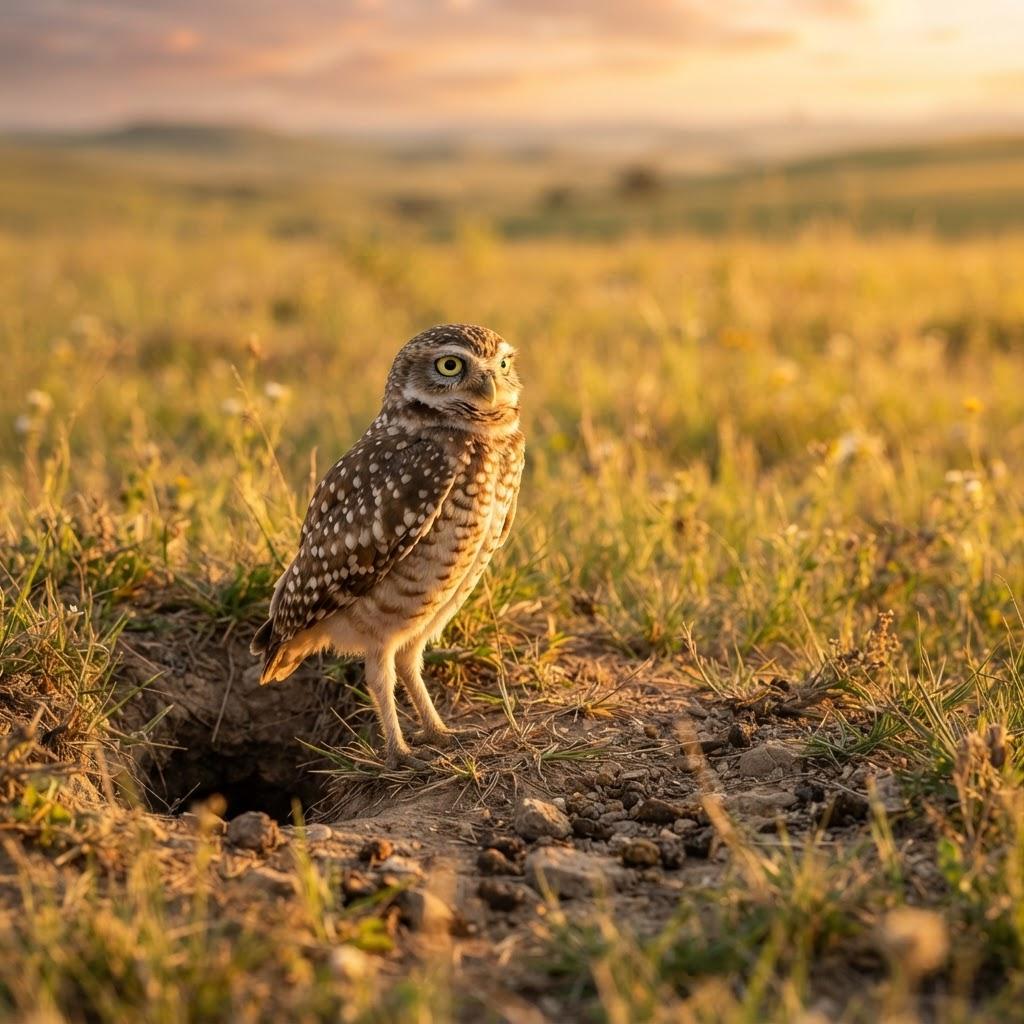
Athene cunicularia
Burrowing Owl
Imagine a tiny, long-legged owl that traded the tree branch for a real estate investment in the ground. These charismatic ground-dwellers are the underground real estate moguls of the bird world, turning dusty burrows into sophisticated bachelor pads.
Meet the Bird
The Burrowing Owl is the eccentric character in your neighborhood who decided that living in a tree was far too mainstream. Picture an owl roughly the size of a pigeon, but blessed with legs that seem to go on for days. While its cousins are busy hooting from the safety of oak branches, the Burrowing Owl is hanging out in a hole in the dirt, bobbing its head at passing grasshoppers with the intensity of a heavy metal drummer. It is a desert-dwelling, hole-dwelling, sunshine-loving oddball that defies every stereotype you have about owls. They are arguably the most charismatic birds in the animal kingdom, often standing near their burrow entrances during the day with a permanent look of mild surprise or profound judgment. When they get excited, they perform a little bob-and-weave dance that suggests they might have had too much espresso. These birds do not just occupy the landscape; they command it with a mixture of tiny-warrior bravery and comedic physical flair.
Superpowers & Weird Abilities
While most owls are built for silent, nocturnal stealth, the Burrowing Owl has adapted to the bright, scorching reality of life in the open. One of their most fascinating traits is their 'rattlesnake impression.' When a predator approaches a burrow—perhaps a curious coyote or a neighborhood dog—the young owls have a secret weapon: they mimic the distinct, buzzy rattle of a rattlesnake. It is the avian equivalent of an 'Exit Only' sign. Beyond this psychological warfare, they have incredible panoramic vision, which is necessary when your entire world is at ground level. Their ear placement is also slightly asymmetrical, which functions like a biological sound-triangulation system. This allows them to pinpoint a beetle scuttling through dry grass from fifty feet away with the precision of a heat-seeking missile. They aren't just surviving in the dirt; they are using advanced sensory technology to turn the ground into a highly protected fortress, complete with an acoustic security alarm system.
Drama, Personality & Feathered Chaos
If you think your neighbors are dramatic, you have never sat near a colony of Burrowing Owls. These birds are the feathered equivalent of a reality television cast. They are incredibly social, often living in loose neighborhoods where the gossip is constant and the territorial disputes are legendary. If a neighbor owl moves in a little too close to the property line, you will see a flurry of wing-flapping and high-pitched chattering that rivals any soap opera confrontation. They are also opportunists; if a ground squirrel digs a perfectly good basement suite, the Burrowing Owl is more than happy to initiate a hostile takeover. They don't mind 'evicting' the previous tenant with a little intimidation or simply waiting for the squirrel to abandon the property. They have a permanent 'bossy' vibe, strutting around their mounds as if they own the entire acre, and they have absolutely zero qualms about staring down a human who dares to walk too close to their front door.
Bizarre Rituals & Quirky Habits
The most famous—and arguably most disgusting—habit of the Burrowing Owl is their love of poop. Specifically, they collect cow, dog, or horse dung and line the entrance of their burrows with it. At first glance, this seems like a decorator with questionable taste, but there is a brilliant, scientific method to the madness. The dung acts as a beacon for dung beetles, which are the Burrowing Owl’s favorite snack. By creating a 'bait station' at the door, the owl ensures that room service is constantly delivering fresh food right to the porch. Furthermore, the smell may help mask the scent of the owl chicks inside from predators like foxes or weasels. It is a masterclass in efficiency that puts modern food delivery apps to shame. Additionally, they are known to spend their days standing outside in the sun, soaking up the heat like tiny, feathered sunbathers who are clearly overdue for a vacation.
Legends, Folklore & Human Stories
In some cultures, owls are associated with mystery and the afterlife, but the Burrowing Owl has a more grounded reputation. Because they live in the ground, they have been woven into the folklore of various Indigenous tribes across the Americas, often representing a connection to the spirit world or a guardian of the plains. Early pioneers and settlers in the American West often found them to be a source of amusement, frequently referred to as 'howdy birds' because they appeared to be nodding hello to passersby. In stories from the pampas of South America, they were seen as watchmen of the underground, quiet observers of the changing tides of the landscape. Unlike the 'ominous' screech owl of spooky movies, the Burrowing Owl has always been viewed with a sense of affection by those who work the land. They are the 'good guys' of the rangeland, working hard to keep insect populations in check and providing a bit of levity in the wide-open, lonely spaces of the frontier.
Mating: The Ridiculous World of Avian Dating
Courtship for a Burrowing Owl is less like a candlelit dinner and more like a high-stakes talent show performed on a dusty stage. The male puts his heart and soul into a series of displays that involve elaborate flight patterns—circling high above the territory and then diving toward the ground with a rhythmic fluttering—followed by intense bowing sessions near the burrow entrance. He is basically showing off his real estate and his fitness levels. If the female is interested, she will join him for a 'duet' of head-bobbing and chirping that can last for hours. If she is unimpressed, she simply flies off to find a male with a better-located burrow or smoother dance moves. It is a brutal process; the rejected suitor is left standing alone in the dirt, wondering where he went wrong. The ones that do pair up often remain together for the season, forming a powerhouse team dedicated to the expansion and defense of their subterranean empire.
Nesting: Master Architects and Lazy Slumlords
When it comes to nesting, these birds are essentially professional squatters. While many birds build intricate nests of twigs and mud, the Burrowing Owl looks at a perfectly good prairie dog hole and thinks, 'Yes, I will take that.' They are expert renovators, though. Once they move into a burrow, they clear out debris, widen the tunnels, and line the nesting chamber with grass, feathers, and occasionally bits of shiny foil or bottle caps to make the nursery more comfortable. It is a functional, low-maintenance design that keeps the eggs and chicks safe from extreme temperatures and hungry predators. They are the ultimate slumlords of the avian world, taking over abandoned infrastructure and making it work for their families. There is something deeply satisfying about watching a bird that refuses to waste energy on sticks and mud, choosing instead to focus on the 'location, location, location' strategy of subterranean real estate.
Raising Babies: The Screaming Food Disposals
Once the eggs hatch, the burrow transforms from a quiet bachelor pad into a frantic, high-intensity nursery. A clutch can contain up to a dozen chicks, and those little balls of fluff are essentially bottomless pits. The parents are on an endless loop of hunting insects, lizards, and small rodents to keep the growing brood satisfied. In the dark confines of the burrow, the chicks use their 'rattlesnake' vocalization to keep intruders away, but they also use it to beg for food, making the entire nest sound like a high-pitched, angry rattle-box. It is an exhausting cycle for the parents, who must spend every waking hour guarding the entrance and flying back and forth with snacks. By the time the chicks emerge, they are already masters of the 'burrow defense' behavior, ready to carry on the family tradition of bobbing at strangers and keeping the local bug population in a constant state of panic.
Bird-Watching Travel & Local Hotspots
If you want to see a Burrowing Owl in the wild, skip the deep forest and head for the open spaces. Southern California, particularly the Imperial Valley, is a goldmine for these birds. Many agricultural areas, especially those with canal banks, offer prime real estate for owl colonies. In Florida, keep your eyes peeled near the sandy, open lots of Cape Coral, where the local community has actually embraced them as mascots. Wildlife refuges like the Bitter Lake National Wildlife Refuge in New Mexico or the grasslands of Colorado are also fantastic places to find them. The secret is to go early in the morning or just before sunset when the heat dies down. They are creatures of habit, so if you spot a burrow, pull over safely, grab your binoculars, and be patient. Do not approach the nest; just wait at a respectful distance, and you will eventually see one pop out for its evening jog.
Food, Feeder Hacks & DIY Projects
You cannot exactly put out a bird feeder for a Burrowing Owl because they prefer their meals to be running, flying, or crawling away from them. They are carnivores with a taste for the 'crunchy' side of life: grasshoppers, beetles, crickets, and occasionally small mice or frogs. Instead of a traditional seed feeder, the best way to attract these birds is to create a 'biodiversity oasis' in your backyard. Avoid using pesticides, as these chemicals kill the insects the owls depend on. If you live in an area where they are known to roam, leave a patch of wild, unmowed grass to encourage local insect life. Consider building a 'wildlife-friendly' burrow structure if you have the space—some conservation groups offer guides for installing artificial burrows that are safe from local machinery. Your best bet is to maintain a natural, untamed corner of your yard where crickets and beetles can thrive, providing a natural buffet that keeps the owls happy and full.
Seasonal Guides & "Crisis" Management
During the spring, you might witness the 'fledgling phase,' where young owls wander out of the burrow before they are fully flight-capable. To an untrained eye, a baby bird sitting on the dirt looks like an emergency, but it is entirely normal behavior. Do not try to 'rescue' these birds; their parents are almost always watching from a few feet away, ready to dive-bomb anyone who gets too close to their offspring. If you see a young owl bobbing and weaving, it is practicing its survival skills. As winter approaches, Burrowing Owls in colder northern regions will migrate south, while those in warmer climates hunker down. If you live in an area where they stay year-round, ensuring that their habitat isn't disturbed by lawnmowers or pets during the sensitive nesting months is the best 'crisis management' you can provide. Keep your dogs on a leash, stay on marked trails, and let the owls do their thing.
Backyard Tech & Gadget Reviews
While smart feeders are fun for tracking backyard songbirds, they won't do much for a Burrowing Owl. However, if you are lucky enough to have them nearby, a motion-activated trail camera is a total game-changer. These cameras, often used by hunters to track deer, are perfect for capturing the nocturnal or twilight activities of Burrowing Owls without disturbing them. Place one facing a known burrow entrance, set it to video mode, and you will get a front-row seat to the daily drama of their lives. For window protection, use simple UV-reflective decals or window film to prevent collisions if you live in a rural area where they hunt. The goal is to observe without becoming part of the landscape. Using low-tech solutions like a good pair of 8x42 binoculars and a bit of patience will always yield better results than high-tech gadgets when it comes to respecting the owl's need for personal space.
How to Spot One & How It Is Doing
To identify a Burrowing Owl, look for a small, round bird with bright yellow eyes and a short tail, standing stiffly on the ground. Its plumage is a mottled mix of sandy browns and whites, which acts as the perfect camouflage against dry dirt and grass. Their call is a soft, rhythmic 'coo-coo' that sounds almost like a dove, which is easy to miss if you aren't listening closely. While they are listed as 'Least Concern' globally, they face significant threats from habitat loss due to development and the decline of the prairie dog and ground squirrel populations that provide their homes. You can help by supporting local land conservation trusts and advocating for 'wild zones' in your community. Every acre of protected prairie or open grassland is a potential neighborhood for these delightful, bobbing little comedians. They are resilient and adaptable, but they definitely appreciate a little help from their human fans.