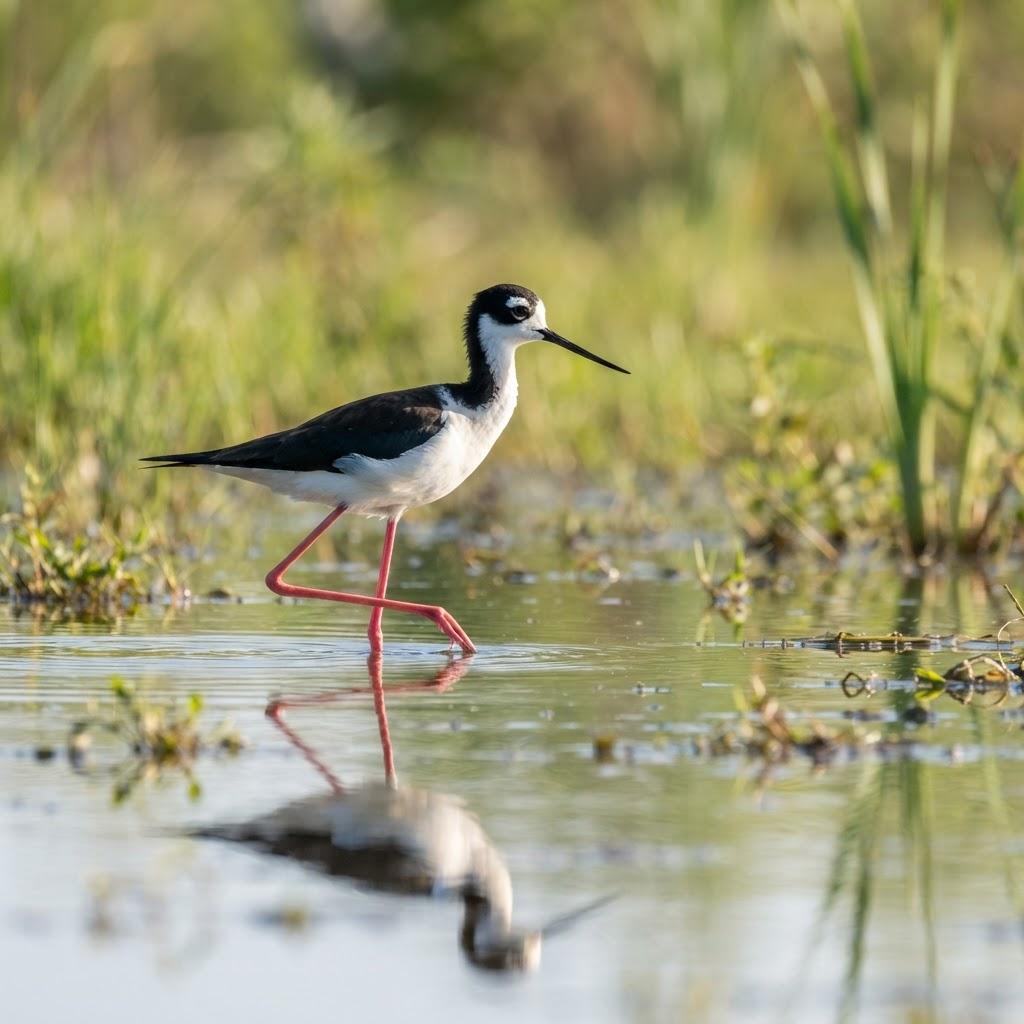
Himantopus mexicanus
Black-necked Stilt
Meet the Black-necked Stilt, a bird that struts like a supermodel with legs for days! This feathered fashionista is a master of wetland living, dazzling with its vibrant colors and surprisingly serious parenting skills. Get ready to be charmed by this striking shorebird.
Meet the Bird
Imagine a bird that looks like it’s been dipped in an inkwell from the neck down and then styled by a Hollywood hair stylist on top. That’s the Black-necked Stilt for you! This isn't just any bird; it's a runway model of the wetlands. With impossibly long, neon-pink legs that seem to defy gravity, and a sleek, black-and-white tuxedo-like plumage, it’s always dressed to impress. It moves with a peculiar, almost deliberate grace, like it’s being filmed in slow-motion for a nature documentary where it’s the star. What’s immediately captivating, and frankly a little bizarre, is the sheer audacity of those legs. They are so long, it looks like a gust of wind might just pick the whole bird up and send it sailing away like a kite. But don't let the elegant proportions fool you; this bird is built for business, navigating shallow waters with a style all its own. It’s the kind of bird that makes you do a double-take, a living, breathing optical illusion that reminds us nature’s design department has a sense of humor and a flair for the dramatic. Prepare to be utterly fascinated by this leggy marvel.
Superpowers & Weird Abilities
The Black-necked Stilt boasts a superpower that’s both visually striking and biologically ingenious: its legendary legs. These aren't just for show; they are incredibly sensitive instruments. Think of them as advanced sonar systems, but for wading. The bird can detect the slightest ripple or vibration in the murky shallows, pinpointing the location of tiny aquatic invertebrates, insect larvae, and small fish hidden beneath the surface. It’s like having built-in, underwater radar that never needs charging. When it steps, its long legs transmit vibrations through the water, essentially 'feeling' its prey before it even sees it. This allows it to hunt effectively in conditions where its eyesight might be hampered by muddy or cloudy water. Furthermore, these magnificent limbs are also fantastic for thermoregulation. On hot days, the stilt can lift its legs to keep its body away from the scorching ground, and it can even dip them into the water to cool down. It’s an elegant solution to a common problem, a biological air-conditioning unit that’s both effective and stylish. It also possesses an incredible ability to walk on water, or rather, to stand on the surface with such minimal disturbance that it appears to glide, thanks to its incredibly lightweight build and those long, spindly legs distributing its weight perfectly. It’s not magic, but it sure looks like it.
Drama, Personality & Feathered Chaos
The Black-necked Stilt might look like a sophisticated avian diplomat, but don't let the monochrome elegance fool you – there's plenty of drama unfolding in its watery world. These birds can be surprisingly territorial, especially during breeding season. Picture this: a stilt, standing tall and proud on its chosen patch of mud, issuing loud, sharp alarm calls that sound like a disgruntled car alarm. It’ll chase off anything it deems an intruder, from a nosy Killdeer to a fluffy duckling that wandered too close. They are particularly vigilant and will mob larger birds, like egrets or herons, with a flurry of aerial dives and scolding cries, effectively telling them to "Get off my lawn!" Their social dynamics can get heated, with squabbles over prime feeding spots or nesting real estate. Sometimes, you'll see two stilts engaging in what looks like a territorial dispute, facing off with exaggerated movements, wings spread, and heads held high. It’s a feathered standoff worthy of a Western movie, with the shallow water as the dusty main street. While not as notoriously cunning as a crow or as thuggish as some jays, the stilt certainly knows how to stand its ground and make its displeasure known. They are fiercely protective parents, and their drama escalates to DEFCON 1 when their chicks are around, turning their normally graceful demeanor into that of feisty little guardians.
Bizarre Rituals & Quirky Habits
One of the most fascinating, albeit slightly unsettling, habits of the Black-necked Stilt involves its approach to foraging. While many birds peck and probe, the stilt has a rather unique method of fishing for its meals. It engages in what's called 'foot-vibrating' or 'foot-paddling.' Imagine a bird doing a frantic, underwater jig with its long legs. It vigorously shakes its feet just below the surface of the water. This bizarre dance serves a dual purpose: it stirs up mud and debris, flushing out hidden invertebrates and small crustaceans, and the vibrations themselves can also disorient prey, making it easier to snatch. It looks utterly ridiculous, like a tiny, elegant ballerina attempting a tap dance in a muddy puddle, but it's incredibly effective. Another peculiar behavior, particularly observed in warmer climates, is their tendency to seek out brackish or even salty water. While many birds shy away from highly saline environments, the stilt thrives, possessing specialized salt glands above its eyes that filter out excess salt from its bloodstream. It can then expel this concentrated salt solution through its nostrils, essentially 'sneezing' out salty water. This adaptation allows them to exploit food resources in environments that are off-limits to many other species, turning salt flats into their personal all-you-can-eat buffet.
Legends, Folklore & Human Stories
While the Black-necked Stilt may not be the star of ancient epics or the subject of widespread mythologies like some more prominent birds, its striking appearance has certainly woven it into the fabric of human observation and, more recently, conservation. In many indigenous cultures of North and South America, birds with long legs and vibrant colors are often associated with messengers, intermediaries between worlds, or symbols of grace and balance. The stilt, with its almost ethereal presence wading through shallow waters, could easily have been perceived as a mystical creature or a guide to the watery realms. More tangibly, the stilt's life is intimately tied to the health of wetlands, making it an unwitting indicator species for environmental changes. Stories of its presence or absence have become important for communities that rely on these ecosystems. In modern times, the stilt has become a beloved character in the world of birdwatching, a sought-after sighting for its beauty and unique form. Conservation efforts often highlight species like the stilt as flagships for wetland protection. There are countless personal stories from birders who, after hours of patient waiting, experienced the sheer delight of spotting this elegant bird, an encounter that often sparks a deeper connection to the natural world and a commitment to preserving its habitats. It’s a bird that, by simply existing beautifully, inspires tales of wonder and care.
Mating: The Ridiculous World of Avian Dating
Forget Tinder; bird dating is a high-stakes, performance-based game, and the Black-necked Stilt is no exception to the often bizarre courtship rituals. For males, it’s all about showcasing their prowess and commitment, often with a flair for the dramatic. When a male stilt decides he's ready to mingle, he’ll engage in a series of elaborate displays. One of the most captivating is the 'preening-while-walking' display, where he struts around, seemingly nonchalantly preening his wing feathers while simultaneously keeping a keen eye on potential mates. But the real showstopper is the 'sky-pointing' or 'wing-waving' display. He’ll suddenly arch his back, point his beak skyward, and dramatically extend his wings, showing off those magnificent black and white patterns. It's like a sudden, avian ballet move that screams, 'Look at me! I'm fabulous and I have excellent wingspan control!' The female, meanwhile, plays the discerning critic. She’ll observe these displays with a cool, calculated gaze. If she’s unimpressed by the swagger, the wing-waving, or perhaps the choice of territory he’s defending, she has the ultimate power: she can simply walk away. The male is left to ponder what went wrong – was his stance not proud enough? Were his wing-waves too tentative? It’s a high-pressure situation, and a rejection can send him back to the drawing board, or rather, the muddy patch, to try his luck with the next eligible female. It’s a world where love is quite literally a dance, and a single misstep can mean a broken heart… or at least a very lonely breeding season.
Nesting: Master Architects and Lazy Slumlords
When it comes to nesting, the Black-necked Stilt leans towards the 'minimalist chic' end of the architectural spectrum. They aren't exactly building multi-story mansions or intricate woven baskets. Instead, they are the masters of the 'scrape nest.' Picture a shallow depression, a simple scoop in the dirt or sand, often lined with a few pebbles or bits of vegetation. That’s it. That’s the whole house. It’s less 'architectural marvel' and more 'strategically placed divot.' They choose locations that offer a mix of visibility and proximity to water, usually on exposed mudflats, gravel islands, or the edges of salt marshes. This seemingly haphazard approach is actually quite clever. The exposed nature of the nest allows the parents to easily spot approaching predators and, more importantly, to escape quickly if danger arises. Plus, in those hot, sunny environments, a simple scrape in the mud can often stay cooler than a more enclosed structure. They are certainly not lazy freeloaders like some birds who pawn off parenting duties, but they are definitely not engaging in advanced engineering either. Their nests are functional, no-frills residences that perfectly suit their lifestyle. It’s the avian equivalent of saying, 'Why build a house when a comfortable spot on the ground will do?'
Raising Babies: The Screaming Food Disposals
Once the eggs hatch – usually a clutch of three to four speckled wonders – the Black-necked Stilt parents transform into high-octane, feather-covered delivery services. And let’s be clear: the babies are demanding little clients. These chicks are precocial, meaning they are remarkably self-sufficient shortly after hatching, able to walk and even run, but they still require a constant supply of food brought to them by Mom and Dad. The parents dive into a relentless cycle of foraging and feeding, darting into the shallows to snag tiny insects, crustaceans, and worms, then rushing back to the nest to present their bounty. The chicks, upon seeing a parent approach, erupt into a symphony of high-pitched peeps and cheeps, stretching their tiny necks expectantly, their gaping mouths a testament to their insatiable hunger. It's a noisy, chaotic, and utterly exhausting operation. The parents are incredibly attentive and will use distraction displays – pretending to be injured to lure predators away from the chicks – to protect their brood. This phase lasts for about a month, during which the parents are running on fumes, fueled by sheer parental dedication and the desperate need to get these noisy little food vacuums ready to fledge. The chicks grow rapidly, their spindly legs already showing hints of the magnificent stilts they will become.
Bird-Watching Travel & Local Hotspots
If your heart is set on witnessing the leggy elegance of the Black-necked Stilt firsthand, you're in luck, as they are quite widespread. Your best bet is to head to areas with shallow, open water. Think vast expanses of salt flats, coastal lagoons, managed wetlands, and even flooded agricultural fields. During the breeding season, which generally spans from spring through summer, they can be found across much of the United States, particularly in the West and central parts of the country. Iconic birding destinations like the Great Salt Lake in Utah, Bosque del Apache National Wildlife Refuge in New Mexico, and various wildlife refuges along the Texas coast are prime locations. Out on the East Coast, look for them in places like the Outer Banks of North Carolina or coastal marshes in Florida. In winter, they move south, becoming more common throughout Mexico, Central America, and down into South America. A fantastic spot for winter viewing is the Yucatán Peninsula in Mexico, particularly around Celestún Biosphere Reserve and Ría Lagartos Biosphere Reserve, where large flocks can gather. Another excellent region is the Pacific coast of Costa Rica, with places like Palo Verde National Park offering superb stilt sightings. The key is to look for open, shallow water; they are usually quite visible on the mudflats, often in large groups, so once you find one habitat, you're likely to find many.
Food, Feeder Hacks & DIY Projects
Attracting the Black-necked Stilt to your backyard is a bit like trying to get a supermodel to frequent a fast-food joint – it’s not really their scene. These birds are specialized wetland foragers, and their diet consists primarily of aquatic insects, larvae, small crustaceans like brine shrimp and fairy shrimp, and tiny fish found in shallow waters. They aren't seed-eaters, and they certainly won't be lining up at your standard bird feeder. Forget the cheap millet mixes; they attract more squirrels than stilts and are a waste of money for these specific birds. So, how *can* you enjoy them nearby? The best 'feeder hack' is habitat creation. If you live near a suitable area, consider creating a shallow water feature in your garden. This could be a purpose-built wetland garden, a large pond with very gently sloping edges, or even a series of shallow basins. Stocking such a feature with native aquatic plants can attract the insects and invertebrates that stilts feed on. For a DIY project, think about building a 'mudflat' area. A shallow tray filled with sand and a bit of water, perhaps with some pebbles, can mimic their natural feeding grounds on a small scale. It won't attract them in large numbers, but it might encourage a curious individual to investigate. For attracting *other* birds to your yard, though, focus on native plants like sunflowers, coneflowers, and serviceberries, and offer a good quality mixed seed or suet. But for the stilt, it’s all about creating a mini-wetland paradise.
Seasonal Guides & "Crisis" Management
The Black-necked Stilt’s life unfolds with the rhythm of the seasons, offering different spectacles throughout the year. In spring, as the ice recedes and wetlands rehydrate, these birds undertake their migratory journeys. This is prime time to spot them returning to northern breeding grounds. If you have a wetland garden, this is when you want to ensure it’s pristine and ready, with fresh water and abundant insect life. As summer progresses, breeding activity peaks, and you might witness their elaborate courtship dances and the hustle of raising chicks. This is also the season for the 'fledgling panic.' People often find young stilts on the ground and assume they are abandoned. However, the parents are almost always nearby, observing and waiting for the human to leave. If you find a stilt chick that looks healthy and isn't in immediate danger (like being near a road or a predator), the best action is to leave it be. Observe from a distance, and the parents will likely resume their care. As autumn arrives, the bustling breeding colonies disperse. The stilts begin their southward migration, often forming larger flocks as they head to warmer climes. During fall and winter, they are more likely to be found in larger numbers in coastal areas and southern wetlands. Keeping a birdbath filled and unfrozen during winter is crucial for *other* bird species, but stilts typically find adequate water in natural sources. For the stilt, the biggest 'crisis' management involves protecting their wetland habitats from development and pollution, as their very existence depends on these fragile ecosystems.
Backyard Tech & Gadget Reviews
In the quest to get closer to our feathered friends, technology offers some intriguing possibilities, though perhaps less so for the specialized stilt. While AI-powered feeders like the Bird Buddy are fantastic for identifying common backyard visitors and snapping glamorous portraits, they are unlikely to capture a Black-necked Stilt. These birds aren't feeder regulars. However, if you’re interested in observing wetland birds and have a suitable habitat nearby, a wildlife camera placed strategically near a pond or wetland edge could be a game-changer. Think of a motion-activated camera that can capture footage of visiting stilts, herons, or other water dwellers, day or night. These cameras can reveal behaviors you might miss with the naked eye, offering a glimpse into the secret lives of wetland residents. For the more common backyard birds, the smart feeders are indeed fun, providing real-time notifications and photo galleries of your visitors. Just be aware that the novelty can wear off, and the ongoing subscription costs for some models can add up. Regarding window collisions, a persistent issue for many birds, simple yet effective solutions include applying window decals, using reflective tape, or even just regularly cleaning your windows with a solution that creates a slight smudge, disrupting the illusion of a clear path. For the stilt, the primary 'gadget' is really just good binoculars and a keen eye for spotting those improbable legs in the distance.
How to Spot One & How It Is Doing
Spotting a Black-necked Stilt is usually an exercise in scanning wide, open, shallow water. Look for a stark contrast of black and white against the mud or water. The most unmistakable feature, of course, is those unbelievably long, bright pink legs, often trailing behind the bird in flight or holding it high as it walks. They are medium-sized shorebirds, about the size of a robin but with a much more elegant, elongated build. Their call is a sharp, yappy bark, often given when alarmed or when defending territory. In flight, their wings are pointed, and the white underparts and black upperparts create a distinctive pattern. Listen for their calls and scan the edges of ponds, salt marshes, alkaline lakes, and flooded fields. As for how they are doing, the Black-necked Stilt is currently listed as 'Least Concern.' This means their populations are generally stable and widespread, which is good news! However, like many wetland-dependent species, they face threats. Habitat loss due to development, pollution of wetlands, and changes in water availability, especially in arid regions where they breed, can impact local populations. Fortunately, their adaptability to some human-modified habitats, like flooded fields and ponds, helps them persist. You can help by supporting local conservation organizations that protect wetlands, reducing your water usage, and keeping water bodies clean. Every effort to preserve these vital habitats is a step towards ensuring these leggy wonders continue to grace our wetlands for generations to come.