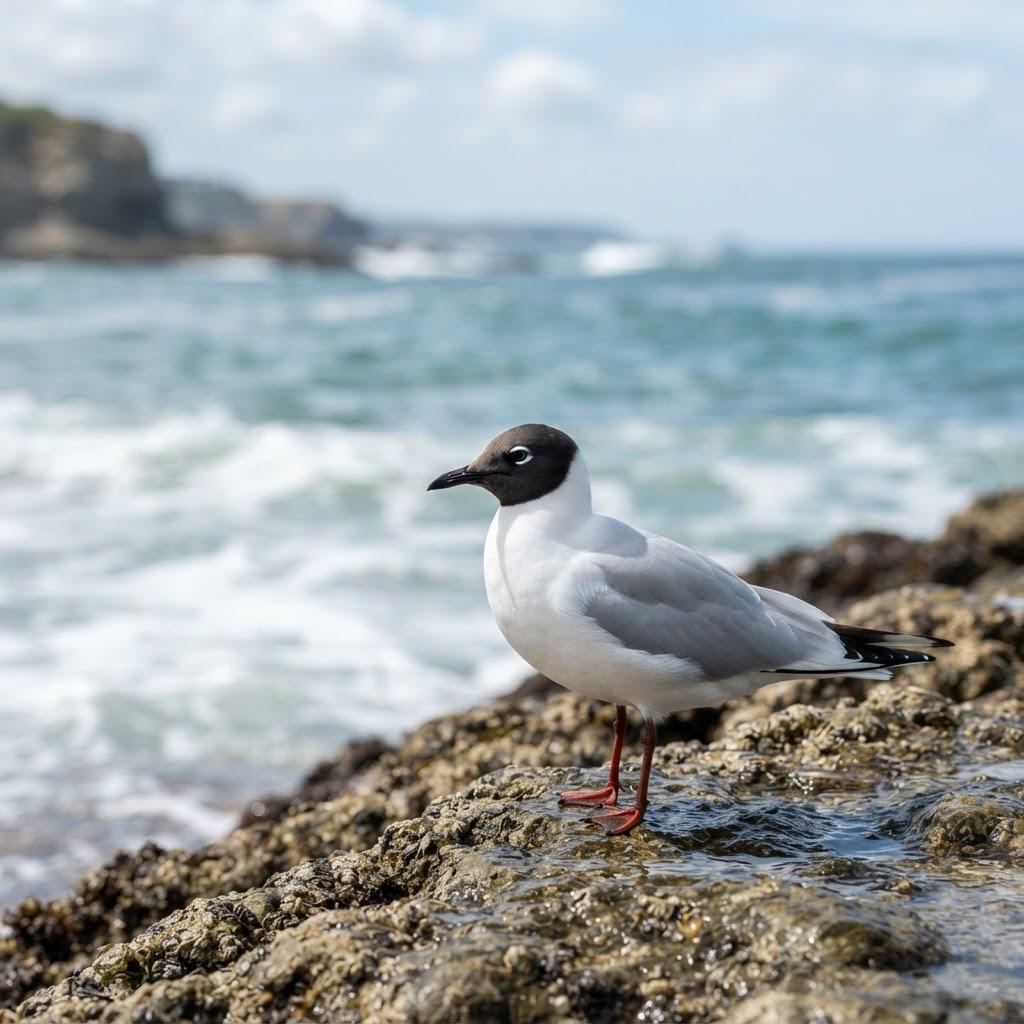
Chroicocephalus philadelphia
Bonaparte's Gull
Meet the Bonaparte's Gull, the only gull in the world that decided forests were classier than parking lots. With its sleek black cap and hyperactive flight, this bird is essentially the parkour athlete of the avian world.
Meet the Bird
If you walked into a trendy urban coffee shop and saw someone wearing a sleek, dark hood, hovering in the corner with intense, caffeinated energy while everyone else was just sitting there, that would be the Bonaparte's Gull. Unlike their cousins who hang out at fast-food joints waiting for a dropped French fry, the Bonaparte’s Gull acts like it has somewhere very important to be. They are the smallest of the North American gulls, and they carry themselves with a certain refined, petite elegance. They do not lumber; they zip. They do not waddle; they glide. Most notably, they look like they are wearing a tuxedo mask for a masquerade ball. During the breeding season, their heads turn a deep, smoky charcoal color, making them look like the mysterious protagonist of a noir film. When they are not in the mood for romance, they switch back to a plain white look, keeping everyone guessing about their identity. They are the shapeshifters of the shore, and they definitely know they look good.
Superpowers & Weird Abilities
Imagine if you could fly through a storm with the precision of a heat-seeking missile while snacking on a gnat mid-air. That is a Tuesday for the Bonaparte's Gull. Their primary superpower is their incredible maneuverability. While most gulls act like lumbering dump trucks in the sky, the Bonaparte’s Gull moves like a dragonfly crossed with a fighter jet. This is made possible by their unique wing structure, which allows them to pivot and stall in a fraction of a second. Beyond the aerial acrobatics, these birds possess an internal compass that would make a GPS manufacturer cry. They can track magnetic fields to navigate thousands of miles from the dense, dark forests of the Canadian north all the way to the sunny coastlines of the southern states. It is not just about flying; it is about knowing exactly where the wind is, how the air pressure is shifting, and how to use those forces to conserve energy during long-distance marathons.
Drama, Personality & Feathered Chaos
If the social world of birds were a high school, the Bonaparte's Gull would be the kid who is somehow in every single club, plays three sports, and still manages to ignore all the drama. They are surprisingly social yet fiercely independent. You will often see them in massive, swirling flocks during migration, acting as a single, coordinated organism that turns left and right in unison—a display that looks like liquid silver poured across the sky. However, beneath this polished exterior lies a bit of a chaotic streak. When a food source is spotted, the gentlemanly behavior disappears. They are notorious for being kleptoparasites, which is just a fancy way of saying they love to steal. They will happily swoop down and snatch a morsel right out of the beak of a tern or another gull, all while keeping their composure. It is not malicious, really; it is just a high-stakes, avian version of grabbing the last seat on the subway.
Bizarre Rituals & Quirky Habits
Birds have a lot of weird hobbies, but the Bonaparte’s Gull takes the cake for its 'fishing' style. While most gulls are bottom-feeders, scavenging for whatever is left over, the Bonaparte’s Gull is a sophisticated snacker. They prefer to 'dip' feed, hovering just inches above the water's surface like a feathered helicopter before daintily plucking a tiny fish or crustacean from the top layer. It is incredibly precise and remarkably clean compared to their cousins who tend to dig through trash cans. They also have a very quirky habit of 'milling' around on the water. You will see them spinning in tight circles, almost like they are trying to drill into the surface. What they are actually doing is stirring up the water to force tiny bugs to the surface. It is a brilliant, low-tech way of bringing the buffet directly to their doorstep without having to do any heavy lifting.
Legends, Folklore & Human Stories
The Bonaparte's Gull is named after Charles Lucien Bonaparte, a nephew of Napoleon, which gives the bird an air of historical prestige it probably doesn't even know it has. While it does not feature in many ancient myths, its presence in North American history is closely tied to the expansion of naturalists in the 19th century. Early explorers were enchanted by the way these birds inhabited the deep, interior wilderness, often far away from the sea. They were seen as harbingers of the deep woods, spirits of the north that came down to visit the coast during the winter months. In the maritime culture of the Atlantic, sightings of these agile birds were often interpreted as signs of changing seasons. If the 'little dark-headed gulls' appeared, you knew that the frost was coming to the tundra and the time for harvest was nearly over. They are not ghosts, but they certainly act like they have secrets to keep.
Mating: The Ridiculous World of Avian Dating
Courtship for the Bonaparte's Gull is a frantic, high-intensity performance. Once they arrive at their nesting grounds, the males go absolutely bonkers trying to impress the ladies. It starts with the 'long call,' a rhythmic, slightly nasal sound that is less of a romantic serenade and more of a 'Look at me! I am the most eligible bachelor in the swamp!' announcement. The dance itself involves a lot of posturing, head-bobbing, and wing-flicking. If the male is really feeling the love, he will puff up his chest to show off those beautiful, snowy white wing linings, trying to appear larger and more formidable than he actually is. If the female thinks he has potential, she will join him in a synchronized walk, keeping pace with his every step. It is essentially a blind date where the success rate depends entirely on who can pace the most perfectly in a circle.
Nesting: Master Architects and Lazy Slumlords
Most gulls are happy to just plop an egg on a sandy beach and call it a day, but the Bonaparte's Gull is a total non-conformist. They are the only gulls that consistently nest in trees. Yes, you heard that correctly—these birds are arboreal, meaning they prefer the high-rise life of a coniferous forest. They often repurpose old nests made by other birds or build their own structures out of twigs, moss, and grass high up in the branches of spruce or pine trees near a bog or a lake. It is a smart move, really, because it keeps their eggs safely away from land-bound predators like foxes or raccoons. They are surprisingly dedicated parents, and because they are tucked away in the thick, piney branches, their nests can be notoriously hard to find. It is like they are living in a secret treehouse estate, far away from the prying eyes of the rest of the world.
Raising Babies: The Screaming Food Disposals
Once those eggs hatch, the peace and quiet of the boreal forest is shattered by the sound of hungry chicks. Raising babies is an all-hands-on-deck, exhaustion-inducing operation. The chicks are born as little, fluffy, brown-spotted bundles of nerves and hunger. Because they are nestled high in the trees, they have to be cautious, but that does not stop them from being incredibly vocal. They essentially turn into living, breathing, screaming food funnels. Both parents spend their entire day zipping back and forth between the lake and the nest, delivering tiny fish, insects, and crustaceans. If the parents are one second late with a delivery, the chicks let out a high-pitched, insistent piping sound that could wake the dead. It is a chaotic, stressful, and incredibly fast-paced nursery phase that lasts just long enough for the parents to start questioning their life choices before the chicks are finally ready to fledge.
Bird-Watching Travel & Local Hotspots
If you want to catch a glimpse of these dashing birds, timing is everything. During migration, keep your eyes on the Great Lakes region or the Atlantic coast. Places like Point Pelee National Park in Ontario are legendary for the massive flocks that gather during the spring. If you are on the West Coast, look toward the Salish Sea or any of the protected estuaries in Washington and British Columbia. The best way to see them is to visit during the 'transition months' of April, May, or October. You want to look for shallow, calm bodies of water where they can perform their spinning, bug-stirring dance. Bring a decent pair of binoculars and a warm coat, because even in spring, these birds tend to hang out in breezy, cool locations that can leave you shivering if you are not prepared. Check local birding eBird lists a day before you head out to see where the local 'milling' spots are.
Food, Feeder Hacks & DIY Projects
Trying to attract a Bonaparte's Gull to a standard hanging bird feeder is a fool's errand because these birds are wild souls that do not care for sunflower seeds or generic suet cakes. They want the real deal: live, wriggling, aquatic protein. If you live near a pond or lake, you can try to attract them by maintaining a healthy, native shoreline with lots of vegetation that harbors insects. A truly DIY project for these birds is to install a small, shallow water feature or an aeration stone in a backyard pond. The movement of the water will attract insects, which in turn will attract the gulls. Forget the expensive bags of birdseed from the grocery store; they are useless here. If you want to help them, focus on protecting the water quality in your local area. A clean, bug-filled pond is the best possible advertisement for a hungry Bonaparte's Gull looking for a quick, mid-migration lunch.
Seasonal Guides & "Crisis" Management
Seasonal changes for the Bonaparte's Gull are defined by the grand migration. In the spring, they are moving north to the breeding grounds, fueled by the hope of fresh fish and pine forests. In the fall, they are moving south to escape the biting arctic chill. If you happen to find a 'stranded' bird, it is crucial to understand the difference between an injured bird and a fledgling. If you find a young gull that looks clumsy but has feathers, it is likely a fledgling practicing its flight; keep your pets inside and give it space. If the bird is lethargic, has drooping wings, or is sitting in a dangerous spot like a road, that is the only time you should intervene. Always contact a certified wildlife rehabilitator instead of trying to feed it yourself, as they have specific dietary needs that you definitely cannot replicate with whatever is in your fridge.
Backyard Tech & Gadget Reviews
While you are unlikely to get a Bonaparte's Gull to perch on a smart camera-feeder, you can definitely use tech to spot them. Motion-activated trail cameras, often used for capturing deer or coyotes, can be set up along the edge of a pond or marsh to track movement. Because these birds are so quick, you will want a camera with a high shutter speed. Regarding window safety, since these gulls spend so much time in the air, ensure your home windows are treated with UV-reflecting decals. These are invisible to humans but look like a solid 'no-fly' sign to birds. It is a small investment that prevents accidents during those chaotic migration days when the wind is gusting and the gulls are navigating your neighborhood at high speeds. Tech is great, but the best gadget remains a sharp pair of eyes and the patience to sit still and watch the water.
How to Spot One & How It Is Doing
To identify a Bonaparte's Gull, look for the 'black mask' during the spring and the smaller, more compact frame compared to the common Herring Gull. Listen for their sharp, piping 'tew' notes that sound more like a squeaky toy than a traditional gull squawk. As for their conservation status, they are currently listed as Least Concern, which is excellent news. They are doing well, but their reliance on specific northern ecosystems makes them vulnerable to climate change and habitat loss in the boreal forests. The best thing you can do to help is to support organizations that protect wetlands and forest interiors. When you spot one, appreciate the fact that this small, tuxedoed traveler has flown thousands of miles just to say hello to your local shoreline. Share your sightings with local birding clubs and keep encouraging others to care about these little, hyper-energetic, tree-nesting oddballs.