Hydroprogne caspia
Caspian Tern
Prepare to meet the ocean's swaggering gangster, the Caspian Tern! This majestic seabird is a master of the dramatic dive, a frequent flyer with a serious attitude, and surprisingly, a backyard visitor. Dive into the world of this stunning avian character, from its aerial acrobatics to its surprisingly relatable family feuds.
Meet the Bird
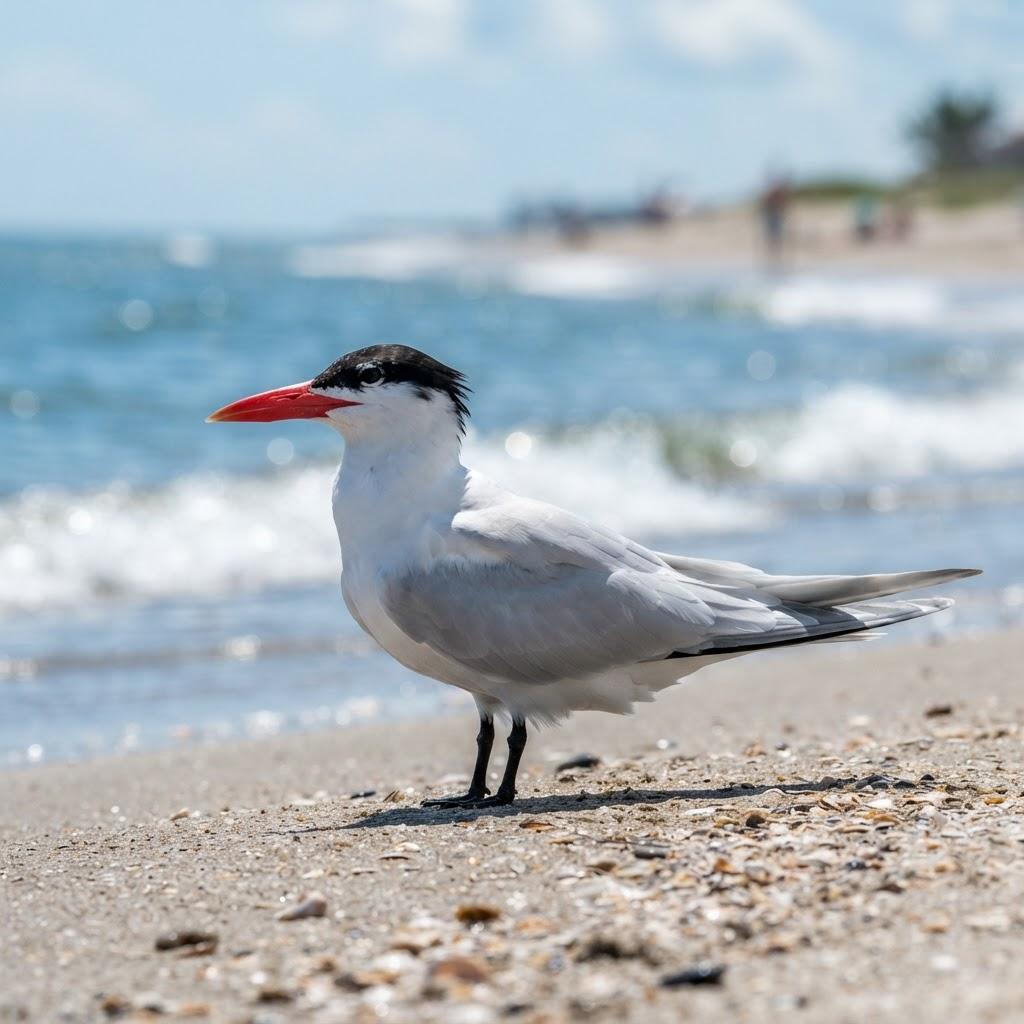
Imagine a feathered torpedo, a sleek, powerful aerialist who just swooped in from a James Bond movie set, but with more squawking. That's the Caspian Tern for you. These aren't your average, shy garden birds. Oh no, the Caspian Tern is the cool kid at the avian party, rocking a striking black cap that looks suspiciously like a stylish skullcap, a crisp white body, and powerful grey wings that mean business. They have this vibe, you know? Like they just won the lottery and are contemplating their next yacht purchase, even when they're just perched on a piloti or a wave-battered rock. Their massive, bright red-orange bill isn't just for show; it’s a billboard announcing their arrival and their prowess. They’re the titans of the tern world, the biggest and arguably the boldest. When one of these beauties is around, you can't help but feel a sense of awe, like you've just witnessed a moment of pure, unadulterated bird royalty. They strut, they dive, they conquer. It’s a performance, and they know it.
Superpowers & Weird Abilities
The Caspian Tern’s most impressive superpower is its incredible precision diving. Picture this: hovering hundreds of feet above the water, a tiny speck against the vast sky. Then, with a speed that defies gravity, it folds its wings and plummets earthward, hitting the water like a feathered missile. They can dive deeper than most terns, not just skimming the surface but plunging in to snatch unsuspecting fish. How do they do it without getting waterlogged or, you know, cracking their skulls? Their bodies are built for it. They have dense bones, which helps them cut through the water with less buoyancy resistance. Plus, they have special eyelids, like built-in goggles, that protect their eyes from the impact and saltwater. And their nostrils? They have special flaps that close automatically, keeping water out while they're on their underwater mission. It's like having a built-in wetsuit, goggles, and nose plugs all rolled into one aerodynamic package. They are the Navy SEALs of the seabird world, executing flawless missions with every dive, emerging triumphant with a slippery prize.
Drama, Personality & Feathered Chaos
Don't let their elegant appearance fool you; Caspian Terns are capable of some serious avian drama, especially when it comes to their colonies. These birds often nest in large, boisterous groups, and let me tell you, it's a neighborhood watch that’s always on high alert and prone to hysterical gossip. When an intruder, whether it's a fox, a sneaky gull, or even a human who’s gotten a little too close for comfort, dares to approach their precious eggs or chicks, the colony erupts into a cacophony of alarm calls. It’s like a flash mob of feathered fury, swooping and dive-bombing with their sharp bills aimed with pinpoint accuracy. They are fiercely protective, and their collective defense is a sight to behold. Sometimes, this drama extends to territorial disputes within the colony itself, with birds squabbling over prime nesting real estate. They might seem regal from afar, but up close, they’re a feisty bunch, always ready to defend their turf with a squawk and a dive. They’ve got personality, and it’s often expressed through loud, indignant complaints.
Bizarre Rituals & Quirky Habits
While they might not engage in the full-blown interpretive dance routines of some other birds, Caspian Terns have their own brand of quirky habits, especially when it comes to feeding their young. You might see a parent bird return to the nest with a particularly large fish, only to engage in a bit of a 'presentation' for its chick. This isn't just about showing off; it's a crucial part of teaching the little one how to handle food. The parent will often hold the fish proudly, sometimes tilting its head back dramatically, before offering it. If the chick is particularly demanding or the fish is a bit unwieldy, it can turn into a comical tug-of-war. Another interesting habit is their incredible ability to fish in both saltwater and freshwater environments, making them highly adaptable. They aren't picky about where they get their grub, as long as it's wriggling. They might also engage in what looks like playful chases or aerial displays amongst themselves, which could be practice for hunting or just pure, unadulterated birdy fun. It's hard to say, but it’s always a spectacle.
Legends, Folklore & Human Stories
While not as prominently featured in ancient myths as some other birds, the Caspian Tern holds its own in the lore of coastal and riverine communities. In many cultures, large seabirds like the Caspian Tern are seen as messengers or omens from the sea. Their powerful flight and sharp vision have often led people to associate them with keen insight and spiritual guidance. Indigenous peoples along the Caspian Sea itself, from where they get their name, likely have generations of stories tied to these magnificent birds, perhaps seeing them as indicators of good fishing seasons or as guardians of sacred waters. There are tales of sailors who relied on the presence of terns to find land or to predict changes in weather, as these birds often move inland before storms. While they might not be the star of every epic legend, their sheer presence and aerial mastery have undoubtedly woven them into the fabric of human observation and storytelling for centuries. They are the silent witnesses to human history along the shores.
Mating: The Ridiculous World of Avian Dating
Forget swiping right on an app; bird dating is where the real drama happens, and Caspian Terns are no exception, though their courtship is more about understated elegance and solid offerings than flamboyant displays. When a male Caspian Tern wants to impress a lady, he doesn't break out into a silly dance. Instead, he relies on his skills as a provider and his general air of suave confidence. His main game? Bringing gifts. He'll present his potential mate with a plump, wriggling fish – a clear demonstration of his hunting prowess and his ability to feed a future family. If she's impressed by his catch (and his general demeanor), she might accept the fish, and perhaps engage in some mutual head-bobbing and soft calls. It’s less 'let's get a room' and more 'let's assess your financial stability and fishing portfolio.' The female is basically conducting a job interview, and the male needs to prove he's got the goods. It’s a practical courtship, focused on survival and genetic fitness, rather than just flashy moves. He’s showing her he can put fish on the table, literally.
Nesting: Master Architects and Lazy Slumlords
When it comes to nesting, the Caspian Tern falls somewhere in the middle, leaning towards the practical and the communal rather than the overly elaborate or the disastrously simple. They aren't building cozy, cup-shaped homes woven with spider silk like some of the smaller songbirds, nor are they just throwing a few twigs together and hoping for the best like a pigeon. Instead, Caspian Terns are masters of the 'ground floor' real estate. They typically choose a spot on the ground, often on a sandy beach, a gravelly island, or even a flat rooftop, and create a simple scrape. This scrape is essentially a shallow depression in the sand or gravel, sometimes lined with a few shells, pebbles, or bits of vegetation. It’s minimalist chic, designed for maximum exposure to potential predators but also for quick accessibility and a clear view of the surrounding water. The communal nesting strategy, where dozens or even hundreds of pairs nest close together, provides a sort of 'safety in numbers' effect. While it might look like a chaotic construction site, each pair has its own designated spot, and their simple scrapes are perfectly suited to their environment and lifestyle.
Raising Babies: The Screaming Food Disposals
The moment Caspian Tern eggs hatch, the parents' lives transform into a relentless, 24/7 fish-delivery service. Those fluffy, downy chicks, looking like little balls of cotton with oversized beaks, are born with an insatiable appetite. They don't just ask for food; they DEMAND it with ear-piercing chirps that can likely be heard from space. Imagine trying to get any sleep when you have a tiny, feathered alarm clock glued to your leg, constantly yelling 'FEED ME! FEED ME NOW!' The parents work tirelessly, making endless flights to catch fish and then returning to the colony to distribute their catch. It’s a delicate balancing act – ensuring each chick gets enough without anyone getting left out. The chicks, eager to prove their worth and secure their next meal, will often stretch their necks out as far as they can, gaping wide, and jostling for position. Sometimes, if the parent isn't quick enough, the chick might even try to snatch the fish mid-air. It’s a chaotic, noisy, and utterly exhausting period for the parents, but it's all part of raising these future masters of the sea and sky.
Bird-Watching Travel & Local Hotspots
If you’re dreaming of witnessing the majestic Caspian Tern in action, pack your binoculars and a sense of adventure! These birds are quite widespread, but spotting them requires knowing where to look. Along the coasts of North America, particularly on the East Coast from Massachusetts up through the Canadian Maritimes, you'll find them. Look for them on islands, rocky shorelines, and even large estuaries. The Great Lakes region is another prime spot, with numerous colonies and individuals seen around large bodies of freshwater, especially during migration and breeding seasons. Think along the shores of Lakes Michigan, Superior, and Erie. Head west, and you might find them along the Pacific coast, from California up through Alaska. Famous birding locations like the Malheur National Wildlife Refuge in Oregon, known for its diverse birdlife, can be excellent places to search during the breeding season. Internationally, they are abundant around the Caspian Sea (hence the name!), but also along the coasts and major waterways of Europe, Africa, Asia, and Australia. Best times to see them are generally during their breeding season, typically from late spring through summer, but they can be found year-round in many coastal areas. Just remember to observe from a respectful distance, especially if you stumble upon a nesting colony!
Food, Feeder Hacks & DIY Projects
Attracting Caspian Terns to your backyard is a bit of a long shot, as they are large seabirds with a very specific diet and habitat preference – think open water and fish, not sunflower seeds and suet. They aren't the kind of birds that will flock to a standard bird feeder. Their primary diet consists of fish, which they catch themselves with spectacular dives. They'll also eat amphibians, insects, and crustaceans, but fish are their main gig. If you live right on the coast or a very large lake, the best 'feeder' you can provide is a healthy, thriving natural environment. Keeping local waterways clean and ensuring healthy fish populations is the ultimate way to support them. You can indirectly help by promoting healthy coastal ecosystems. For a fun DIY project that mimics their natural fishing environment, you could create a shallow water feature in your garden, perhaps a pond or a large, shallow bird bath with some pebbles and plants. While they won't necessarily visit a standard feeder, supporting their natural habitat is key. Think of it as providing a Michelin-star buffet in the wild, rather than a fast-food joint in your yard. Focus on conservation and clean water, and you're doing more than enough.
Seasonal Guides & "Crisis" Management
The life of a Caspian Tern is dictated by the seasons, and understanding these shifts can help you appreciate their journey. In spring, they undertake long migrations, returning to their breeding grounds with a renewed vigor for nest building and egg-laying. This is when coastal and lakeside areas come alive with their presence. Summer is all about raising the young, a period of intense activity and constant foraging. As autumn arrives, you’ll see them dispersing from their breeding colonies, often heading towards warmer coastal areas or undertaking further migrations. Winter is a time of relative quiet, spent foraging in marine environments or large open waters, conserving energy. Now, about that 'fledgling panic' – if you find a young Caspian Tern on the ground, looking a bit wobbly and out of place, resist the urge to 'rescue' it immediately. These birds, even after they leave the nest, often spend time on the ground being cared for by their parents, who are usually watching from nearby. Unless the chick is in immediate danger (like being in the middle of a busy road or an area with lots of predators), the best course of action is to observe from a distance. The parents are likely to return and feed it. If you’re truly concerned, contact a local wildlife rehabilitation center, but more often than not, nature knows best.
Backyard Tech & Gadget Reviews
While Caspian Terns are unlikely to grace your average backyard feeder, technology can still enhance your bird-watching experience if you happen to be in their preferred habitat. For those living near coastal or large lake areas, consider a good pair of binoculars – think 8x42 or 10x42 for a balance of magnification and field of view. This will let you observe their fishing dives and colony interactions without disturbing them. If you're lucky enough to have them nest nearby, a spotting scope can be invaluable for studying colony dynamics from a distance. As for those fancy AI feeders like Bird Buddy? They're designed for smaller garden birds, so a Caspian Tern showing up would be like a whale crashing a goldfish pond – highly unlikely and probably not what the feeder is designed to handle! However, if you’re interested in capturing images of *other* birds in your yard or in a wildlife area where terns might be present, a trail camera or a remote camera strategically placed near a body of water could capture some amazing footage of various wildlife, perhaps even a tern passing by. For window collisions, the best tech is actually low-tech: strategically placed decals or window paints that break up the reflection of the sky and trees, making the glass visible to birds. No fancy AI needed, just effective bird-proofing.
How to Spot One & How It Is Doing
Spotting a Caspian Tern is like finding a VIP at a bird convention. Look for the largest tern you're likely to see, with a heavy, dagger-like red-orange bill and a thick black cap in breeding season (which looks like a stylish haircut, even when molting). They have long, pointed wings and a steady, powerful flight. Their call is a distinctive, harsh 'karr' or 'kreh,' quite different from the softer calls of smaller terns. You'll find them near large bodies of water – oceans, bays, large lakes, and wide rivers. They often hover over the water before executing their impressive dives. As for how they’re doing, thankfully, the Caspian Tern is currently listed as 'Least Concern' by conservationists. This means they are relatively widespread and their populations are stable or increasing in many areas. However, like all wildlife, they face challenges like habitat loss, pollution, and disturbance at nesting sites. Protecting coastal and freshwater habitats, reducing plastic pollution, and being mindful of nesting colonies are simple ways anyone can help ensure these magnificent birds continue to grace our skies and waters for generations to come. So next time you’re by the water, keep an eye out for that flash of red bill and those powerful wings – you might just witness a true avian legend.