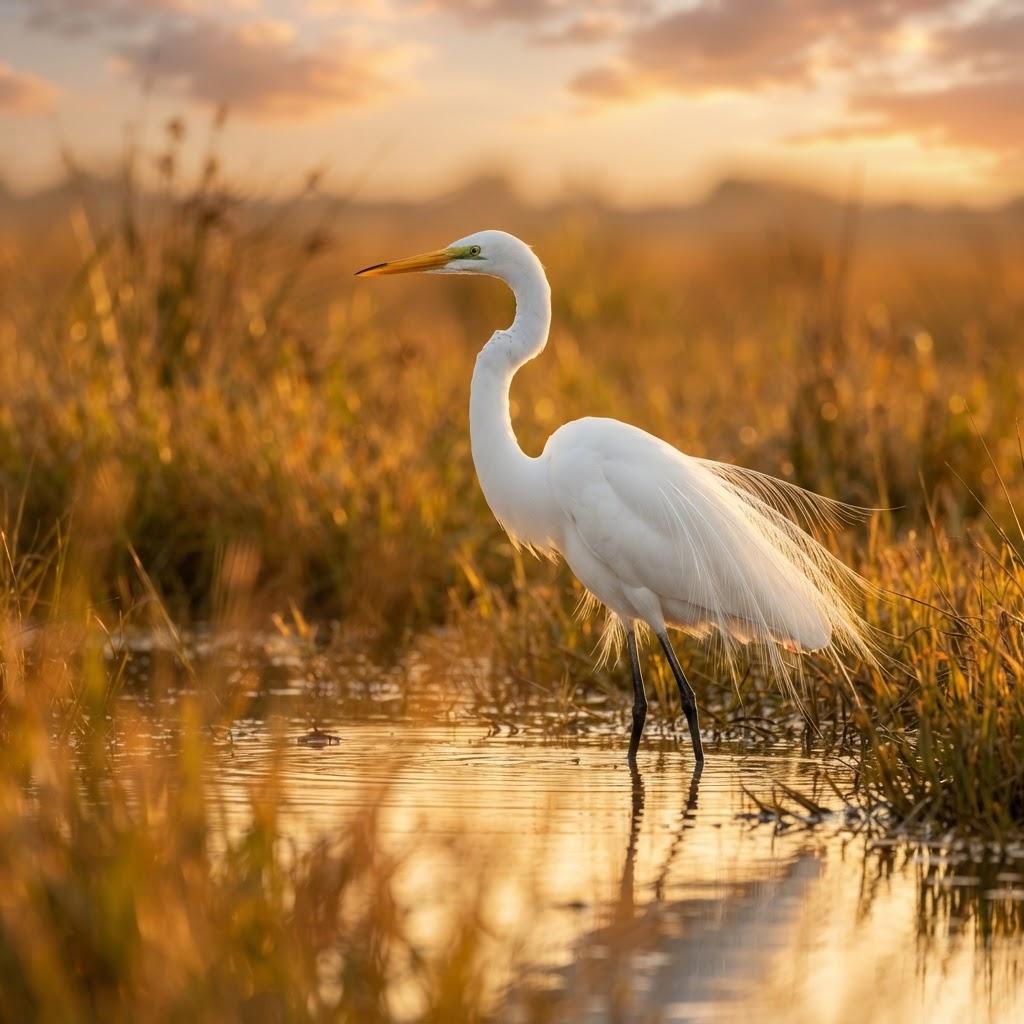
Ardea alba
Great Egret
The Great Egret is the supermodel of the swamp, rocking a pristine white tuxedo and a neck that defies the laws of geometry. Part elegant dancer, part lightning-fast assassin, this bird is a masterclass in patience and poise.
Meet the Bird
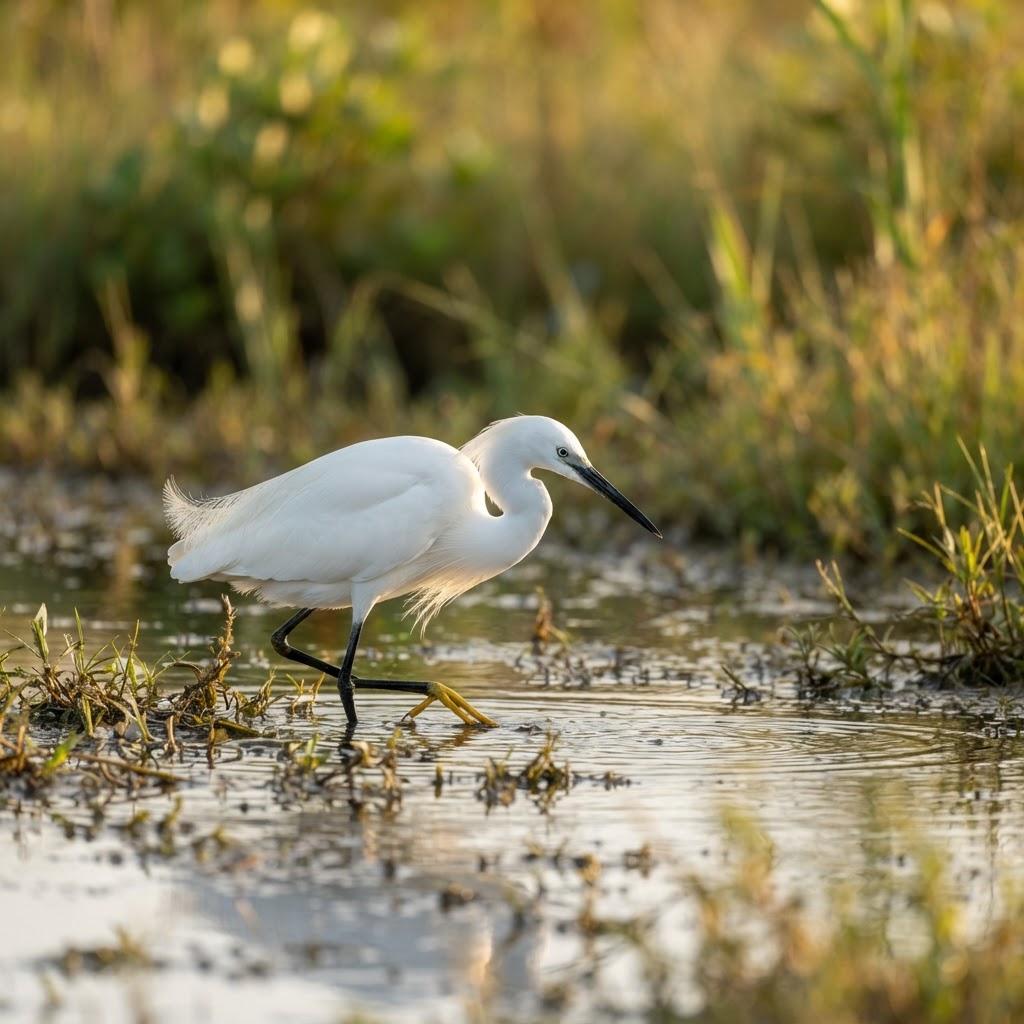
If the Great Egret were a human, it would definitely be a retired ballet dancer living in a minimalist loft with nothing but a single, expensive fiddle-leaf fig. This bird is the definition of high-contrast drama, featuring a stark white plumage that looks like it was bleached by a professional, set against a beak of sunshine-yellow and black-dusted eyes. When it stands perfectly still in the shallows, it looks less like a bird and more like a lawn ornament that somehow achieved sentience. It is the silent, brooding protagonist of the marsh, often found staring into the water for hours as if contemplating the deeper meaning of life—or, more likely, calculating the exact trajectory required to impale a crawfish. Unlike the chaotic, squawking mobs of seagulls or the hyperactive sparrows, the Great Egret carries an aura of calculated mystery that makes you stop walking just to see if it finally moves.
Superpowers & Weird Abilities
The Great Egret’s neck is a feat of biological engineering that makes a telescope look like a child’s toy. It possesses a specialized S-shaped structure in its vertebrae that functions like a coiled spring. When it decides to strike, that neck uncoils with the speed of a snapping rubber band, extending forward to catch prey before the fish even realizes the party is over. But that is not all. Its eyesight is essentially high-definition 4K zoom. The eyes are positioned to give it binocular vision, meaning it can judge depth perfectly—a necessity when you are trying to poke a moving target through the refraction of water. Think of it like a sharpshooter who has built-in windage and elevation adjustments. Furthermore, its feathers are waterproofed by a natural powder down that the bird preens and distributes across its body, ensuring it stays dry even after hours of wading in the swamp.
Drama, Personality & Feathered Chaos
Do not be fooled by the graceful posture; underneath that snowy exterior beats the heart of a feathered tyrant. Great Egrets are fiercely territorial, and they view other birds as either lunch or intruders to be banished. They are the ultimate 'Get off my lawn' neighbors of the wetland. If a Great Blue Heron dares to step into a prime fishing spot, the Egret will engage in a slow-motion stare-down that is more intimidating than any physical brawl. They don’t just fight; they perform a display of dominance, puffing out their white plumes like a Victorian ballroom attendee who has been insulted by a commoner. They aren’t interested in sharing the neighborhood pond, and they will happily bully smaller shorebirds just to prove that the best piece of real estate in the marsh belongs strictly to them. It is high-stakes drama, performed in complete, eerie silence.
Bizarre Rituals & Quirky Habits
Egrets have a habit that looks like a dance move gone wrong: the 'gaping' behavior. Occasionally, you will see one standing in the sun with its wings held wide open, mouth agape, looking like it is trying to channel some ancient cosmic energy. Scientists aren't entirely sure why they do this, but the best theory is thermoregulation—they are essentially acting like a solar panel to manage their body temperature. They also have a weird relationship with their own feathers during breeding season. They grow long, wispy plumes called 'aigrettes' that drape over their back like a fancy cape. They spend an absurd amount of time carefully arranging these feathers, appearing as if they are checking their reflection in the water to ensure their outfit is perfectly symmetrical. It is essentially the bird equivalent of spending an hour on your hair before a big date, only to spend the rest of the night getting it wet in a swamp.
Legends, Folklore & Human Stories
Humans have had a complicated, often tragic, history with these birds. At the turn of the 20th century, the Great Egret was almost wiped out entirely because the fashion industry went wild for those beautiful breeding plumes. Women’s hats were decorated with Egret feathers, making the birds more valuable than gold. It was a dark time, but it eventually gave birth to the modern conservation movement. The Egret became the face of the National Audubon Society, acting as a rallying cry for people to start protecting wetlands instead of treating them like disposable property. Now, they are often seen as symbols of restoration and wild beauty. In some cultures, seeing a tall, white bird standing perfectly still is considered a sign to pause and practice patience. They remind us that not everything in life needs to be a frantic, fast-paced event; sometimes, you just need to stand in the water and look for your dinner.
Mating: The Ridiculous World of Avian Dating
When a male Egret decides it is time for romance, he basically transforms into a feathered performance artist. He sets up a display platform and starts showing off his best assets, which includes flashing his neon-green lores—the skin near the beak—which actually changes color during the breeding season. He performs a series of 'snap-displays,' where he clatters his bill, bows, and stretches his neck in rhythmic pulses. He is basically saying, 'Look at my long neck! Look at my pristine feathers! Am I the best boyfriend in the swamp, or what?' The female watches from the sidelines, judging his every move. If she isn't impressed by his choreography or the quality of his display branch, she will leave him standing there looking like a fool. It is high-stakes speed dating where the penalty for a poor performance is ending the season alone in the weeds.
Nesting: Master Architects and Lazy Slumlords
If you are looking for a masterpiece of architecture, keep looking. Egrets are the definition of 'good enough' when it comes to home building. They construct their nests high up in trees, usually in colonial rookeries where hundreds of other birds are screaming at each other. The nest itself is a loose, chaotic platform of sticks that looks like a pile of firewood that was dropped from a plane. There is very little structural integrity here, but for some reason, it works. The male does most of the heavy lifting, hauling sticks back and forth, while the female acts as the site manager, weaving them together just enough to make sure the eggs don't roll out. It is not exactly a luxury condo, but the location is prime, and the view is spectacular, provided you don’t mind the smell of a crowded, bird-filled neighborhood.
Raising Babies: The Screaming Food Disposals
Once the eggs hatch, the peace and quiet of the swamp is officially over. The chicks are helpless, gangly, and possess an endless capacity for vocalizing their hunger. Parents are forced into a relentless cycle of hunting, flying back to the nest, and dumping partially digested fish directly into the waiting maws of their offspring. It is not for the faint of heart, but the level of dedication is impressive. As the chicks get older, they start to resemble miniature, angry dinosaurs with bad haircuts. They will spend their days practicing their lunging skills on their siblings, which is essentially a sibling rivalry on steroids. Watching a parent try to feed three or four screeching, wing-flapping teenagers is the original version of a chaotic household, and the parents deserve a medal for not just flying away to a tropical island and starting a new life.
Bird-Watching Travel & Local Hotspots
If you want to see these elegant giants in their element, you need to find a place with plenty of standing water. In North America, the Everglades in Florida is the undisputed King of Egrets; you can see hundreds of them hunting in the shallow glades. If you are on the East Coast, the Edwin B. Forsythe National Wildlife Refuge in New Jersey is a goldmine. For those in the West, the Sacramento National Wildlife Refuge provides an incredible stopover for them. The best time to see them is in the early morning or late afternoon, when the light hits their white feathers and makes them glow against the murky green background of the swamp. Bring binoculars, a long lens if you are into photography, and be prepared to stand still for a long time. They don't mind humans, but they don't like sudden movements.
Food, Feeder Hacks & DIY Projects
Let’s be honest: you aren't going to get a Great Egret to visit a hanging bird feeder filled with sunflower seeds. These birds are strict carnivores that specialize in fishing. However, if you have a property with a pond or a wet area, you can make your yard 'Egret Friendly.' Native aquatic plants like Pickerelweed or Arrowhead help create a natural nursery for the small fish and amphibians they crave. If you really want to help, avoid pesticides and fertilizers that run off into the water—the cleaner the water, the healthier the fish, and the more likely your local Egret will return. For a fun DIY project, build a small, shallow stone-lined pool in a low spot in your yard. It’s not a bird feeder in the traditional sense, but providing a safe, clean water source will make you the most popular house in the entire wetland neighborhood.
Seasonal Guides & "Crisis" Management
As the seasons shift, so does the Egret's schedule. In the spring, they are busy fighting for the best nesting branches; in the summer, they are playing parent to their rowdy offspring. When autumn rolls around, they start to drift south if they are in colder climates, or they simply find a reliable fishing spot to hunker down in. If you find a 'fledgling'—a teenager bird that looks a bit uncoordinated and is hanging out on the ground—do not assume it is an orphan! They are often just 'branching out,' testing their wings. Unless the bird is visibly injured or covered in blood, leave it alone. The parents are watching from a nearby tree. The best thing you can do is keep pets indoors and make sure the neighborhood dogs aren't creating a 'crisis' for the young bird while it gathers the courage to fly.
Backyard Tech & Gadget Reviews
Technology has made observing birds easier than ever, but for a Great Egret, you need to be smart about your gear. If you have a backyard pond, a trail camera like the Browning Strike Force is a fantastic investment. These motion-activated cameras can capture the Egrets patrolling your pond in the middle of the night or while you are at work. Regarding window safety: if you have large windows near your water feature, the best solution is to apply external window film or decals. These break up the reflection of the sky, so the Egret doesn't see a clear path into what it thinks is an open sky. Avoid those fake plastic owls; they might work for a day, but birds are smart, and they will eventually realize the 'predator' never actually moves, effectively turning your yard into a laughingstock for the local avian community.
How to Spot One & How It Is Doing
Spotting a Great Egret is easy—look for the biggest, whitest bird in the wetland. If it has a long, yellow bill and black legs, you have found it. If it’s smaller, it might be a Snowy Egret, but the Great Egret’s sheer stature is the giveaway. They are currently thriving, which is a massive success story for conservation. They aren't going anywhere, and that is a testament to what happens when we stop using nature as a department store. To help them continue to prosper, support local wetland restoration projects and speak up when you see developers trying to drain marshes for more parking lots. These birds are the sentinels of the swamp, and as long as they are standing there, looking like aristocratic statues in the mud, we know the ecosystem is holding on. Go out, find one, and just watch. It is free entertainment that makes the world feel just a little more magical.