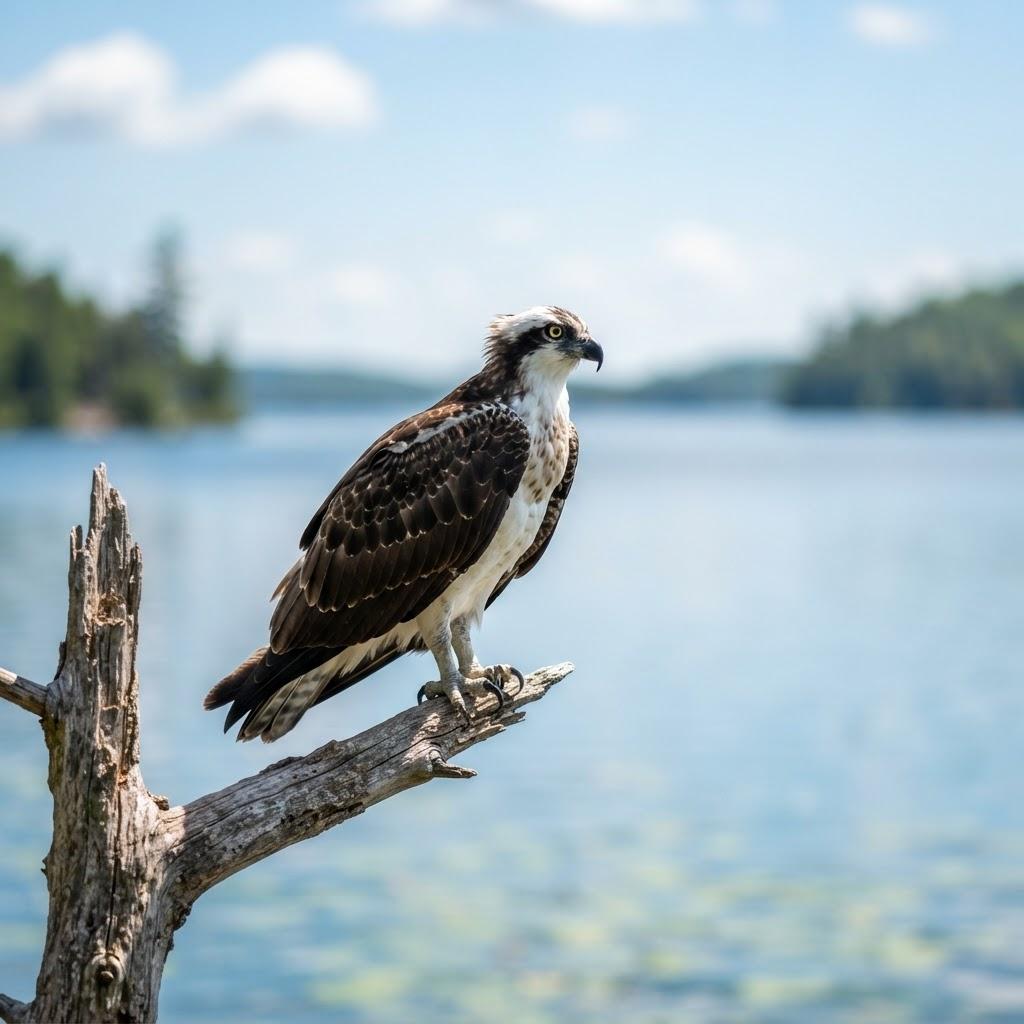
Pandion haliaetus
Osprey
The Osprey is the ultimate aquatic action hero, a feathered torpedo with a flair for dramatic splash-landings and serious home-improvement skills. Meet nature's most dedicated fisherman, a bird that makes every other raptor look like a clumsy amateur at the dinner buffet.
Meet the Bird
Imagine a bird that treats life like an endless summer vacation at a luxury lake house, provided that lake house has a 24-hour sushi bar. The Osprey is the quintessential water-obsessed raptor, a master of the skies whose entire personality revolves around the singular pursuit of fish. Unlike other hawks that might get distracted by a field mouse or a passing lizard, the Osprey has tunnel vision for anything with scales and gills. With a dramatic white head, a dark bandit-like mask that screams 'professional athlete,' and a silhouette that makes it instantly recognizable against the blue sky, the Osprey is the rockstar of the wetlands. It does not just fly; it patrols. It does not just eat; it performs. When you see an Osprey hovering like a giant, feathery helicopter before folding its wings and diving into the water with a splash that would make a competitive diver jealous, you are witnessing one of nature's greatest reality TV stars. It is cool, collected, and relentlessly focused on the prize.
Superpowers & Weird Abilities
If the Osprey were a character in a comic book, its superpower would be 'Extreme Aquatic Precision.' This bird is physically engineered to be the ultimate fisherman. First, consider its feet: they are covered in tiny, spiny scales called spicules that act like sandpaper or the tread on a high-performance tire, ensuring that a slippery, thrashing trout does not wiggle free during the flight back to the nest. But that is not even the weirdest part. Ospreys possess a reversible outer toe, which is essentially the avian equivalent of an opposable thumb, allowing them to grasp prey with two toes in front and two in back for maximum stabilization. Furthermore, when they fly with a fish, they rotate the catch so its head faces forward, turning the fish into a living, scaly aerodynamic surfboard. This reduces drag and helps the bird conserve energy. It is like the Osprey is constantly performing complex physics equations in its head just to get a snack back to the table.
Drama, Personality & Feathered Chaos
Don't let the stoic expression fool you; Ospreys are the undisputed drama queens of the river. They are notoriously protective of their territory, and if a Bald Eagle—the neighborhood bully of the sky—shows up, the Osprey doesn't just cower; it launches a full-scale aerial assault. You will often see the smaller Osprey aggressively mobbing the much larger eagle, screaming its high-pitched, whistled call like a referee blowing a whistle during a foul. Furthermore, Ospreys are incredibly possessive of their nests. If another Osprey dares to fly too close to their high-rise real estate, the owner will perform a terrifying display of wing-flapping and vocal warnings. They are the neighborhood association presidents of the avian world, keeping a sharp eye on property lines and ensuring that no unauthorized intruders are loitering near their prime fishing spots. They bring a level of intensity to daily life that is both hilarious and surprisingly effective.
Bizarre Rituals & Quirky Habits
The Osprey has a very specific habit that makes birdwatchers laugh: the 'fish shake.' After a successful hunt, when the bird lifts off from the water dripping wet, it will often perform a full-body mid-air shudder, much like a wet dog, to flick excess water off its feathers. It is an undignified move for such a majestic creature, but necessary for maintaining flight speed. Another weird behavior is their tendency to decorate their nests with, well, trash. While they mostly use sticks, they are known to incorporate plastic bags, fishing line, driftwood, and sometimes even children’s toys into their architecture. This results in nests that look like a suburban garage sale gone wrong. Scientists have noted that this isn't a fashion statement; it is just a sign that these birds are opportunistic scavengers who see a discarded piece of rope and think, 'That will add some lovely texture to my living room wall.' It is charmingly chaotic and highly visible.
Legends, Folklore & Human Stories
Historically, Ospreys have been viewed with a mixture of reverence and superstition by coastal communities. In many maritime cultures, the arrival of the Osprey signaled the beginning of the salmon or trout runs, making them the unofficial harbinger of a good harvest. Fishermen often considered them a 'good luck' charm; if the birds were fishing in a certain bay, it meant the water was teeming with life. There is even an old piece of maritime folklore suggesting that fish are so afraid of the Osprey that they become paralyzed and float to the surface just from watching the bird dive—a total myth, of course, but it speaks to how impressed humans have always been by their success rate. Throughout literature, they have been portrayed as the guardians of the coast, stoic sentinels that watch over the shifting tides. In some regions, their nests were so respected that landowners would intentionally build platforms to encourage them to stay, believing that having a pair on your property brought prosperity to the surrounding waters.
Mating: The Ridiculous World of Avian Dating
When it comes to love, the male Osprey goes full 'show-off mode.' To attract a mate, the male will perform an elaborate aerial maneuver known as the 'sky-dance.' He carries a fish in his talons and flies in a roller-coaster pattern, undulating up and down while letting out a series of high-pitched chirps. It is essentially an aerial performance of 'Look at me, I am a great provider, and look at this high-quality dinner I caught for you.' If the female is impressed by his flight choreography and his taste in fish, she will join him in the sky. If she is unimpressed, she simply ignores him and keeps soaring, forcing him to do another lap. Once they are a couple, they perform a courtship ritual involving aerial chases and mid-air tumbles that look like a choreographed dance routine. It is high-stakes dating where the price of rejection is just a bit of lost pride and a very lonely fish.
Nesting: Master Architects and Lazy Slumlords
Osprey nests are the skyscrapers of the bird world. They start as a modest collection of sticks, but because Ospreys are incredibly loyal to their home turf and return to the same site for years, these nests grow over time. We are talking about massive, multi-level condos made of thick branches, seaweed, and whatever random debris they find floating in the harbor. Over decades, some nests become so heavy they require sturdy support, which is why you see them perched atop utility poles or artificial nesting platforms. They are the ultimate 'fixer-upper' enthusiasts. While they have the potential to be master architects, they are also prone to laziness; sometimes they just pile more sticks on top of last year’s mess instead of cleaning up. It is a 'good enough for government work' approach to architecture that results in truly massive, tangled piles of organic matter that can weigh several hundred pounds and last for many years of seasonal occupancy.
Raising Babies: The Screaming Food Disposals
Raising Osprey chicks is a full-time, high-stress gig. The female usually lays two to four eggs, which are carefully incubated for about five weeks. Once the chicks hatch, the nest becomes a screaming contest. Baby Ospreys are essentially bottomless pits with feathers. They spend most of their early lives stretching their necks toward the sky and yelling for room service. The male is the primary breadwinner, flying out to the water dozens of times a day to haul back fresh fish. He does not even get to eat; he is just a delivery guy. The mother stays in the nest to protect the chicks and tear the fish into bite-sized pieces. As the chicks get older, they start testing their wings, flapping vigorously while standing on the edge of the nest, looking like teenagers who are too embarrassed to be seen with their parents. They fledge after about eight weeks, finally leaving the nest to start their own frantic fishing careers.
Bird-Watching Travel & Local Hotspots
If you want to experience the true majesty of the Osprey, you need to go where the water is wide and the fish are plentiful. In the United States, the Chesapeake Bay is legendary, with thousands of breeding pairs making it one of the best places on the planet for viewing. For the adventurous birder, Assateague Island National Seashore in Maryland or Virginia offers incredible opportunities to see them patrolling the dunes and coastal marshes. If you are in the Pacific Northwest, the San Juan Islands in Washington are absolute hotspots where you can see Ospreys against a backdrop of mountains and whales. In Europe, the Scottish Highlands are the place to be, particularly the Loch Garten Nature Centre. No matter where you go, the best strategy is to look for bodies of water with tall, isolated structures—think power poles, channel markers, or dead trees—where they can perch and keep a sharp eye on the surface below.
Food, Feeder Hacks & DIY Projects
Here is the reality check: you are not going to attract an Osprey to a bird feeder filled with sunflower seeds. Ospreys are strict piscivores, which is a fancy way of saying they only eat fish. They are not interested in your suet cakes or your premium nut mix. However, you can make your property more attractive by installing a nesting platform if you live near a large lake or coastal area. These are essentially sturdy, elevated platforms that give the birds a safe, predator-free place to build their homes. If you want to support them in other ways, focus on water quality. Ospreys thrive when the fish population is healthy, so avoiding toxic pesticides in your yard and preventing plastic pollution from reaching local waterways is the best 'feeder hack' of all. Supporting local conservation groups that focus on wetland restoration is essentially the equivalent of providing an all-you-can-eat buffet for the entire population.
Seasonal Guides & "Crisis" Management
Ospreys are famous migrators. In the fall, they pack their bags and head south, sometimes traveling thousands of miles to reach the tropics. If you are a birdwatcher, keep an eye on the calendar—migration usually happens in late August through October. During the spring, watch for their return in March or April. The biggest 'crisis' for birders happens when people find a young Osprey that has just left the nest and is sitting on the ground looking dazed. It is not necessarily injured; it is just a 'brancher'—a teenager learning to fly. Unless the bird is clearly wounded or tangled in fishing line, keep your distance. The parents are usually nearby, bringing food and watching the show. If you ever see an Osprey tangled in fishing line—which happens more often than it should—call a local wildlife rehabilitator immediately. Do not attempt to catch it yourself unless you want to see exactly how sharp those talons are.
Backyard Tech & Gadget Reviews
If you have an Osprey nest on your property, you are living the dream. To get the best view without disturbing them, consider setting up a high-quality trail camera on a neighboring tree, pointed safely away from the nest. Modern trail cameras are cheap, weather-resistant, and motion-activated, perfect for catching candid moments without being a 'bird-stalker.' Regarding smart feeders: these are fantastic for songbirds, but they will not do much for Ospreys. Instead, look into long-range binoculars or a spotting scope with a tripod. The best 'tech' you can have is a pair of 8x42 binoculars and a good field guide app. If you have windows that face the water, put up simple window decals to prevent collisions, as these large birds occasionally misjudge their flight paths when they are focused entirely on a fish. Keeping the view clear for them is the most helpful tech-based intervention you can manage.
How to Spot One & How It Is Doing
Spotting an Osprey is easy if you know what to look for. Search for a large, brown-and-white raptor with a distinctive dark eye-stripe and a white head. When they are flying, look for the 'M' shape their wings make. They often carry their prey head-first, which is a dead giveaway. Listen for their sharp, whistling 'cheep-cheep-cheep' calls. Fortunately, the Osprey is doing quite well these days! After populations plummeted decades ago due to pesticide use, they made a massive comeback thanks to conservation efforts and the banning of harmful chemicals like DDT. They are a true success story. To help them continue to thrive, keep your local waters clean, advocate for healthy fish stocks, and give them plenty of space during their sensitive nesting season. By protecting the water, you protect the Osprey, ensuring that these incredible, fish-loving aviators remain a permanent fixture of our skies for generations to come.