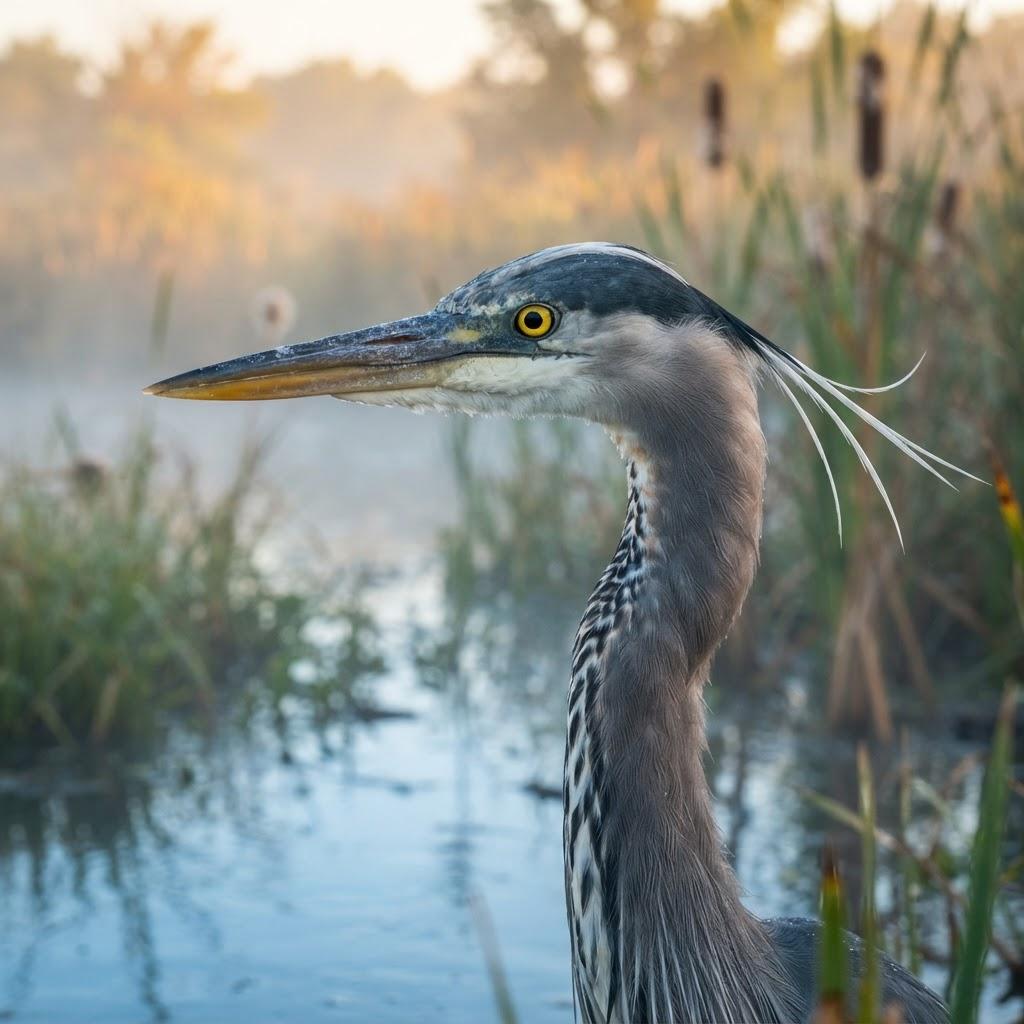
Ardea herodias
Great Blue Heron
The Great Blue Heron is the ultimate zen master of the swamp, standing perfectly still like a feathered statue before transforming into a lightning-fast assassin. This prehistoric-looking giant is a must-see for anyone who appreciates a bird that lives life in the slow lane—until it is time to strike.
Meet the Bird
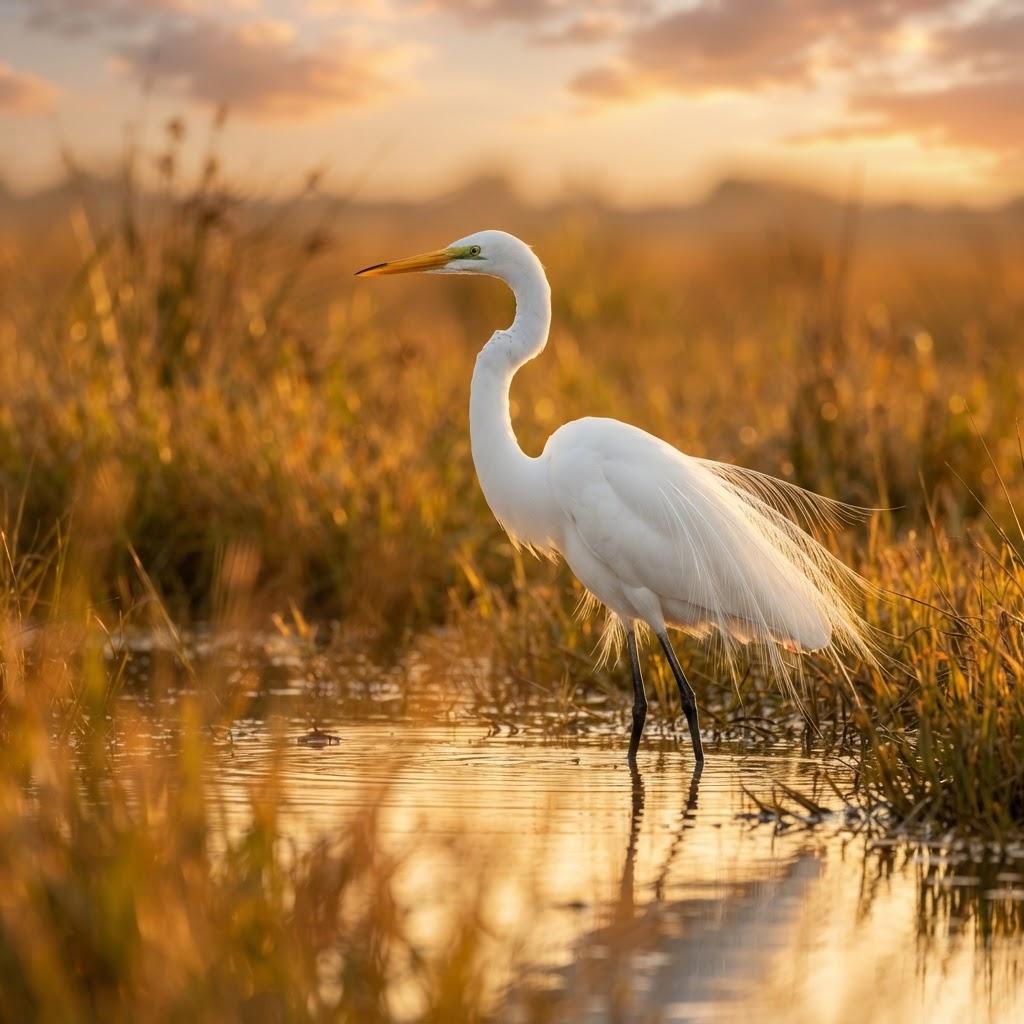
Imagine a bird that looks like it just stepped off a set from the Jurassic era. Meet the Great Blue Heron, the lanky, sophisticated, and occasionally terrifying titan of the marsh. Standing at nearly four feet tall with a wingspan that could cover your entire picnic table, the Great Blue Heron carries itself with the air of a grumpy professor who has seen it all and is unimpressed by your nonsense. Their Vibe is strictly 'professional hunter,' and they wear their slate-gray and rust-colored plumage like a tuxedo that has seen a few too many swamp parties. They possess a neck that seems to fold like a piece of origami, allowing them to tuck their heads into their shoulders with an air of immense mystery. Unlike the frantic, jittery songbirds that flit around your backyard, the Heron is the embodiment of patience. It can stand in a single spot for hours, waiting for the perfect meal, looking less like a bird and more like a carefully placed piece of lawn art that just happens to occasionally blink at you with piercing yellow eyes. If you ever wanted to see what a dinosaur would look like if it decided to take up competitive fishing, this is the bird for you.
Superpowers & Weird Abilities
The Great Blue Heron has a secret weapon that sounds like something out of a superhero comic book: a specialized neck structure. Their neck contains a unique arrangement of vertebrae that functions like a high-speed spring. When they stand still, they are conserving energy, but when the moment arrives to strike, that neck can shoot forward with the velocity of a striking cobra. This allows them to impale fish with surgical precision before the prey even knows it is being hunted. Furthermore, these birds have something called specialized powder down feathers. While most birds have to oil their feathers to stay waterproof, Herons actually produce a fine, talcum-like dust from these specific feathers. They use their feet to comb this powder through their plumage, which acts as a degreasing agent to remove slime from fish scales and keep their tuxedo looking sharp. It is basically the avian equivalent of an all-natural dry shampoo that ensures they never look messy, no matter how much time they spend wading through murky, algae-covered water. It is a brilliant bit of evolutionary engineering that keeps them dry and looking dapper while performing their messy day job.
Drama, Personality & Feathered Chaos
Do not let that statuesque posture fool you; the Great Blue Heron is a drama queen of the highest order. While they are generally solitary fishers, when the breeding season rolls around, they turn into a noisy, squabbling mess of feathers. They are notorious for being territorial, and they will squawk, fluff their crests, and chase away any other heron that dares to fish in their designated 'spot.' They act like the neighborhood busybody who is convinced that the entire pond belongs to them and will happily screech at any goose or duck that drifts too close. Watching a Great Blue Heron try to defend its territory is like watching an elderly man yelling at kids to get off his lawn, only with more stabbing motions and dramatic flight displays. They have zero chill when they feel their dominance is threatened. Even when they are not fighting, they have a certain arrogance to them. They will stand in the middle of a busy bike path or near a fishing pier, staring down humans with a look that suggests they are silently judging the quality of your sandwich. They are the feathered embodiments of 'I am not angry, I am just disappointed in you.'
Bizarre Rituals & Quirky Habits
Beyond their fishing skills, Herons have some truly bizarre habits that would make any human think they are living in a dream. One of the most fascinating is their habit of 'shading' the water. Sometimes, a Heron will spread its wings wide over the surface of the water, creating a shadow. This isn't for sunbathing; it is a tactical play. By blocking the light, they make it easier to see through the surface tension of the water, allowing them to spot movement that would otherwise be hidden by the glare. It is essentially the avian version of wearing polarized sunglasses to fish. Then there is the 'neck-stretching' display. When feeling threatened or just generally annoyed, they will point their beak straight at the sky, puff up their chest, and freeze. They believe this camouflage makes them look like a reed or a piece of driftwood, and they will hold this pose until the threat passes. It is hilarious because they look like they are trying to perform a very intense yoga pose in the middle of a swamp, hoping that if they don't move, the world will simply stop existing. It is absurdly effective, though, and it perfectly captures their commitment to their weird lifestyle.
Legends, Folklore & Human Stories
Across various cultures, the Great Blue Heron has been viewed with a mixture of reverence and fear. In many Indigenous cultures, the heron is seen as a symbol of wisdom, patience, and good judgment. They are often portrayed as the masters of self-reflection because of their tendency to stand still and 'contemplate' the water. On the flip side, early colonial explorers sometimes thought these birds were omens of bad luck or storms, largely because of their guttural, prehistoric-sounding squawks that would echo through the marsh at twilight. There are countless stories from old fishermen claiming that a heron 'showed them the way' to a hidden creek or a bountiful fishing hole. Whether or not the bird actually knew it was helping is up for debate, but the association remains. Even today, they are the 'celebrity' of the wetland. If you see one in a city park, people will stop, pull out their phones, and stand in awe, treating the bird like a minor deity that has graced them with its presence. They carry an aura of ancient mystery that demands respect, turning every human observer into a humble tourist in the bird’s kingdom.
Mating: The Ridiculous World of Avian Dating
If you think your Tinder profile is embarrassing, wait until you hear about the mating rituals of the Great Blue Heron. When a male wants to show off, he doesn't just buy a drink; he builds a 'starter home' and stands on it, vibrating with desire. He will stretch his neck out, snap his beak in a rhythmic, clacking performance, and ruffle his feathers until he looks like a giant, angry feather duster. He performs a 'circle flight' where he launches himself into the air, circles around, and lands with a dramatic flourish. If the female is impressed by his stick-stacking skills and his ability to clack his beak in a way that sounds like a malfunctioning typewriter, she might accept his invitation. However, if she thinks he is a total amateur, she will fly off, leaving him to sit alone on his pile of twigs, looking utterly dejected. They even partake in 'ritualized preening,' where the couple gently nibbles on each other’s feathers to build trust. It is tender, slightly awkward, and completely fascinating to watch as these two giant, dinosaur-looking birds try to act all lovey-dovey on a flimsy branch.
Nesting: Master Architects and Lazy Slumlords
Nesting for a Great Blue Heron is a communal effort that looks like an urban planning nightmare. They prefer to nest in colonies known as 'heronries,' often high up in trees where they can keep an eye on their neighbors. They are not the most talented architects; their nests are essentially piles of sticks thrown together with a 'good enough' attitude. A nest starts as a small platform and grows over the years, as the parents keep adding more sticks until the structure becomes a massive, multi-year apartment building of twigs and debris. Sometimes, these nests get so heavy they collapse the branches they are sitting on, which is a hilarious disaster for everyone involved. They show no shame in their construction habits. Some nests are so flimsy that you wonder how they manage to hold an egg, let alone a growing chick. But there is a sort of chaotic brilliance to it. They prioritize proximity to food over architectural beauty. They want to live in a high-rise with a view of the buffet, and they don't care if the exterior looks like a giant bird-made trash heap as long as the location is prime.
Raising Babies: The Screaming Food Disposals
Once the eggs hatch, the peace and quiet of the heronry is replaced by the sound of demanding, screeching monsters. Baby Herons are arguably the least cute birds in the world when they are tiny. They look like fuzzy, gray aliens with oversized beaks and an endless appetite. The parents work themselves to the bone, flying back and forth from dawn until dusk, regurgitating half-digested fish into the beaks of these noisy food disposals. The chicks are never satisfied. They will scream at their parents for more food even while the parents are trying to rest. It is a high-stakes, exhausting marathon of parenthood. The parents have to manage the heat, the predators, and the constant demand for more fish, all while the chicks get bigger, stronger, and more obnoxious by the day. By the time the fledglings are ready to leave the nest, they are nearly the size of their parents and have an attitude to match. Watching a parent Heron try to navigate a nest full of giant, flapping, demanding teenagers is enough to make any human parent feel better about their own struggles with a toddler.
Bird-Watching Travel & Local Hotspots
If you are ready to track down this giant, start by heading to the nearest National Wildlife Refuge, as they are essentially the five-star resorts for Herons. In the United States, places like the Everglades in Florida are basically Heron central, where you can see them wading in every direction. If you are in the Pacific Northwest, check out the wetlands around the Puget Sound. If you are on the East Coast, the Chesapeake Bay is a massive hotspot where these birds thrive. For the best experience, go early in the morning or just before sunset. These are the hours when the fish are most active, and the Herons are the most hungry. Don't worry about being an expert birder; if you are near a body of water that isn't completely frozen or paved over, you have a solid chance of finding one. Bring a pair of decent binoculars, wear muted colors so you don't spook them, and for heaven's sake, stay quiet. They are sensitive to noise, and if you stomp around like a bull in a china shop, you will only see the back of a large bird flying away from you.
Food, Feeder Hacks & DIY Projects
Here is the reality check: you cannot attract a Great Blue Heron to a standard backyard bird feeder. They are not interested in your sunflower seeds or your suet cakes. They want fresh, living prey, preferably swimming in a pond or lake. If you want to attract them to your property, you need to turn your backyard into a habitat. This means a natural pond with fish, frogs, and aquatic insects. Do not put out plastic bird food; invest in native landscaping instead. Planting tall grasses and sedges around the edges of a water feature provides the cover they need to feel safe. If you have a pond, make sure it has shallow edges so they can wade comfortably. The best 'feeder' project is simply keeping your water source clean and free of chemicals. Avoid using pesticides in your yard, as these toxins wash into the water and eventually reach the fish, which then makes the Heron sick. Save your money on store-bought 'wild bird' seeds and put that budget into planting native trees that might house a nesting colony. A healthy, natural ecosystem is the only bait this bird respects.
Seasonal Guides & "Crisis" Management
Herons are remarkably hardy, but winter can be a bit of a, well, cold shower. During the winter, you will find them clustered near areas where the water doesn't fully freeze, like fast-moving rivers or power-plant discharge areas where the water stays warm. If you see a Heron in mid-winter looking like a hunched-over statue, it is probably just conserving heat. Do not worry about them starving; they are experts at finding whatever is left. The real 'crisis' comes in spring when people find 'fledgling' herons on the ground. Please, do not panic. These young birds often take a tumble while learning to fly. Unless the bird is clearly injured—like having a drooping wing or blood—leave it alone. The parents are usually watching from a nearby branch and will come down to feed them on the ground. If you try to 'rescue' it, you are likely just kidnapping a perfectly healthy teenager who is currently having a bad day. If it is in a dangerous place, like a road, nudge it to the grass, but otherwise, walk away and let nature do its thing.
Backyard Tech & Gadget Reviews
Technology has changed birding forever, but don't expect a smart feeder to solve all your problems if you are chasing a Heron. Those fancy AI-powered cameras that sit on a pole are great for titmice, but a Heron will likely treat them as a potential hunting perch. Instead, consider a motion-activated trail camera. Place it near your pond, camouflaged with some brush, and set it to capture video of the nighttime or early-morning visitors. You will be shocked by what you catch. As for window collisions, Herons are big enough to be seen, but they can still get confused by reflections in large glass windows. Use bird-safe UV decals that are invisible to humans but look like giant spiderwebs to birds. This prevents them from flying into your house, which is good for the bird and definitely good for your nerves. A basic pair of high-quality, weather-sealed binoculars will serve you far better than any app. The best gadget you can have is a comfortable chair and a thermos of coffee, sitting patiently near a pond until the giant gray knight shows up to hunt.
How to Spot One & How It Is Doing
To spot a Great Blue Heron, look for the 'S' shape. Even when flying, they tuck their heads back onto their shoulders, unlike cranes, which fly with their necks straight out. They look like a giant, flapping cross in the sky. If they are on the ground, look for the long legs and that unmistakable, jagged, prehistoric silhouette. They sound like a low-frequency, throaty 'grok' or a harsh squawk that sounds like someone stepping on a squeaky toy in a basement. The population of the Great Blue Heron is doing quite well, which is rare in today’s world. They are highly adaptable and have learned to tolerate humans better than most wild animals. To help them continue to thrive, support local wetlands protection. If your local park has a 'no-mow' zone near a pond, leave it alone—those messy edges are essential habitat. Pick up trash around shorelines, because a heron doesn't know the difference between a fish and a discarded fishing hook. They are the guardians of our waterways; let’s make sure we keep those waterways clean and safe for our lanky, dinosaur-like friends.