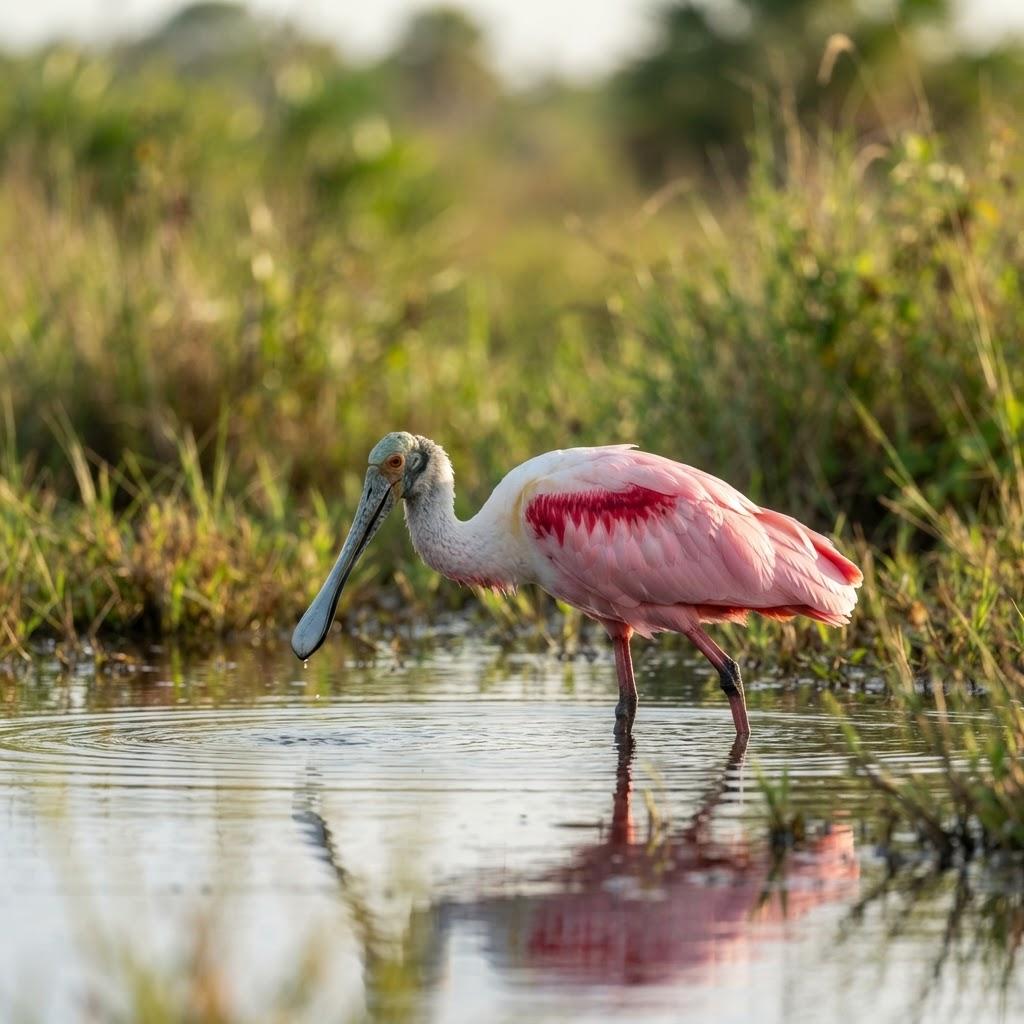
Platalea ajaja
Roseate Spoonbill
The Roseate Spoonbill is essentially a flamingo that spent too much time at a punk-rock salon and decided to accessorize with a giant spatula. This bright pink marsh-dweller is the fashion icon of the swamp, bringing bold color and bizarre table manners to every wetland it graces.
Meet the Bird
If you walked into a swamp expecting to see something dignified like a Heron, you might be surprised to find the Roseate Spoonbill looking like a neon-pink disco ball that took a wrong turn at the mangroves. This bird is the life of the party, possessing a look that screams 'I woke up like this' while rocking a bill that looks like it was borrowed from a kitchen utensil drawer. The Roseate Spoonbill isn't trying to fit in; it is trying to dazzle. With its vibrant bubblegum-pink plumage and a face that is frankly as bald and wrinkly as an angry old man, it occupies the strange middle ground between 'elegant sunset' and 'cartoon character.' It acts like the eccentric artist of the avian world, wading through murky water with its oversized spoon-shaped beak held just beneath the surface, waiting to catch a snack in a move that looks remarkably like someone absentmindedly fishing for car keys in a sofa cushion.
Superpowers & Weird Abilities
The true superpower of the Roseate Spoonbill lies in its specialized face-gear. That flat, rounded bill is not just for show; it is a high-tech vibration sensor. When the bird hunts, it sweeps that spoon back and forth through the water, relying on a dense cluster of nerve endings—think of them as built-in radar—to detect the slightest twitch of a shrimp or tiny fish. It is the ultimate hands-free dining experience. When it touches prey, the bill snaps shut in a fraction of a second, faster than you can blink. Furthermore, their bright pink coloration isn't just about style; it is powered by their diet. Much like flamingos, they ingest pigments found in the tiny crustaceans they hunt. If a spoonbill stopped eating these colorful critters, it would eventually fade to a dull, sad off-white. You are literally what you eat, and in their case, that means turning into a vibrant, living sunset.
Drama, Personality & Feathered Chaos
Spoonbills are surprisingly communal, which is code for 'they love a good gossip session.' They tend to hang out in groups, but don't let the group mentality fool you; there is always a hierarchy to be maintained. You will often see them engaging in 'bill-popping' or light sparring matches, where they lock their giant spoons together and push, looking like two brawling toddlers playing with oversized toys. They are not the aggressive, territorial monsters that some birds are, but they definitely have a sense of entitlement when it comes to the best spot in the lagoon. If a newcomer arrives, the resident spoonbills might greet them with a series of squawks that sound like a rusty gate hinge. It is avian drama at its finest, filled with posturing, head-tossing, and just enough sass to make you wonder if they are plotting to take over the local ecosystem one crustacean at a time.
Bizarre Rituals & Quirky Habits
When a Spoonbill isn't eating, it is often preening, and they take this ritual very seriously. Because their beak is, well, a giant spoon, it makes the act of grooming their feathers a rather comical affair. They have to twist their necks into positions that would make a yoga instructor wince just to get a feather perfectly in place. Another quirky habit is 'gular fluttering'—when it gets too hot, they vibrate the muscles in their throat to cool down, looking like a teenager shaking their head to a heavy bass beat. They also exhibit a strange behavior of standing on one leg, tucked away so deeply that they look like they have lost a limb entirely. It is a balancing act that seems to defy gravity, especially considering they have a relatively heavy, paddle-shaped face-tool to keep steady. They are the acrobats of the marsh, provided the acrobat had a sense of humor.
Legends, Folklore & Human Stories
Historically, the Roseate Spoonbill was a bit of a fashion victim. In the late 19th century, their feathers were so highly prized for ladies' hats that they were almost hunted to extinction. It is a dark chapter in their story, but thankfully, they have become a symbol of conservation success. In many coastal communities, spotting a flock of these pink oddities is considered a mark of a healthy ecosystem. People tend to treat them with a sense of wonder, often referring to them as 'Florida's Flamingos.' There is a certain reverence for them now; people organize festivals and birding tours specifically to catch a glimpse of them. The story of the spoonbill is a classic tale of human folly turned around by sheer willpower and habitat protection, proving that when we stop trying to turn birds into hats, they actually stick around to bring joy to our backyards.
Mating: The Ridiculous World of Avian Dating
Courtship for the Roseate Spoonbill involves a level of theatricality that would make Broadway producers jealous. Males compete for the attention of females through a series of elaborate displays that include bringing sticks to the female—a classic 'Look, I have a home!' move—and puffing up their plumage until they look like giant, pink pom-poms. They also participate in ritualized bowing and bill-clacking, where they stand face-to-face and snap their spoons together like they are keeping time with a metronome. If the female finds his dance moves adequately rhythmic and his stick-gathering skills up to par, they engage in a ceremonial dance that looks like a slow-motion ballet. If he messes up? The female will simply walk—or fly—away, leaving the poor guy standing there with his beak in his chest. It is brutal, it is high-stakes, and it is usually very, very loud.
Nesting: Master Architects and Lazy Slumlords
When it comes to building, the Roseate Spoonbill is a practical, if somewhat disorganized, architect. They build nests in trees or shrubs, usually overhanging the water for extra protection. They create a platform of sticks and twigs that can look like a pile of debris you might find after a storm. However, don't let the messiness fool you; they are remarkably dedicated parents. They add a lining of softer materials like grass and leaves to make it cozy for the incoming chicks. They are not the slumlords of the bird world, but they aren't winning any 'Most Aesthetic Home' awards either. The nest serves its purpose: it is sturdy enough to hold a clutch of two to three eggs and high enough off the ground to keep their precious cargo safe from hungry raccoons or snakes. They prioritize function over style, which is honestly a refreshing take in a world obsessed with curb appeal.
Raising Babies: The Screaming Food Disposals
Once the chicks hatch, the parents are essentially glorified drive-thru attendants. Baby spoonbills are tiny, awkward, and possess an appetite that would frighten a teenager after football practice. They start off with a normal-looking beak, and it is honestly adorable to watch them grow into that iconic, spatula-like appendage. The parents take turns bringing back regurgitated snacks, and the chicks respond by wiggling, flapping, and emitting high-pitched, insistent peeps that can be heard from a distance. It is a non-stop cycle of begging and feeding. As they grow, the chicks get more mobile and eventually start wandering around the branches near the nest, looking like balls of downy gray fluff. The parents continue to defend the nest with surprising ferocity, chasing away intruders and ensuring the little ones are safe until they are ready for their first flying lesson.
Bird-Watching Travel & Local Hotspots
If you are ready to play detective and track down these pink legends, you need to head south. The Florida Everglades are the gold standard for Spoonbill spotting; places like the Anhinga Trail or the Ding Darling National Wildlife Refuge on Sanibel Island are virtually guaranteed sightings during the winter months. If you are in Texas, the coastal marshes around the Bolivar Flats near Galveston are legendary. The key is to look for shallow, calm water where the mud is exposed at low tide. Visit in the early morning or late afternoon when the light is perfect for photography and the birds are most active in their 'sweeping' feeding style. Bring binoculars and be patient—once you spot one pop of pink, you will soon realize the whole marsh is likely home to a dozen more that were hiding in plain sight.
Food, Feeder Hacks & DIY Projects
Let’s get real: you aren't going to get a Roseate Spoonbill to visit a plastic tube feeder in your backyard. They are wild, wetland-dwelling creatures that demand a specific buffet of small fish and aquatic invertebrates. However, you can make your yard more attractive to the insects that eventually support the ecosystem. Instead of buying cheap, millet-filled birdseed, which mostly just attracts starlings and squirrels, focus on native plant gardening. Planting native grasses or creating a small, natural pond can increase the biodiversity of your yard. If you want to do a DIY project, skip the plastic store-bought houses and try building a bat box or a native bee hotel. By supporting the 'bottom' of the food chain—the tiny bugs and larvae—you are indirectly keeping the entire neighborhood healthy, which is exactly what these wading birds need.
Seasonal Guides & "Crisis" Management
Spoonbills are year-round residents in many warmer regions, but their behavior shifts with the seasons. During nesting season, they are homebodies, sticking to their colonies. In the post-breeding season, you might see them wandering further afield in search of food. If you ever find a 'fledgling'—a bird that looks like a teenager with awkward, half-grown feathers—sitting on the ground, do not panic. They are usually just learning the ropes of independence, and their parents are almost certainly watching from nearby. Keep your pets inside and give the bird space. Unless it is clearly injured or in immediate danger, let it be. They have a natural learning curve that doesn't include human intervention. If it is winter, they are mostly just trying to keep warm and fed; leaving the natural marsh habitat undisturbed is the best gift you can give them.
Backyard Tech & Gadget Reviews
While smart feeders with cameras like the Bird Buddy are fantastic for seeing common backyard visitors, they aren't designed for wading birds. If you want to monitor a local wetland, invest in a motion-activated trail camera. These can be strapped to a post or a tree near a known hotspot to catch footage of spoonbills, herons, and egrets without you standing in the swamp for eight hours. Regarding window collisions—which is a major risk for all birds—installing UV-reflective decals or simple external screens can save countless lives. They break up the reflection that makes windows look like open sky. It is low-tech, affordable, and incredibly effective. If you are really into the tech side, use an app like eBird to track your sightings and contribute to citizen science, which helps researchers map where these beautiful pink birds are currently thriving.
How to Spot One & How It Is Doing
Spotting a Roseate Spoonbill is easy once you know the secret: scan for the pink. Nothing else in a North American marsh looks like them. When they fly, they hold their neck stretched out, unlike herons who pull their necks in, creating a silhouette that looks like a giant cross with a paddle on the end. They are currently doing quite well, with populations rebounding thanks to careful environmental management, though they remain sensitive to water quality. To help them, support local wetlands protection and advocate for keeping our waters clean. These birds are the barometer of the swamp; if they are happy, the whole ecosystem is likely healthy. Go out, find your local wetland, bring some patience, and enjoy watching the world's most colorful, spoon-faced bird live its best, pink life.