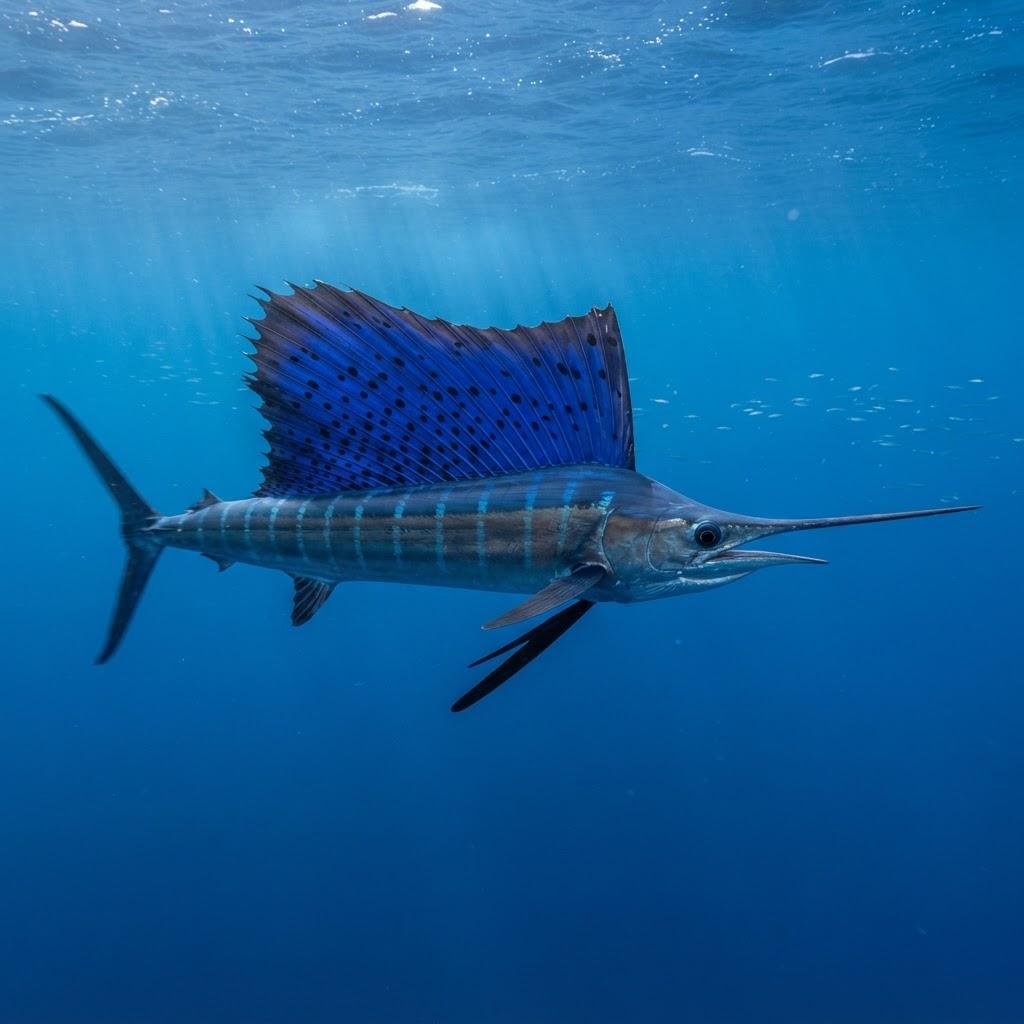
Istiophorus albicans
Atlantic Sailfish
Meet the Atlantic Sailfish, the ocean's ultimate speed demon with a massive dorsal fin that puts every pirate ship's rigging to shame. This sleek, hyper-fast sprinter treats the open sea like its personal drag-racing circuit.
Meet the Fish
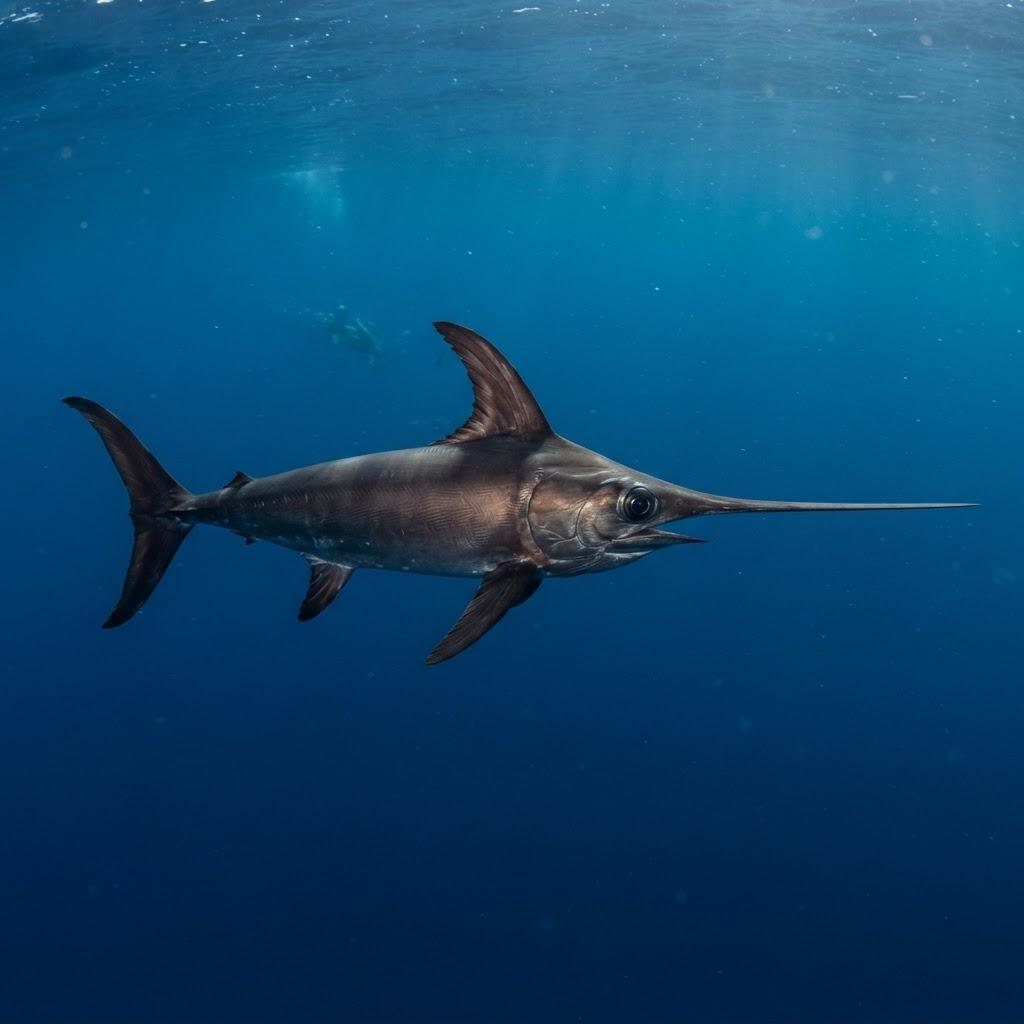
Imagine a torpedo got into a fight with a peacock, decided to grow a gigantic, iridescent blue crown, and then started training for the underwater Olympics. That is the Atlantic Sailfish in a nutshell. While most fish are perfectly content drifting along, looking for a snack and generally minding their own business, the sailfish is the equivalent of that guy at the gym who is constantly doing sprints and checking his heart rate on a fancy watch. With a dorsal fin that unfolds like a massive, spiky sail—hence the name—this creature is essentially a living, breathing yacht that can outrun almost anything on two legs or fins. It is sleek, it is silver, it has a bill that could double as a fencing sword, and it carries an aura of supreme confidence. If the ocean had a nightlife scene, the sailfish would be the one wearing a sharp suit, walking through the crowd like he owns the place, because frankly, when you can move faster than a speeding car, you pretty much do.
Weird Biological Superpowers Explained Simply
How does a fish become the fastest animal in the ocean? It is not by eating fancy supplements or doing yoga; it is all about hydrodynamics. Think of the sailfish as a biological cheat code for physics. It has a specially shaped, elongated snout called a rostrum that slices through the water like a hot knife through butter, drastically reducing drag. But the real kicker is the sail. When it is hunting, it unfurls that massive fin to herd schools of baitfish into a tight, panicking ball, creating an underwater wall of doom. It is essentially a corral made of cartilage and skin. Furthermore, its body is packed with specialized muscles that allow it to reach speeds of over 65 miles per hour in short, explosive bursts. Imagine you are trying to run through a pool; now imagine you are a rocket ship designed specifically to ignore the resistance of the water. That is the sailfish lifestyle, and it is honestly just showing off at this point.
Absurd Self-Defense Mechanisms
You might think an animal that is practically a living spear would be immune to being a snack, but in the ocean, there is always a bigger, hungrier neighbor. When a sailfish finds itself in a tight spot, it does not cower. Instead, it uses its 'scare tactic' maneuver. By flashing its sail and rapidly changing its colors—shifting from a dull, stealthy gray to a vibrant, strobe-light blue—the sailfish essentially tries to look like a much larger, more dangerous, and definitely non-edible monster. It is the aquatic version of puffing out your chest and waving your arms to look tougher. If the flashing lights and sudden size increase do not deter the predator, the sailfish does the only logical thing: it turns on the afterburners. The sheer acceleration is enough to leave most sharks confused, wondering if they just hallucinated a glittery, high-speed blur. It is a masterclass in 'you cannot hit what you cannot catch,' combined with a 'look at me, I am terrifying' display that would put a theater production to shame.
Fish Drama and Gossip
If you put a group of sailfish in a reality TV show, you would have a high-stakes, cutthroat competition for the best hunting grounds. These fish aren't loners by choice; they form hunting 'packs' to maximize efficiency. However, when it comes time to actually bag the prize, the social etiquette goes out the window. It is essentially an office potluck where everyone is trying to grab the last piece of pizza simultaneously. You have got alpha sailfish jostling for position, trying to make sure they get the most bites out of the sardine ball, while smaller, sneakier ones dart in to steal a quick meal before anyone notices. There is a constant, underlying tension about who is the fastest and who has the most impressive display. It is not just about survival; it is about status. If a sailfish shows up with a particularly bright or sturdy dorsal fin, you can bet the rest of the school is looking over their gills with a mix of jealousy and reluctant respect.
The "Wait, That's Real?!" Deep-Sea Oddities
While the sailfish loves to hang out near the surface where the sun shines bright enough to tan, it has some distant, downright bizarre cousins living in the crushing blackness of the deep. If you think the sailfish is weird because it has a sword on its face, imagine the barreleye fish, which has a transparent head so you can see its brain and glowing green eyes inside a glass bubble. While the sailfish is all about 'speed and style,' deep-sea denizens are all about 'survival in a wasteland.' Down there, you need to either glow in the dark to find a date or have teeth the size of your own body to make sure you never miss a meal. The sailfish is the flashy sprinter of the penthouse, whereas the deep-sea fish are the eccentric, light-show-loving hermits living in the basement. They might look like aliens from a low-budget sci-fi flick, but they are perfectly adapted to a world where light is a luxury and dinner is a rare occurrence.
Myth Busting
Let us clear the air regarding a few fishy misconceptions. For a long time, people thought the sailfish used its bill to impale prey like a kebab stick, skewering fish one by one. This would be incredibly inefficient and frankly hilarious to watch, but it is just not the case. In reality, the sailfish uses its bill more like a slasher weapon, swiping it through schools of fish to stun or confuse them, making them easier to pick off. Also, there is a myth that sailfish are just giant, mindless, swimming missiles. Science tells us that these creatures are actually quite intelligent and observant, capable of coordinating complex hunting strategies with other sailfish. They are not just mindless eating machines; they are strategic hunters that understand the geometry of a bait ball and the timing required to strike. The idea that fish are simple-minded is an insult to the complexity of the aquatic world, and the sailfish is leading the charge in proving otherwise.
Humorous Historical Tales or Folklore
Humans have been staring at the ocean for millennia, trying to make sense of the strange, pointy things jumping out of the water. In various maritime cultures, billfish were often viewed as the knights of the sea, armored and ready for battle. Old sailors used to tell tall tales about sailfish that could outrace hurricanes or carry treasure to the bottom of the ocean. Some ancient legends even suggested that the sailfish’s fin was a primitive map, with the markings acting as a secret code for the location of sunken gold. While these stories were likely the result of a few too many days at sea and perhaps a little bit of scurvy-induced imagination, they speak to the impact this fish has had on our collective psyche. We have always been fascinated by things that are faster, stronger, and pointier than us. The sailfish represents that untamable, wild spirit of the blue abyss, a symbol of everything we cannot quite catch or fully understand.
Underwater Love Stories and Bizarre Romances
Courtship for the sailfish is not a candlelit dinner; it is an high-energy, chromatic dance party. When it comes to finding a mate, the males turn their scales into a neon light show, pulsing with blues, purples, and silvers to prove they have the best genes and the most stamina. It is essentially an underwater talent show where the prize is starting a family. They swim alongside potential partners, engaging in a synchronized, high-speed performance that serves as both a courtship ritual and a 'look how fast I am' flex. It is dramatic, it is intense, and it involves a lot of showing off in front of the competition. If a male can maintain the intensity of his colors and the grace of his swimming, he might just win over a female. It is less about romance and more about proving that you are the most vibrant, capable, and 'fit for the ocean' candidate on the market.
Underwater Architecture and DIY Nesting
Unlike some fish that spend their lives building elaborate fortresses out of shells or pebbles—like the humble pufferfish—the sailfish is a bit of a minimalist. They do not build 'nests' in the traditional sense because they are nomadic, wandering spirits that don't like to be tied down to a specific patch of seabed. Instead of architecture, their 'nests' are the open, vast currents of the ocean. They rely on the water column itself to keep their eggs buoyant and distributed. This is a brilliant, if chaotic, survival strategy; by spreading their eggs across a massive area of the ocean, they increase the odds that at least some of their offspring will survive the treacherous journey of early life. It is the ultimate 'don't put all your eggs in one basket' strategy, adapted for a life spent entirely on the move. They are the nomads of the sea, and their home is wherever the current takes them.
The Chaos of Raising Tiny Swimmers
Raising children in the ocean is a statistical nightmare, and the sailfish handles it with a shrug and a high-volume approach. They release thousands, sometimes millions, of eggs into the water, and once those eggs are fertilized, the parents are essentially done. It is the ultimate hands-off parenting style. The tiny, newly hatched fry are basically translucent specks that have to survive being eaten by everything from plankton to other fish. They are on their own from the moment they emerge. It is a brutal, high-stakes game of hide-and-seek, where the only goal is to eat enough and avoid being eaten long enough to grow that signature bill. The irony is that the fastest animal in the ocean starts out as a defenseless, drifting speck of life. It is a classic underdog story—if they survive the gauntlet, they grow up to be the undisputed speed kings of the Atlantic, ready to start the cycle all over again.
How to Spot One & How It Is Doing
If you want to catch a glimpse of the ocean’s resident speedster, you will need to head to the tropical or temperate Atlantic, ideally where the water is warm and the baitfish are plenty. Look for disturbances on the surface, as that is where they spend most of their time hunting. Seeing a sailfish crest the water with its sail fully extended is a bucket-list moment for any ocean lover. Fortunately, the Atlantic Sailfish is currently classified as 'Least Concern' in terms of conservation status, which is great news. They are doing relatively well, but like all marine life, they face threats from overfishing and climate changes that shift their habitat. You can help by supporting sustainable seafood choices and organizations that advocate for protected marine areas. Keep the ocean healthy, and this silver streak of nature will keep lighting up our seas with its speed and style for generations to come.