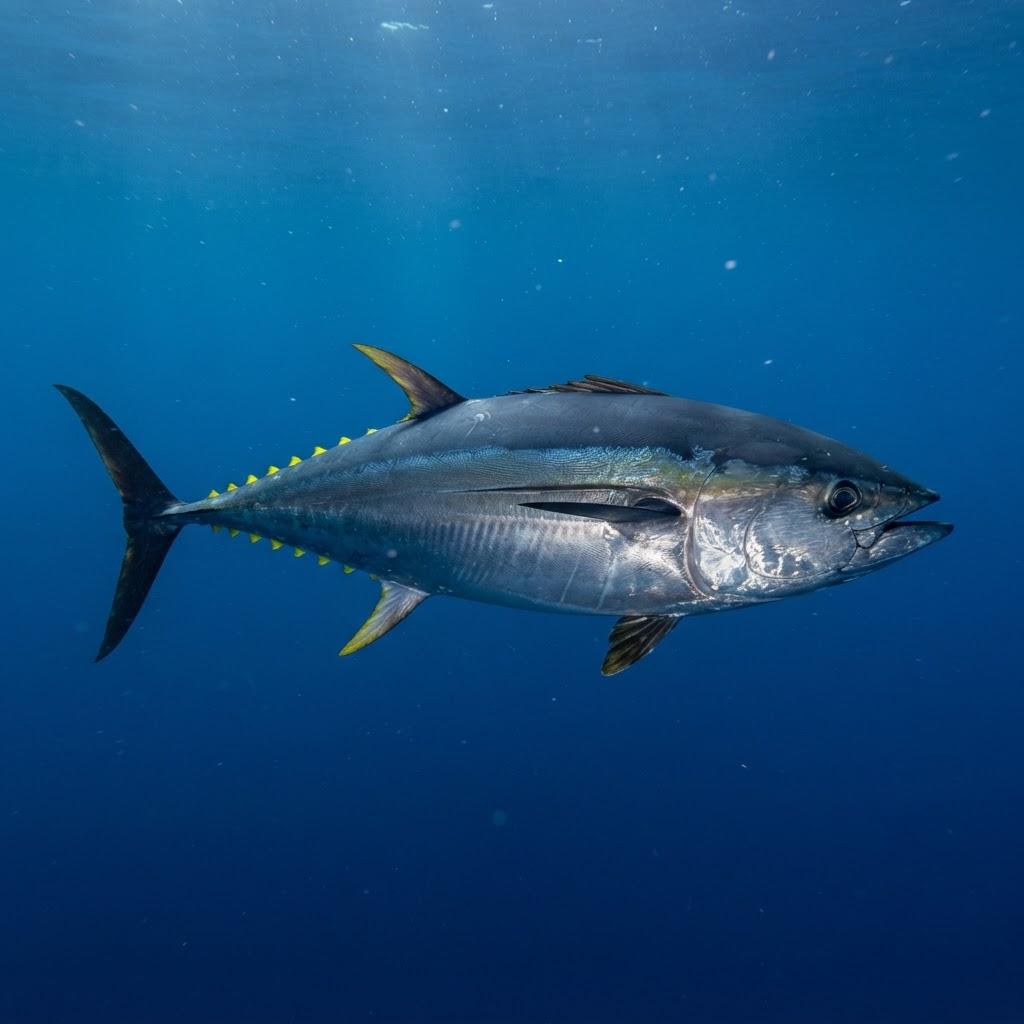
Thunnus thynnus
Bluefin Tuna
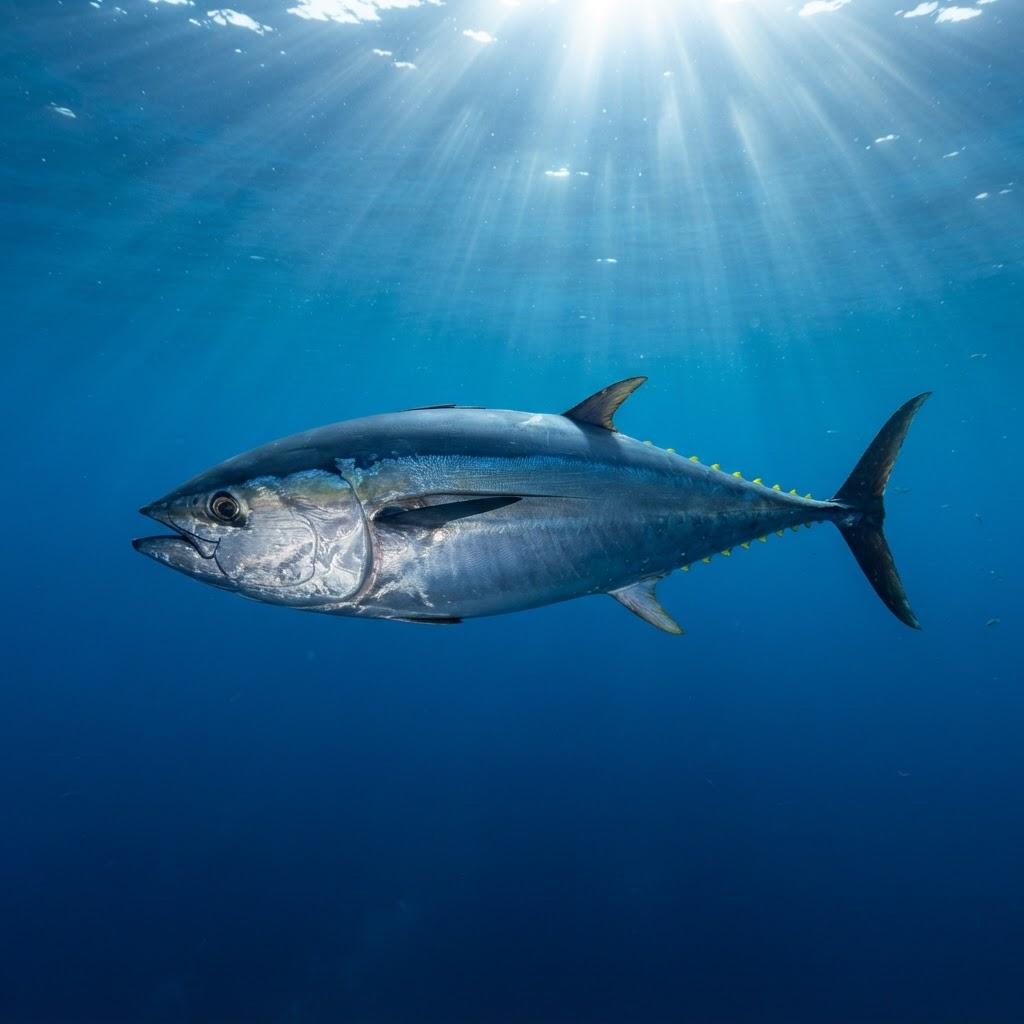
Meet the Atlantic Bluefin Tuna, the ocean's very own Ferrari with fins. This massive, high-speed hunter is a biological marvel that defies logic, turning cold water into pure, adrenaline-fueled muscle.
Meet the Fish
Imagine you have taken a torpedo, wrapped it in shimmering, metallic blue-and-silver armor, and fed it nothing but pure espresso for twenty years. That is the Atlantic Bluefin Tuna. This isn't your average goldfish sitting in a bowl, waiting for a flake of food; this is the ocean's apex athlete, a creature built for the sole purpose of moving faster than common sense would dictate. With a body shape that is perfectly streamlined like a high-end race car, the Bluefin looks like it was designed in a wind tunnel by aerospace engineers who were given an unlimited budget and a penchant for speed. They are sleek, powerful, and arguably the most charismatic heavyweights of the open sea. While other fish are content with meandering through the kelp forests, the Bluefin is busy breaking speed limits and making the rest of the ocean look like it is stuck in slow motion. If the ocean had a VIP list for high-performance celebrities, the Bluefin would be the guy arriving in a diamond-encrusted jet, looking effortlessly cool while everyone else is still looking for a parking spot.
Weird Biological Superpowers Explained Simply
How do you stay warm when you live in a refrigerator? That is the question the Bluefin Tuna answers every single day with a trick called regional endothermy. Now, don't let that fancy term scare you off; it basically means the fish has a built-in radiator system. Most fish are cold-blooded, meaning they just give up and match the temperature of the water around them. If the water is chilly, they are chilly. But the Bluefin? It has a specialized network of blood vessels that act like a heat exchanger. It keeps its muscles, brain, and eyes significantly warmer than the freezing depths of the Atlantic. Think of it like a human wearing a high-tech wetsuit that generates its own body heat while you are skiing. This allows the Bluefin to hunt in frigid waters where its prey—who are busy shivering—become very easy targets. It’s a biological hack that lets this fish operate at peak performance levels, turning it into a warm-bodied, high-octane machine that can outmaneuver almost anything else in the blue void.
Absurd Self-Defense Mechanisms
You might wonder how something that weighs as much as a grand piano hides from predators. The answer is simple: they don't hide, they vanish. The Bluefin doesn't need to inflate like a pufferfish or squirt ink like a squid because it has opted for the 'if you can catch me, you can have me' strategy of survival. Since almost nothing in the ocean is faster than a Bluefin Tuna, their primary defense is pure, unadulterated acceleration. When a shark or an orca decides it wants a tuna snack, the Bluefin hits the biological equivalent of a nitro boost, shifting its gears into a speed that makes the predator look like it is standing still. They are built for extreme durability, with skin that is as tough as leather and a skeleton that can handle the massive physical stress of high-speed turns. They don't need tricks or camouflage when they possess the ability to literally outrun their own problems, vanishing into the horizon faster than a gossip column headline at a celebrity wedding.
Fish Drama and Gossip
Life in a tuna school is not for the faint of heart. Imagine a high-stakes, high-speed boarding school where everyone is competing for the best spot in the hierarchy. These fish are intensely social, moving in massive, coordinated schools that resemble a well-drilled marching band or a chaotic swarm of synchronized swimmers. Gossip in the school is mostly about who is the fastest and who has the best access to the krill buffet. There is constant jostling for position because being in the center of the school offers the best protection from predators. If you are on the outside edge, you are essentially the appetizer. This creates a relentless, high-pressure environment where every individual is constantly shifting, trading places, and watching their neighbors. It is basically the underwater version of trying to get to the front of a mosh pit at a heavy metal concert. One wrong turn, and you are the one getting bumped to the outside lane where the sharks are prowling.
The "Wait, That's Real?!" Deep-Sea Oddities
While the Bluefin Tuna prefers the upper layers of the ocean where the light is good and the hunting is fast, its cousins in the deep sea are living a completely different, weirder life. If the Bluefin is the jock of the ocean, deep-sea fish are the eccentric poets who live in the basement. Down in the twilight zone, creatures have to deal with crushing pressure and absolute darkness, leading to some truly bizarre inventions. Some fish, like the dragonfish, produce their own light using chemical reactions, effectively carrying a flashlight on their faces to lure in snacks. Others look like they were built out of spare parts, with teeth that are far too large for their bodies and bodies that are mostly just stomach. While the Bluefin relies on pure muscle and speed to dominate the surface, these deep-sea oddities rely on patience, glowing lures, and the ability to survive in environments that would turn a normal fish into a pancake within seconds. It is a wild, alien world just a few miles down from where our tuna friends are zooming around.
Myth Busting
There is a persistent myth that the Bluefin Tuna is just a dumb, mindless eating machine. People often assume that because they are constantly moving, they don't have the brainpower for anything more complex than 'eat, swim, repeat.' Nothing could be further from the truth. These fish are actually incredibly clever navigators. They travel thousands of miles across entire oceans, returning to the exact same spots in the Mediterranean or the Gulf of Mexico to spawn, year after year. They have an internal compass that would put most human GPS devices to shame, relying on the earth's magnetic fields and the position of the sun to cross featureless deserts of blue water. They aren't just bumping into things randomly; they are calculated, intelligent voyagers that possess an impressive memory and a map of the ocean inside their heads. To call them mindless is like calling a world-class pilot a glorified bus driver—it completely ignores the sheer mental effort required to navigate the globe with such precision.
Humorous Historical Tales or Folklore
Throughout history, humans have been obsessed with the Bluefin Tuna, though our relationship has been less of a friendship and more of an expensive, ancient obsession. In the Mediterranean, ancient civilizations like the Phoenicians were building massive traps to catch these beasts as far back as 2,000 years ago. There are legends from the Mediterranean islands of the 'Tuna Kings,' people who were considered local royalty if they managed to coordinate a successful catch. In some coastal towns, the arrival of the tuna migration was treated like a major holiday, with priests blessing the nets and entire villages shutting down to join the hunt. It was a serious business, often treated with the same level of reverence we might give to a major sporting event today. They were so prized that some cultures used the images of these fish in their currency, proving that even thousands of years ago, people knew that the Bluefin was worth its weight in gold—literally.
Underwater Love Stories and Bizarre Romances
When it comes to dating, the Bluefin Tuna takes the 'let's just go with the flow' approach to an extreme level. They don't do elaborate, jewelry-giving dance-offs like some birds; instead, they opt for the giant, chaotic, underwater rave. During spawning season, thousands of these fish gather in specific areas and engage in what can only be described as a high-speed, synchronized explosion of life. There is no privacy, no quiet dinner for two, just a massive, coordinated release of eggs and sperm into the water column. It is a numbers game. By creating such a massive swarm, they ensure that at least some of their offspring will survive the onslaught of hungry neighbors waiting for an easy meal. It is efficient, it is dramatic, and it is entirely focused on the survival of the species. Think of it as the ultimate group wedding where the entire guest list contributes to the future of the family tree all at the same time.
Underwater Architecture and DIY Nesting
Unlike some fish species that spend weeks carefully crafting a nest or building a fortress out of shells and pebbles, the Bluefin Tuna is the ultimate minimalist. They are nomads of the ocean, moving constantly across vast distances, which means they don't have the luxury of settling down to build a house. Their 'nest' is the open water itself. They trust in the sheer scale of the ocean to protect their young. By releasing their eggs into the wild, drifting currents, they avoid the pitfalls of defending a static location that could be targeted by predators. They are the 'van-lifers' of the fish world, preferring to live out of their metaphorical backpacks and never staying in one place long enough to worry about property taxes or home improvement projects. Why build a house when the entire Atlantic Ocean is your living room? It is a bold, breezy, and entirely nomadic approach to starting a family that fits perfectly with their high-speed lifestyle.
The Chaos of Raising Tiny Swimmers
If you thought having a toddler was exhausting, imagine having a thousand of them floating around in the open ocean with absolutely no supervision. Once the eggs hatch, the tiny tuna larvae are basically left to fend for themselves in a world where everything is trying to eat them. They are essentially microscopic snacks for the first few weeks of their lives, floating along in the currents and hoping they don't drift into the mouth of a hungry jellyfish. The mortality rate is staggering, which is exactly why the adults have to produce millions of eggs at a time. It is a harsh, chaotic, and high-stakes environment where only the fastest and the luckiest make it to the juvenile stage. The transition from a tiny, transparent speck to a sleek, metallic hunter is one of the most perilous journeys in the animal kingdom, turning the 'raising' of offspring into a numbers-driven survival experiment that nature has been running for millions of years.
How to Spot One & How It Is Doing
Spotting an Atlantic Bluefin in the wild is basically like winning the lottery while riding a jet ski. You are looking for a massive, torpedo-shaped flash of silver and dark blue moving at breakneck speeds near the surface, likely trailing a group of panicked baitfish. If you happen to be on a boat, you might see them break the water with an incredible amount of power. Currently, these icons of the ocean are listed as Endangered due to decades of overfishing, but thanks to international conservation efforts and stricter quotas, their numbers are slowly beginning to stabilize in some areas. You can help by being a conscious consumer and checking the source of your seafood, ensuring you are buying fish caught through sustainable methods rather than destructive ones. Supporting marine protected areas is another great way to give these speed demons the space they need to recover. They are an essential part of the ocean’s balance, and keeping them in the water is the best way to ensure the ocean stays as vibrant and fast as it has always been.