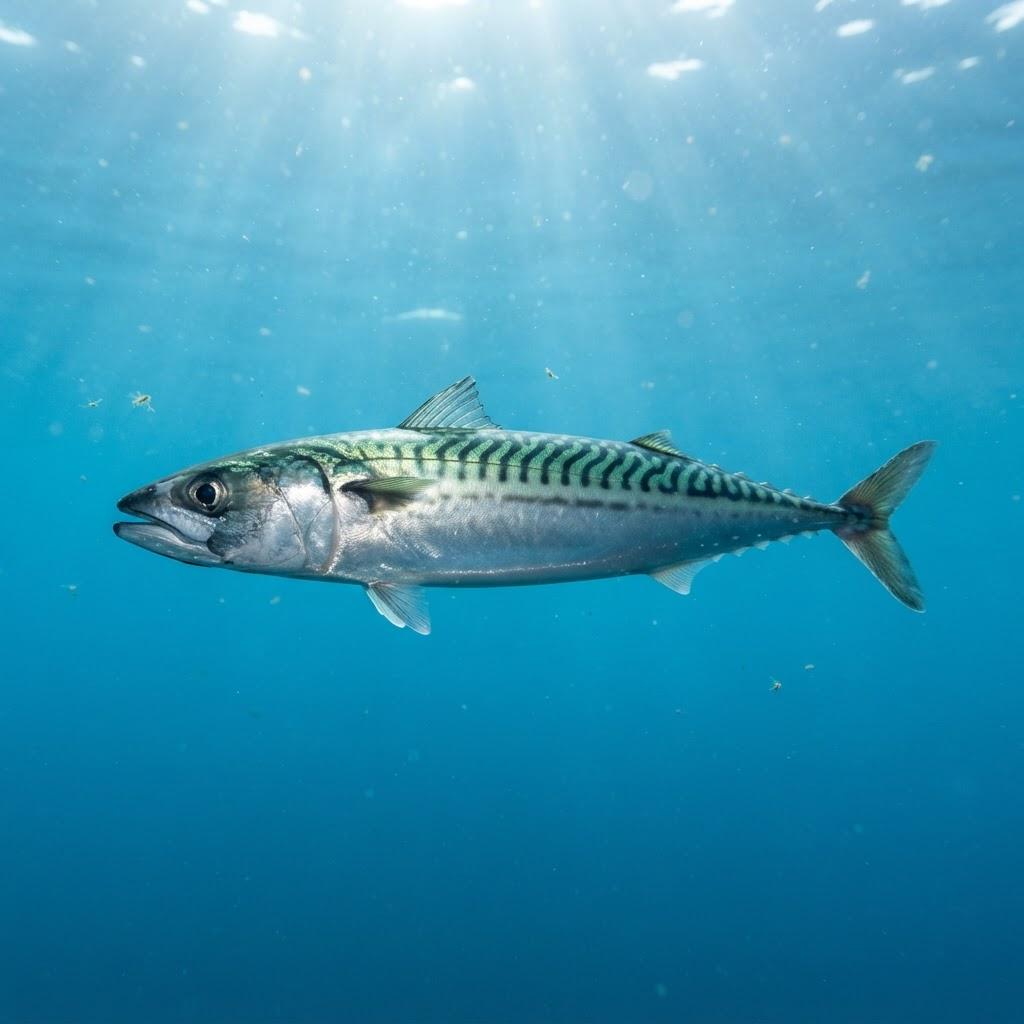
Scomber scombrus
Mackerel (Atlantic)
Meet the Atlantic Mackerel, the ocean's sleekest speed-demon and professional party animal. These glittery socialites live their lives in high-speed, synchronized swarms, proving that life is truly better when you have a million best friends.
Meet the Fish
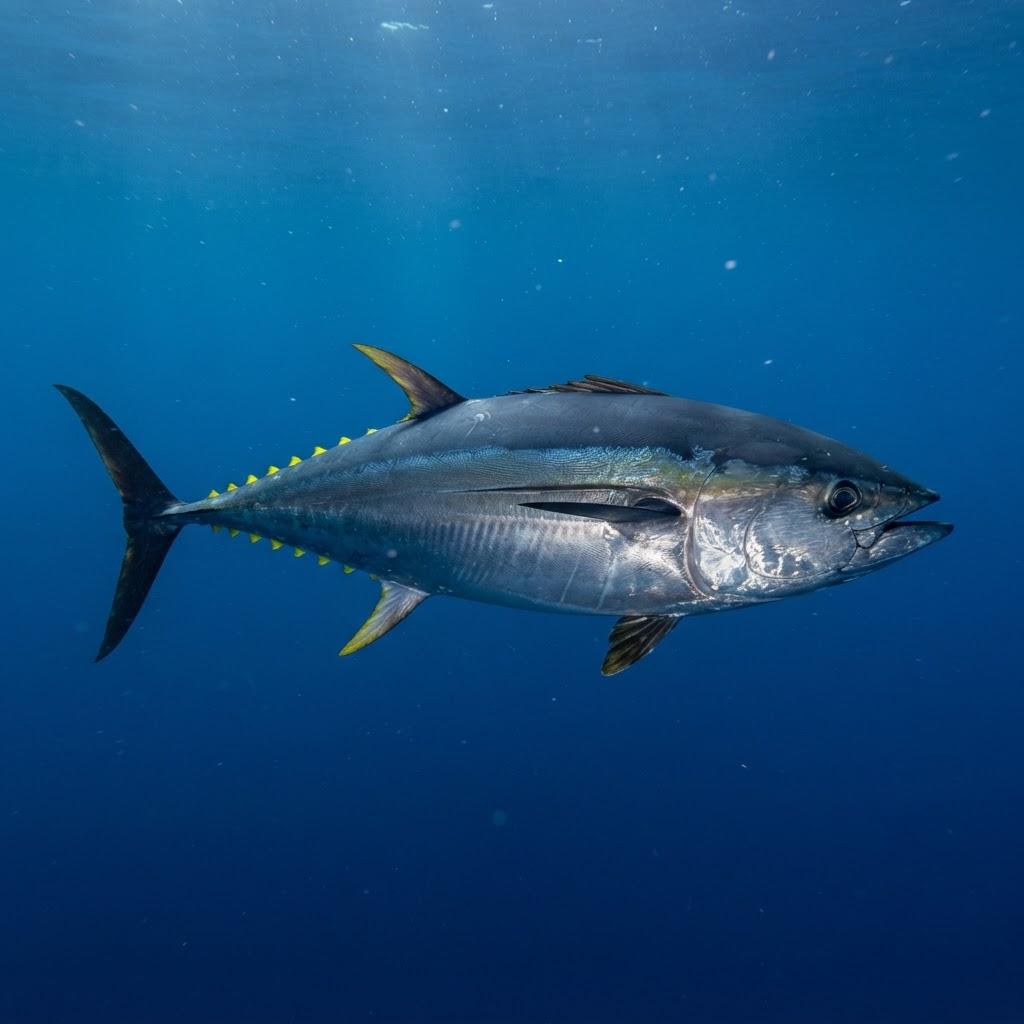
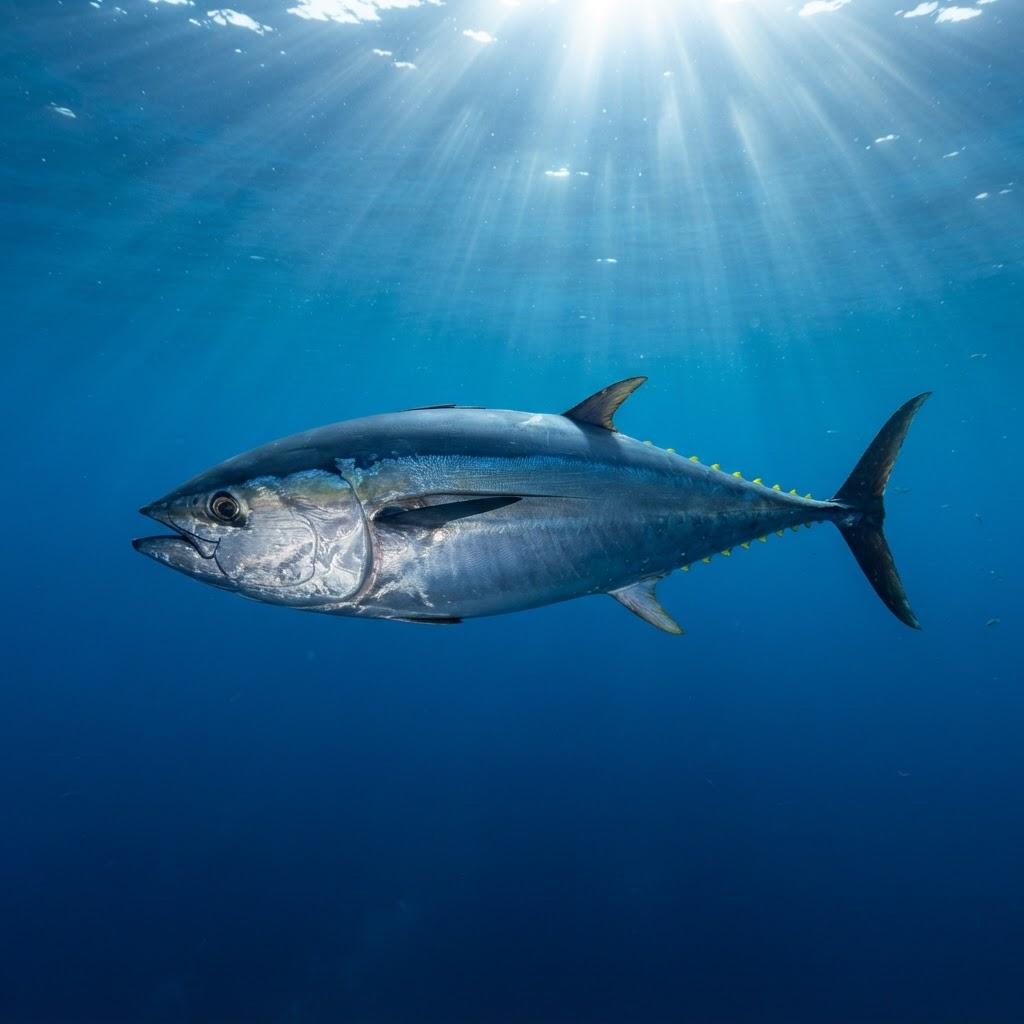
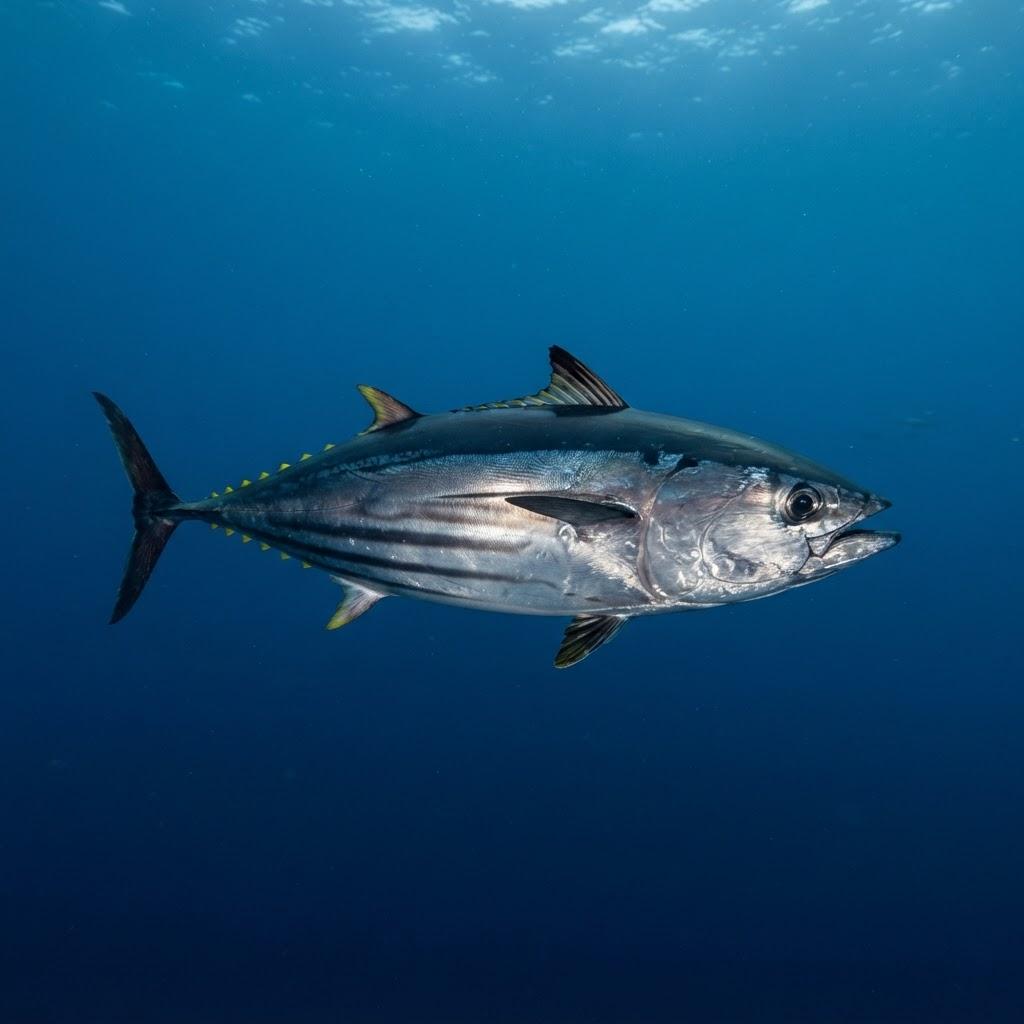
Imagine a torpedo wrapped in shimmering, iridescent armor that looks like it was painted by a street artist with a penchant for neon zebra stripes. Meet the Atlantic Mackerel, the James Bond of the North Atlantic. This isn't your average, lazy bottom-dweller lurking in the mud; this fish is a high-octane athlete designed for one thing and one thing only: absolute, terrifying speed. With a body shape that screams aerodynamics, the mackerel is the Ferrari of the sea. They are constantly on the move, never sitting still, and possess a level of social dependency that would make a teenager look like a hermit. They travel in massive, bustling schools that function like a synchronized dance troop, turning on a dime without ever bumping into each other. If you were looking for the fish that would be the captain of the football team while also holding the lead role in the school play, it is definitely the mackerel. They are perpetually fashionable, vibrantly patterned, and undeniably fast, making them the ultimate influencers of the open ocean.
Weird Biological Superpowers Explained Simply
The mackerel possesses a biological superpower that puts our best human technology to shame: the inability to stop breathing, which is actually a weird survival mechanism. Unlike some fish that can just sit there and pump water over their gills like they are lounging in a recliner, the mackerel is an obligate ram ventilator. Think of it like this: if a mackerel stops swimming, it stops breathing. It is effectively a living jet engine that requires constant forward motion to force oxygenated water through its gills. To keep this engine running, they have evolved a rigid, hydrodynamic body that cuts through the water with almost zero friction. Furthermore, they lack a swim bladder—the internal balloon most fish use to float—which means they are naturally heavy. They have to keep swimming to stay at their preferred depth. They are essentially biological perpetual motion machines, wired to maximize energy efficiency while moving at breakneck speeds, making them the most high-maintenance swimmers in the entire aquatic kingdom.
Absurd Self-Defense Mechanisms
When you are a tasty, bite-sized snack for everything from whales to tuna, you cannot rely on spikes or heavy armor because that would slow you down. Instead, the Atlantic Mackerel employs the ultimate defense strategy: the 'chaos cloud' maneuver. By schooling in the millions, they transform from individuals into a singular, shimmering, confusing entity. When a predator lunges, the school explodes into a chaotic swirl of silver flashes, making it impossible for the attacker to lock onto a single target. It is the aquatic version of a flash mob designed to cause a panic attack in a hungry shark. If that wasn't enough, their coloration is a masterclass in deception. Their dark, wavy dorsal patterns mimic the undulating surface of the water from above, hiding them from hungry seagulls, while their silver bellies blend into the bright sky when viewed from below. They are the masters of the vanishing act, hiding in plain sight by being exactly the same as everyone else around them.
Fish Drama and Gossip
Life in a mackerel school is essentially a high-stakes, underwater soap opera where the drama never ends. Because there are literally millions of them, the gossip is constant, though it mostly involves synchronized turns and frantic speed-matching. There is no such thing as 'personal space' in a mackerel school; it is more like an endless mosh pit where you are expected to know your choreography perfectly. If you are a mackerel, you live in constant fear of being the 'odd one out' who drifts too far from the group, because the loners are the first ones to get snatched up by a passing predator. The hierarchy is surprisingly flat—there is no 'King Mackerel' dictating orders—but the peer pressure is immense. Every fish is constantly monitoring the neighbors to ensure they are all moving at the exact same tempo. If one fish gets spooked, the entire school ripples with a wave of panic that travels faster than a text message, creating a viral sensation of movement that keeps everyone safe.
The "Wait, That's Real?!" Deep-Sea Oddities
While the Atlantic Mackerel prefers the sunny, upper layers of the ocean where the light is good and the snacks are plentiful, their cousins in the deep sea are living in a completely different reality. Down in the twilight zone, the 'oddities' look like science experiments gone wrong. Take the barreleye fish, for example, which has a transparent, jelly-filled head where you can see its actual brain and eyes rotating inside like some kind of biological arcade machine. Mackerel are the sensible, athletic jocks of the ocean, while the deep-sea dwellers are the eccentric, goth cousins who hang out in basements, wearing bioluminescent makeup to attract dates. While a mackerel relies on its sharp eyesight and speed to find dinner in the bright sun, deep-sea fish have to invent their own light just to see what they are eating. It makes you realize that while the mackerel is a speed-demon, there is a whole other world beneath them that operates on absolute weirdness and spooky, self-generated neon.
Myth Busting
There is a persistent myth that mackerel are 'dumb' because they just swim in circles all day, but this couldn't be further from the truth. Science has shown that schooling fish like the mackerel are actually incredibly intelligent when it comes to spatial awareness and group dynamics. Some people assume that because they travel in such massive groups, they aren't thinking at all, but each individual mackerel is processing massive amounts of sensory input from its 'lateral line'—a special organ running down the side of its body that detects tiny vibrations in the water. This allows them to feel the movement of their neighbors and react instantly. They aren't just mindless drones; they are highly attuned sensors linked together in a massive biological network. Another myth is that they are just 'trash fish,' but in reality, they are some of the most ecologically important species in the Atlantic, supporting entire food webs that humans and other animals rely on for survival.
Humorous Historical Tales or Folklore
Historically, the mackerel has been the backbone of human coastal survival for centuries, often appearing in folklore as the 'fish that saves the hungry.' In medieval Europe, they were so abundant that they were often considered the food of the commoners, which led to some rather funny snobbery among the wealthy who preferred more 'prestigious' catches. There are old fishermen's tales that suggest the mackerel were guided by the moon, with ancient sailors claiming the fish would only show up when the tides whispered to them. Some cultures even believed that the wavy stripes on a mackerel's back were scars from an epic, underwater sword fight between the ocean spirits. While we know better now, these stories highlight just how integral this fish was to the human experience. They were not just a meal; they were a source of mystery and wonder, proving that even a fish as common as the mackerel can leave a mark on human history that spans generations of campfire storytelling.
Underwater Love Stories and Bizarre Romances
When it comes to romance, the mackerel isn't exactly the type to write a sonnet or bring flowers. Their dating life is a massive, chaotic party known as 'broadcast spawning.' Imagine a stadium filled with millions of people all throwing glitter into the air at the exact same moment—that is a mackerel wedding. There is no elaborate dance or fancy nest. Instead, the males and females congregate in massive numbers, swimming in tight, frantic patterns until the timing is just right. At a signal that seems to involve a sudden change in pressure or temperature, the females release their eggs and the males release their milt into the vast, open water. It is a numbers game. They don't have to win over a specific partner; they just have to be part of the biggest, fastest, and most energetic release of eggs possible. It is a biological lottery, and they are playing with millions of entries to ensure that at least a few tiny mackerel make it to adulthood.
Underwater Architecture and DIY Nesting
If you are looking for an architectural masterpiece, look elsewhere, because the Atlantic Mackerel are the ultimate minimalist nomads. They do not build castles, they do not dig tunnels, and they certainly do not tidy up their bedrooms. To a mackerel, the concept of a 'home' is totally foreign. Why bother building a nest when you have the entire ocean at your disposal? While other fish spend weeks moving pebbles or weaving kelp to make a nursery, the mackerel is out there living the ultimate 'van life'—or rather, 'ocean life'—traveling thousands of miles across the Atlantic. Their lack of architecture is a brilliant evolutionary choice; by not being tethered to a specific spot, they avoid being hunted by creatures that would wait outside their front door. They are the nomadic poets of the sea, carrying their entire lives with them in their sleek, silver bodies, untethered and entirely free from the burden of chores and property maintenance.
The Chaos of Raising Tiny Swimmers
If you thought having a toddler was exhausting, spare a thought for the mackerel egg. Once the parents have finished their massive, chaotic spawning party, they basically say, 'good luck, kid,' and swim off into the distance. There is zero parenting involved. The eggs are tiny, buoyant, and left to drift on the ocean currents. This is known as 'pelagic' development, which is fancy talk for 'floating in the middle of nowhere.' Once the tiny larvae hatch, they are basically invisible specks with eyes. They have to fend for themselves from second one, dodging hungry plankton eaters that are only slightly larger than they are. It is the ultimate survival of the fittest. The ones that survive are the ones that learn to swim, find microscopic food, and avoid getting eaten within their first few hours of life. It is brutal, it is high-stakes, and it is a testament to the sheer resilience of these fish that they manage to thrive in such a dangerous, wide-open environment.
How to Spot One & How It Is Doing
Spotting an Atlantic Mackerel is relatively easy if you are in the right spot at the right time. Look for that signature flash of silver and those unmistakable dark, wavy stripes along the top of their backs. They are often found near the surface, and if you are on a boat, you might see the water churning as the school moves through. As for their conservation status, they are doing quite well—currently listed as 'Least Concern.' They are hardy, fast-growing, and have a massive population that covers a huge range. However, that doesn't mean we should take them for granted. The best way to help keep their populations healthy is by supporting sustainable seafood choices. When we buy fish that are caught using methods that don't destroy their environment, we ensure that the mackerel parties keep on rocking for generations. So, next time you are out on the water, keep an eye out for those silver streaks—they are the true legends of the open ocean.