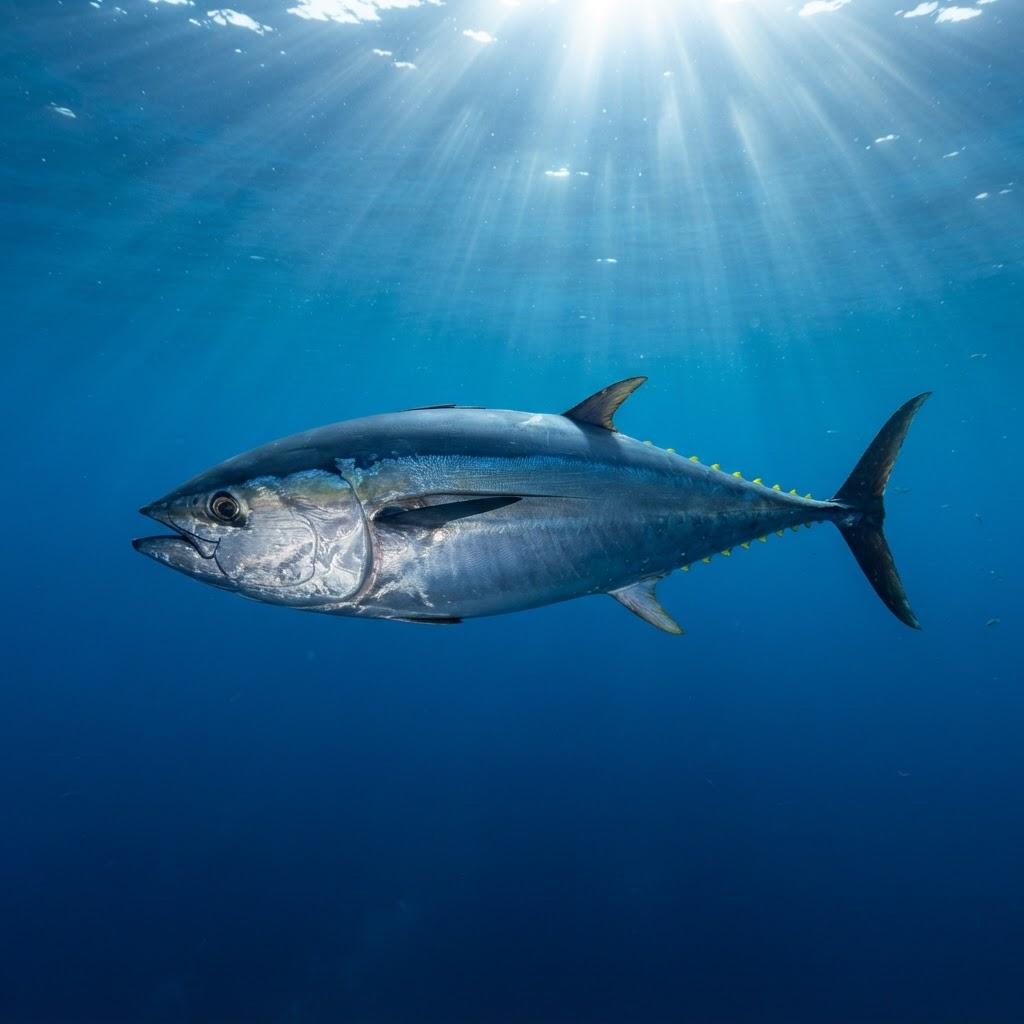
Thunnus thynnus
Tuna (Atlantic Bluefin)
Meet the Atlantic Bluefin Tuna, the ocean's ultimate muscle car that combines the speed of a jet with the sheer size of a small boat. This isn't your average sandwich filling; it's a high-octane predator that makes professional athletes look like couch potatoes.
Meet the Fish
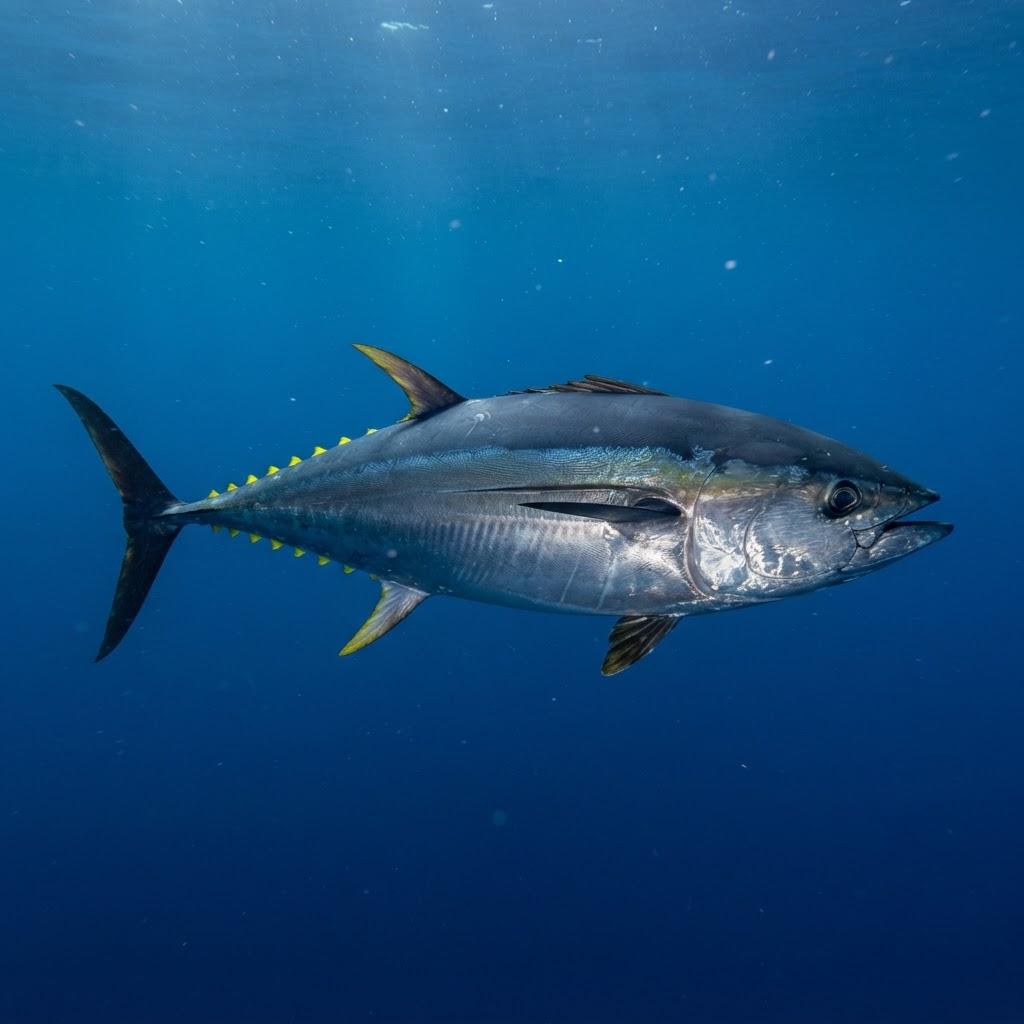
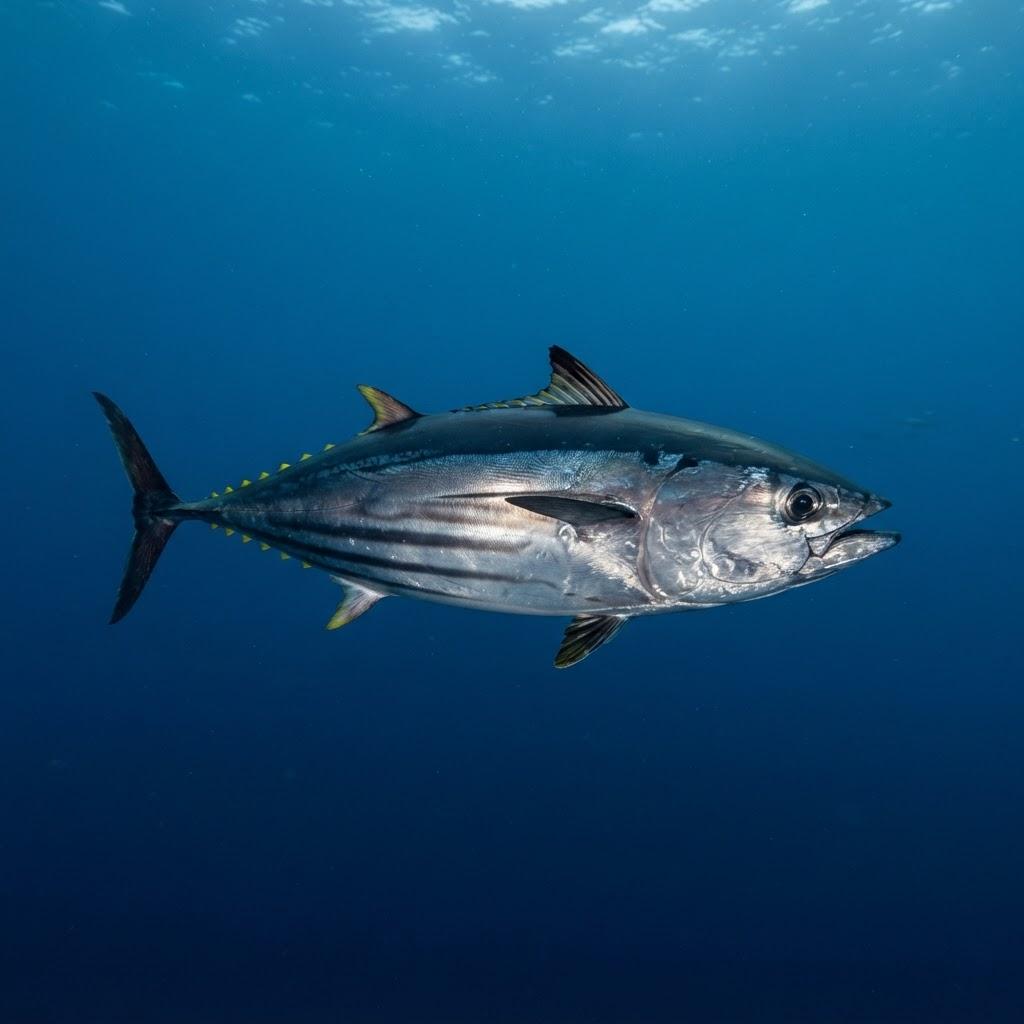
Imagine a torpedo designed by a luxury Italian car manufacturer, but instead of leather seats, it is packed with pure, raw power and a metabolism that would make a marathon runner jealous. That is the Atlantic Bluefin Tuna. These fish are not just wandering aimlessly through the blue; they are the undisputed kings of the open ocean, clocking in at speeds that would get them a hefty speeding ticket in a school zone. With a streamlined, bullet-shaped body that looks like it was carved from a single piece of dark steel, the Bluefin is built for one thing: velocity. They have retractable fins that tuck into little grooves on their bodies to reduce drag, essentially turning themselves into organic missiles. They are the A-list celebrities of the tuna world, possessing a kind of stoic, focused vibe that says they have places to be and herring to consume. They do not do slow, and they do not do boring; every movement is a calculated, efficient snap of muscular grace that makes other fish look like they are moving through molasses.
Weird Biological Superpowers Explained Simply
While most fish are cold-blooded, essentially taking on the temperature of their surroundings, the Bluefin Tuna has a trick up its sleeve called regional endothermy. Think of it like this: most fish are like cheap plastic drink coolers that just sit there and eventually get warm, but the Bluefin has a built-in, high-efficiency engine block. Through a complex system of blood vessels known as the rete mirabile—or wonderful net—they can keep their core muscles, brain, and eyes significantly warmer than the chilly water around them. This is the biological equivalent of wearing a high-tech thermal wetsuit while everyone else is shivering in their birthday suits. This superpower allows their muscles to fire faster and their brains to process information with lightning speed, giving them a massive advantage when chasing down snacks in cold northern waters. It is basically the difference between trying to play a video game with frozen fingers versus playing with high-speed, warmed-up reflexes. This internal heater is why they can survive in a wider range of temperatures than almost any other fish in the sea, turning them into the ultimate globetrotting machines.
Absurd Self-Defense Mechanisms
When you are the biggest, fastest, and most intimidating fish in the neighborhood, you do not really spend much time worrying about being eaten, but that does not mean the Bluefin lacks a strategy. Their primary defense mechanism is the ultimate game of tag: they are simply too fast to catch. If a shark or an orca starts eyeing them up, the Bluefin does not hide in a cave or sprout spikes; it hits the gas. They are the equivalent of a sports car on an open highway versus a tricycle. But beyond speed, they possess a sensory system that is nothing short of ESP. They have a lateral line running down their sides that detects pressure waves from even a tiny movement a mile away. It is like having a 360-degree radar system that senses danger before it even realizes it is a threat. They don't need slime or camouflage; they rely on pure, unadulterated situational awareness. They are constantly scanning, constantly shifting, and constantly proving that if you are too quick for your enemies to track, you don't really need a Plan B.
Fish Drama and Gossip
Life in a Bluefin school is not all about synchronized swimming and high-speed hunting; it is actually a complex, high-stakes social scene that would make a reality TV producer drool. These fish move in schools, and contrary to the belief that fish are mindless automatons, Bluefin hierarchies are surprisingly nuanced. There is a constant, subtle competition for the best position in the slipstream of the fish ahead, which saves energy during long-distance migration. Think of it like a professional cycling team drafting off one another, except everyone is fighting for that prime spot while maintaining a perfectly coordinated formation. When mealtime hits, the decorum breaks down slightly into a chaotic, adrenaline-fueled frenzy where size and speed dictate who gets the best slice of the bait ball. It is a world of silent, underwater diplomacy where a slight flick of a tail or a change in swimming speed is a signal, a warning, or a subtle power move that everyone else instantly understands without a single word being exchanged.
The "Wait, That's Real?!" Deep-Sea Oddities
While the Bluefin Tuna loves to surf the upper layers of the ocean, they are arguably the greatest deep-sea explorers of the fish world. They frequently dive to depths where the sunlight is a mere memory, plunging into the mesopelagic zone. This is a dark, cold, and slightly alien place where the residents have evolved to look like they came straight out of a horror movie budget meeting. While the Bluefin doesn't have bioluminescent lures dangling from its forehead like an anglerfish or translucent skin like a glass squid, it acts as a bridge between the sun-drenched surface and the midnight abyss. When a Bluefin dives deep, it is essentially moving between worlds. They encounter creatures with massive, glowing eyes designed to catch a single photon of light and others that are so squishy they would essentially turn into a puddle of goo at surface pressure. The Bluefin is like the brave, muscular explorer who ventures into the dark caves to hunt, proving that you don't need neon lights to thrive in the darkness if you have enough raw muscle and a high-performance, heat-managed core.
Myth Busting
For years, people thought that big fish were just big, dim-witted swimmers that bumped into things, but the Bluefin Tuna has shattered those myths into tiny pieces. One of the biggest misconceptions is that fish are incapable of long-distance navigation or that they are purely reactive. In reality, the Bluefin is a navigational genius. They cross entire oceans with the precision of a GPS-guided aircraft, finding their way back to specific spawning grounds with uncanny accuracy. Another myth is that all fish are cold, mindless creatures. The Bluefin’s ability to maintain a body temperature higher than the ocean proves they are as active and physiologicaly complex as many land mammals. People also like to assume that because they are huge, they must be sluggish, but a 600-pound Bluefin can move with more agility than a cat chasing a laser pointer. They aren't just swimming; they are engaging in a sophisticated, highly intelligent interaction with an environment that would kill most other animals in minutes.
Humorous Historical Tales or Folklore
The Atlantic Bluefin has been the subject of human obsession for thousands of years, popping up in everything from ancient Roman mosaics to the logs of medieval fishermen who were convinced these things were monsters. In some Mediterranean cultures, the arrival of the tuna was treated with the same reverence as a religious festival. There are ancient stories of 'tonnara' nets—massive, intricate labyrinth structures made of rope and iron that were set up in coastal bottlenecks to trap the migrating tuna. It was a high-stakes, communal battle of wits and strength between village fishermen and these hulking, silver-scaled beasts. Some legends even suggest that the size and power of these fish led sailors to mistake them for the mythical sea serpents that supposedly guarded the edges of the world. It is easy to see why; if you were a lonely sailor in a tiny wooden boat and a 500-pound, metallic, hyper-fast fish smashed into your hull, you might start telling stories about monsters, too. They have been the inspiration for wealth, epic feasts, and tall tales for as long as humans have been setting sail on the Atlantic.
Underwater Love Stories and Bizarre Romances
When it comes to romance, the Bluefin Tuna does not bother with chocolates or flowers; they go for the grandeur of the open ocean. During the spawning season, they undergo a miraculous transformation, returning to specific, warm-water breeding grounds like the Gulf of Mexico or the Mediterranean. Here, the 'romance' is essentially a high-energy, mass-participation event. There are no delicate dances or elaborate nesting sites. Instead, the water fills with a chaotic, adrenaline-pumping explosion of activity where thousands of these giants congregate. It is like the ultimate singles mixer where the goal is to release eggs and sperm into the current with such intensity and frequency that the chances of fertilization are maximized. It is a numbers game played on a gargantuan scale. While it might sound unromantic, it is actually a testament to the raw drive of life. They travel thousands of miles through harsh conditions, powered by pure instinct, just to participate in this grand, aquatic gala of genetics that ensures the next generation of speed-demons is born.
Underwater Architecture and DIY Nesting
If you are looking for a fish that builds elaborate sandcastles or hidden fortresses, the Bluefin is going to disappoint you. They don't do architecture. They are the digital nomads of the ocean, the people who carry everything they need in their own bodies. Why waste time building a nest in a current that is going to shift in five minutes when you can just be the most efficient swimming machine on the planet? Their 'nesting' strategy is simplicity itself: the open ocean is their home, their nursery, and their gymnasium. They rely on the sheer, vast scale of the sea to protect their eggs. By spawning in vast quantities and leaving the larvae to drift in the plankton-rich currents, they are essentially outsourcing their nursery duty to the ocean itself. It is a minimalist philosophy taken to the extreme. They don't need walls; they have the entire Atlantic, and they know how to use every square inch of it to find food, avoid predators, and thrive in a world that never sits still.
The Chaos of Raising Tiny Swimmers
The parenting style of an Atlantic Bluefin Tuna can best be described as 'hope for the best and pray the currents are kind.' Once the eggs are fertilized, the adult Bluefin washes its hands—or fins—of the whole situation. There is no hovering, no guarding, and absolutely no teaching their young how to hunt. The tiny, microscopic larvae that hatch are left to fend for themselves in the treacherous world of the plankton layer. They start as tiny, vulnerable specks that are essentially at the mercy of every other predator in the sea. It is a brutal, high-stakes game of survival where the odds are stacked against them from second one. However, the sheer volume of eggs released ensures that even if only a tiny fraction survive to adulthood, the species continues. It is a chaotic, Darwinian approach that is the complete opposite of the 'helicopter parent' fish. They provide the genetic blueprint and a kickstart, and the rest is up to the survival-of-the-fittest training camp that is the open sea.
How to Spot One & How It Is Doing
Spotting a Bluefin in the wild is basically like trying to spot a Ferrari on a racetrack while standing in the parking lot; it is mostly about knowing where to look and being in the right place at the right time. If you are ever on a boat in the open Atlantic or Mediterranean and see a blur of silver and blue cutting through the water at impossible speeds, you might have just witnessed the king. They are instantly recognizable by that sleek, torpedo shape and the distinct, yellowish tint on their finlets. Currently, the Bluefin is navigating a tricky chapter in its story. Due to their immense value as high-quality seafood, they have faced heavy fishing pressure that has pushed their numbers to precarious levels. The good news? Conservation efforts and strict, science-based quotas are helping them stage a comeback. You can help by being a conscious consumer—always asking where your fish comes from and supporting sustainable fisheries. The Bluefin is a resilient survivor, and with a little help from us, this high-octane ocean traveler will keep tearing through the waves for generations to come.