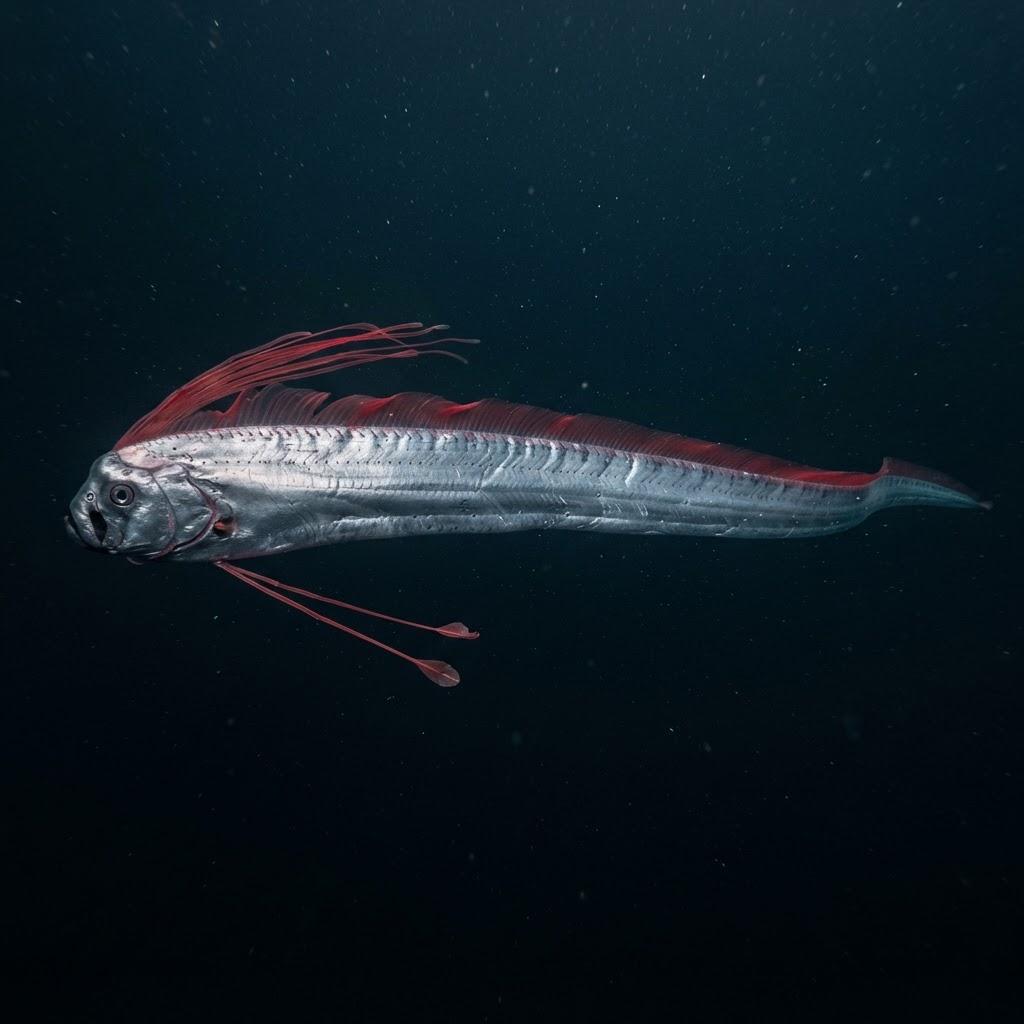
Regalecus glesne
Giant Oarfish
Meet the Oarfish, the ocean's answer to a living, breathing ribbon of mystery that likely inspired every sea serpent legend in history. Part fashion model and part deep-sea ghost, this silver-scaled giant is as weird as it is massive.
Meet the Fish
Imagine you are strolling down the beach, minding your own business, when suddenly you see a giant ribbon of silver and red flopping on the sand. You might think you have stumbled upon a movie prop from an abandoned 1950s horror film, but nope, you have just met the Giant Oarfish. This creature is essentially the fashion model of the deep sea—incredibly long, impossibly thin, and draped in a shimmering, pearlescent coat that would make any mermaid jealous. It does not swim like a normal fish; it drifts through the water like a lonely piece of shimmering silk ribbon caught in a light breeze. With its bright crimson crest standing up like a flamboyant mohawk and its face frozen in an expression of perpetual, wide-eyed confusion, it is hard to believe this thing is actually real. While most fish look like torpedoes or pancakes, the oarfish decided to be a giant piece of spaghetti. It is the kind of fish that clearly marches to the beat of its own drum—or perhaps its own aquatic synth-pop soundtrack—and it does not care who is watching.
Weird Biological Superpowers Explained Simply
If you were a giant ribbon, you would need some serious tech to survive in the dark, high-pressure depths of the ocean. The oarfish has a secret weapon: it is an absolute master of vertical swimming. Most fish spend their days swimming horizontally, but the oarfish prefers to hang out in the water column like a human standing in a swimming pool. It keeps itself upright using its long, specialized pelvic fins—which look exactly like oars, hence the name—that act as stabilizers. Think of it like a tightrope walker who has two long poles to keep them from wobbling, except the tightrope is the entire ocean. Furthermore, the oarfish has a jaw structure that would make a horror movie monster proud. It can extend its mouth forward, like a robotic arm reaching out to snag a snack, allowing it to vacuum up tiny creatures like krill and jellyfish without having to exert much energy. It is essentially the world’s largest, most elegant, living biological vacuum cleaner.
Absurd Self-Defense Mechanisms
The oarfish lives by a code: if someone is bothering you, just lose a part of yourself. This sounds counterintuitive, but for the oarfish, it is a masterclass in 'oops, not my problem.' If a predator decides that an eight-meter-long snack is a good idea, the oarfish can actually undergo a process called autotomy. It effectively decides that it does not need its own tail section anymore. It will simply drop or break off a portion of its long, ribbon-like body to distract the attacker. While the shark or squid is busy wondering why it just got a mouthful of fish tail that wasn't attached to anything, the oarfish swims away, albeit slightly shorter than before. It is not exactly like a lizard dropping its tail, but rather a final, 'take this and leave me alone' maneuver. It is the ultimate diva exit strategy, leaving the predator confused while the oarfish slinks off into the shadows of the deep.
Fish Drama and Gossip
In the social circles of the deep, the oarfish is the mysterious hermit who never goes to parties. Because they live so deep, they don't have to deal with the petty squabbles of the reef-dwelling clownfish, who are constantly arguing over anemone real estate. Instead, the oarfish social scene is virtually non-existent. They are solitary wanderers who prefer their own company to the noise of the crowd. If you were to peer into their lives, it would be the most boring reality TV show ever produced—just one giant, silver ribbon floating in the dark, avoiding everyone else at all costs. There are no power struggles, no territorial markings, and absolutely no group chats. They are the antisocial geniuses of the ocean, proving that if you are large enough and weird enough, you don't need to fit in with the school. They are basically the 'loner at the back of the class' who turns out to be an alien mastermind.
The "Wait, That's Real?!" Deep-Sea Oddities
The world of the oarfish is the 'Twilight Zone' of the ocean, a place where sunlight is a distant memory and the pressure is high enough to crush a submarine like a soda can. It is a world inhabited by creatures that would give H.P. Lovecraft nightmares. While the oarfish is relatively straightforward in its design, its neighbors are far more bizarre. You have fish that glow in the dark to lure in prey, fish that are essentially see-through bags of jelly, and creatures with teeth that look like serrated knives. The oarfish represents the upper tier of the weirdness scale, yet it is oddly refined compared to some of the monstrosities lurking further down. In this environment, where food is scarce and mates are even scarcer, being a giant, slow-moving ribbon is actually a brilliant strategy. Why chase dinner when you can just drift around and wait for it to wander into your mouth? It is the ultimate life hack for the deep-sea inhabitant.
Myth Busting
There is a persistent rumor that seeing an oarfish near the surface is a harbinger of doom, particularly earthquakes. Because they were often found washed up on Japanese shores before major seismic events, people decided the fish was a prophet of impending disaster. Let us be very clear: the fish has no psychic powers. It is not reading tectonic plates, it is not checking the Richter scale, and it is definitely not an underwater fortune teller. The reason they end up on beaches is likely due to strong currents or simply being sick or injured, not because they are trying to warn the coastal residents of a coming shake. They are just fish trying to survive, not divine messengers sent to ruin your vacation plans. So, if you see one, you don't need to start packing your emergency bags; you should just be grateful you are witnessing one of the rarest sights in the natural world.
Humorous Historical Tales or Folklore
For centuries, sailors have returned from sea with tall tales of sea serpents—monstrous, undulating beasts with manes of fire that could swallow ships whole. Given that the oarfish can grow to legendary lengths and has a striking, crimson-colored fin crest that looks exactly like a fiery mane, it is almost certainly the culprit behind these myths. Imagine being a 17th-century sailor who has been drinking fermented grog for three weeks, and suddenly, a twenty-foot-long shimmering silver beast rises from the waves. You would tell everyone you saw a dragon, too. The oarfish has been the unwitting mascot of sea monsters for generations. It is funny to think that the most terrifying monster in nautical folklore is actually just a big, peaceful, plankton-eating fish that is more scared of you than you are of it. History has done the oarfish a huge disservice by painting it as a beast when it is really just a misunderstood giant.
Underwater Love Stories and Bizarre Romances
Finding love in the deep sea is harder than finding a decent signal in a remote desert. For an oarfish, it is a game of extreme hide-and-seek. Because they are so rare and widely dispersed, meeting a potential partner is a monumental logistical challenge. They don't have dating apps, and the ocean is vast enough to keep a billion fish apart for a lifetime. When they do manage to find each other, there is no elaborate dance-off or gift-giving ritual. Instead, it is likely a quiet, solitary affair in the blackness of the abyss. They release their eggs and sperm into the water column, hoping for the best in a process called broadcast spawning. It is a romantic strategy that basically amounts to 'I hope this works out,' which, in the vast, dark, cold ocean, is really the only strategy that makes sense. It is not exactly a candlelit dinner, but it gets the job done.
Underwater Architecture and DIY Nesting
Do not expect an oarfish to be building a beautiful sandcastle or a cozy apartment out of coral. These fish have absolutely no interest in architecture or interior design. While other fish spend their time meticulously stacking rocks or weaving algae into intricate nests, the oarfish is a minimalist in every sense of the word. They live their entire lives in the open water, far from the seabed, meaning there is no 'home' to renovate. To an oarfish, architecture is for suckers who don't have the luxury of being eight meters long and able to float wherever they want. They treat the entire ocean like a giant, open-concept living space, refusing to be tied down to a single location or a specific structure. They are the nomadic travelers of the deep, proving that you don't need a mortgage or a permanent address to be successful in the wild.
The Chaos of Raising Tiny Swimmers
Parenting is not really a concept for the oarfish. After the eggs are fertilized in the water, the parents promptly forget that they ever had children. There is no nursery, no babysitting, and certainly no college fund. The eggs drift in the ocean currents, becoming part of the plankton soup that feeds half the ocean. It is a high-stakes, chaotic numbers game where the survival rate is roughly 'good luck, kid.' By the time the tiny larvae hatch, they are on their own, navigating a world where almost everything is bigger and hungrier than they are. They start as tiny, transparent specks and grow into the giants we see on the rare occasion they reach the surface. It is a ruthless, sink-or-swim education that creates the toughest fish in the sea. It is definitely not the picture of gentle parental guidance, but it has kept the species around for millions of years.
How to Spot One & How It Is Doing
Unless you are a deep-sea researcher with a multi-million dollar remotely operated vehicle, you are likely not going to 'spot' an oarfish in its natural habitat. Your best bet for seeing one is, unfortunately, walking along a beach after a storm or a weird oceanic event, hoping a washed-up specimen is there. They are not endangered, and they aren't currently being targeted by commercial fisheries, which is great news. Because they live so deep and taste (reportedly) like gelatinous rubber, we generally leave them alone. To help these weird, wonderful giants, the best thing you can do is support healthy oceans in general. Reducing plastic pollution and supporting sustainable fishing practices keeps the entire food chain—from the tiniest plankton to the biggest ribbon-fish—healthy. So, keep the ocean clean, and maybe one day, you will be the lucky soul who encounters the King of the Herrings washed upon the shore. Just remember: don't call the ghostbusters, just call a marine biologist.