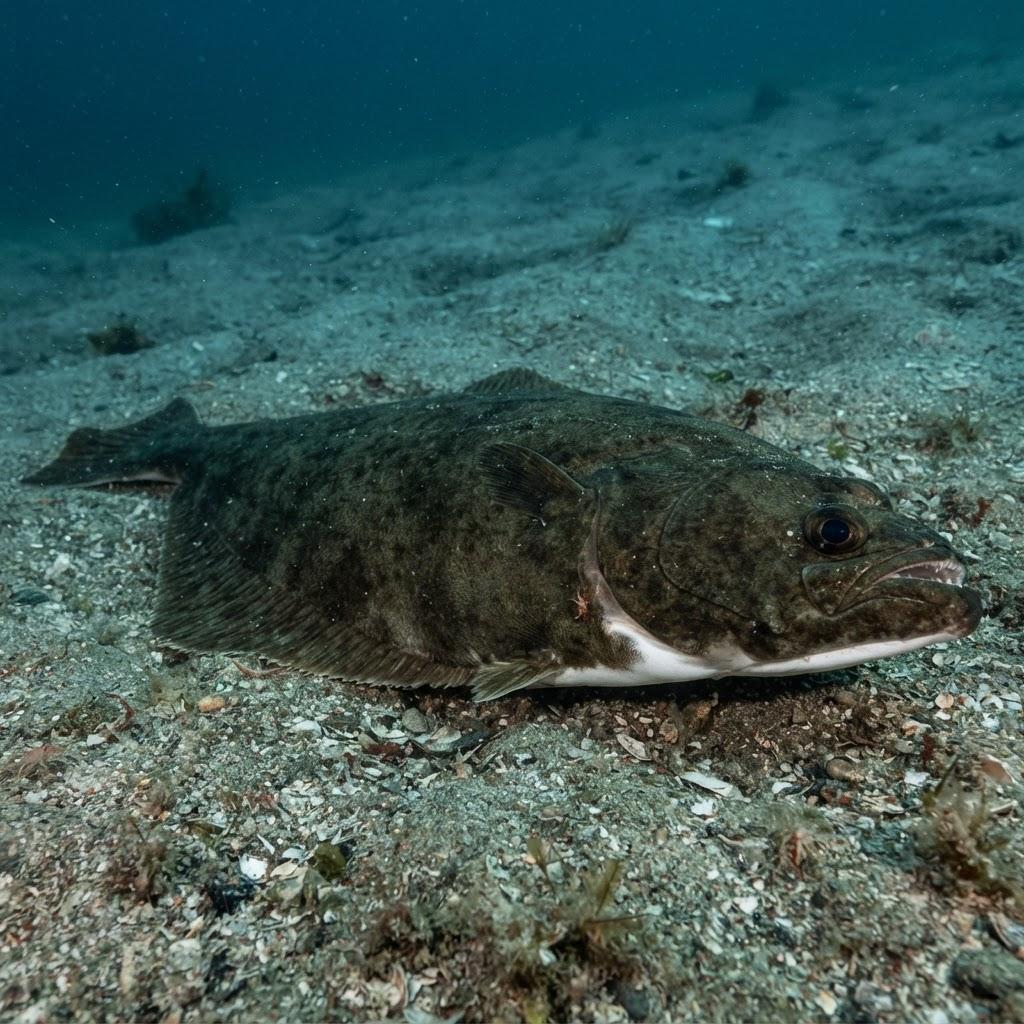
Hippoglossus stenolepis
Halibut (Pacific)
Meet the Pacific Halibut, the ocean's ultimate shapeshifter that spends its entire adult life lying on its side. It is essentially a giant, delicious pancake with a serious attitude and a wandering eye.
Meet the Fish
Imagine you wake up one morning, roll out of bed, and decide that standing up is officially overrated. Now, imagine you do that for the next fifty years. That is the daily vibe of the Pacific Halibut. This fish is the heavy-weight champion of flat-bottomed living, a creature so committed to the horizontal lifestyle that it literally remodeled its own skull to accommodate its laziness. When a halibut is born, it looks like a normal, upright fish—think of a little Nemo swimming around looking for adventure. But soon, nature pulls a prank. One of its eyes decides that the side of the head is boring and literally migrates across its forehead to the other side. By the time it reaches adulthood, the halibut is a lopsided masterpiece, with both eyes staring upward at the surface like it is waiting for a cosmic pizza delivery. It is big, it is broad, and it has enough attitude to make a shark nervous. It is the grumpy grandpa of the seafloor, watching the world go by from the comfort of a sandy couch, and it is absolutely fascinating.
Weird Biological Superpowers Explained Simply
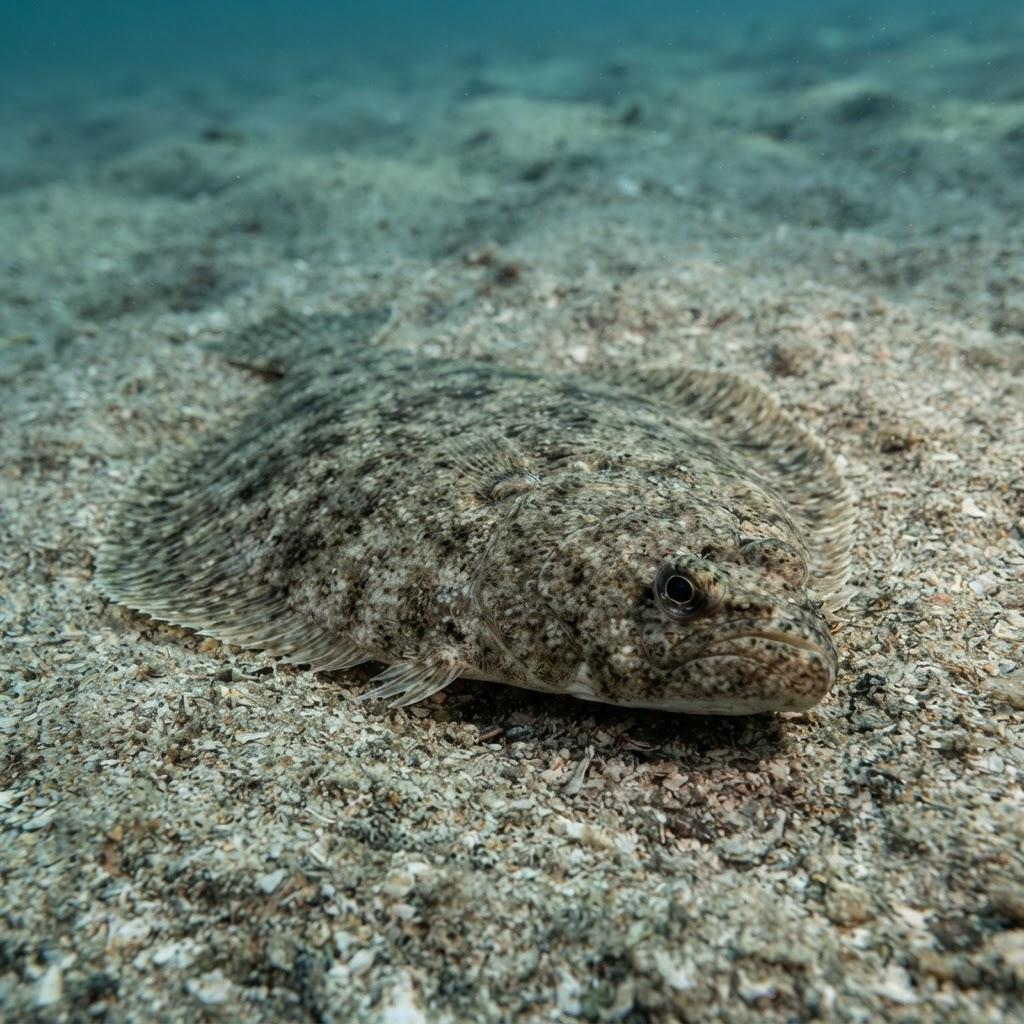
The halibut’s superpower is not laser vision or super strength; it is the art of being a literal living doormat. This fish utilizes a biological trick called countershading, but with a twist. While most fish hide from predators by being light on the bottom and dark on top, the halibut turns itself into a chameleon-like master of disguise. It possesses chromatophores, which are tiny, color-changing cells in its skin that act like a living high-definition screen. If the halibut settles on a patch of gravel, it can adjust its texture and pattern to mimic the rocks so perfectly that even a hungry seal would swim right over it. It is essentially wearing a high-tech ghillie suit that never runs out of batteries. Furthermore, the way it uses its pectoral fins to fan away sand creates a perfect, depressed crater, hiding its outline completely. It is like being a master of hide-and-seek where the prize for winning is not getting eaten for lunch, a game this fish plays with terrifyingly high stakes.
Absurd Self-Defense Mechanisms
When you are a giant, flat fish living on the bottom, you cannot exactly zip away at high speeds like a tuna. Instead, the halibut relies on the 'don't mind me, I'm just a rock' strategy. If that fails, it has a backup plan involving sheer explosive force. When a halibut decides it is time to move, it does not just swim—it launches like a torpedo made of muscle and bad intentions. By undulating its massive, flat body in a rhythmic wave, it can propel itself with enough power to escape an encroaching predator. Its skin is also remarkably thick and tough, acting like a suit of armor against the teeth of smaller fish. However, its best defense remains its ability to blend into the seafloor topography. It turns itself into the texture of the environment so well that it essentially disappears from the visual spectrum of any passing predator, proving that being boring-looking is actually the ultimate tactical advantage in the dangerous waters of the North Pacific.
Fish Drama and Gossip
Life on the seafloor is not just about naps and sand-wiggling; it is a cutthroat soap opera. While they are generally solitary creatures, halibut have a social hierarchy based on size and, frankly, who can eat whom. There is no 'schooling' here—halibut are loners who view other fish mostly as snacks. When two large halibut meet, it is not a friendly encounter. They are intensely territorial, often engaging in subtle staring contests where they raise their bodies slightly off the sand to show off their massive girth. It is the fish equivalent of a bodybuilder trying to look bigger in the mirror. If you could hear them, the gossip would be endless: 'Did you see that rock-fish over there? Totally asking for it.' They are the neighborhood bullies who own the sidewalk, and everyone else just keeps their distance to avoid becoming a mid-afternoon snack for a fish that literally has eyes on the back of its head.
The "Wait, That's Real?!" Deep-Sea Oddities
While the halibut spends most of its time on the continental shelf rather than the crushing, pitch-black abyss, it is deeply connected to the strange creatures that do live there. Think of the halibut as the sturdy suburbanite who occasionally goes for a hike into the dark woods. Its cousins, like the various deep-sea flatfish, live in environments where creatures have transparent skin, glow-in-the-dark organs, and teeth that look like medieval torture devices. In those deep, dark zones, the pressure is enough to turn a car into a soda can, and yet life thrives in ways that defy logic. The halibut might not have a bioluminescent lure hanging from its head, but it shares the same evolutionary pressure: adapt to the bottom-heavy lifestyle or become someone else's calories. Comparing the halibut to these deep-sea oddities highlights how successful the 'flat body' design is—whether you are in the sunlit shallows or the midnight depths, being flat is a winning strategy for survival.
Myth Busting
One of the most persistent myths about halibut is that they are slow, dim-witted creatures because they spend all day lying down. Let us be clear: this is categorically false. A halibut is a high-speed ambush predator. They have to be alert enough to snap up a passing squid or a smaller fish in a split second. People often assume that because they don't 'look' like the sleek, fast fish we see on television, they lack intelligence. In reality, their ability to navigate complex underwater terrain, hunt in varying light conditions, and avoid massive fishing nets proves they are quite sharp. Another myth is that they only eat the 'bad' fish. Halibut are opportunistic diners; if it fits in their mouth and is made of protein, it is fair game. They aren't moralistic eaters; they are survivors who know exactly how to manage their energy by staying still until the perfect, calorie-dense meal wanders by.
Humorous Historical Tales or Folklore
The halibut has been a major player in human history, particularly for the Indigenous peoples of the Pacific Northwest. For many tribes, the halibut was not just food—it was a spiritual icon of strength and resourcefulness. There are legendary stories of 'giant halibut' that were said to be so large they could pull a canoe under the surface if the fishermen were not careful. In some folklore, the halibut is portrayed as the wise, heavy-set elder of the ocean who watches the tides and protects the secrets of the deep. Historically, the halibut was so prized that special bone hooks were crafted specifically to capture them, designed to target the jaw without harming the fish before it was brought to the surface. It is a fish that has earned its place in our stories through both its size and its reliability as a source of nourishment during long, dark winters, cementing its status as a legend of the North.
Underwater Love Stories and Bizarre Romances
When it comes to romance, the halibut does not do moonlight dinners or fancy dances. Their dating life is a serious, high-seas affair that happens deep underwater during the winter months. Because they are scattered across huge distances, they must migrate to deeper, specific spawning grounds to find a mate. It is essentially a giant, cold-water singles mixer. When a male and female find each other, they engage in a ritual of synchronicity. They swim together, hovering in the water column—a rare moment where they finally leave the sand behind—and release their eggs and sperm into the open water simultaneously. It is a mass-production romance. The female can release millions of eggs, ensuring that at least a few will make it to adulthood. It is not romantic in the human sense, but there is something poetic about millions of tiny futures drifting away into the massive, dark blue expanse of the Pacific, hoping to survive.
Underwater Architecture and DIY Nesting
Halibut are not exactly known for their construction skills; they do not build castles or intricate coral forts. Their version of 'nesting' is far more minimalist: a clean patch of sand. You could call it the ultimate 'less is more' architecture. They use their large fins to clear out a spot, creating a perfectly shaped indentation that fits their body like a glove. This serves as both a hiding spot and a base of operations. While they don't build nests for their eggs—preferring to let the currents carry them away—this crater is their home. It is a functional piece of art, perfectly shaped by the fish's own weight and movement. It shows an incredible attention to detail; they don't just flop down anywhere. They seek specific sediment types and depths to ensure their home base is stable. It is the ocean's version of a custom-built recliner, meticulously maintained by the fish that lives in it.
The Chaos of Raising Tiny Swimmers
Parenting, if you can call it that, is a total free-for-all for the halibut. Once the eggs are released into the water, they are on their own. There is no 'nurturing' or 'tutoring' here. The parents have a 'set them free and pray' philosophy. The larvae drift in the ocean currents, acting as tiny pieces of floating plankton. This is the most dangerous time of their lives—they are basically bite-sized snacks for everything else in the ocean. During this stage, they are transparent and delicate, floating wherever the tide decides to take them. They are essentially tiny, drifting gamblers. Only a tiny fraction of those millions of eggs will ever survive to become a flat, sand-dwelling giant. It is a chaotic, high-stakes lottery where the winning prize is just the chance to grow up and one day stare at the world with both eyes on one side of your head.
How to Spot One & How It Is Doing
If you want to spot a halibut, you need the patience of a saint and the eyes of a hawk. You are not looking for a fish—you are looking for a shift in the sand. If you are diving or viewing from a boat, look for those subtle, crater-like shapes on the seafloor or a slight puff of sand that shouldn't be moving. They are masters of blending in, so you have to look for the outline, not the color. As for how they are doing, the Pacific Halibut population is generally well-managed. They are a resilient species that has benefitted from careful regulation. We can all help by supporting sustainable seafood choices and keeping our oceans clean of plastic and pollutants that disrupt the delicate seafloor ecosystems they call home. By being conscious consumers and protectors of our coastal waters, we ensure that these flat-headed, grumpy, and magnificent giants continue to thrive on the ocean floor for generations to come. Keep the water clean, respect the depth, and keep your eyes on the sand.