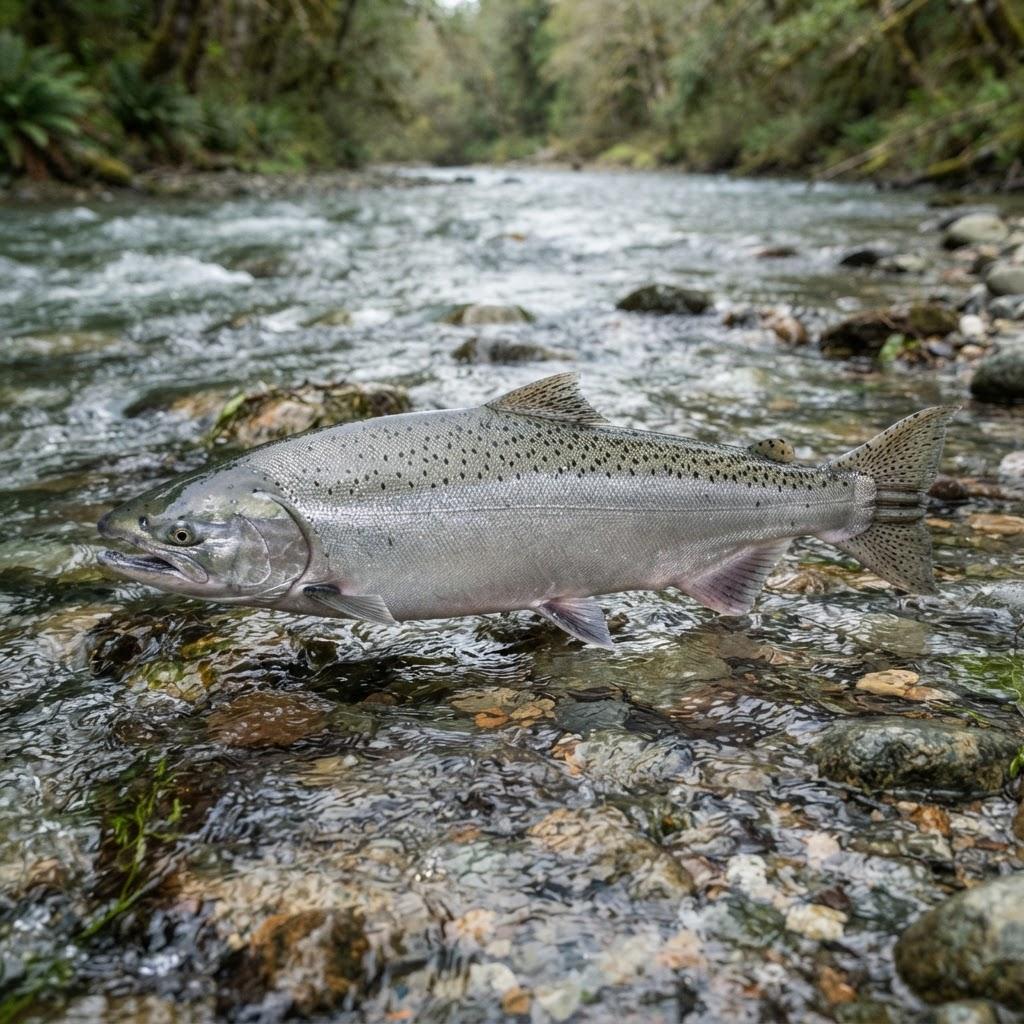
Oncorhynchus tshawytscha
Chinook (King) Salmon
Meet the Chinook Salmon, the heavyweight champion of the river who treats life like an extreme cross-country triathlon. It is a fish with a taste for luxury, a nose for its childhood home, and a stubbornness that would put a mule to shame.
Meet the Fish
Imagine a fish that decides to run an Ironman triathlon while wearing a tuxedo, and you have got the Chinook Salmon. Often dubbed the 'King of Salmon,' this fish is the undisputed heavyweight celebrity of the Pacific. While other fish are busy lounging around the reef, the Chinook is living a life of high-stakes drama. It has a vibe that suggests it just stepped out of a luxury fitness magazine, all sleek muscles, silver skin, and an ego that matches its massive size. But do not let that shiny exterior fool you; this fish is a rugged survivalist with a GPS system built into its skull that puts your smartphone to shame. It is the kind of creature that stares at a thousand-mile upstream trek against raging currents and says, 'Hold my roe.' The Chinook is fascinating not because it sits pretty, but because it refuses to quit, making it the most legendary road-tripper of the underwater world.
Weird Biological Superpowers Explained Simply
The Chinook Salmon possesses a superpower that sounds like pure magic: it can smell the distinct chemical fingerprint of its own home stream from hundreds of miles away in the vast, salty abyss of the Pacific Ocean. Imagine if you could be blindfolded, dropped in the middle of a forest in a different country, and somehow sniff out exactly which kitchen in your house made your favorite grilled cheese sandwich when you were five. That is essentially what these fish do using a process called olfactory imprinting. They essentially download a sensory map of their 'home' river while they are just tiny fry. As they swim through the ocean, their brains are constantly processing water samples, comparing the faint mineral 'notes' of the streams they encounter against their internal saved file. When they hit the right scent, it is like hitting the home button on a remote control. It is an evolutionary feat that turns a massive, confusing ocean into a giant breadcrumb trail leading them back to their birthplace.
Absurd Self-Defense Mechanisms
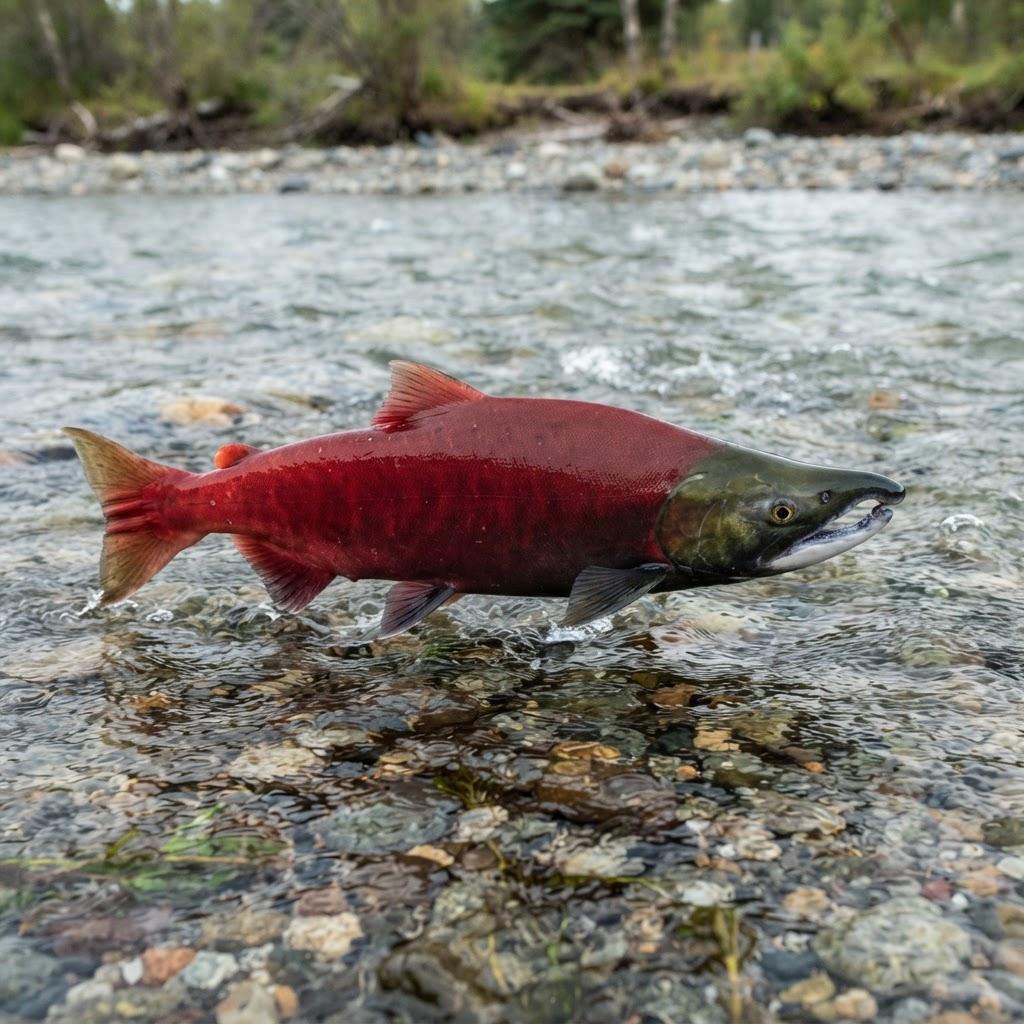
When you are a Chinook Salmon, you are basically a giant, delicious snack moving through a neighborhood full of hungry grizzlies, seals, and eagles. The Chinook does not have a fancy poison gland or a suction-cup defense, so it relies on the 'look how fast I am' school of combat. Their defense strategy is pure, unadulterated velocity. When a predator lunges, the Chinook utilizes a burst of explosive power, launching its massive body into the air or darting behind rocks with the agility of a ballerina in a heavy metal concert. They also play the long game by changing color. As they leave the ocean and enter the freshwater, they transform from shiny, armored silver to deep, bruised reds and greens. This might look like a bold fashion choice, but it is actually a form of camouflaging against the rocky, mossy bottoms of shallow rivers. By effectively disappearing into the scenery, they avoid being the main course for a passing bear, relying on the 'hide in plain sight' technique.
Fish Drama and Gossip
The spawning grounds of the Chinook Salmon are the equivalent of a high-stress reality TV show finale where everyone is exhausted, cranky, and competing for the same apartment. Once they hit the river, the vibe shifts from 'peaceful travelers' to 'intense territorial battlers.' Males engage in what can only be described as high-speed shoving matches. They grow hooked jaws, called 'kypes,' which serve as both a statement piece and a blunt weapon for head-butting rivals. It is a soap opera where the stakes are life and death, and the drama involves endless posturing and intimidation displays. You will see males circling females, trying to guard them from 'sneaker' males who are essentially trying to crash the party and steal some of the glory. It is loud, it is aggressive, and it is honestly exhausting to watch. If the fish had social media, their feeds would be nothing but angry status updates and passive-aggressive photos of the competition getting pushed away from the best nesting spots.
The "Wait, That's Real?!" Deep-Sea Oddities
While our Chinook friend prefers the scenic route of the rivers and the surface-level shelves of the Pacific, it shares the world with some truly bizarre deep-sea neighbors that make the Salmon look almost boring. Down in the twilight zone, creatures like the Barreleye fish exist, featuring a transparent head dome that lets you peek right at its tubular green eyes that are constantly staring upward like a nosy neighbor. Then there are the anglerfish, which carry their own glowing fishing rods to lure prey in the absolute darkness. Compared to these deep-sea aliens, the Chinook is a creature of daylight and current. The deep sea is a world of pressure and cold, where bioluminescence is the only way to say 'Hello' or 'I am going to eat you.' The Chinook might not have a glow-in-the-dark stomach, but it navigates the vast, pressurized, and dark expanse of the open ocean just as masterfully, proving that you do not need neon lights to be an extreme explorer.
Myth Busting
There is a persistent myth that Chinook Salmon swim upstream and immediately die just for the fun of it, or that they are mindless drones following a simple instinct. In reality, their return journey is a calculated, physiological marvel. Another myth often touted is that all salmon are the same, and that they all stay in the ocean for equal amounts of time. False! Chinooks are the rebels of the salmon world, choosing to spend anywhere from one to five years in the ocean, growing to massive sizes that would make other species blush. People also think that salmon are simply 'swimming steaks' that exist only to be caught, ignoring the fact that they are the primary architects of the forest ecosystem. When they die, they bring marine nutrients deep into the mountains, fertilizing the trees and plants along the riverbanks. They are not just food; they are the literal fuel for the entire Pacific Northwest's green canopy. Stop thinking of them as menu items and start seeing them as forest-makers.
Humorous Historical Tales or Folklore
Indigenous cultures throughout the Pacific Northwest have treated the Chinook Salmon with the respect usually reserved for royalty—because, frankly, it is the King. Folklore often depicts the Salmon as a person who lives in a great underwater house, putting on a 'fish cloak' to travel the rivers and feed the people. There is a beautiful, if slightly intense, cultural tradition of the 'First Salmon Ceremony,' where the first fish caught is treated like a returning ancestor. The bones are returned to the water with prayers to ensure that the Salmon People return the following year. Contrast this with early European settlers who famously looked at these massive fish and treated them like a nuisance that got in the way of their boats. There are stories of early logs from trappers claiming the fish were so thick in the rivers that you could 'walk across the water on their backs.' While that is definitely an exaggeration born of tired legs, it paints a picture of a world where the Chinook was not just a fish, but an overwhelming force of nature.
Underwater Love Stories and Bizarre Romances
The courtship ritual of the Chinook Salmon is not a candlelit dinner; it is more like a grueling, long-distance obstacle course where the romance is secondary to the sheer exhaustion of existing. The female is the one in charge, choosing the perfect rocky spot—the 'nest' or 'redd'—and she will spend hours clearing it out. The male, meanwhile, is doing his best to show off his size and strength, chasing away any other males who get too close. It is a strange, high-stakes dance of energy conservation and posturing. They do not have elaborate songs or synchronized swimming routines; instead, their romance is defined by a shared sense of duty. They vibrate together, eggs and milt (fish sperm) are released in a synchronized burst, and then it is time to move on. It is the ultimate 'love means never having to say you are sorry, but always having to finish the job before you die' scenario. It is not romantic in the Hallmark sense, but it is deeply committed.
Underwater Architecture and DIY Nesting
Forget the beavers; the female Chinook Salmon is the true master engineer of the riverbed. Using nothing but her massive tail, she performs a rhythmic, powerful maneuver called 'cutting,' which involves turning on her side and digging into the gravel. This is not just a lazy scrape; she is creating a deep, precise pit designed to withstand the crushing force of winter river currents. She is testing the gravel, moving rocks, and creating a flow-through system that ensures her eggs will get plenty of oxygen-rich water while remaining hidden from hungry eyes. It is essentially an underground bunker designed to perfection. If she does not like the flow or the size of the pebbles, she moves to another spot and starts the renovation all over again. It is a exhausting, meticulous process of interior design where the 'decor' is specifically calculated to keep future salmon babies from being swept away by a sudden rainstorm.
The Chaos of Raising Tiny Swimmers
Once the female deposits her eggs in the bunker, the parenting 'shift' enters the 'hope for the best' phase of evolution. After the eggs are laid, the Chinook parents do not exactly hand out baby monitors or attend PTA meetings. In fact, their job ends pretty abruptly because they are essentially running out of gas. The babies, known as alevin, stay buried in the gravel for weeks, living off a bizarre, yolk-filled backpack attached to their bellies. It is like being born with a lunchbox you cannot take off. Once they emerge as fry, they are on their own in a world where everything—from dragonflies to other fish—wants to eat them. It is a numbers game; by laying thousands of eggs, the parents hope that at least a few will survive the gauntlet. The 'parenting' here is all about the preparation of the home and the inheritance of the genes that tell the kids to swim for the ocean when the time is right.
How to Spot One & How It Is Doing
Spotting a Chinook is a thrill. Look for a massive, torpedo-shaped fish with a dark back covered in little black spots, almost like a leopard print on a silver background. If you see one with a metallic, dark gums in its mouth, you have found the King. They are currently doing okay, but they face challenges like warming water temperatures and dams that block their 'home' GPS signals. Being 'Near Threatened' means they need us to pay attention. You can help by supporting clean water initiatives, refusing to dump chemicals down drains that lead to storm sewers, and supporting organizations that work on river restoration and fish ladders. It is not just about saving a fish; it is about keeping the heart of the Pacific landscape beating. When you stand by a river, think about the incredible journey these creatures have made, and realize that every little bit of river health makes their heroic, marathon journey just a little bit easier.