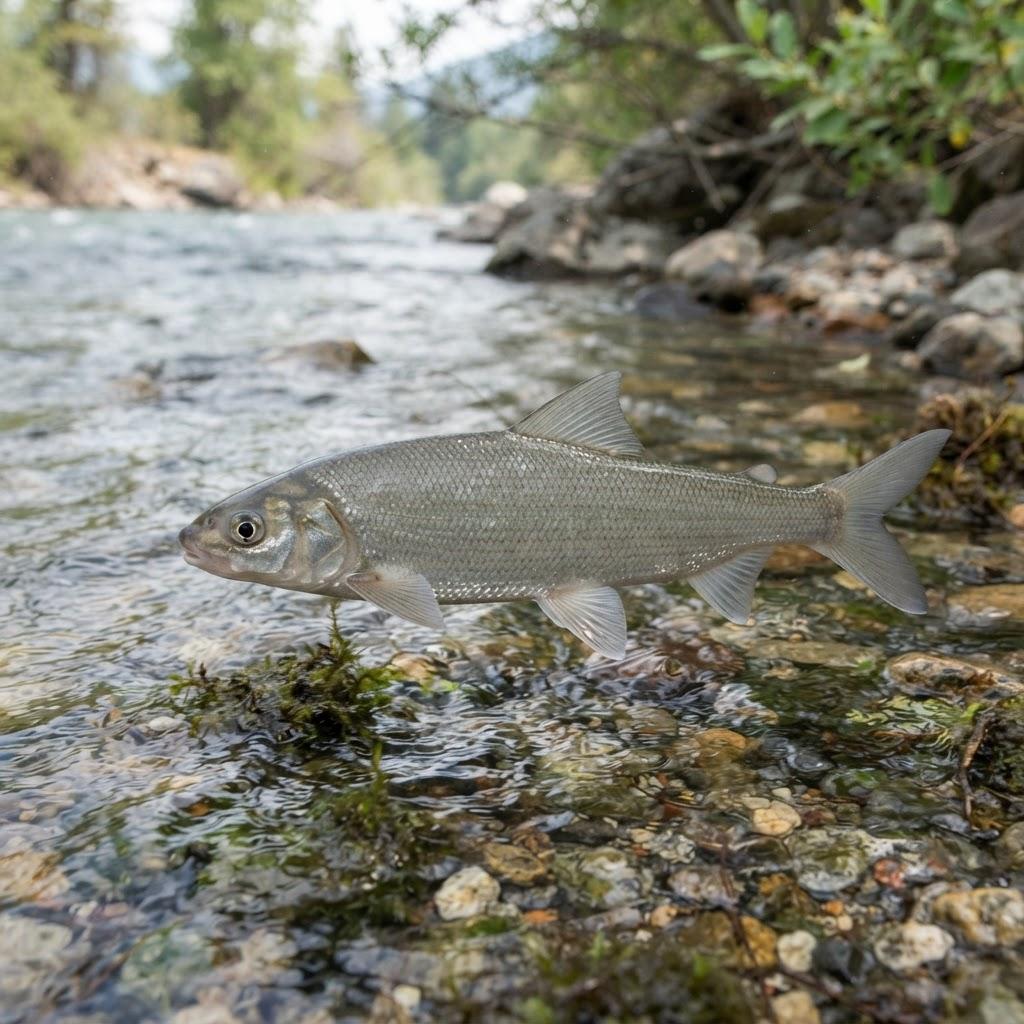
Prosopium williamsoni
Mountain Whitefish
Meet the Mountain Whitefish, the mountain stream’s most misunderstood minimalist. It is an unassuming salmonid that prefers cold, clear water over the glitz and glamour of its flashier trout cousins.
Meet the Fish
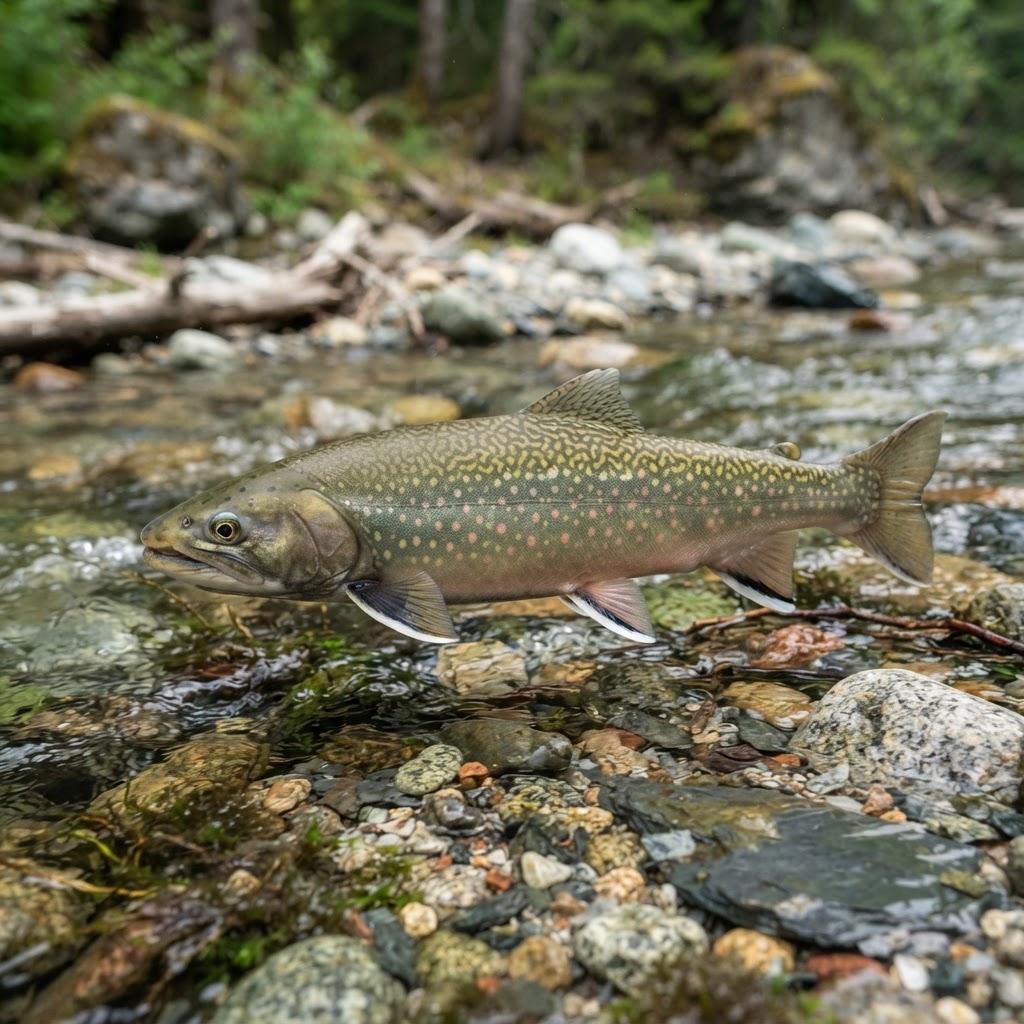
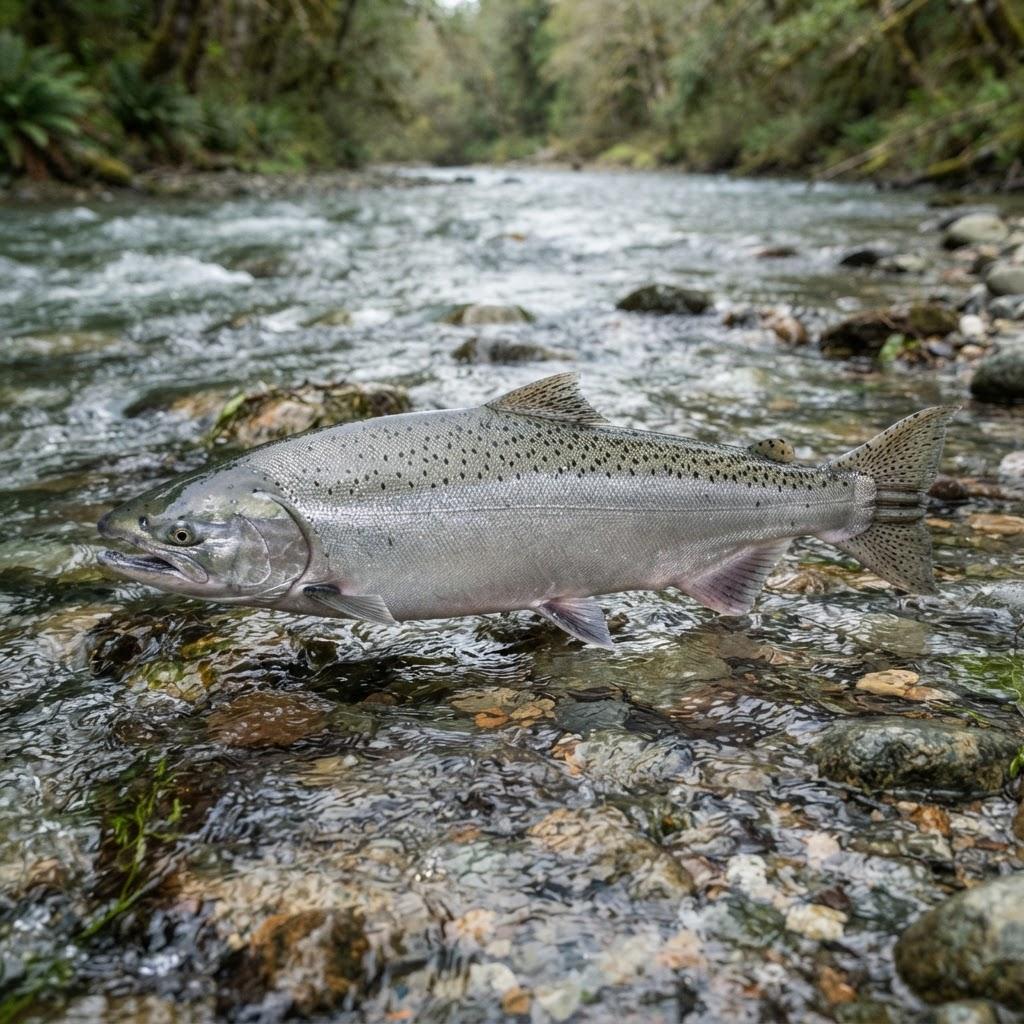
Imagine a fish that is the living embodiment of a chill weekend in a flannel shirt, avoiding all the drama of the local trout scene. The Mountain Whitefish is that guy at the party who is standing in the corner, looking unassuming but actually having a very productive time. It looks like a trout that decided to go on a strict diet and opted for a sleek, monochromatic wardrobe. While a Rainbow Trout is out there flaunting neon pink racing stripes and speckles that look like a Jackson Pollock painting, the Mountain Whitefish is rocking a sophisticated, silvery-grey aesthetic that says, I am here to survive, not to be featured on a magazine cover. It has a tiny, almost apologetic mouth located just under its snout, giving it a permanent expression of slight confusion or perhaps deep, existential contemplation. You will find this guy hanging out in the fast, cold currents of the Rockies, minding its own business while everyone else tries too hard to be the apex predator of the stream. It is the fish version of that friend who always knows the best hidden hiking spots but never brags about it.
Weird Biological Superpowers Explained Simply
You might think the Mountain Whitefish is just a plain Jane, but its biology is a masterclass in living in high-pressure, high-velocity environments. These fish are absolute masters of the cold-water life. Their bodies are shaped like a hydro-dynamically perfect torpedo, allowing them to slice through mountain rapids that would turn a lesser fish into a soggy pile of sushi. But the real magic lies in their swim bladder. Think of this as an internal buoyancy controller, a bit like the system that keeps a submarine at the perfect depth. By adjusting the gas inside this bladder, the whitefish can hover perfectly still in the current without wasting a single calorie fighting the river’s push. They also possess a lateral line, which is essentially a sixth sense that runs along their body like a high-tech vibration sensor. This allows them to feel the movement and pressure changes of every single bug or pebble in the water, making them the ultimate stealth ninjas of the riverbed. They are basically living, breathing underwater radar systems designed for the rugged backcountry.
Absurd Self-Defense Mechanisms
When you live in a stream that is basically an icy, high-speed highway filled with hungry predators like bull trout and osprey, you need a strategy, and the Mountain Whitefish has chosen the art of the vanishing act. They don’t have venomous spikes or the ability to turn into an electrified balloon. Instead, their defense is pure, unadulterated camouflage. They have evolved scales that act like tiny, reflective mirrors, scattering the light in a way that makes them blend perfectly with the shimmering, rocky bottom of the river. If a predator comes looking for a snack, the whitefish simply stays low and stays still. Because they are the color of a wet stone on a cloudy day, they basically become invisible. It is the aquatic equivalent of wearing a ghillie suit to a corporate board meeting. If they do get spotted, they don’t try to fight back; they just use their incredible burst speed to find the nearest deep hole or patch of dark water. They are the ultimate masters of 'nope, nothing to see here, just a rock, move along.'
Fish Drama and Gossip
If the river bottom had a neighborhood watch, the Mountain Whitefish would be the ones filing all the reports. They are surprisingly social creatures, often found in small groups that act like a tight-knit clique at a high school dance. But do not let their calm exterior fool you; there is plenty of drama under the surface. During the spawning season, the hierarchy becomes as complex as an episode of a reality show. Males start getting territorial, puffing out their gills and performing little shimmy-dances to prove they are the most eligible bachelor in the stream. They are constantly navigating a social structure where everyone knows their place. If a newcomer tries to steal a prime feeding spot in the current, you can bet there will be some aggressive posturing. It is not necessarily a full-on brawl, but rather a series of 'don't you dare sit there' glares and territorial nips. They are constantly jostling for the best position behind a large boulder, because in the river, real estate is everything, and the best current-breaking rocks are highly sought-after properties.
The "Wait, That's Real?!" Deep-Sea Oddities
While our buddy the Mountain Whitefish stays firmly in the shallows of mountain streams, it is worth looking at its distant, much weirder cousins in the deep sea. Imagine a fish that had to survive in complete darkness, where the only thing on the menu is falling bits of debris and the occasional glowing jelly. In the midnight zone, fish like the barreleye have transparent heads that let them see through their own skulls, with green, barrel-shaped eyes that point straight up like a periscope to catch shadows from above. Compared to these deep-sea aliens, our whitefish is quite grounded. The deep sea is a place where you have to invent your own light, attract mates with chemical beacons, or just evolve to look like a floating horror movie prop. The Mountain Whitefish stays in the sunlit, oxygen-rich world where survival isn't about being a monster, but about being a master of the current. It doesn't need bioluminescence when it has the crystal-clear water of a snow-melt stream to navigate, but it’s fun to imagine what a whitefish would look like if it moved to the abyss—probably just a glow-in-the-dark version with a very fancy, neon-lit snout.
Myth Busting
For years, people have dismissed the Mountain Whitefish as a 'trash fish' or a 'nuisance' because they don't fight like a trophy-sized trout. This is a total myth that needs to be tossed out with yesterday's bait. Anglers often complain that these fish are 'too easy' or 'not exciting,' but that is mostly because they are targeting them with the wrong gear. These fish have small mouths for a reason—they are picky, precise eaters. If you try to catch them with a lure the size of a dinner plate, you are going to fail, and then you are going to blame the fish. They are actually incredibly intelligent and wary, capable of discerning the difference between a natural insect and a fake fly from miles away. Another myth is that they aren't good to eat; in reality, they have a light, delicate flavor that is highly prized by those who actually know how to cook them properly. They aren't a nuisance; they are a sophisticated culinary challenge for any angler who isn't obsessed with just catching the biggest, loudest fish in the water.
Humorous Historical Tales or Folklore
Throughout the history of the North American West, the Mountain Whitefish has lived in the shadows of the salmon and trout empires. Native American tribes have long known the value of these fish, treating them as a reliable, year-round food source that kept communities fed when the flashier salmon runs had finished for the season. There are few wild, monstrous myths about them because they are just too sensible to be the stars of a horror movie. However, there are old tall tales from early pioneers about whitefish that were 'so numerous they could be walked upon,' a classic bit of frontier exaggeration that highlights just how abundant these little guys were in the days before dams and habitat changes. They never got the glory of the sea serpent or the legend of the giant sturgeon, but they were the unsung heroes of the campfire dinner table. There is a certain dignity in being the fish that actually feeds the people, rather than the one that just gets its picture taken and thrown back into the river.
Underwater Love Stories and Bizarre Romances
When love is in the air—or rather, the water—the Mountain Whitefish goes through a transformation that is nothing short of dramatic. During the late autumn, when the water temperature drops and the leaves are turning, these fish congregate in large schools to perform a courtship ritual that is essentially an underwater ballroom dance. It is not just one pair dancing; it is a synchronized swimming routine involving dozens, sometimes hundreds, of fish. They gather over specific gravel beds where the water flow is just right—think of it as the most romantic spot in the river. The males develop a breeding dress, which is just a fancy way of saying they get a little extra colorful and show off their best side. They shimmy, they splash, and they vibrate their bodies to attract a partner. It is chaotic, it is intense, and it is entirely focused on ensuring the next generation of whitefish has the best possible start in life. It is the most action-packed dating scene you could ever hope to witness, provided you have a waterproof camera and a very high tolerance for freezing cold water.
Underwater Architecture and DIY Nesting
These fish are the interior designers of the riverbed. They don’t build fancy, complex nests made of woven kelp or bubbles, but they are incredibly picky about their real estate. A Mountain Whitefish mother needs the perfect gravel—not too big, not too small—where the water will gently flow through the gaps to keep her eggs oxygenated. They work the riverbed, using their bodies to fan away silt and debris until they find the pristine, rocky substrate that meets their high standards. This is not just a pile of rocks; it is a carefully curated incubator. They spend hours cleaning the site to ensure that there isn't a single grain of dirt that could suffocate their future offspring. It is essentially the underwater version of spending three months painting the nursery and researching the best crib mattress. They put a lot of effort into preparing the ground because, in a mountain stream, your house is only as good as your foundation, and a solid, silt-free bed of gravel is the ultimate luxury apartment for a baby fish.
The Chaos of Raising Tiny Swimmers
Once the eggs are laid and fertilized, the parents essentially say, 'good luck, kid,' and head back to their lives. They don't stick around to do the parenting, and honestly, can you blame them? After all that romantic shimmying and gravel-shoveling, they’ve earned a break. The newly hatched fry are tiny, transparent, and absolutely at the mercy of the current. They spend their first few days huddled deep in the crevices of the rocks, hiding from everything that wants to make them a snack. It is a world of absolute chaos. Most of these tiny swimmers will never make it to adulthood, which is why the whitefish produces so many eggs. It is a numbers game. The survival rate is low, but the strategy is volume. For the few that survive, the stream provides a brutal but effective training ground. They learn to navigate the currents almost immediately, and by the time they are a few inches long, they are already masters of their environment. It is a rough start, but it produces some of the most resilient fish in the river.
How to Spot One & How It Is Doing
If you want to spot a Mountain Whitefish, grab your polarized sunglasses—they are the most important tool for any fish watcher—and head to a clear, cold mountain stream. Look for them in the mid-depths, often tucked behind large boulders where they can save energy while waiting for a snack to drift by. Look for that sleek, silvery-grey body and the distinct, sub-terminal mouth that makes them look like they are perpetually searching for a lost contact lens. They are thriving in many areas, but they are sensitive to water quality and temperature changes, so they are a great indicator species for the health of our mountain watersheds. They are currently listed as 'Least Concern,' which is great news, but they still need clean, cold water to survive. You can help by supporting local conservation efforts, keeping our streams free of pollution, and being mindful when wading in rivers during their spawning season. They might not be the most famous fish in the lake, but they are a vital part of the mountain ecosystem, and they deserve our respect and protection.