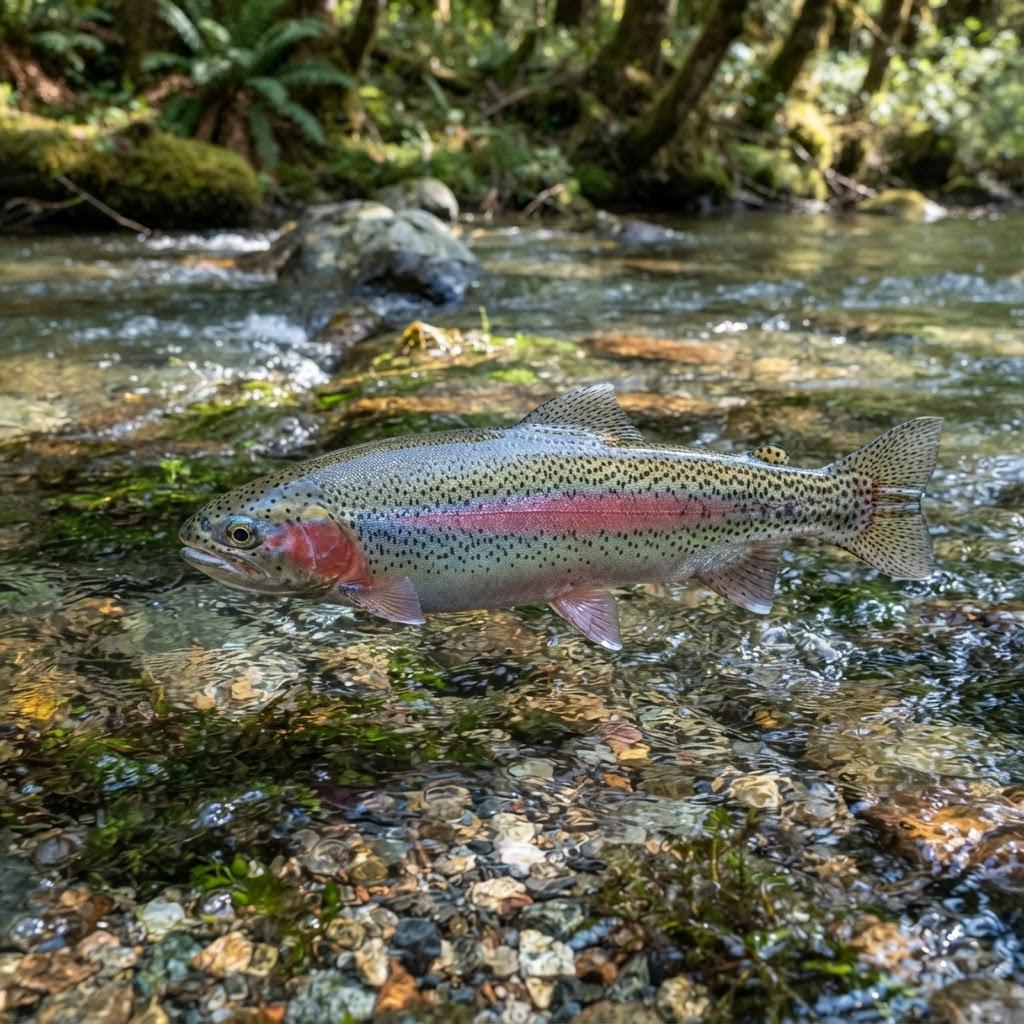
Oncorhynchus mykiss
Rainbow Trout
Meet the Rainbow Trout, the aquatic equivalent of an Olympic gymnast with a taste for flashy colors and high-speed chases. It is the ultimate river celebrity that knows how to turn a mountain stream into its own personal runway.
Meet the Fish
Imagine you are at a high-end gala, but instead of people in tuxedos, you have a sleek, shimmering torpedo with a side of pink glitter. Enter the Rainbow Trout, the undeniable superstar of the freshwater world. This isn't just a fish; it is the aquatic equivalent of a professional athlete who refuses to take a day off. With its signature iridescent pink lateral line that runs down its side like a neon racing stripe, the Rainbow Trout looks like it was designed by a fashion-forward engineer who wanted to make sure everyone saw it coming. It carries a vibe that is equal parts 'cool, calm, and collected' and 'I will absolutely outswim you for that snack.' While most fish are perfectly happy blending into the muddy background of a pond, the Rainbow Trout chooses to announce its presence with a splash of color that screams confidence. It is a fish that feels like it has a secret, a little twinkle in its eye that suggests it knows exactly how popular it is among anglers and nature enthusiasts alike. Whether it is darting through rapids or lounging in a deep, cool pool, the Rainbow Trout brings a level of charisma to the river that is frankly hard to beat, making it the undeniable protagonist of any stream it decides to call home.
Weird Biological Superpowers Explained Simply
If you think your favorite superhero has cool gear, you clearly haven't met the Rainbow Trout. This fish is essentially a biological marvel when it comes to oxygen management. Think of its gills like a high-tech filtration system that never quits. When water flows over those feathery, red structures, the trout is extracting dissolved oxygen with such efficiency that it makes scuba gear look like a child's toy. But that is not all. These fish have something called a lateral line system, which is essentially a superpower of super-hearing. It is a line of tiny, fluid-filled pits along their sides that detect the slightest vibrations or pressure changes in the water. Imagine being able to 'feel' the presence of a fly hitting the water surface from ten feet away or knowing exactly when a rock shifts in the current behind you without even looking. It is like having a sixth sense for everything happening in a 360-degree radius. This, combined with their ability to regulate buoyancy through a specialized gas bladder, makes them masters of their environment, moving with a grace and precision that borders on the magical, allowing them to hang perfectly still in a roaring current like a ghost in the water.
Absurd Self-Defense Mechanisms
When you are as popular as the Rainbow Trout, everyone and their cousin wants a bite. To handle this, the Rainbow Trout doesn't rely on slime or spikes; it relies on pure, unadulterated speed and evasive maneuvers that would make a fighter pilot jealous. If a hungry heron or a stealthy otter lunges, the trout executes a 'burst speed' reaction. These fish have white muscle fibers packed into their bodies that allow for explosive, short-duration speed, enabling them to launch themselves into the air with the grace of a ballerina and the power of a rocket. They essentially have a 'nitro' button for their swimming muscles. If being fast isn't enough, they play the ultimate game of hide-and-seek using their 'countershading.' This means their backs are dark and their bellies are light. From above, they blend into the dark river bottom, and from below, their light bellies disappear into the bright sky. It is like wearing a permanent camouflage suit that changes based on who is looking at you, making them the masters of deception in a world that is literally trying to eat them.
Fish Drama and Gossip
Life in a river is not all sunshine and flowing water; it is a full-blown soap opera. Rainbow Trout are surprisingly territorial, and the 'Mean Girls' of the river have nothing on a large trout defending its favorite rock. These fish establish social hierarchies based on size, attitude, and whoever can hold the best spot in the current. If a newcomer dares to drift into a prime feeding lane, a standoff ensues. It starts with a little posturing—flaring the gills, wiggling the body just enough to show off muscle, and darting in tight circles. It is the fish equivalent of a tense schoolyard staring contest. They don't want a full-blown fight because energy is precious, so they use subtle intimidation tactics to drive rivals away. You might see two trout chasing each other in a chaotic, high-speed spin cycle, but it is all just theater for the sake of real estate. The big, dominant trout gets the best food that floats by, while the youngsters and the 'lesser' fish have to hang back in the scraps, waiting for their chance to climb the social ladder. It is a cutthroat world, and in the trout neighborhood, you are only as good as your position in the current.
The "Wait, That's Real?!" Deep-Sea Oddities
Rainbow Trout are strictly freshwater party-goers, but they have some long-lost, weird cousins lurking in the deep, dark abyss. While the trout is basking in sunlight and playing in clear streams, the deep-sea inhabitants are dealing with pressures that would crush a submarine like a soda can. Imagine comparing the Rainbow Trout to a gulper eel or a fangtooth. While the trout has beautiful, sleek scales and a refined, predatory look, deep-sea fish often look like they were drawn by a child with a wild imagination—transparent skin, glowing lure-tentacles, and teeth so large they can't even close their mouths. It really highlights how lucky our trout friend is. Instead of making its own light to find a snack in a pitch-black void, the trout uses its sharp eyesight to scan for insects or smaller fish in the bright, sun-drenched shallows. The contrast is staggering. Our Rainbow Trout lives in a world of high-definition clarity, while its deep-sea relatives are living in a sci-fi horror movie. One is the athlete of the stream, and the other is the creature that nightmare-fuel dreams are made of.
Myth Busting
Let’s clear the air on some classic trout misconceptions. First off, there is a pervasive myth that trout are 'dumb' fish that will eat anything that moves. While they are opportunistic, they are actually incredibly observant and cautious. They learn quickly, and if they see an angler trying to pull the same trick twice, they will ignore it with a level of indifference that is honestly impressive. Another myth is that they are all the same, but the reality is much more complex. We have 'steelhead,' which are the same species but have evolved to live part of their lives in the ocean, growing to massive sizes and developing a silver, metallic sheen. People often think these are a different fish entirely, but they are just Rainbow Trout who decided to take a 'gap year' in the salt water. They also have an incredible ability to remember where they were born, using a sense of smell that is more sensitive than a bloodhound to navigate hundreds of miles back to their home stream. Forget the 'three-second memory' rumor; these guys are the navigators of the wild.
Humorous Historical Tales or Folklore
Rainbow Trout have been the subject of countless tall tales from mountain men and fishermen for centuries. Back in the day, there were legends about 'Giant Trout' that were allegedly the size of canoes and could swallow a whole backpacker if they got too close to the edge. These stories, clearly cooked up over a campfire with a little too much mountain dew, added a layer of mystery to the species. Historically, humans have had a love affair with these fish, building entire cultures around their migration patterns. Native American tribes honored them as spirits of the water, recognizing the trout's vital role in the food web. In the Victorian era, they became the status symbol of the elite angler, leading to a massive movement of transporting these fish across the globe, which is why you can find them in such random places today. They have effectively colonized the world, not by force, but by being so incredibly popular that humans just couldn't help but pack them up and bring them along to every corner of the planet.
Underwater Love Stories and Bizarre Romances
When it is time for romance, the Rainbow Trout turns into a dramatic performer. Forget candlelit dinners; for a trout, it is all about finding the perfect patch of gravel. The male becomes absolutely stunning during the spawning season, with those pink colors intensifying until he looks like a walking (or swimming) neon sign. He will spend hours nudging the female, showing off his best side, and vibrating his body to get her attention. It is a very rhythmic, very intense courtship dance. They aren't just pairing up; they are engaging in a high-stakes partnership to ensure the next generation survives. The male will chase away any 'homewreckers' with aggressive charges, proving his worth as a protector. It is a classic romantic trope: the flashy, protective suitor working overtime to impress the lady, all set to the backdrop of a rushing mountain stream. Once they find that perfect spot, the romance takes a turn for the practical as they prepare for the ultimate test of their commitment.
Underwater Architecture and DIY Nesting
If you thought home renovations were stressful, try being a trout. The female trout is the master architect here. She uses her strong tail to dig a depression in the gravel, known as a 'redd.' She will turn on her side and beat her tail against the riverbed, literally excavating a hole with the sheer force of her muscle. It is a grueling, repetitive process that requires serious effort. She is not just digging a hole; she is sculpting an environment where water flows through perfectly to keep the eggs oxygenated. While she is doing the heavy lifting, the male is constantly patrolling the perimeter, keeping a lookout for any curious onlookers or rivals who want to crash the party. It is an impressive display of cooperative construction. They have to find just the right size of gravel—not too big, not too small—to protect the future eggs from being washed away or buried too deep. It is a feat of engineering that happens in a flowing river, which is no small task when the current is constantly trying to fill your work back in.
The Chaos of Raising Tiny Swimmers
Once the eggs are laid, the real circus begins. These eggs are incredibly vulnerable, so the parents stick around for a bit, but then nature takes its course and the parents eventually move on, leaving the 'fry' to figure it out. When the tiny trout hatch, they are essentially walking stomachs with eyes. They have a yolk sac attached to their bellies, which provides them with a packed lunch so they don't have to hunt right away. They look like little translucent ghosts with big, blinking eyes. As they grow, they have to navigate a world where literally everything wants to eat them—birds, bigger fish, even their own cousins. It is a chaotic, high-speed game of survival. The ones that make it are the ones that learn to use cover and current to their advantage as quickly as possible. It is a classic 'sink or swim' scenario, quite literally. They form little schools, darting around in the eddies, learning the ropes of river life by trial and error, and slowly growing into the shiny, resilient trout we all know and love.
How to Spot One & How It Is Doing
So, how do you find this elusive river star? You want to look for cold, clear, moving water. Polarized sunglasses are your best friend—they cut the glare off the water so you can see right down to the bottom. Look for the 'shadows' behind large rocks or logs where the water slows down; that is where the trout are hiding. Keep an eye out for that iconic pink stripe flashing in the sunlight. As for their well-being, the Rainbow Trout is generally doing quite well. Because they are so popular, people work hard to keep their streams clean and healthy. However, they are sensitive to temperature, so protecting the forests around rivers to provide shade is a huge deal. You can help by supporting local river conservation groups and practicing 'leave no trace' principles when you visit their habitat. Keeping the water clean and the temperatures cool is the best way to ensure these shimmering athletes keep dancing in our rivers for generations to come. They are a sign of a healthy ecosystem, and keeping them thriving is a win for everyone involved.