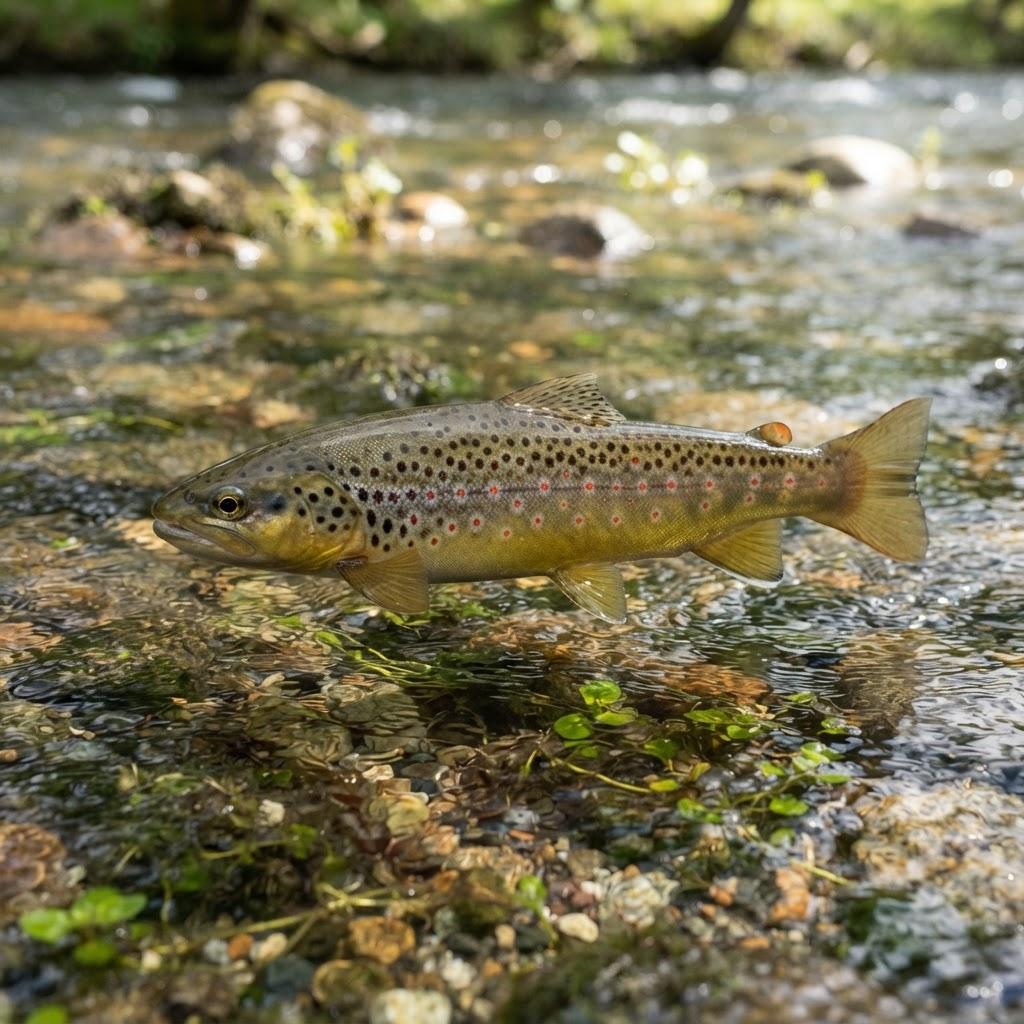
Salmo trutta
Brown Trout
Meet the Brown Trout, the undisputed heavy-weight champion of the river who acts like a grumpy landlord. With its beautiful spotted coat and a stubborn personality, this fish is the ultimate survivor of the freshwater world.
Meet the Fish
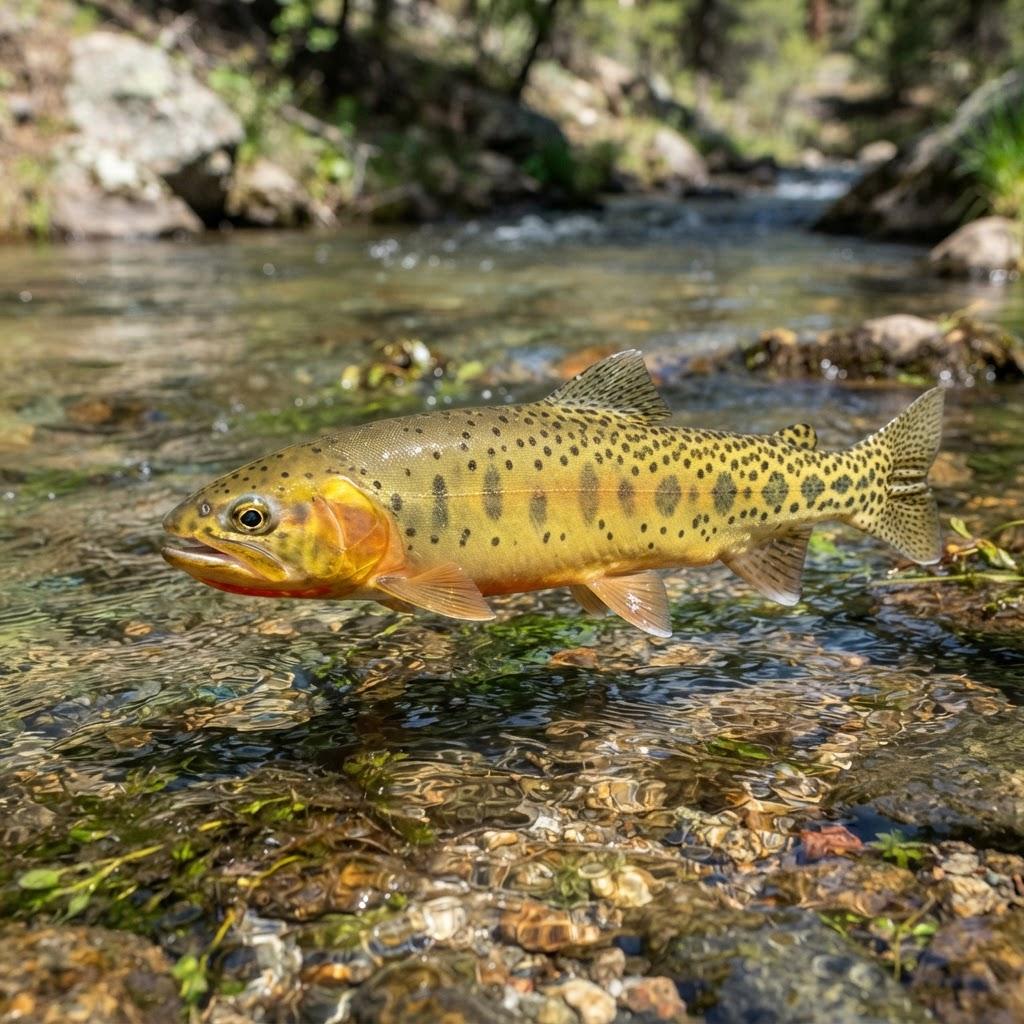
Imagine a fish that spent its entire life taking a masterclass in being the most difficult, elusive, and handsome tenant in a luxury apartment building. That is the Brown Trout. If this fish were a character in a high-stakes heist movie, it would be the guy in the shadows, sipping a martini, watching the security guards scramble while he picks the lock. Unlike its flashier cousin, the Rainbow Trout, the Brown Trout is a sophisticated connoisseur of the water column. It isn't just swimming; it is calculating. It holds a distinct vibe that says it has seen it all, done it all, and probably finds your fishing fly slightly offensive. It is the grumpy grandpa of the stream, hiding under a undercut bank, waiting for the perfect snack to drift by so it can snatch it up with surgical precision. Brown Trout aren't just fish; they are the gold standard of freshwater intrigue, boasting butter-yellow flanks and constellations of black and red spots that look like they were painted by an impressionist artist who had a bit too much espresso. They are the original rebels of the river, introduced around the world not just because they are fun to catch, but because they have a 'catch me if you can' attitude that keeps everyone on their toes.
Weird Biological Superpowers Explained Simply
The Brown Trout possesses a biological superpower that puts our best GPS technology to shame: magnetoreception. Essentially, these fish have a built-in compass in their heads. Scientists believe they use tiny crystals of magnetite in their tissues to detect the Earth's magnetic field, allowing them to navigate back to their exact natal streams after spending years wandering the ocean or roaming huge lake systems. It is like having an internal map that doesn't need a Wi-Fi connection. Furthermore, they are masters of light-sensitive camouflage. Brown Trout don't just sit there looking pretty; they can actually shift their skin color slightly depending on the light conditions of their environment. Think of them as the chameleons of the river. Their skin contains special cells called chromatophores that expand and contract to match the rocks or gravel beneath them. It’s a literal hide-and-seek cheat code. When you combine their magnetic navigation with their ability to blend into the shadows like a ninja, you get a predator that doesn't need to chase you down—it simply exists in the environment until the very last second, when it strikes with the speed of a closing trap door.
Absurd Self-Defense Mechanisms
While some fish choose to defend themselves by inflating like a prickly balloon or sliming their enemies into submission, the Brown Trout takes a more cerebral approach to staying alive. Its primary defense mechanism is what we call 'being an absolute ghost.' This fish is a master of the art of invisibility. When a heron is stalking the shallows or an otter is patrolling the pool, the Brown Trout doesn't panic. It simply retreats into the deep, dark sanctuary of an undercut bank—a shelf of earth hanging over the water—and waits. It is the ultimate disappearing act. If you try to catch one, you will quickly realize that they have a sixth sense for movement. They detect the vibrations of a clumsy footstep on the riverbank long before you see them. It is as if they have sonar ears located all over their bodies called the lateral line, which picks up even the tiniest shift in water pressure. They don't need spikes or poison when they have the ability to read the room and vanish into the murk before the predator even knows a meal was present. It is tactical genius disguised as fishy laziness.
Fish Drama and Gossip
Welcome to the high school cafeteria of the river bottom, where the Brown Trout is the kid sitting at the head of the table who doesn't take any nonsense. These fish are intensely territorial. Unlike some fish that school up and share the wealth, Brown Trout prefer to claim a specific 'lie'—their own private patch of prime real estate in the river. If another trout dares to cross into their designated zone, a full-blown drama ensues. It isn't a diplomatic talk; it is a showdown. They engage in side-to-side displays, flaring their gills and opening their mouths to show off their size, much like a bodybuilder trying to intimidate a rival at the gym. If the intruder doesn't back down, the Brown Trout will charge. It is a constant game of social hierarchy where the biggest, strongest, and meanest fish always get the best spot under the tree roots. The gossip around the riverbed is intense: who got kicked out of their favorite pool, who stole whose snack, and why everyone is currently avoiding the big male by the submerged log. It is pure, unfiltered soap opera underwater.
The "Wait, That's Real?!" Deep-Sea Oddities
While the Brown Trout calls the chilly streams of the mountains home, it is distantly related to some of the most bizarre creatures on this planet. Compare the Trout to the deep-sea viperfish or the anglerfish, and you start to realize how wild the fish kingdom really is. The Brown Trout is a model of streamlined efficiency, built for fast currents and oxygenated mountain springs. Down in the midnight zone, however, fish like the barreleye have transparent heads so they can look up with green eyes at their prey. While the Trout doesn't need to glow in the dark or have a retractable jaw that can swallow a fish twice its size, it does share a common ancestor with these deep-sea weirdos. Looking at a Brown Trout, you are seeing the 'classic' fish design that has been refined over millions of years, whereas the deep-sea dwellers are the experimental art project of evolution. If you think the Trout is cool for hanging out in cold rapids, imagine how it would feel to be a cousin living five miles down in the crushing pressure, glowing like a neon sign.
Myth Busting
Let's clear the air: people often think that trout are simple-minded eating machines that will snap at anything shiny. This is the biggest myth in the angling world. In reality, Brown Trout are incredibly selective and display distinct 'learning' behaviors. There is a common belief that they have a three-second memory, but research shows that they can remember specific locations, safe hiding spots, and even recognize potential threats—including those annoying humans wearing bright neon fishing hats. They aren't just swimming around waiting to be caught; they are calculating the energy cost versus the reward of every potential snack that drifts by. Another myth is that they only eat bugs. While they love a good fly hatch, a fully grown Brown Trout is an apex predator that will happily munch on smaller fish, frogs, or even a mouse that makes the mistake of trying to swim across the river. They are the omnivorous scavengers of the trout family, and their dietary variety is a testament to their ability to thrive in almost any environment they are introduced to, provided the water stays cold enough.
Humorous Historical Tales or Folklore
The Brown Trout has been woven into human culture for centuries, often appearing in folklore as the elusive prize that only the most dedicated—or most obsessed—person can catch. There are ancient tales from the Highlands of Scotland about 'King Trout' that were said to be as big as a man and lived for a hundred years, guarding sunken treasures under the waterfalls. While those are likely just stories meant to keep children from falling into the icy currents, they reflect the deep respect and mystery surrounding this species. Throughout history, Brown Trout have been the subject of countless poems, songs, and even royal decrees. In medieval Europe, owning a stretch of river that held a healthy population of Brown Trout was the equivalent of owning a private golf course today. They were the fish of the elite, the centerpiece of grand banquets, and the inspiration for early fishing manuals that were essentially the 'how-to' guides for the medieval gentleman. They haven't just been swimming in our rivers; they have been swimming in our history books for centuries, demanding the spotlight.
Underwater Love Stories and Bizarre Romances
When spawning season arrives, the Brown Trout transforms from a solitary grouch into a romantic lead in a very intense drama. The ritual is not a gentle stroll through the park; it is a high-energy, competitive dance. Males undergo a physical transformation, sometimes developing a hook in their lower jaw called a 'kype,' which makes them look like they are ready for a tough boxing match. They chase off rivals, circle the females, and vibrate their bodies in a display of pure trout passion. The female, meanwhile, is the one in charge. She spends her time testing the gravel of the riverbed to ensure it is the perfect spot for her future family. It is a world of constant movement, aggressive posturing, and high-speed chases. It is less like a candlelit dinner and more like a high-octane dance competition where the stakes are the future of the river. When you see a pair of Brown Trout during the spawn, you are witnessing the culmination of millions of years of evolutionary drive, played out in the icy, rushing water.
Underwater Architecture and DIY Nesting
If you thought only birds built nests, meet the female Brown Trout, the river's premier civil engineer. When she is ready to lay her eggs, she uses her tail like a shovel to excavate a depression in the gravel called a 'redd.' She doesn't just slap a nest together; she meticulously cleans the stones, flicking away silt and debris until the gravel is perfectly aerated and clean. It is a multi-hour construction project that requires immense stamina against the current. Once the hole is ready, she signals the male, and they release their eggs and milt—the fish version of genetic material—simultaneously into the redd. She then covers the eggs back up with the loose gravel, protecting them from hungry onlookers and the scouring action of the river current. This buried treasure is the foundation of the next generation. It is a masterclass in DIY construction, proving that you don't need blueprints or a hardware store to create a fortress that keeps your offspring safe from the harsh realities of a flowing river.
The Chaos of Raising Tiny Swimmers
Once the eggs are hidden in the gravel, the parents basically say 'good luck' and move on with their lives. The tiny fry—the baby trout—don't have a daycare center or a doting mother. They hatch with a built-in lunchbox called a yolk sac attached to their bellies. For the first few weeks, they stay buried in the gravel, feeding off this energy reserve and keeping their heads down. Once they consume the yolk, they emerge from the gravel as 'fry,' looking like tiny, semi-transparent versions of their parents. They are immediately thrust into a world where everything wants to eat them, from larger trout to hungry ducks. This is the ultimate 'survival of the fittest' scenario. Only a small fraction of the thousands of eggs laid in the redd will ever make it to adulthood. It is a chaotic, high-stakes start to life where the only way to survive is to be fast, hide well, and learn how to hunt before something else hunts you. It is nature’s version of a baptism by fire, or rather, a baptism by cold, rushing water.
How to Spot One & How It Is Doing
To spot a Brown Trout, you need a pair of polarized sunglasses and a lot of patience. Look for areas in a river where the water slows down, such as behind large boulders, near fallen logs, or under overhanging banks. They love the transition zones between deep and shallow water. If you see a shadow that looks like a piece of driftwood but seems to be pointing upstream, that is your target. Conservation-wise, the Brown Trout is doing surprisingly well. Because they are tough and adaptable, they have thrived in many places they were introduced to by humans. However, they still need cold, clean, and oxygenated water to survive. Pollution, dams that block their migration, and rising water temperatures are their biggest enemies. To help them out, you don't need a PhD in marine biology; you just need to be a responsible visitor to nature. Keep the water clean, advocate for healthy rivers, and make sure that the places they live remain untouched by industrial waste. By protecting their habitat, we ensure that these grumpy, beautiful, and fascinating fish can keep lurking in the shadows of our rivers for generations to come.